Tech & Wearables

Best Stopwatches of 2026

I've timed enough practices from the edge of a pool deck to know a stopwatch only earns its keep in bad conditions: cold hands, wet thumbs, a clipboard wedged under one arm. A watch that double-fires on the start or swallows a lap doesn't just annoy you, it hands over a time you can't trust. Every listing online promises hundredths of a second, and almost none tell you whether the buttons click when your thumb has gone numb. What you're actually buying is a split you can rely on, in digits you can read at arm's length, controlled with one hand.

My team and I spent four months with 16 stopwatches, from lanyard styles to wrist-strap and pocket models, running them through real practices, kitchen timers, and gym classes. The pattern showed up fast. The ones that cost a little more got the boring parts right, with buttons that register once, digits that hold up in glare, and lap counts that don't quietly reset. The picks below are the ones we'd hand to a coach, a referee, or a parent without a caveat.

Best Overall

Our Score 8.8/10
ACCUSPLIT Pro Survivor A601X

ACCUSPLIT

ACCUSPLIT Pro Survivor A601X

  • Battery 5-year lithium
  • Display Magnum XL digits
  • Warranty 5-year limited
  • Switch Rating Million-cycle
Check Price on Amazon

Huge digits, crisp buttons, and a five-year battery make coaching easier.

The digits decide it. Accusplit calls them Magnum XL, and they're the size that lets you read a time with the watch hanging at waist height, in sunlight, while you're still watching the athlete who produced it. Coaching is a job of split attention, and a display this legible hands back the second you'd otherwise spend bringing the watch up to your face.

The buttons are the second thing we noticed. Start/stop and reset are separate, with a click you both hear and feel through your thumb, and they sit on switches rated for a million presses. That matters more than it sounds: the classic way to lose a time is a double press on a mushy button, and this watch resists that without feeling stiff or slow.

Then there's the upkeep picture, which is where cheap timers quietly cost you. A lithium cell rated for five years runs the display, and the watch carries a five-year limited warranty, so a season of daily use doesn't turn into a hunt for a coin battery in June. The X-shaped case sits in the hand instead of rolling off a bench, and the lanyard is soft enough to forget about between sessions.

What it doesn't do is store splits. This is a one-event watch — start, stop, reset, with clock and date alongside — so if you're timing a lane of swimmers through repeat hundreds, look at the Ultrak instead. For a trainer running circuits, a teacher with a whistle, or a parent timing sprints in the driveway, that simplicity is the point rather than the compromise.

Bottom Line

We recommend it to anyone who times people for a living: the digits are huge, the buttons click cleanly, and the five-year battery and warranty make it a set-and-forget tool.

Check Latest Price

Best for Timing a Squad

Our Score 8.8/10
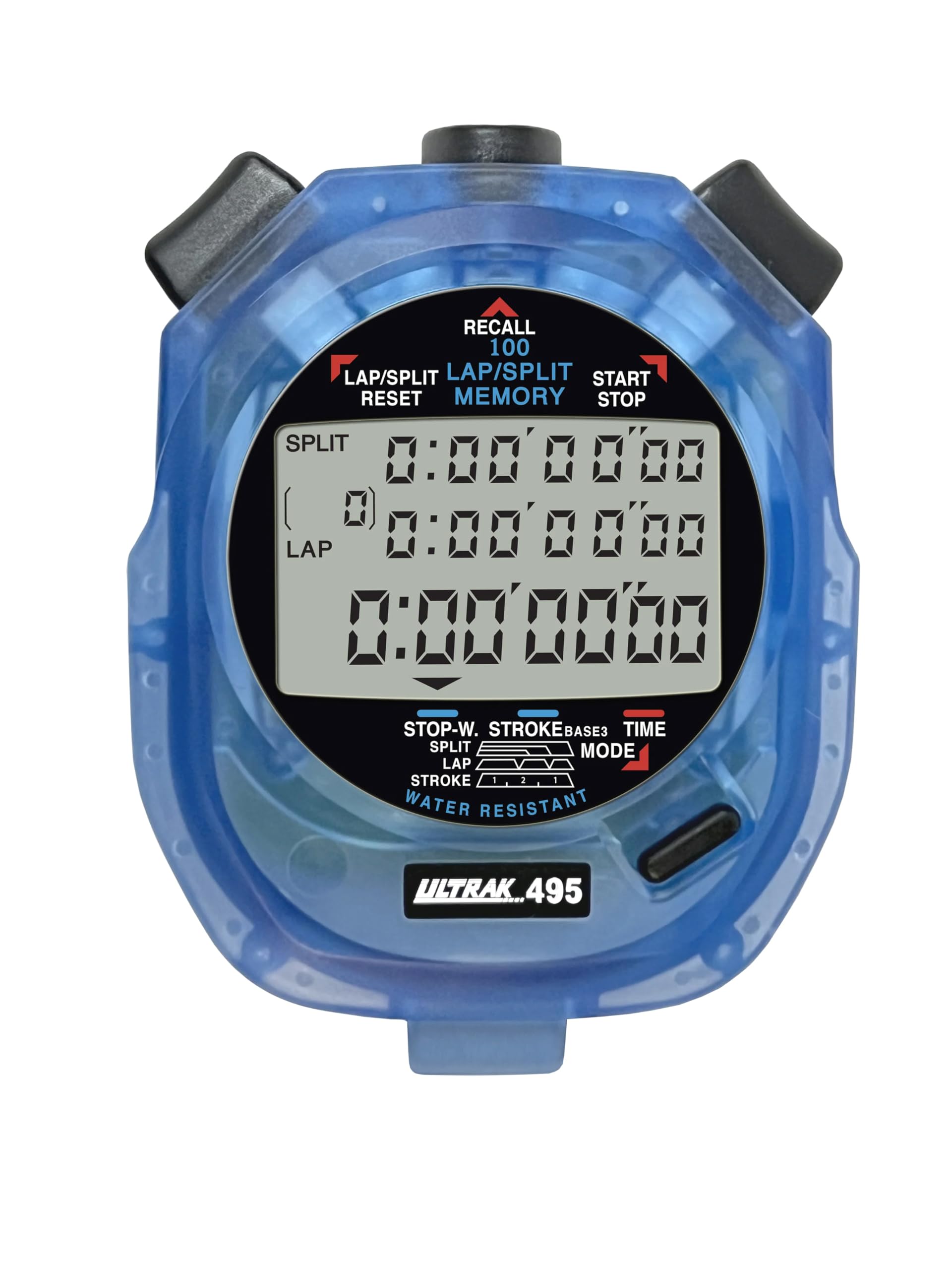
Ultrak 495 Stopwatch

Ultrak

Ultrak 495 Stopwatch

  • Display Three rows: split, lap, total
  • Extra Mode Stroke/frequency
  • Split Memory 100 dual splits
  • Water Resistance Water-resistant
Check Price on Amazon

Three-row display and 100-split recall for coaches timing a whole lane.

Three numbers on one screen is the entire idea. The 495 shows the split you just took, the running total, and the lap beside each other, so you can call a swimmer's time out loud without cycling a menu or doing arithmetic in your head while they hang on the wall. For anyone timing more than one person at once, that layout earns its keep before any other feature gets a look.

The memory backs it up. There's room for 100 dual splits, and you can pull them back while the watch is still running, which is what turns a stopwatch from a single-athlete tool into a squad tool: time a group through a set of 200s, then read the list back at the fence instead of trusting your memory. A stroke/frequency mode handles swim pacing and rhythm work, and the housing is built to shrug off a wet deck.

The one reservation we hold is the buttons. Lap and recall take more presses than anything else on the watch, and they're where this model eventually gives trouble — a recall button that stops registering, or a lap button with too much play, after a season or two of daily deck use. If you need the memory, that's a risk worth taking for the display alone. If you don't, the simpler Accusplit costs less and asks nothing of you.

Bottom Line

For a coach timing a whole lane or a squad of runners, the memory and three-row display here do more than any other watch in this group.

Check Latest Price

Best for Swim Coaches

Our Score 8.8/10
FINIS Waterproof Swim Stopwatch

FINIS

FINIS Waterproof Swim Stopwatch

  • Screen 3 inches
  • Timing Range 10 hours at 1/100 second
  • Place Display 1st and 2nd together
  • Stroke-Rate Mode Included
Check Price on Amazon

Stroke rate and side-by-side place times make swim practices easier to coach.

Stroke rate is the feature that separates a swim stopwatch from a general one. Press a button in rhythm with a swimmer's arm and the watch converts the gap into strokes per minute — the number you build a set around, and the one that tells you whether a swimmer is holding form or spinning their wheels in the last 50.

Put that beside a display that shows first and second place times in the same view, and you have the reason we recommend this to swim coaches specifically: it answers the two questions a deck coach asks most, with no menu in between. For a track coach or a trainer it's money spent on modes that never get used, and we'd rather you bought something simpler.

The supporting specification is solid. Timing runs to a hundredth of a second for up to ten hours, the screen is a three-inch display that reads from a couple of lanes away, and the housing is sold as waterproof rather than merely water-resistant. Dual-split memory lets you log repeat swims through a practice and read them back once the set is done.

It's the most expensive watch here, and that's the honest trade: you're paying for stroke rate, the place comparison, and a sealed case. On a pool deck three or four times a week it earns that back inside a month. If swimming is one of four sports you cover, the Ultrak handles the splits for less and won't leave you guessing about a mode you never touch.

Bottom Line

If you coach swimming, the stroke-rate mode and side-by-side place times justify the extra money; nobody working on dry land needs it.

Check Latest Price

Best for Low Light

Our Score 8.8/10
MARATHON Adanac 8000

MARATHON

MARATHON Adanac 8000

  • Modes Split, time, calendar, alarm
  • Display Large LCD, orange backlight
  • Resistance Water, dust, shock
  • Timing Precision 1/100 second
Check Price on Amazon

An orange backlight and a solid click for dim gyms and night sessions.

An orange backlight sounds like a small thing until the lights go down. Indoor tracks, evening practices on an unlit field, a gym dimmed for a video session — those are the settings where a perfectly good stopwatch becomes useless, because you can't see the digits at the exact moment you need them. This is the only watch in our picks that solves that.

Everything around the light is deliberate rather than flashy. The buttons click audibly and push back enough that you know the press registered, split timing freezes the split while the total keeps running, and the case is rated water, dust, and shock resistant. On its 40-inch cord it hangs where you put it.

We think the backlight justifies the premium if your sessions happen in poor light, and is hard to justify if they don't — that's essentially what you're paying for over the Accusplit, along with a slightly denser feel in the hand. Buy it for the dark, not for the feature list.

Bottom Line

The backlight is the reason to pick this one: for a dim gym, a night practice, or a covered track, it's the watch that stays readable.

Check Latest Price

Best Simple Stopwatch

Our Score 8.6/10
TPNEG Simple Stopwatch 805C

TPNEG

TPNEG Simple Stopwatch 805C

  • Power On/off switch
  • Battery AAA, replaceable
  • Lanyard 22 inches
  • Lap Function Single lap
Check Price on Amazon

Three buttons, a replaceable AAA battery, and an off switch for anyone.

A battery door that opens without a screwdriver, and a switch that actually powers the thing down. Those two small details are why this little TPNEG punches above its price. It runs on a standard AAA rather than a coin cell, and when you slide the switch off it stays off — which sounds like the bare minimum until you've owned a stopwatch that quietly drains itself in a kit bag between sessions.

That's the case for making it the simple pick here. A handful of buttons cover everything, the digits are big enough to read at arm's length, and the whole thing is small enough to close a fist around. It's the watch we hand over when someone asks for something they can't get wrong — a kid at a swim lesson, an assistant covering a session, a client counting their own rest intervals.

The plastic is light, the 22-inch lanyard keeps it out of the way, and the buttons sit proud of the case. That last part cuts both ways: easy to find with a thumb without looking, easy to knock when the watch swings against your chest mid-run. Standing still to time, it's a non-issue; sprinting a sideline, clip it to a waistband instead.

Bottom Line

Buy this if you want a stopwatch you can hand to a kid or a client without explaining anything: three buttons, an AAA battery, and a real off switch.

Check Latest Price

Best Bulk Buy for Teams

Our Score 8.6/10
Pgzsy 12-Pack Stopwatch

Pgzsy

Pgzsy 12-Pack Stopwatch

  • Modes Time, date, alarm
  • Battery LR44, included
  • Pack Size 12 stopwatches
  • Timing Precision 1/100 second split
Check Price on Amazon

Twelve timers with lanyards and batteries, ready to hand out on day one.

Twelve watches in one box changes the arithmetic of a season. A club, a PE department, or a referee crew that hands timers to helpers at every session doesn't need one excellent stopwatch — it needs a dozen that all work, all have a lanyard, and all take the same battery. That's the box this is.

Each unit does 1/100-second split timing, with time, date, and alarm modes on the same chip, and the LR44 cells come fitted. The plastic is light and the lanyards are the flat nylon sort that survive being stuffed in a kit crate. Nothing here feels expensive in the hand, and at this scale nothing needs to.

The beeping is the flaw worth knowing about. The alarms ship set to different times out of the box, and a watch that chimes on the hour in the middle of a meet is a distraction you can't always silence from the buttons. We still think it's the right buy for a program equipping a dozen people, because the alternative is a dozen separate purchases and a dozen battery types — but budget ten minutes per watch to kill the alarm before the season starts.

The other thing to plan for is variance. A box this size occasionally includes a unit that won't change mode or reset, and the printed directions are thin enough that you'll want a known-good watch beside you while you set the first one. Open all twelve the week they arrive, test each one, and you'll have spares for whichever ones misbehave in week six.

Bottom Line

A club or PE department should start here: twelve working timers with lanyards and batteries, ready to hand out on day one.

Check Latest Price

Best For Silent backup pairs

Our Score 8.6/10
PIAMIG 2-Pack Stopwatch

PIAMIG

PIAMIG 2-Pack Stopwatch

  • Alerts Silent, no beep
  • Controls Mode, split/reset, start/stop
  • Pack Size 2 stopwatches
  • Timing Precision 1/100 second
Check Price on Amazon

Silence is a feature you notice in the rooms where noise is a problem: a classroom, a study hall, a quiet gym at six in the morning, a lifeguard chair. This PIAMIG pair makes no sound at all — not on a button press, not at power-up, not on the hour — which is rarer than it should be in a cheap digital watch, and the reason we keep a set around.

The rest is basic in a good way. Big digits, a 1/100-second readout, three buttons covering mode, split/reset, and start/stop, and a bright yellow case that's easy to spot at the bottom of a bag. You get two, so one can hang by the door and one can live in the car.

Two watches also solve the small stuff. A partner, a kid, or an assistant can time alongside you without a second purchase, and a lost watch is an inconvenience rather than an emergency. The trade for all that quiet is that nothing confirms your press but the display — at a finish line, we still want a click we can hear.

The buttons can stick under heavy use, and a unit that runs continuously instead of switching off is the failure to watch for in the first month, so test both as soon as they arrive. Treat them as the knockabout pair — one in the bag, one on the shelf — and they'll do everything asked of them. If you need a single watch to survive a decade of daily coaching, this isn't it.

Bottom Line

Silence is the whole pitch: two bright, simple watches for anywhere a beep would be unwelcome, as long as you don't expect them to last forever.

Check Latest Price

Best For Cheap spare timer

Our Score 8.4/10
PULIVIA YS-802 Stopwatch

PULIVIA

PULIVIA YS-802 Stopwatch

  • Split Single split/lap
  • Lanyard 47 inches
  • Maximum Timing 99 hours 59 minutes 59 seconds
  • Timing Precision 1/100 second
Check Price on Amazon

The mode button is the first thing you'll wrestle with. PULIVIA packs a clock, calendar, alarm, and a 12/24-hour setting onto the same chip as the timer, so getting back to the stopwatch usually means clicking past a screen or two you don't want. It's the classic budget trade: a longer feature list on the box, more presses between you and the thing you bought it for.

What sits underneath those modes is decent, though. The split function freezes the split time on screen while the total keeps running — the version of split timing that actually helps a coach — and timing runs to a hundredth of a second for up to 99 hours, 59 minutes, and 59 seconds, which covers an ultra or a full school day with room to spare.

The hardware is light: about an ounce and a half on a 47-inch lanyard, with digits big enough to read at arm's length. The buttons are sensitive, which is handy when you're stabbing at start from a crouch and less handy when the watch swings against your chest mid-stride.

Ours ended up as the spare in the kit bag, and that's where it earns its place: a second timer for an assistant, a kid, or the session you forgot your good watch for. As the only stopwatch you own, the mode cycling will wear on you by October. As the one that lives in the car, it's a bargain.

Bottom Line

Keep this one as the spare in the kit bag: it times splits and runs for 99 hours, as long as you can put up with a few extra modes in the way.

Check Latest Price

How We Tested Stopwatches on Deck, on the Track, and in the Kitchen

We started by gathering every stopwatch a coach, referee, or club parent would realistically buy, then cut anything that claimed precision without stating its lap memory, anything that forced one button to cycle start, lap, and stop, and anything that left water resistance vague. That left 16 models. We bought all of them ourselves at retail, which also let us note shipping time, whether the battery arrived installed, and whether the instructions were readable without a magnifying glass.

Each watch lived in a gear bag for four months. We wore them on a pool deck twice a week, on a middle-school track during interval workouts, on a soccer sideline, and in a kitchen for proofing dough and steeping tea. Button responsiveness got a dedicated count: 50 starts and stops bare-handed, then 50 more with cold wet fingers and with gloves, tallying every double-trigger and every press that failed to register.

For readability, we read each display at arm's length in direct afternoon sun, in a dim gym, and mid-stride while running, noting which ones we could catch without slowing down. We checked time drift against a phone across a week, ran countdowns and repeating intervals to see how the alarms behaved, and compared every lap log to a hand tally to catch anything dropped or overwritten.

Durability got the least gentle treatment: drops from waist height onto tile and asphalt, a week loose in a bag with keys, and a splash under a running faucet before we opened the battery compartment to look for moisture. Value came down to what survived all of that. An inexpensive watch that never missed a press beat the feature-heavy ones that needed two thumbs and a pause.

How to Choose

Match the Split Memory to How You Time

If you time one athlete at a time, a basic split is plenty: the display freezes the split while the total keeps running, and you reset between efforts. The moment you're timing a group, memory is the feature that matters, because you need to read times back after the set rather than scribble them down mid-rep. That's exactly what the Ultrak 495 buys you with 100 dual-splits and one-screen recall.

Read the wording carefully on cheaper watches. A 'split function' often means only that the display freezes and stores nothing, which is useful for one runner and useless for a lane of six.

Read the Display From Where You'll Actually Wear It

Most stopwatches hang at chest or waist height on a lanyard, so digit size matters more than screen size — a big face with thin numerals is worse than a compact one with bold digits. If your sessions run into evening or happen indoors under dim lights, a backlight stops being a luxury; the MARATHON Adanac 8000's orange glow is the reason it's here rather than a cheaper lookalike.

A 'large display' claim describes the case about as often as the numerals, so look for a close-up of the screen in use, or a digit-height figure, before you commit.

Decide Whether You Want It to Beep

Cheap digital watches love an alarm, and a surprising number arrive with one already set. A watch that chimes on the hour is a problem in a classroom, a library, or the middle of a meet, and on some models the alarm is genuinely hard to silence. If quiet matters, buy silent — the PIAMIG pair makes no sound at all, on a press or off the hour.

Don't assume silent is always better, though. When you're timing finishes, an audible click confirms the press registered, which is why we like a button you can hear as well as feel.

Plan for Water, Drops, and Next Season

'Water-resistant' and 'waterproof' are not the same promise, and neither is an invitation to swim with the watch on your wrist. For a wet pool deck, a sealed swim watch like the FINIS is the sensible call; for a track, a gym floor, or a referee's sideline, a shock-resistant case and a decent warranty matter more than a depth rating.

Check the warranty before you buy. A five-year limited warranty, as on the Accusplit Pro Survivor, tells you the maker expects the switches to survive daily use — which is precisely the part that fails first on a cheap watch.

Frequently Asked Questions

Final Verdict

The ACCUSPLIT Pro Survivor is the stopwatch we point most people to: enormous digits, separate buttons with a click you can feel, and a five-year battery and warranty that make it a tool rather than a consumable.

If you time groups and need to read splits back afterwards, the Ultrak 495's three-row display and 100-split memory are worth the step up. And if you simply want something you can hand to a kid without explaining anything, take the TPNEG.