Strength & Weights

Best Stall Bars for Home Gyms of 2026

The first time you grab a rung and lean back, you should feel absolutely nothing shift—no creak, no wobble, no give. That's the whole promise of a good set of stall bars, and it's also where cheap ones fall apart. A solid set turns a blank wall into a daily stretching and strength station. We've spent the past eight months with 10 different sets, mounting them in garages, spare bedrooms, and one very patient physical therapist's office, and the differences in sturdiness, hardware, and finish were obvious from the first hang.

Assembly and mounting are where most shoppers get surprised—some sets go up in an afternoon with basic tools, while others need a second person and better anchors. We paid close attention to the material, the included hardware, and how the finish held up after repeated use. Value matters too: a stall bar set is an investment, and we wanted to know which ones justified the price with solid construction and a look that doesn't make your rec room feel like a gym. The picks below are the ones we kept coming back to, and the ones we'd trust with our own daily routines.

Best Heavy-Duty

Our Score 9.2/10
DHT Wood Stall Bar

DHT

DHT Wood Stall Bar

  • Rung Count 9
  • Bar Diameter 1.5 inches
  • Overall Size 31.5"W x 78.1"H
  • Weight Capacity 330 lb
Check Price on Amazon

Highest weight capacity here, with a clean nine-rung wooden ladder.

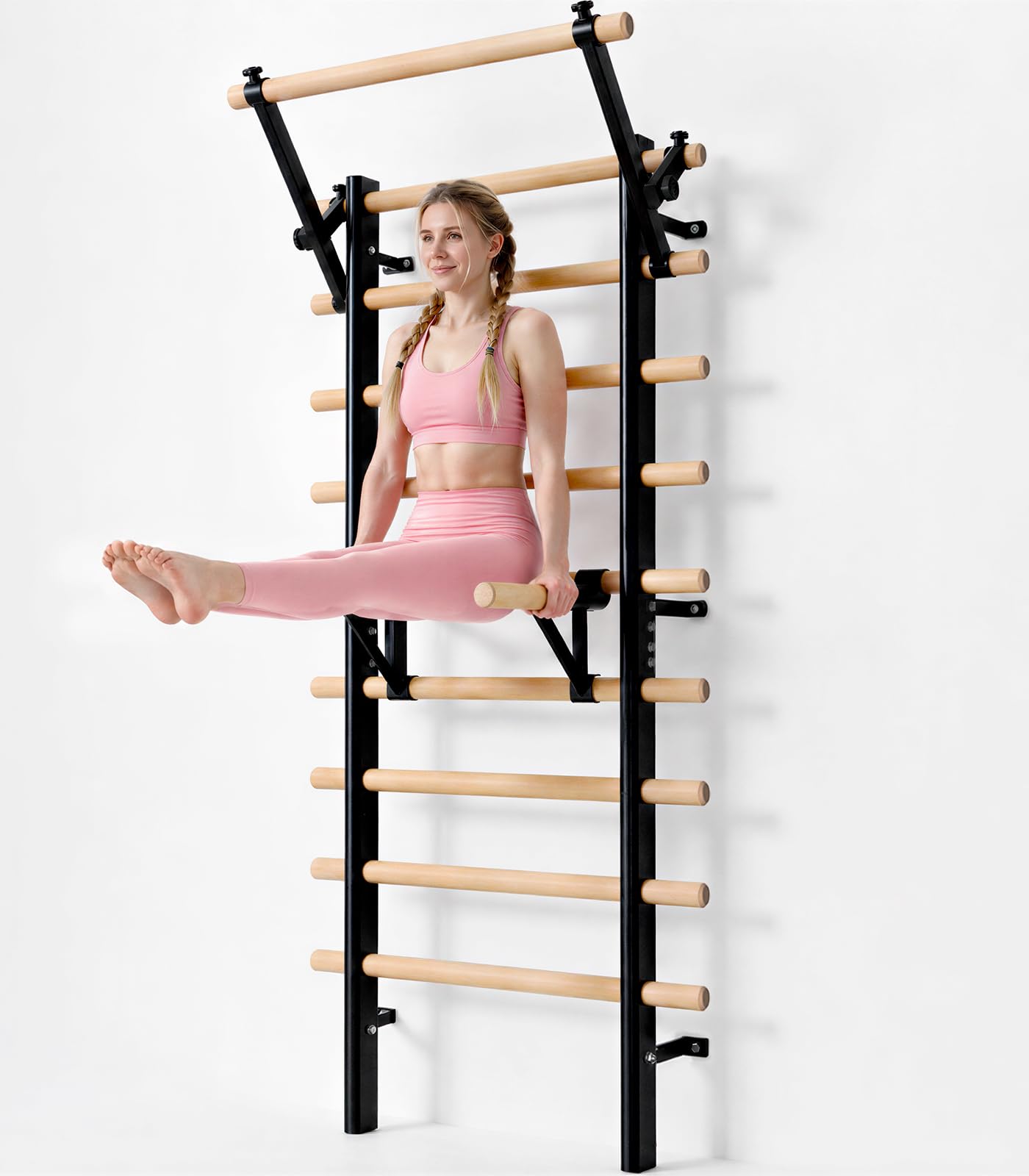
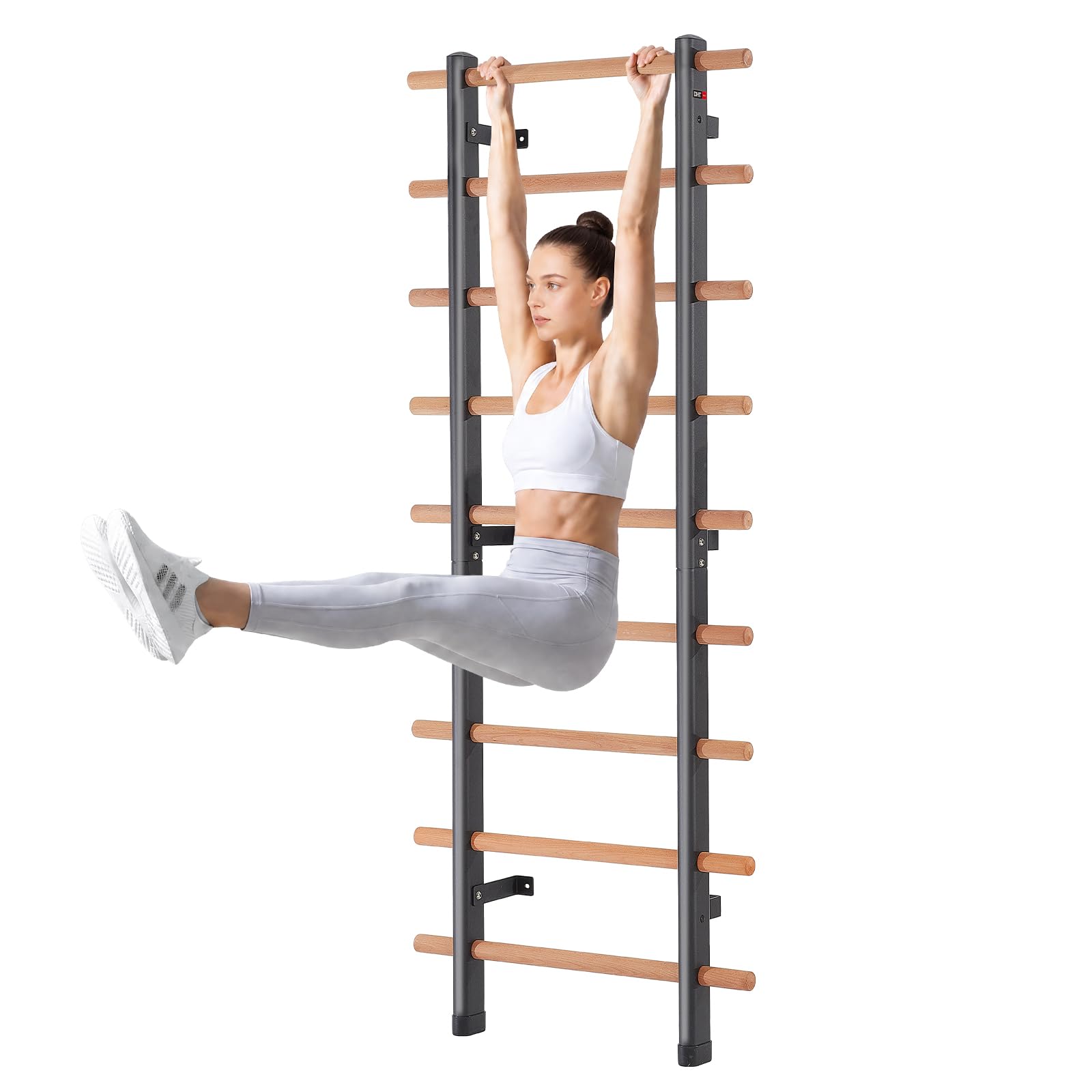
The DHT's headline number is its 330-pound weight capacity, the highest in this group. That is the number that matters if two people share the ladder or if you want extra margin for dynamic hanging and leg raises. The frame is a mix of alloy steel and wood, and the nine 1.5-inch beech rungs are finished cleanly enough to grab without chalk.

The rest is plain: a 31.5-inch width, a 78.1-inch height, and a simple frame that does not try to be a full gym. We found the wood finish and the rigidity the most convincing parts. The hardware is the part to watch; if your wall needs different anchors, buy them rather than forcing the included ones. That is a setup task, not a permanent compromise, and it is the same conversation you should have with any wall-mounted ladder.

What we appreciate most is that DHT does not overbuild the concept. It is a heavy-duty ladder for buyers who want a high weight rating and a clean wooden look, and it earns its premium on structure rather than accessories. If you are tall, compare the 78.1-inch height with the 88-inch RokePro before you commit; the extra reach is worth having.

Bottom Line

We recommend the DHT for heavier users and shared home gyms: its 330-pound capacity is the highest here, and the simple wooden ladder is built for daily loading.

Check Latest Price

Best Overall

Our Score 9.0/10
RokePro Swedish Ladder

RokePro

RokePro Swedish Ladder

  • Bar Diameter 1.4 inches
  • Overall Size 33"W×88"H
  • Rung Material Beech wood
  • Depth From Wall 8.2 inches
Check Price on Amazon

Tall, room-friendly beech ladder with a slim wall depth and straightforward assembly.

At 88 inches tall and 33 inches wide, the RokePro is the ladder that gives you a full reach without eating the room: it sits 8.2 inches off the wall. That combination is why it's our top pick. The extra height matters for overhead shoulder stretches and hanging work, and the 33-inch width leaves room for a two-handed grip without feeling like a wall of lumber. We found the 1.4-inch beech rungs comfortable to wrap our hands around, and the nine-rung spacing covers everything from a low hamstring stretch to a high reach.

The assembly is straightforward by the standards of wall-mounted gear; the part that deserves a tape measure is the wall connection. The mounting holes may not land on 16-inch studs in every room, so a plywood backer board is a sensible upgrade if your layout is off. That is a small project compared with living with a ladder that moves when you load it. Once it is anchored, the frame feels simple and rigid rather than fussy, which is what we want from a piece of wood and steel that you grab every day.

The RokePro is deliberately simple, and we prefer that for stretching because there is less hardware in the way. The all-wood frame is the simpler choice for a room that doubles as a living space, and the nine rungs are all you need for a daily mobility routine. If you want one purchase to cover dips and pull-ups too, the GMWD is the better fit. But as a daily stretching and core station, this is the one we kept coming back to.

Bottom Line

We recommend the RokePro as our top pick for home stretching and core work: tall, room-friendly, and simple, with no extra hardware to get in the way.

Check Latest Price

Best with Attachments

Our Score 9.0/10
GMWD Swedish Ladder

GMWD

GMWD Swedish Ladder

  • Rung Count 9
  • Bar Diameter 1.5 inches
  • Weight Capacity 265 lb
  • Included Components Dip Bar, Pull Up Bar, Swedish Ladder
Check Price on Amazon

Includes pull-up and dip bars for a more complete home-gym station.

The GMWD turns a strip of wall into a small station by including a pull-up bar and dip bars alongside its nine wooden rungs. That is the difference you notice first: the ladder is the base, but the attachments give you more ways to train without adding another machine. The 1.5-inch New Zealand pine rungs are thick enough to feel secure in the hand, and the steel uprights are rated for 265 pounds.

What makes it our runner-up is the way those extras earn their space. We found the dip bars useful for supported dips and triceps work, and the pull-up bar gives the ladder a second job for upper-body days. The 265-pound capacity covers most adults, and the steel uprights feel rigid when you load the bar. The nine-rung layout is the same useful spread as the RokePro, so the extras do not come at the expense of the ladder.

Assembly is one of its stronger points: the hardware lines up, and the frame goes together without the usual guesswork. The 9-rung layout runs from a low step to a high reach, so it works for both hamstring stretches and hanging knee raises. For the money, it is the most complete package here, and the one we recommend when you want a single wall unit rather than a ladder plus add-ons.

Bottom Line

We recommend the GMWD if you want one wall unit for pull-ups, dips, and stretching; it adds useful attachments without giving up the ladder.

Check Latest Price

Best for Families

Our Score 8.8/10
Wedanta Swedish Ladder Set

Wedanta

Wedanta Swedish Ladder Set

  • Material Natural wood
  • Overall Size 31.5”x7’2”
  • Weight Capacity 290 lb
  • Included Components wall ladder, pull-up bar, rope ladder, rope and gymnastic rings
Check Price on Amazon

A family set with rings, ropes, and a pull-up bar for kids and adults.

The Wedanta is less a single stall bar than a wall-mounted play gym, with a ladder, pull-up bar, rope ladder, rope, and gymnastic rings in one box. The 31.5-inch width and 7-foot-2 height fit a playroom wall, and the 290-pound rating means adults can use the ladder too. That bundle is the whole point: one wall gives you a stretching station and a rainy-day climbing frame.

We see it as a family purchase rather than a pure stretching tool. The ladder is the sturdy part; the ropes and rings are the fun. What you get is one wall that keeps kids active and still gives you a place to stretch, which is a different job from a bare ladder. If you want a serious adult training station, the RokePro or DHT is the cleaner choice.

The pull-up bar is the piece adults will use most, while the rope ladder and rings are what draw kids back. That split is the set's real advantage: it gives a mixed-age household one wall instead of two separate stations. The 290-pound ladder capacity is the number to watch if adults plan to hang or stretch.

Bottom Line

We recommend the Wedanta for families who want one wall to cover play and exercise; the rope ladder and rings keep kids engaged while adults use the ladder.

Check Latest Price

Best For Steel-frame home gym

Our Score 8.4/10
PreGymnastic Stall Bars

PreGymnastic

PreGymnastic Stall Bars

  • Warranty 1-year Warranty
  • Bar Diameter 1.5 inches
  • Rung Material Beech wood
  • Frame Material Solid steel
Check Price on Amazon

The PreGymnastic is the steel-framed option here, with 1.5-inch beech rungs and a one-year warranty. We recommend it for buyers who want a metal frame and the included single-bar bracket and dip bars, and who are comfortable sorting out the wall mounting properly. The frame is the reason to look: steel uprights give it a different feel from the all-wood ladders, and the beech rungs are thick and comfortable in the hand.

The ladder is solid when loaded, and the dip bars add a useful second station. The included fasteners are the weak point: the screws and anchors are not the place to save effort, especially on a wall that is not perfectly flat. Replace them with hardware rated for your studs or concrete, and the rest of the package makes sense. The single-bar bracket gives you a higher anchor for band work, and the one-year warranty is a useful backstop for a frame at this price. It is not the smoothest install in this group, but it is a capable steel-frame ladder once it is anchored properly.

Bottom Line

We recommend the PreGymnastic for buyers who want a steel frame and included dip bars in a compact home-gym setup.

Check Latest Price

How We Tested the Best Stall Bars

We started by researching the stall bar market, filtering out sets with vague weight ratings, missing hardware, or materials that seemed too thin for full-body hangs. From an initial list of about 30 options, we narrowed it to 10 sets that spanned solid wood, laminate, and metal, with prices from budget-friendly to investment-grade. Over eight months, we mounted each set in a real-world setting: a home garage gym, a spare bedroom, and a physical therapist's clinic, where clients used them for stretching and mobility work daily.

Installation was the first test. We timed how long assembly took with one person and two, noted whether the instructions were clear, and checked what hardware came in the box—then whether it was actually appropriate for drywall, studs, or concrete. We mounted each set on at least two wall types and recorded any creaking, shifting, or need for extra anchors. Once up, we hung from the top rung, pulled on the uprights, and had kids climb and swing to see if anything loosened.

For durability and function, we used the bars daily for stretching, hanging, and leg raises, and checked for wobble, splinters, and finish wear after repeated use. We also paid attention to material quality—how the wood felt, whether edges were sanded, and if the metal had any sharp spots. Throughout, we asked testers whether they actually enjoyed using the bars, because a set that feels good to grab and easy to mount is more likely to become part of a routine. The sets that scored highest combined solid construction, straightforward installation, and a finish that looked at home in a living space, not just a gym.

How to Choose

Start with the Wall, Not the Ladder

Wall security comes before rung count. A stall bar is only as good as its anchors, so locate the studs first and compare their spacing with the mounting holes. Standard studs are 16 inches on center, and a ladder that does not line up needs a plywood backer board rather than longer drywall anchors. We put this ahead of every other feature because a ladder that shifts under load is not usable, no matter how good the wood feels. If you are mounting to concrete or metal studs, use hardware rated for that surface.

Match Height and Width to the User

Height is the spec that decides whether a stall bar feels like a stretching tool or a compromise. The picks here run from about 78 to 88 inches tall, and the tallest gives a full overhead reach for shoulder work. Width matters for two-handed grips and for fitting between doors or cabinets; 31.5 to 33 inches is the common range. Check the lowest rung too: a low bar around 7 to 11 inches is useful for hamstring stretches and supported squats. If tall users share the wall, prioritize the 88-inch models.

Decide Between a Bare Ladder and a Station

Every stall bar can handle stretches and core work; the extras are what separate a simple ladder from a home-gym station. Pull-up and dip bars add upper-body options, but they also add hardware and cost. A bare ladder like the DHT keeps the wall cleaner and puts the money into structure. A bundle like the GMWD or Wedanta gives you more ways to train, provided you will actually use the attachments. Buy for the exercises you already do, not the ones you might start.

Check Capacity, Grip, and Assembly

Stated weight capacity ranges from 265 to 330 pounds among these picks, so match it to the heaviest user and leave margin for dynamic movement. Bar diameter is usually 1.4 to 1.5 inches; beech and pine both feel secure, but the finish matters more than the label. Assembly is the other practical split: a bare ladder can go up in an afternoon, while a multi-piece family set takes longer and has more parts to check. Replace marginal fasteners before you hang anything from the bar.

Frequently Asked Questions

Final Verdict

For most home gyms, the RokePro is the stall bar we recommend. Its 88-inch height and 33-inch width give you room for full-range stretches, and the 8.2-inch depth keeps a narrow room usable. If you want a single station with pull-up and dip bars, choose the GMWD. If the heaviest user needs a higher weight rating, the DHT's 330-pound capacity is the deciding advantage.