Yoga Mat Materials Compared: Grip, Care, and Durability
There is no universally best yoga mat material. Closed-cell PVC is often durable and easier to wipe down; natural rubber provides dense floor grip but adds weight and latex exposure; polyurethane-topped rubber favors wet grip but absorbs moisture; TPE is usually lighter but varies by formula; cork is a textured surface normally bonded to another base.
Compare the complete construction—not a single material word. The top layer controls hand and foot grip, while the base controls floor grip, cushioning, weight, and much of the mat’s lifespan.
Yoga Mat Material Comparison
These are common tendencies, not guarantees. Surface texture, cell structure, density, additives, and laminated layers can make two mats in the same material category perform differently.
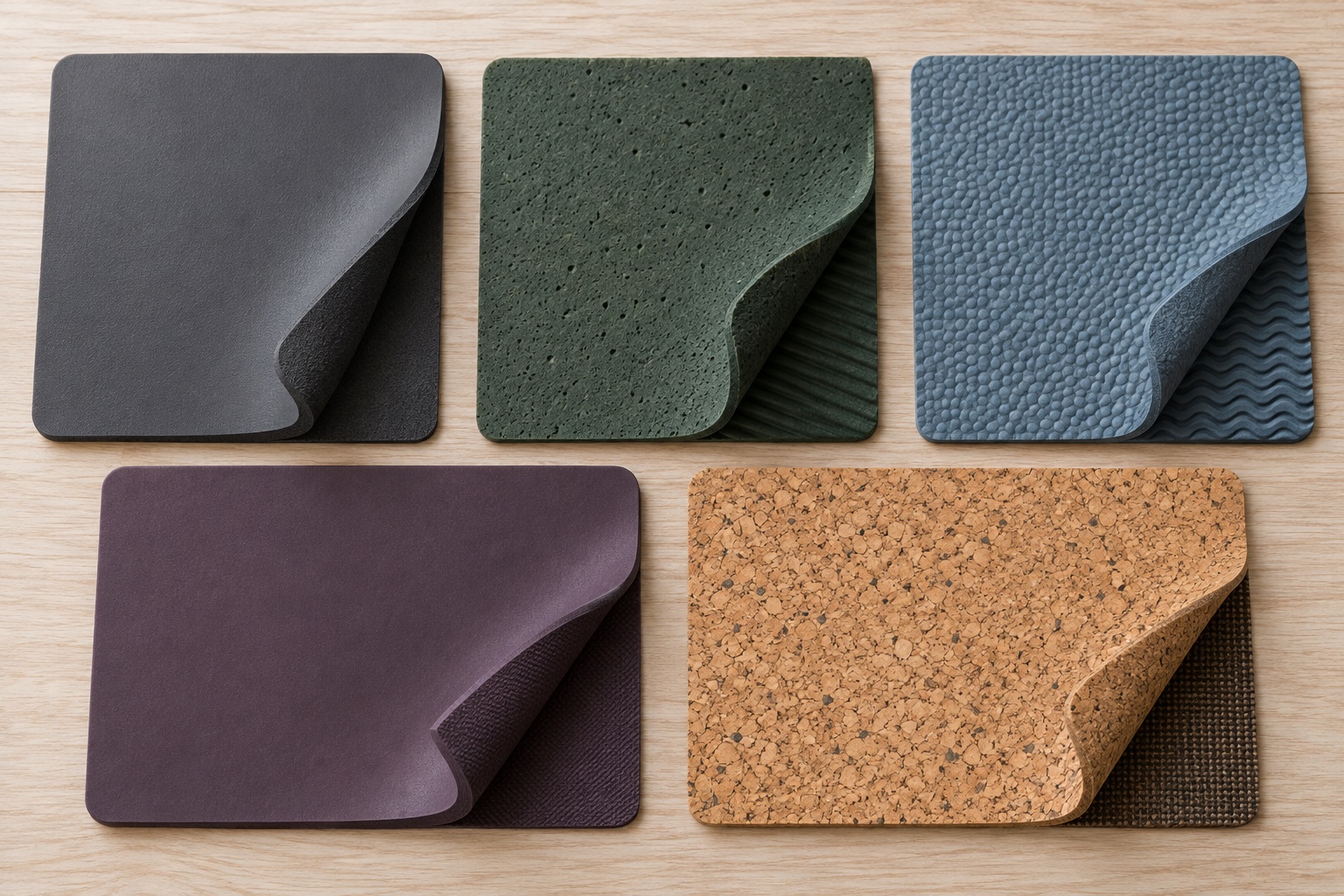
| Material or construction | Likely strengths | Main tradeoffs |
|---|---|---|
| Closed-cell PVC | Dense support, moisture resistance, long service life in quality models | May feel slick with sweat; heavier dense versions; environmental claims vary |
| Natural rubber | Strong floor grip, dense resilient feel | Heavy, rubber odor, sun and heat sensitivity, contains natural latex |
| TPE | Often lightweight, closed-cell, and easy to carry | Formulas and durability vary; the label alone reveals little |
| Polyurethane top + rubber base | High wet grip and a firm base | Absorbs sweat, requires complete drying, can stain or show wear |
| Cork top + rubber or TPE base | Textured feel; some surfaces gain traction when damp | Thin cork layer can dry or separate if misused; base determines weight and latex exposure |
| NBR or soft EVA foam | Light, inexpensive, soft for floor exercise | Can dent, stretch, or feel unstable in standing yoga; not always designed as a practice mat |
Open-Cell vs. Closed-Cell Is the Useful Question
A closed-cell surface resists liquid penetration, so sweat stays on top and the mat is generally easier to wipe. That can become slippery in a hot class unless the texture or formulation provides wet grip.
An open-cell or absorbent surface draws in moisture and can maintain traction as hands sweat. The cost is slower drying and more careful cleaning. Manduka, for example, describes its closed-cell PRO and absorbent polyurethane-and-rubber GRP as different constructions with different cleaning needs. Do not soak an absorbent mat or apply a disinfectant unless the manufacturer explicitly permits it.
PVC, Natural Rubber, and TPE
PVC
PVC is not automatically a cheap, squishy material. High-density closed-cell PVC mats can be firm, durable, latex-free, and non-absorbent. Their dry grip may improve with use, but sweat remains on the surface. Check product-specific substance certifications rather than treating broad ‘non-toxic’ language as evidence.
Natural rubber
Natural rubber usually gives a dense, grippy base and strong contact with the floor. It is heavier, may have a noticeable odor, and should be kept away from prolonged sun and heat. It also contains natural latex, so someone with a latex allergy should use a verified latex-free alternative.
TPE
Thermoplastic elastomer is a broad family rather than one formula. TPE mats are often light and closed-cell, but density, tear resistance, odor, and recyclability depend on the exact blend and local facilities. Ask the manufacturer for weight, care, warranty, and material disclosure instead of assuming every TPE mat performs alike.
Polyurethane and Cork Surface Mats
Polyurethane-topped mats
A polyurethane practice surface bonded to natural rubber is a common wet-grip construction. Liforme identifies natural rubber and a proprietary polyurethane surface in its mats, while Manduka uses an absorbent PU-and-rubber construction in its GRP line. These mats suit sweaty practice but demand full air-drying and model-specific cleaning.
Cork-topped mats
Cork is normally a thin surface layer over rubber or another foam. It has a distinct dry texture and may become more tactile when damp. The hidden base still determines much of the weight, cushioning, floor grip, and latex exposure. Inspect the edge for lifting and follow the specific brand’s cleaning limits; ‘cork’ does not mean the entire mat is a single natural slab.
How to Compare Durability Before Buying
- Inspect the edge. Look for poorly bonded layers, bubbles, ragged cuts, or a surface film that lifts when flexed.
- Press and release. The dent should recover rather than remain deeply compressed.
- Flex one corner gently. Stop if a top layer creases, flakes, or separates.
- Read storage limits. Rubber and laminated surfaces can be sensitive to sun, heat, and being rolled damp.
- Check the warranty. A clear warranty is more actionable than an unsupported ‘eco’ or ‘lifetime’ claim.
Durability is also behavioral: shoes, pet claws, outdoor grit, harsh cleaners, and hot-car storage shorten the life of many mats regardless of material.
Choose by Constraint, Not by Material Trend
- Heavy sweater: start with an absorbent wet-grip surface or plan to use a mat towel.
- Easy cleaning: choose a closed-cell surface with explicit care directions.
- Latex avoidance: verify the full mat and adhesives are latex-free; avoid natural-rubber bases.
- Daily commuting: compare finished weight before favoring dense rubber.
- Long-term home use: prioritize dense construction, edge quality, warranty, and correct storage.
Then confirm thickness and stability with our thickness guide, run the pose tests in how to choose a yoga mat, and use the exact material method in our cleaning guide.
Sources and Manufacturer Guidance
Requirements can vary by product, model, and situation. These primary sources informed this guide; official instructions for your exact product and current authoritative guidance take priority.
Frequently Asked Questions
-
Not universally. Natural rubber often provides dense floor grip but is heavier, sensitive to prolonged sun, and contains latex. Quality closed-cell PVC can be durable, non-absorbent, and latex-free but may need a towel during very sweaty practice.
-
An absorbent polyurethane-style surface designed for wet grip is a strong starting point. It needs careful cleaning and complete drying. A closed-cell mat plus a washable yoga towel is another practical system.
-
TPE describes a broad material family, not one verified formulation. Review the exact manufacturer’s material disclosure, testing or certification, care instructions, and warranty rather than relying on the TPE label alone.
-
Yes. Natural rubber contains natural latex. People with latex allergy should avoid natural-rubber mats and confirm that the entire alternative construction—not only the top surface—is labeled latex-free.