How to Choose a Yoga Mat: A Practical Fit Test
The short answer: start with a dense 4–5 mm mat for general practice, then change one feature for your main constraint: choose a more absorbent surface if you sweat heavily, a dense 5–6 mm mat if floor pressure is the problem, or a 1.5–2 mm travel mat if packability matters most. Thickness alone does not tell you how supportive or stable a mat will feel.
The right mat should pass four tests in your most common poses: your hands do not creep in downward dog, one-leg balance does not feel wobbly, kneeling is tolerable, and the mat is still practical to carry and clean.
Choose for Your Actual Practice
Write down where you practice, whether your hands get sweaty, which body parts feel floor pressure, and whether the mat must commute. Those answers are more useful than a universal ‘best mat’ label.
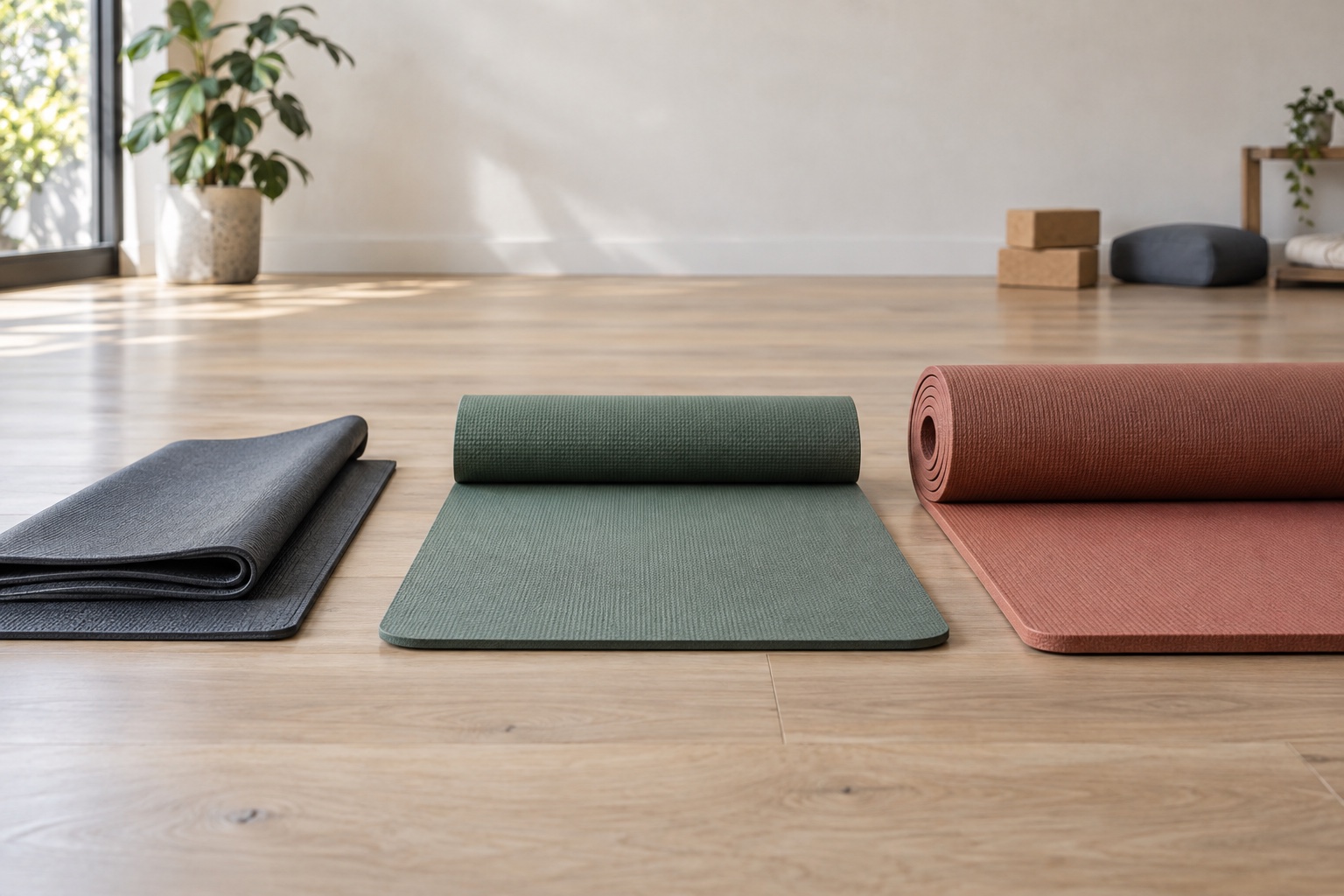
| Main use | Good starting point | Tradeoff to check |
|---|---|---|
| General home or studio practice | Dense 4–5 mm mat with reliable dry grip | May still need a towel for very sweaty sessions |
| Hot yoga or sweaty hands | Absorbent/open-cell top or a mat designed for wet grip | Longer drying time and more careful cleaning |
| Sensitive knees or hard floors | Dense 5–6 mm mat | Extra weight; a soft foam can still feel unstable |
| Balance-heavy practice | Firm, dense surface around 3–5 mm | Less pressure relief than a thick exercise mat |
| Travel | Foldable 1.5–2 mm mat, often used over a studio mat | Minimal cushioning and more floor texture |
| Latex sensitivity | A model explicitly labeled latex-free | Do not assume every synthetic-looking mat is latex-free |
Test Grip Dry and Damp
Dry grip and wet grip are different jobs. A closed-cell surface can feel secure in a dry room and become slick as sweat accumulates; an absorbent polyurethane top may gain wet traction but hold moisture and require longer drying. Natural-rubber and cork constructions also vary by finish, texture, and backing, so material names alone do not predict performance.
- Wash and dry your hands so lotion is not influencing the test.
- Press the heel of each hand forward as if entering downward dog.
- Shift weight for 20–30 seconds rather than judging the first touch.
- If the store permits, repeat with slightly damp—not dripping—palms.
- Check whether the feet and hands grip equally well; some textures feel different in each direction.
If your preferred mat is intended for dry practice, a washable mat towel may be a better hot-yoga solution than choosing a highly absorbent mat you do not want to maintain.
Separate Cushioning From Stability
A thick, low-density foam can compress to the floor under a knee yet wobble under a standing foot. A thinner high-density mat can feel firmer while spreading pressure more evenly. That is why the number of millimeters is only a starting point.
Try low lunge, tabletop, plank, and tree pose. In kneeling, the mat should reduce sharp pressure without letting the knee bottom out. In plank, the hands should not sink into deep dents. In tree pose, the standing foot should feel connected to the floor rather than perched on a pillow. Our yoga mat thickness guide breaks down the ranges and gives a more detailed floor test.
Check Size and Carry Weight
Lie down in savasana with your head and heels on the mat, then extend your arms overhead. You do not need every fingertip to fit, but your usual transitions should not constantly leave the surface. Also check width if broad stances or shoulder room matter to you.
Do not compare dimensions without weight. Manduka lists its full-size 6 mm PRO at about 7.5 pounds, while thinner travel formats can be far lighter. A heavy mat may stay flat beautifully at home and still be the wrong choice for a subway commute. Roll the mat, lift it with the strap or bag you would use, and carry it for a few minutes before deciding.
Match the Material to Care and Sensitivities
Construction affects grip, absorption, odor, weight, cleaning, and durability. Closed-cell PVC commonly resists moisture and can be very durable. Natural rubber often gives dense floor grip but is heavier, can degrade with prolonged sun, and is not appropriate for someone avoiding natural latex. Polyurethane-topped rubber mats prioritize wet grip but need careful drying. TPE varies substantially by formula, while cork is usually a thin surface bonded to a rubber-like base.
Ask for the complete construction, not just the top-layer marketing name. Our yoga mat material comparison covers the main tradeoffs. After purchase, follow the model-specific care instructions in our yoga mat cleaning guide.
The Five-Minute Buying Check
- Confirm the return policy. A short home practice reveals more than squeezing the mat in a store.
- Unroll it fully. Check curling edges, surface defects, strong odor, and whether it lies flat.
- Run the four-pose test. Downward dog, tabletop or low lunge, plank, and a one-leg balance cover grip, pressure, compression, and stability.
- Simulate your commute. Roll or fold it, fit the strap or bag, and carry the actual weight.
- Read the care instructions. Make sure the required drying time and cleaner fit your routine.
Keep the mat only if it solves your real constraint without creating a larger one. A mat that feels luxurious for two minutes but stays damp, strains your shoulder on the commute, or destabilizes standing poses is not a good fit.
Sources and Manufacturer Guidance
Requirements can vary by product, model, and situation. These primary sources informed this guide; official instructions for your exact product and current authoritative guidance take priority.
Frequently Asked Questions
-
A dense 4–5 mm mat is a practical starting point because it offers moderate floor protection without excessive softness. Beginners with sensitive knees may prefer 5–6 mm, while frequent travelers may accept less cushioning for a 1.5–2 mm mat.
-
No. Thickness can reduce pressure, but soft extra-thick foam may make standing balance less stable and increases bulk. Density and compression matter as much as the measurement.
-
An absorbent polyurethane-style top or another surface specifically designed for wet grip is often the most dependable starting point. It must be dried and cleaned correctly. A mat towel is another option for hot practice.
-
Ideally, your head and heels fit during floor poses. Extra length is useful for tall users and wide transitions, but it also adds weight and storage bulk. Test your normal movements instead of choosing from height alone.