The Most Accurate Fitness Tracker Depends on the Metric
There is no single most accurate fitness tracker. Accuracy changes by metric, activity, device generation, fit, firmware, skin contact, and the reference method used in a study. A watch that tracks steady running heart rate well can still estimate calories poorly or miss wake periods during sleep.
Buy for the one or two measurements that will change your behavior. For most people, that means a validated wrist tracker for steps and general trends, a chest strap when workout heart rate is the priority, and skepticism toward calorie, sleep-stage, readiness, and blood-oxygen scores presented with false precision.
Best Tracker Type by Metric
This table summarizes the practical evidence as of September 23, 2026. ‘Best’ means the most defensible measurement approach, not a permanent product winner.
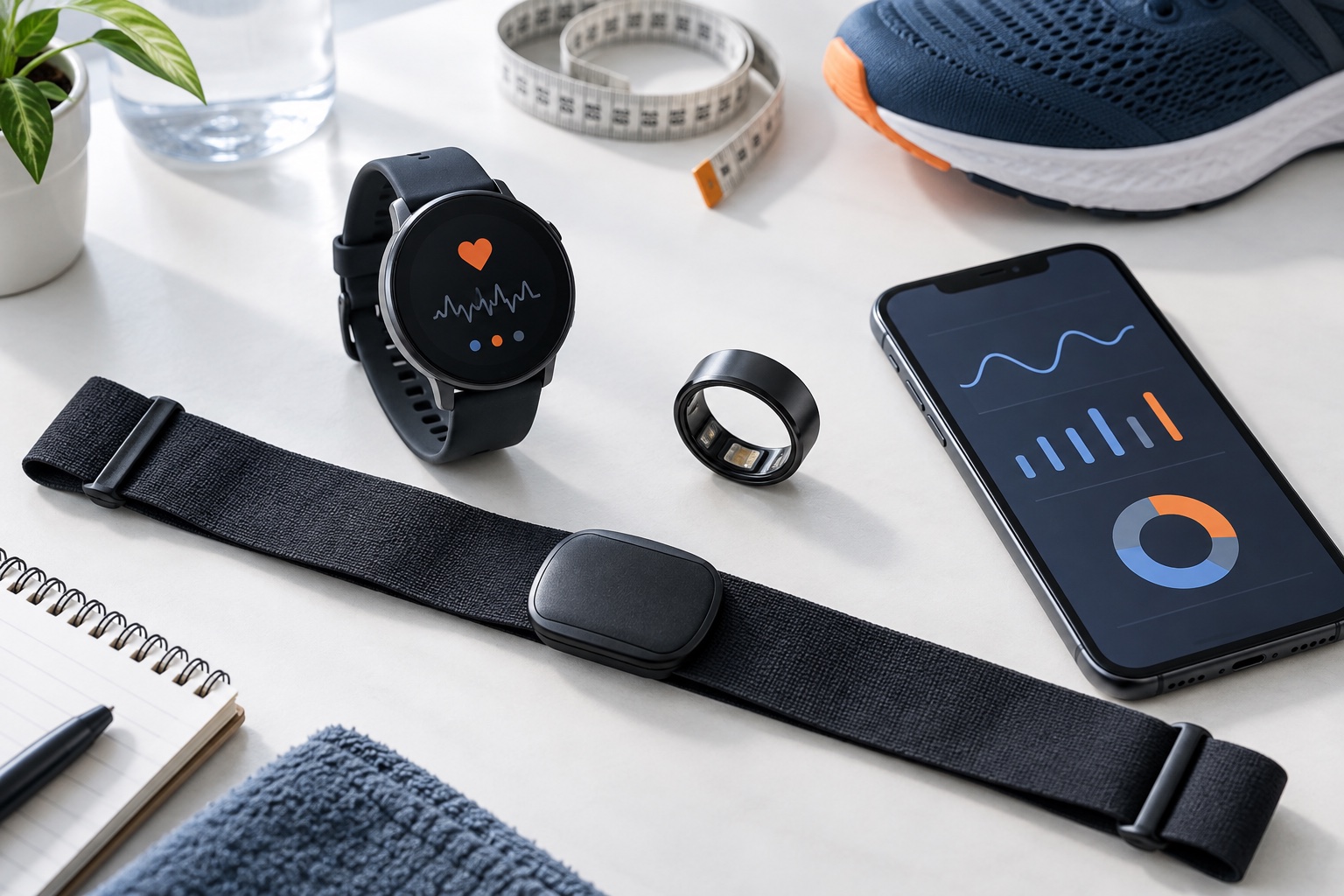
| Metric | Best practical choice | How to interpret it |
|---|---|---|
| Resting and steady-state heart rate | A well-fitted, independently validated optical wrist tracker | Often useful for trends; verify unusual readings and expect more error with motion or poor contact |
| Intervals and resistance-training heart rate | ECG chest strap paired to your watch or phone | Electrical sensing usually follows rapid changes better than wrist optical sensing |
| Steps | A wrist or hip tracker validated at your walking speed | Useful as a consistent activity target; slow gait, pushing a cart, and arm motion can change counts |
| Outdoor distance and pace | A current GNSS sports watch tested on your route type | Open sky is easier than tall buildings, tree cover, tunnels, and tight switchbacks |
| Sleep duration and schedule | Comfortable device you can wear consistently, checked against a sleep diary | Useful for broad patterns; not equivalent to polysomnography |
| Sleep stages | No consumer wearable is a universal laboratory replacement | Treat stage minutes as an algorithmic estimate, not a diagnosis |
| Energy expenditure or calories | No consumer tracker is reliably precise enough for exact food compensation | Use the same device for long-term trend context, not exact calories earned |
| SpO2 | A cleared fingertip pulse oximeter for a measurement that affects health decisions | Watch readings can show trends but may contain important outliers, especially at low saturation |
| HRV and recovery scores | One device, same time and conditions, compared with your own baseline | Do not compare proprietary scores across brands as if they use the same formula |
Heart Rate: Strong at Steady Effort, Weaker During Rapid Change
Modern wrist trackers use photoplethysmography: light detects changes in blood volume under the skin. Reviews generally find better agreement at rest and during steady aerobic work than during intervals, resistance training, arm-heavy exercise, or abrupt intensity changes. Motion, a loose band, cold skin, tattoos, hair, and individual skin-device interaction can degrade the signal.
The Apple Watch has one of the larger published validation bodies among consumer watches, but that does not make every model, sport, or wearer equally accurate. A living systematic review found strong heart-rate performance in many conditions while still reporting variation by activity and study. If heart rate controls training zones or interval timing, use an ECG chest strap and treat the watch as the display.
Steps and GPS: Test the Activities You Actually Do
Step-count accuracy can change with walking speed and arm behavior. A wrist device may miss steps when you push a stroller or cart and may add non-step hand movements. That does not make the daily target useless—consistency can still support behavior—but two brands should not be expected to report identical totals.
GNSS distance depends on the receiver, antenna, satellite systems, sampling and smoothing algorithms, and the environment. Open straight routes are easier than Manhattan streets, tunnels, dense tree cover, and repeated tight turns. An eight-watch validation study found that route conditions and device choices affected distance recordings, which is why a universal GPS winner from one loop is weak evidence. A dedicated GPS accuracy guide is more useful than folding distance into an overall wearable score.
Sleep: Use Patterns, Not Stage-by-Stage Certainty
Consumer wearables infer sleep from motion, heart rate, and related signals; they do not measure the same full set of brain, eye, muscle, breathing, and cardiac signals as laboratory polysomnography. A 2025 meta-analysis of 24 studies and 798 participants found significant differences between wrist-worn consumer devices and polysomnography for total sleep time, sleep efficiency, sleep latency, and wake after sleep onset.
A wearable can still help reveal a late bedtime, inconsistent schedule, or broad change in sleep duration. Review weekly patterns alongside a simple sleep diary. Do not change medication or self-diagnose a sleep disorder from stage percentages, breathing alerts, or a single low score.
Calories and SpO2 Need the Most Caution
Energy expenditure
Calories combine sensor readings with proprietary models based on body data and assumed activity costs. Systematic reviews repeatedly find larger and less consistent error for energy expenditure than for heart rate or steps. Even the 2026 Apple Watch living review reported mean absolute percentage errors of 20% or more in at least one condition in every study that calculated that statistic. Do not eat back an exact calorie number or set a deficit from the watch alone.
Blood oxygen
Reflectance oxygen sensing at the wrist is technically harder than a transmissive fingertip reading. A systematic review of Apple Watch Series 6 studies found no strong systematic bias against medical-grade oximeters, but it also reported limits of agreement of roughly ±2.7 to ±5.9 percentage points and individual outliers up to 15 points. Treat smartwatch SpO2 as a wellness trend unless the exact device and feature have the required regulatory status for your intended use.
Run a Seven-Day Accuracy Audit at Home
- Keep placement constant. Wear the device on the same wrist and position each day.
- Count 500–1,000 steps manually twice. Test once at normal outdoor speed and once during a slow indoor task. Record the percentage difference.
- Repeat one known route. Use the same start point and wait for a full satellite lock. Compare consistency across three sessions rather than trusting one perfect run.
- Compare workout heart rate. If it matters, pair a compatible chest strap and compare steady effort plus several controlled intensity changes.
- Keep a sleep diary. Note lights-out, estimated sleep onset, known awakenings, and final wake time before viewing the app.
- Ignore home calorie ‘validation.’ A treadmill display or another watch is not a metabolic reference, so agreement between them does not establish accuracy.
- Document anomalies. Note loose fit, cold weather, tattoos under the sensor, pushing a cart, strength exercises, and signal dropouts.
Return or change the device if it fails on the metric you bought it for—not because two proprietary readiness scores disagree.
A Better Buying Checklist
- Search for independent validation of the exact model or generation, not only the brand.
- Check whether the study included your activity, pace, age group, and relevant health characteristics.
- Prefer comparisons against ECG, indirect calorimetry, polysomnography, manual counts, or a surveyed distance—not another consumer wearable.
- Look for limits of agreement and individual error, not only a high correlation.
- Confirm battery life supports the measurement you care about, especially overnight use and long GPS sessions.
- Choose comfort and consistent wear over extra scores you will not act on.
Rings can be comfortable for sleep and passive trends, while watches provide screens and workout controls. Keep the metric-first standard when comparing products.
Sources and Manufacturer Guidance
Requirements can vary by product, model, and situation. These primary sources informed this guide; official instructions for your exact product and current authoritative guidance take priority.
- Living Umbrella Review: Consumer Wearable Accuracy Across Metrics
- Consumer Smartwatch Validity, Limitations, and Real-World Applications
- Living Systematic Review: Apple Watch Measurement Accuracy
- Systematic Review: Wrist-Wearable Activity-Tracker Accuracy
- Meta-Analysis: Consumer Wrist Sleep Trackers vs. Polysomnography
- Systematic Review: Apple Watch Oxygen Saturation Accuracy
- Validation Study: Distance Accuracy in Eight Sport Watches
Frequently Asked Questions
-
Several current watches can track steady-state heart rate well when fitted correctly, and Apple Watch models have a substantial validation literature. For rapid intervals, resistance training, or heart-rate-guided sessions, an ECG chest strap is generally the more defensible choice.
-
No consumer tracker is consistently precise enough to treat the calorie estimate as an exact amount of food earned. Use the same device for trend context and base nutrition decisions on longer-term body-weight, performance, and intake data.
-
Many are useful for normal walking trends, but error changes with speed, arm movement, placement, and activity. Test your device against a manual count during both normal walking and a slow real-life task.
-
A consumer sleep score or oxygen trend is not a diagnosis. Some specific features may have regulatory clearance for defined notifications, but suspected sleep apnea requires assessment using appropriate clinical methods.
-
They may use different sensors, sampling rates, placement, signal filtering, and proprietary algorithms. Compare each one with an appropriate reference and with itself over time rather than expecting brands to produce identical numbers.