Home Gym Electrical Requirements: Plan from the Equipment Nameplate
There is no single home-gym circuit requirement. Start with the nameplate and installation manual for every powered machine, then have a qualified electrician compare those requirements with the branch circuit, receptacle, grounding, GFCI/AFCI protection, room conditions, and locally adopted code.
Some residential cardio machines use an ordinary grounded 120-volt receptacle; some treadmills require a dedicated 15- or 20-amp circuit; commercial equipment may specify 20 amps or 230 volts. Never choose a circuit from the motor's advertised horsepower or a competitor's manual.
Build an Electrical Equipment Schedule
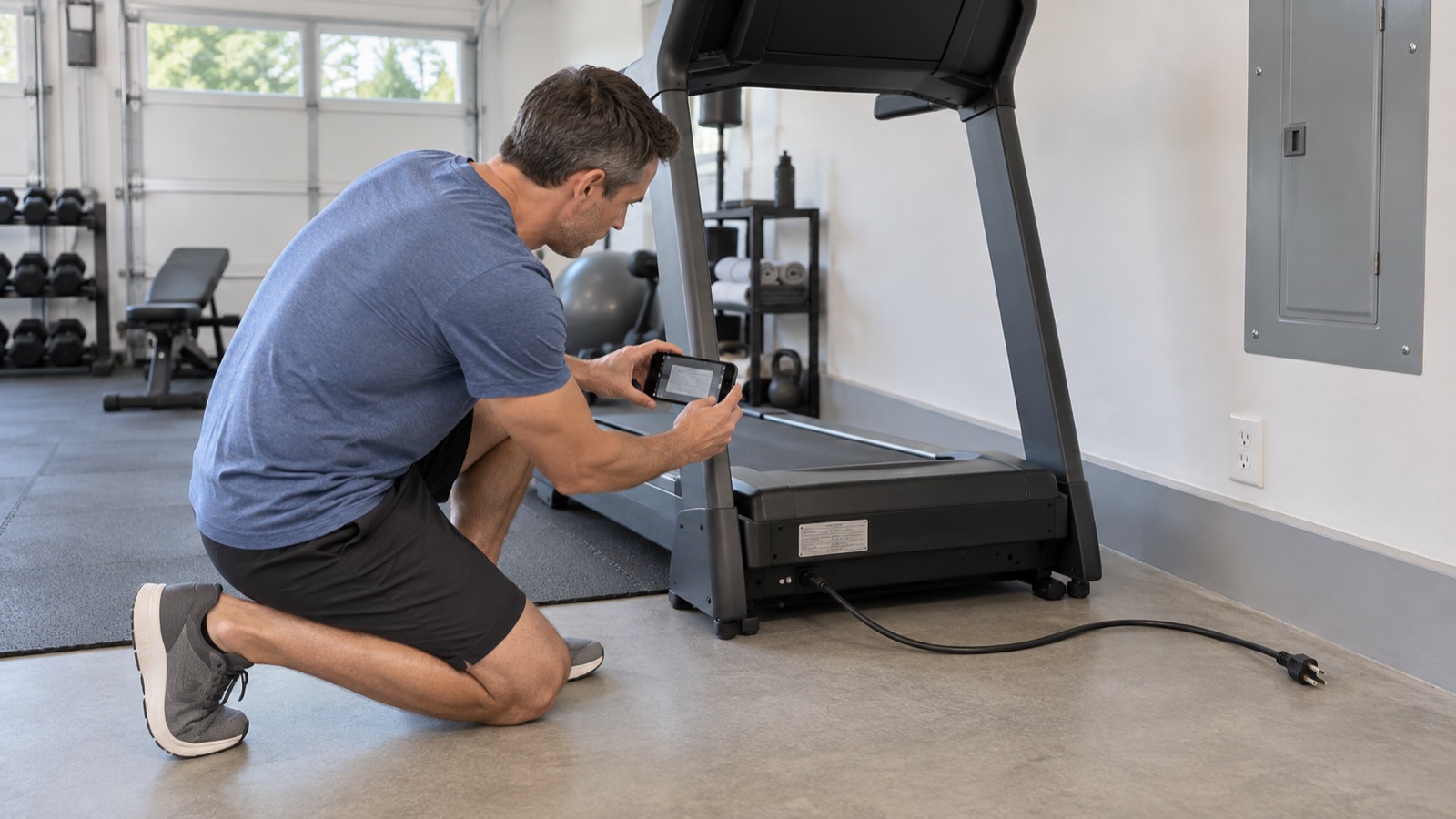
Collect this information before buying equipment or asking for an electrical quote. Photograph each rating plate and save the current manual.
| Equipment | Record from nameplate/manual | Room question |
|---|---|---|
| Treadmill or incline trainer | Voltage, frequency, rated current, plug type, dedicated-circuit language, grounding and surge instructions | Can the cord reach a compliant wall receptacle without crossing a path? |
| Exercise bike, rower, or elliptical | Whether it is self-powered, adapter input/output, battery type, charger listing | Will sweat or cleaning liquid reach the connection? |
| Cable machine or smart strength system | Supply voltage, current or watts, network and standby requirements | Does the moving arm or weight stack contact the cord? |
| TV, fan, speaker, or computer | Rated watts or current and power-supply requirements | Will it share a circuit with a high-demand motor? |
| Heater, dehumidifier, refrigerator, or freezer | Separate appliance requirements and simultaneous load | Is this really part of the gym circuit plan? |
| Future equipment | Largest likely requirement, not a guess based on outlet appearance | Should conduit, panel capacity, or an additional circuit be planned now? |
Read the Nameplate and Manual Together
- Find the complete model and serial label, usually near the power inlet, base frame, or rear cover.
- Record voltage, hertz, amps or watts, phase where listed, and the plug configuration.
- Open the exact model's installation section—not a family brochure or a retailer summary.
- Look for the words dedicated circuit, grounded outlet, do not use an extension cord, surge protection, and any GFCI/AFCI compatibility note.
- Give the electrician the documents and the final equipment layout.
For example, Life Fitness lists a dedicated 120-volt, 20-amp circuit for its commercial Integrity treadmill, while its residential guidance identifies different circuit allowances for consumer equipment. These are manufacturer-specific examples, not rules for every treadmill.
A Circuit Plan Has More Than an Amp Number
A licensed electrician should verify the breaker, wire, receptacle configuration and condition, equipment grounding path, panel capacity, voltage at the location, applicable protection, and every load served by the circuit. An outlet that looks like a 20-amp receptacle does not prove the entire branch circuit is suitable.
| Question | Why it matters | Do not assume |
|---|---|---|
| Is the circuit dedicated? | Another outlet or appliance may share the same breaker even if it is in a different room | A nearby unused receptacle is dedicated |
| Is the receptacle grounded and correctly wired? | Three slots alone do not verify a sound grounding path | A plug-in adapter fixes ungrounded wiring |
| Is GFCI protection required? | Garages and locations exposed to moisture commonly have specific protection requirements | A machine's nuisance-tripping complaint permits bypassing required protection |
| Is AFCI protection required? | Requirements depend on room classification, adopted code edition, and local amendments | Every jurisdiction has adopted the same NEC edition |
| What else runs simultaneously? | Motors, heaters, dehumidifiers, and other appliances can overlap | Equipment nameplate values can simply be added without code analysis |
| Can the cord reach directly? | Extensions and power strips may be prohibited and create heat or trip hazards | A heavy-looking cord is automatically acceptable |
Route Power Without Creating a Second Hazard
- Plug major fitness equipment directly into the specified wall receptacle unless its manual expressly permits another arrangement.
- Do not run cords beneath rubber flooring, across lifting zones, through doorways, under machine feet, or where benches and plates can crush them.
- Keep connections away from sweat, cleaning liquid, floor drains, and water intrusion.
- Leave the plug or equipment disconnect accessible as the manual requires.
- Do not coil excess high-load cord tightly or cover a power supply where heat cannot escape.
- Use only the specified replacement adapter or power cord; connector fit alone does not establish electrical compatibility.
CPSC warns that extension cords can be overloaded and damaged. ESFI describes them as temporary solutions and advises plugging large appliances directly into wall receptacles.
Stop Using the Equipment for These Warning Signs
- A plug, receptacle, cord, adapter, or breaker feels unusually warm.
- The outlet is loose, discolored, cracked, buzzing, sparking, or smells burned.
- Lights dim, breakers trip, or GFCI/AFCI protection trips repeatedly when the machine starts.
- The power cord is pinched, frayed, melted, or missing its grounding pin.
- You feel a tingle or shock from the frame.
- Water has reached the machine, outlet, floor connection, or panel.
Switch off and unplug only if it is safe to approach. Do not repeatedly reset protection or defeat a safety device. Contact the equipment manufacturer and a qualified electrician; use emergency services for smoke, fire, or active electrical danger.
What to Give the Electrician
- A floor plan showing each machine and intended receptacle.
- Nameplate photos and exact installation manuals.
- A list of all equipment that can operate at the same time.
- The room type—garage, basement, bedroom, outdoor structure—and any dampness or water exposure.
- Known panel, breaker, outlet, or wiring history, including previous trips or repairs.
- Future equipment and whether the home will need permits or inspection.
The electrician can then apply the locally adopted code and manufacturer instructions to the actual home. This article is a planning worksheet, not a wiring design.
Sources and Manufacturer Guidance
Requirements can vary by product, model, and situation. These primary sources informed this guide; official instructions for your exact product and current authoritative guidance take priority.
- Life Fitness Aspire Treadmill: dedicated circuit and power specifications
- Life Fitness Integrity Treadmill: 120-volt, 20-amp example
- Life Fitness: residential cardio equipment electrical guidance
- CPSC: Safety at Home—Extension Cords
- ESFI: Home Electrical Safety and warning signs
- ESFI: Ground-Fault Circuit Interrupters
Frequently Asked Questions
-
Many do, but the required voltage and amperage vary by model. Follow the exact treadmill manual and have the existing circuit verified rather than assuming.
-
Only if the manufacturer instructions, circuit design, other loads, and locally adopted code allow it. Some manufacturers require one dedicated breaker per treadmill.
-
Many powered machines prohibit them. Plug directly into the specified receptacle unless the exact manual permits otherwise; do not improvise based on cord gauge alone.
-
The cause can involve the machine, leakage or arcing detection, circuit conditions, or compatibility specified by the manufacturer. Do not bypass required protection—have the equipment maker and a qualified electrician diagnose it.
-
No. Concealed cords can be crushed, overheated, damaged by equipment, or exposed to trapped moisture. Plan receptacles so cords remain protected, visible, and out of travel paths.