Strength & Weights

Best Weight Benches of 2026

A weight bench has one job: stay planted while you move heavy things. But anyone who has owned a wobbly one knows the fear of a bench that shifts mid-press or a back pad that sags under load. The right bench fixes that — it gives you a stable platform for flat, incline, and decline work, adjusts without pinching fingers, and fits your space and your body. A weight rating means nothing if the frame walks across the floor when you rack the bar.

Over the past six months, my team and I assembled, adjusted, and loaded 10 different benches in a garage gym. The pattern is clear: sturdiness and adjustability matter more than extra attachments, and a bench that takes 45 minutes to assemble is one you'll resent. Pay attention to seat height and pad width, too — small differences decide whether your feet plant firmly. The picks below are the ones that held up, earned their price through welds and padding rather than gimmicks, and still felt solid after months of use.

Best Flat Bench

Our Score 9.4/10
Finer Form Foldable Flat Bench

Finer

Finer Form Foldable Flat Bench

  • Dimensions 45 x 12 x 18 inches
  • Item Weight 27.7 lb
  • Weight Capacity 1,000 pounds
Check Price on Amazon

A 1,000-pound flat platform with a thick pad that still folds for storage.

If your training is flat barbell pressing, this is the bench we take ahead of our top pick. The four-way steel frame is rated to 1,000 pounds, the highest capacity here alongside the Finer Form FID, and at 27.7 pounds there is enough bench under you that setting your feet does not push it across the floor.

The fold is the part that sells it. A flat bench with a 1,000-pound frame that still folds away is unusual, and it means the thing lives under a bed in a one-bedroom instead of becoming permanent furniture. Assembly is a handful of bolts, and the extra-thick pad has enough give that hip thrusts and dumbbell rows do not put you on the steel.

Flat is both the point and the limit, and the 12-inch width matters too. Without an incline you lose upper-chest pressing and upright shoulder work, so as an only bench the YOLEO covers more ground. And 12 inches across is narrow for step-ups and split squats, where a wider platform keeps your foot off the edge. In a garage with a rack and a bar, though, this is the bench that gets used every session.

Bottom Line

Our pick for a pure pressing setup: 1,000 pounds of frame, a thick pad, and a fold that gets it under a bed.

Check Latest Price

Best Simple Flat Bench

Our Score 9.4/10
Marcy Flat Utility Bench

Marcy

Marcy Flat Utility Bench

  • Dimensions 41 x 14 x 16.5 inches
  • Item Weight 18 lb
  • Weight Capacity 600 lb
Check Price on Amazon

An 18-pound flat bench you can carry one-handed and leave out.

Eighteen pounds and 41 inches long, this is the bench you carry into whichever room you are training in and put back afterwards. Nothing folds and nothing pins, so it is ready the moment you set it down.

The frame is rated to 600 pounds, the pad has more give than the price suggests, and assembly is a few bolts with the tools in the box. It is also the least expensive flat bench here, which makes it the low-risk way to find out whether the home gym habit is going to stick.

Adjustment is what you give up. No incline, no decline, no leg attachment, so it cannot stand in for an FID when you want steep dumbbell pressing or decline sit-ups. With dumbbells and a floor, it covers presses, rows, hip thrusts and core work, which is most of what a home gym actually gets used for.

The detail that keeps it out of the closet is how little it looks like gym equipment. Matte black, a plain padded top, no branding down the frame: it sits against a living-room wall without announcing itself, and it is the only bench here we leave out when the room has to be a room again.

Bottom Line

A flat bench you can carry one-handed and leave in the living room, with 600 pounds of capacity and nothing to adjust.

Check Latest Price

Best Overall

Our Score 9.2/10
YOLEO Adjustable Bench

YOLEO

YOLEO Adjustable Bench

  • Folded Size 31.5 x 12.6 x 13 inches
  • Item Weight 23.2 lb
  • Weight Capacity 827 lb
  • Backrest Positions 7 back, 4 seat, 3 leg
Check Price on Amazon

Flat, incline and decline, tool-free setup, and a fold that fits a closet.

Two pins and a folded frame — that is the entire setup. The bench arrives almost fully assembled, so there is no bag of bolts to sort through before your first session, and it breaks down just as quickly into a package about 31.5 inches long. Built-in wheels mean you roll it to the closet instead of carrying it.

The numbers are strong for the money. The dual-triangle steel frame is rated to 827 pounds, the bench weighs 23.2 pounds, and the seven backrest, four seat and three leg positions cover flat pressing, incline work and a shallow decline. We like that the seat tilts with the backrest: on a bench where the seat stays flat, an incline leaves a gap under your hips that you feel on every rep.

Size is the compromise. The seat pad is 13 inches wide and the backrest 28 inches, both slightly smaller than the FLYBIRD's and the NICEPEOPLE's here. Lifters much over six feet notice where the pad ends behind their head, and broad shoulders hang over the edges. Under six feet, neither is a problem.

The leg attachment at the front is the detail we did not expect to value. Three positions give you somewhere to hook your knees for decline sit-ups, which is the piece of full-body training most flat benches leave you to improvise with a dumbbell balanced on your chest.

Bottom Line

This is the bench we recommend first: flat, incline and decline, tool-free setup, and a fold that fits a closet, for less than most adjustable benches here.

Check Latest Price

Best for Barbell Training

Our Score 9.2/10
YOLEO Olympic Bench Set

YOLEO

YOLEO Olympic Bench Set

  • Dimensions 93.7 x 47.44 x 61.54 inches
  • Rack Width 47.44 inches
  • Item Weight 81.6 lb
  • Total Capacity 1,980 pounds total: 880 bench, 660 rack, 440 leg frame
Check Price on Amazon

Safety catches, a wide rack, and curl and leg attachments in one station.

At 93.7 inches long and 47.44 inches wide, this is a bench press station rather than a bench, and it wants a wall of its own. What that footprint buys is the thing no other pick here offers: four protective catches and a safety pin, so a failed rep lands on steel instead of on you.

The rack is 47.44 inches between the uprights, wide enough that broad shoulders are not pinched at setup. The bench adjusts through eight backrest positions from a 30-degree decline to upright, and the package adds a preacher curl pad plus a leg extension and curl attachment, so the station covers more than pressing.

Capacity is quoted as 1,980 pounds total, and the breakdown matters more than the headline: 880 for the bench, 660 for the rack, 440 for the leg frame. Reading each part at its own number is what makes the station sensible as a home gym in one purchase rather than a bench with extras bolted on.

Two things to check before you order. The bench pad is thinner than the standalone benches here, with a wider gap between seat and backrest, so buy it for barbell work rather than for the pad. And a 6-foot bench bar can be tight across the 47-inch rack, so measure your bar collar to collar first.

Bottom Line

Buy this one when you want to press a barbell alone: safety catches, a wide rack and curl and leg attachments in a single station.

Check Latest Price

Best for Small Spaces

Our Score 9.2/10
NICEPEOPLE Adjustable Bench

NICEPEOPLE

NICEPEOPLE Adjustable Bench

  • Backrest 29.3 inches, 8 angles
  • Dimensions 46 x 16.7 x 17.2 inches
  • Item Weight 17 lb
  • Weight Capacity 660 lb
Check Price on Amazon

17 pounds, folds flat, and tucks along a bedroom wall.

For a bedroom, a studio or the corner of a shared living room, this is the bench that hides best. At 17 pounds it is the lightest here, it folds down flat, and 46 inches of overall length tucks along a wall once the session is over.

The backrest is 29.3 inches, slightly longer than our top pick's 28, and eight angles cover flat through upright. What impressed us is how much support NICEPEOPLE fits into 17 pounds: the pad is dense, the frame is braced in a triangle at the base, and it sits under you like a heavier bench.

The trade is stability. A 17-pound folding frame has less mass to hold it still, and on a hard floor this one shifts when you are not square over it. A rubber mat under the feet and a re-tighten of the bolts after assembly settle it considerably, which is the first thing we do with any light folding bench.

Where it earns its place is the end of the session. The fold is quick, the footprint disappears, and the bench does not dominate the room it lives in, which for an apartment lifter is often the difference between training regularly and not training at all.

Bottom Line

For a bedroom or studio gym, nothing here stows as easily: 17 pounds, a flat fold and a backrest that suits most frames.

Check Latest Price

Best For Budget adjustable start

Our Score 9.2/10
Teclor Adjustable Bench

Teclor

Teclor Adjustable Bench

  • Dimensions 51.2 x 18.5 x 18.1 inches
  • Item Weight 21 lb
  • Weight Capacity 770 lb
  • Backrest Positions 10
Check Price on Amazon

Ten backrest positions is the most here short of the FLYBIRD's 144, and the lock is a serrated channel rather than a pin through holes: set the angle, let it drop into the teeth, and it holds. We found that faster to change mid-session than pulling a pin and hunting for the next hole.

Both pads are 2.4 inches thick, seat and backrest, which is more cushion than most benches at this end of the range, and the backrest runs 30 inches. It is rated to 770 pounds, weighs 21 pounds, and folds into a package you can stand against a wall.

The hardware is where the budget shows. A folding frame works its pins and bolts harder than a welded one does, and this bench has more of them, so check them after the first few sessions and again every month or so. That is the upkeep a folding bench asks for and a welded flat bench almost never does.

Bottom Line

Ten angles and a thick pad for the least money here, worth it if you keep an eye on the folding hardware.

Check Latest Price

Best Premium Adjustable

Our Score 9.0/10
Finer Form FID Bench

Finer

Finer Form FID Bench

  • Positions 8 backrest, 3 seat, 8 support pad, 4 calf
  • Dimensions 62 x 20 x 30.25 inches
  • Item Weight 46.3 lb
  • Weight Capacity 1,000 pounds
Check Price on Amazon

Adds decline pressing and back extensions to a 1,000-pound frame with 23 settings.

The front end separates this from every other adjustable bench here. Calf rollers and a support pad turn it into a back-extension and sit-up station, and the decline goes far enough down to make decline pressing and ab work worth programming rather than a novelty setting you try once.

Everything behind that end is heavy-duty. The frame is rated to 1,000 pounds, the bench is 20 inches wide, and there are 23 settings across backrest, seat, support pad and calf rollers, with transport wheels at the back. At 21 kg it is not a bench you reposition every session; the wheels make it one you can move at all.

We came away thinking of it as a small gym rather than a bench, and that is the fair way to judge the price: it stands in for a sit-up bench and a back-extension station too. The cost is floor space. Sixty-two inches long and 20 inches wide, it claims a corner and keeps it, where the YOLEO and the NICEPEOPLE fold into a closet.

One habit worth forming: check that the backrest pin is seated before a heavy set. With this many locking points, the flat position has to line up squarely, and a notch off leaves you pressing on a slope your shoulders notice before your chest does.

Bottom Line

If you want decline work and back extensions from one bench, this is the most complete adjustable here, provided it can live in place.

Check Latest Price

Most Adjustable

Our Score 9.0/10
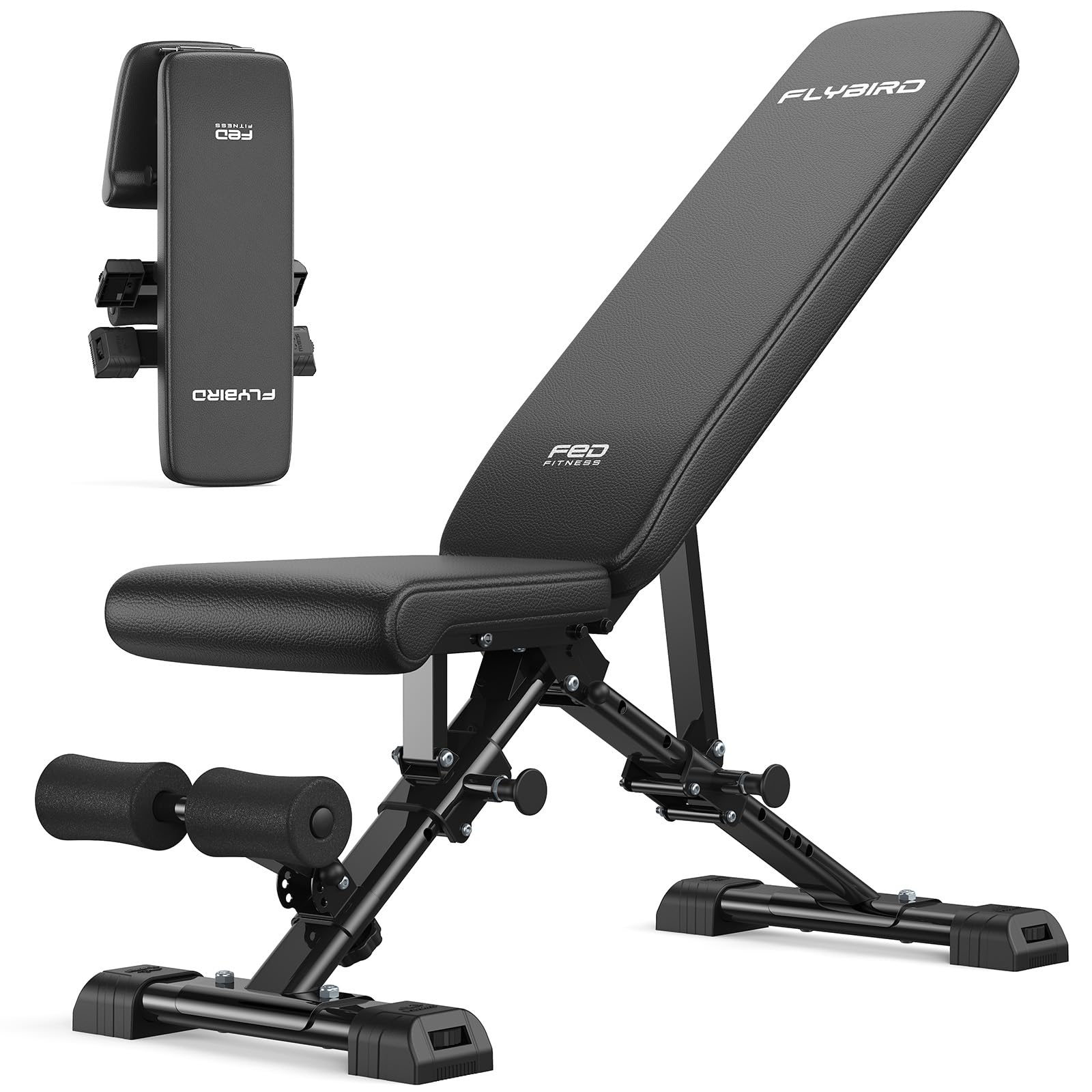
FLYBIRD WB5 Bench

FLYBIRD

FLYBIRD WB5 Bench

  • Positions 144, from -30° to 90°
  • Dimensions 46 x 13 x 48.5 inches
  • Item Weight 28.5 lb
  • Weight Capacity 800 lb
Check Price on Amazon

144 positions and a 30-inch backrest for lifters who want every angle.

The first thing to know is that this bench sits higher off the floor than the others here, and that changes your setup for a heavy press. Planting your feet and setting your arch takes more work when the pad is up, and the taller stance is the reason we do not hand this to someone whose program is built around a big flat bench.

What the height buys is length and range. The backrest runs 30 inches, two inches longer than our top pick's, so a taller lifter's head stays on the pad at incline. The 144 positions run from a 30-degree decline to a 90-degree upright, the widest range in this group, which is why it handles steep incline dumbbell work and upright shoulder pressing that shorter backrests cannot support.

Capacity is 800 pounds, the bench weighs 28.5 pounds, and it folds down to slide under a bed. For an apartment where the bench goes away after every session, that combination is the whole argument.

Buy it for the angles and the backrest length, not for maximal loads. A garage lifter chasing a heavy flat press belongs on the Finer Form's 1,000-pound platform; the FLYBIRD's value is that you can press at almost any angle and still put the bench away.

Bottom Line

The angle range earns it a place: 144 positions and a 30-inch backrest in a bench that folds away, as long as its taller stance suits your press.

Check Latest Price

How We Tested 10 Weight Benches Over Six Months

We started with a long list of more than 30 benches, then filtered by price, footprint, and stated weight capacity to land on 10 models — flat, adjustable, and foldable styles included. Each one went into a garage gym or basement corner, where testers from 5'4" to 6'3" used it for presses, rows, and step-ups three or four times a week for six months. We assembled every bench solo with the included tools and noted whether the instructions matched the hardware.

Once built, we measured seat height and pad width, then checked whether our feet stayed flat during flat presses and whether the pad edge dug into our backs on incline. To judge stability and weight capacity, we loaded each bench to its stated limit with plates and sandbags, rocked side to side, and racked a loaded bar. We switched between flat, incline, and decline mid-workout with sweaty hands to see if pins stuck, pads shifted, or the bench walked across the floor.

Over the six months, we watched for pad compression, weld cracks, rust, and wobble, and we folded or moved each bench to judge its footprint. We compared what you actually get for the price — frame steel, pad thickness, attachment quality — and whether the bench fit each tester's leg length and pressing style. The benches that held up are the ones that stayed solid, adjusted smoothly, and never made us think about them mid-set.

How to Choose

Flat or Adjustable: Start With Your Program

An adjustable bench adds incline and decline to a flat press, and it is the more versatile purchase if the bench will be the only one you own. Incline pressing, upright shoulder work and decline ab work all live in the backrest, and a fixed seat turns an incline into a gap under your hips. If you already have a rack and a bar, a flat bench is the better platform: more capacity, less hardware, nothing to seat before a heavy set. Our Finer Form flat pick is the strongest flat option here, and the YOLEO adjustable covers the widest ground for the least money.

Decide which of those two gyms you are building before you compare anything else. Buying an FID for a garage that already has a rack means paying for angles you will not use, and buying flat when you want incline means buying twice.

Match the Pad to Your Own Frame

Capacity gets the headlines; length and width decide whether you can actually use the bench. Backrests here run from 28 to 30 inches, and if you are around six feet or taller, the long end matters: a short backrest leaves your head with nothing under it at incline. Pads run roughly 12 to 13 inches wide, so a broad pair of shoulders will hang over the narrow ones. Teclor and FLYBIRD both give you 30 inches of backrest; the YOLEO gives 28.

Seat height is the other measurement nobody lists clearly. A taller bench makes it harder to plant both feet and set an arch for a heavy flat press, which is the trade with the FLYBIRD's otherwise excellent range. Before you buy, sit on a dining chair with your feet flat and ask whether you want the bench higher or lower than that.

Read the Capacity Number Carefully

A 600-pound rating is the total the frame is rated to hold, not the size of the person who can use it. Most benches here carry more capacity than a home lifter will ever load, so the design behind the number matters more than the number: a four-way or dual-triangle frame spreads load better than a single tube, and a wider base resists the sideways push that makes a bench feel nervous under a heavy set.

On combination stations the headline is a sum. The YOLEO set's 1,980 pounds is 880 for the bench, 660 for the rack and 440 for the leg frame, and each part should be read at its own figure. A bench rated to 660 pounds is fine for dumbbells and bodyweight work; it is not the bench to load a barbell on.

Why Light Benches Rock, and What to Do About It

Stability is the issue that follows folding benches around, and the mechanism is simple: a bench of 17 to 28 pounds has little mass to resist a sideways push, and folding hardware adds play a welded frame does not have. Nearly every bench here moves a little. Put a rubber mat under the feet, check that the floor is level, re-tighten the bolts after the first session, and keep maximal pressing for a heavier or fixed bench.

If you press heavy and never need to fold the bench, buy the heaviest bench you can store. If it has to disappear after every session, accept a little movement and choose a bench with a wide, braced base.

Measure Storage Space and Floor Space Separately

Compact in a listing usually describes the folded package, not the bench in use. A bench that folds to 31.5 inches still needs 41 inches of floor and room to walk around it, while the YOLEO Olympic station claims 93.7 inches by 47.44. Check both numbers against the room you have.

The folded size decides whether it lives in a closet; the open size decides whether you can set up a bar without hitting a wall. Write both down before you order, because the second one is the number that gets forgotten.

Frequently Asked Questions

Final Verdict

Start with the YOLEO adjustable bench. It covers flat, incline and decline, sets up without tools, folds to the size of a suitcase, and sits at the bottom of the price range here — the right first bench for a spare room.

If flat barbell pressing is the whole program, the Finer Form flat bench is the stronger platform at 1,000 pounds. If you want a barbell and a way to fail safely, the YOLEO Olympic set is the only pick here that gives you both.