Strength & Weights

Best Olympic Weight Benches We Tested of 2026

A foldable weight bench is a small miracle in a garage gym and a liability under a heavy bar if the hinge isn't right. That trade-off—storage versus stability—is the first thing I check now, because a bench that shifts mid-press is worse than no bench at all. The right Olympic bench gives you a solid place to press, row, and brace, and then gets out of the way when you need the floor back.

We assembled, folded, and loaded nine benches over nine months, and the spread was wider than I expected: some were rock-solid but dominated the room, while others folded flat and felt like a different bench once the bar got heavy. None of them come with a bar or plates, so I weighed the total cost of getting set up, not just the bench itself. A few were flat-only—fine if you never incline press, limiting if you do—and our 5-foot-4 and 6-foot-2 testers preferred different pads and legroom. The picks below are the ones that stayed steady, adjusted cleanly, and didn't make me dread assembly.

Best Overall

Our Score 9.2/10
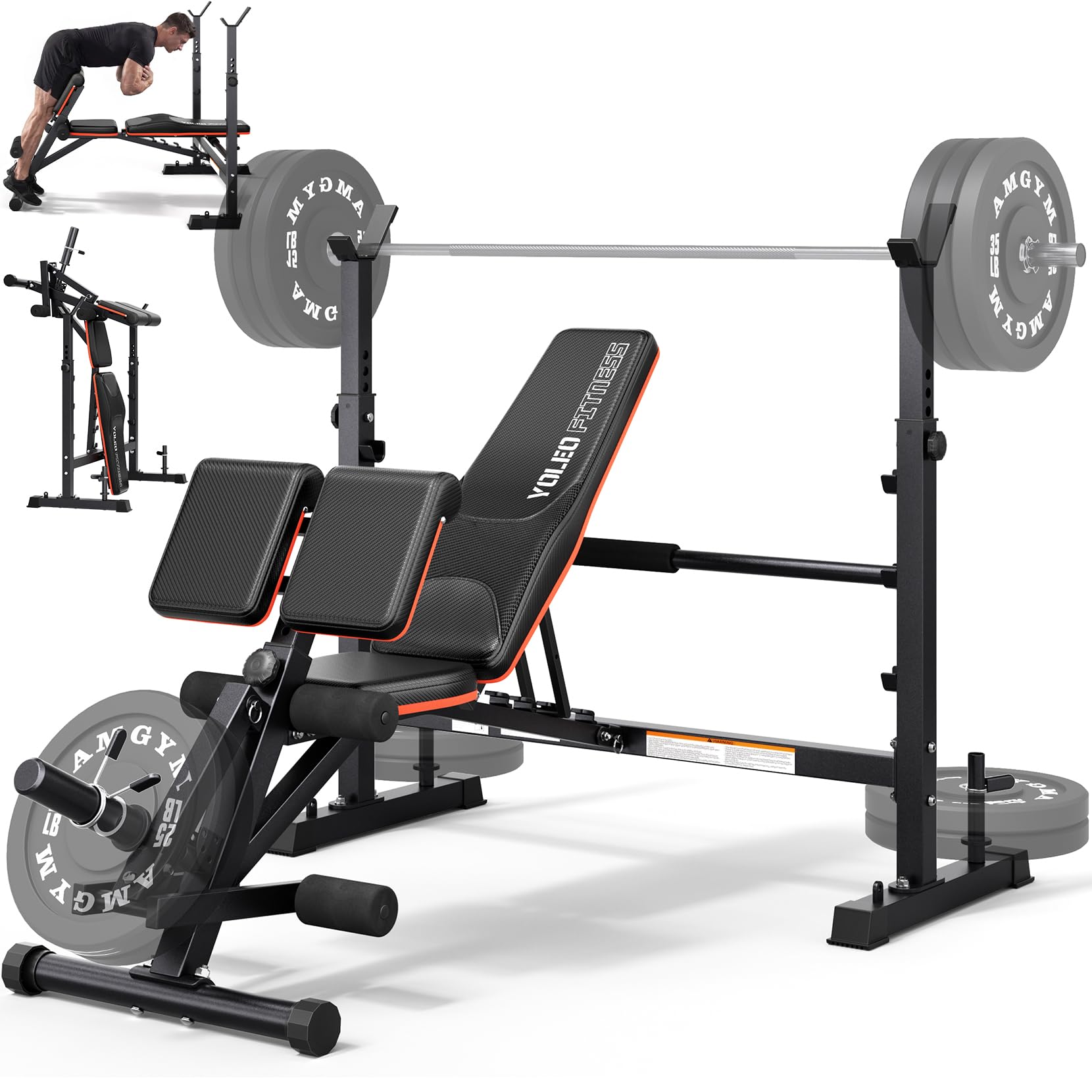
YOLEO FORGE1980 Weight Bench Set

YOLEO

YOLEO FORGE1980 Weight Bench Set

  • Rack Width 47.44 in
  • Max Capacity 1980 lb total
  • Back Pad Range -30° to 90°, 8 positions
  • Safety Catches 4 catches + 1 pin
Check Price on Amazon

Widest rack here, highest rating, and catches that make solo pressing safer.

The measurement that decides this one for us is 47.44 inches across the rack. It's the widest pressing station in this group, and with a 7-foot Olympic bar on the hooks your hands land about where they would on a gym bench instead of being pinched toward the center. For a broad-shouldered or tall lifter, that single figure is the purchase.

The capacity claims are the biggest here too: 1,980 pounds in total, split into 880 for the bench, 660 for the rack and 440 for the leg frame. We read those as three separate limits rather than one promise, and the 660-pound rack figure is the one that governs your press. What reassured us more than the numbers was the steel itself, 81.6 pounds of frame that sat still through a set instead of shifting under the bar.

Four bar catches and a safety pin are what a solo lifter should care about most: set the catches a notch below chest height and a failed rep lands on metal. The back pad runs from a 30-degree decline to a 90-degree upright across eight positions, which covers flat press, incline work and anchored sit-ups on one frame, with the preacher pad and leg extension along for the ride.

The cost is floor space. At 93.7 inches deep and 61.5 inches tall at the uprights it wants a wall and a permanent patch of floor, and nothing about it folds. We'd also...

Bottom Line

Our pick if you press off a full-size Olympic bar: the widest rack here, the highest rating, and catches that make solo lifting a lot less nervy.

Check Latest Price

Best Compact Set

Our Score 9.2/10
OUNUO 6-in-1 Weight Bench Set

OUNUO

OUNUO 6-in-1 Weight Bench Set

  • Folds Yes
  • Back Pad 4 positions
  • Footprint 53"D x 31"W x 50"H
  • Max Capacity 550 lb
Check Price on Amazon

Six stations on a 53-inch footprint that folds and tucks against a wall.

Fifty-three inches deep and 31 wide is what OUNUO has to work with, and it fits a bench, a pair of squat stands, a preacher pad, a leg developer and an ab board into it. Of the compact sets here, this is the one that feels least like a compromise on paper, and it folds and pins down when the session is over.

Assembly is where it quietly wins: the frame goes together with pins and clearly labeled hardware, and the back pad moves between its four angles without a fight. For a first home gym, we think that ease matters as much as the spec sheet, because a bench you dread setting up is a bench you stop using.

The uprights sit close together, which is the compromise the compact shape buys: on a 7-foot bar a wide grip puts your hands outside the posts, so you end up pressing narrower than you'd like. With a 5- or 6-foot bar and a moderate grip it never comes up.

Comfort is better than this category usually manages, with padding thick enough for a full session, and the frame stayed put on a concrete floor. Where it earns its keep is the corner of a shared garage: quick to set up, folded into a strip against the wall, and unremarkable enough that nobody else in the house minds it.

Bottom Line

The best fit for a small home gym: six stations on a footprint you can fold and tuck, as long as your grip stays moderate.

Check Latest Price

Best Folding Bench

Our Score 9.0/10
YOLEO Core 1+X Weight Bench

YOLEO

YOLEO Core 1+X Weight Bench

  • Folds Yes
  • Max Capacity 1870 lb total
  • Fits Bar Length 6 to 7 ft
  • Inner Grip Width 40 in
Check Price on Amazon

40-inch inner grip and a folding frame for garages that double as parking.

A wide rack and a folding frame usually don't come together, which is why this YOLEO kept our attention. The stated inner grip is 40 inches and the rack is rated for 6- to 7-foot Olympic bars, so a proper wide-grip press is on the table, and the frame knocks down for storage when the car needs the garage back.

We rate it as the best compromise here for anyone short on floor space. Capacity is 1,870 pounds across the set, 880 on the bench, 660 on the rack and 330 on the preacher pad, and the frame carries a Roman chair, a preacher pad and a leg extension as well as the press station, so a full session happens without a second machine. At 68 pounds it moves without help.

Folding hardware is where a light frame gives itself away, so seat every pin and snug every bolt before you load it. Rear plate storage is a genuinely useful touch in a small gym, though it means you need clearance behind the bench as well as in front, which is easy to forget when you're arranging a tight room.

What we came back to is how little it asks of the room for what it gives back: a wide-grip press, a leg extension and somewhere to hang plates, all on something that disappears against a wall between sessions.

Bottom Line

Buy this when the bench has to fold away but you still want a genuine wide-grip press off a 6- or 7-foot Olympic bar.

Check Latest Price

Best for Flat Pressing

Our Score 9.0/10
CANPA Olympic Weight Bench

CANPA

CANPA Olympic Weight Bench

  • Folds Yes
  • Footprint 43.3"D x 38.8"W x 46.9"H
  • Max Capacity 500 lb
  • Squat Rack Heights 6 levels
Check Price on Amazon

A flat bench and six-height squat stand that folds into a corner.

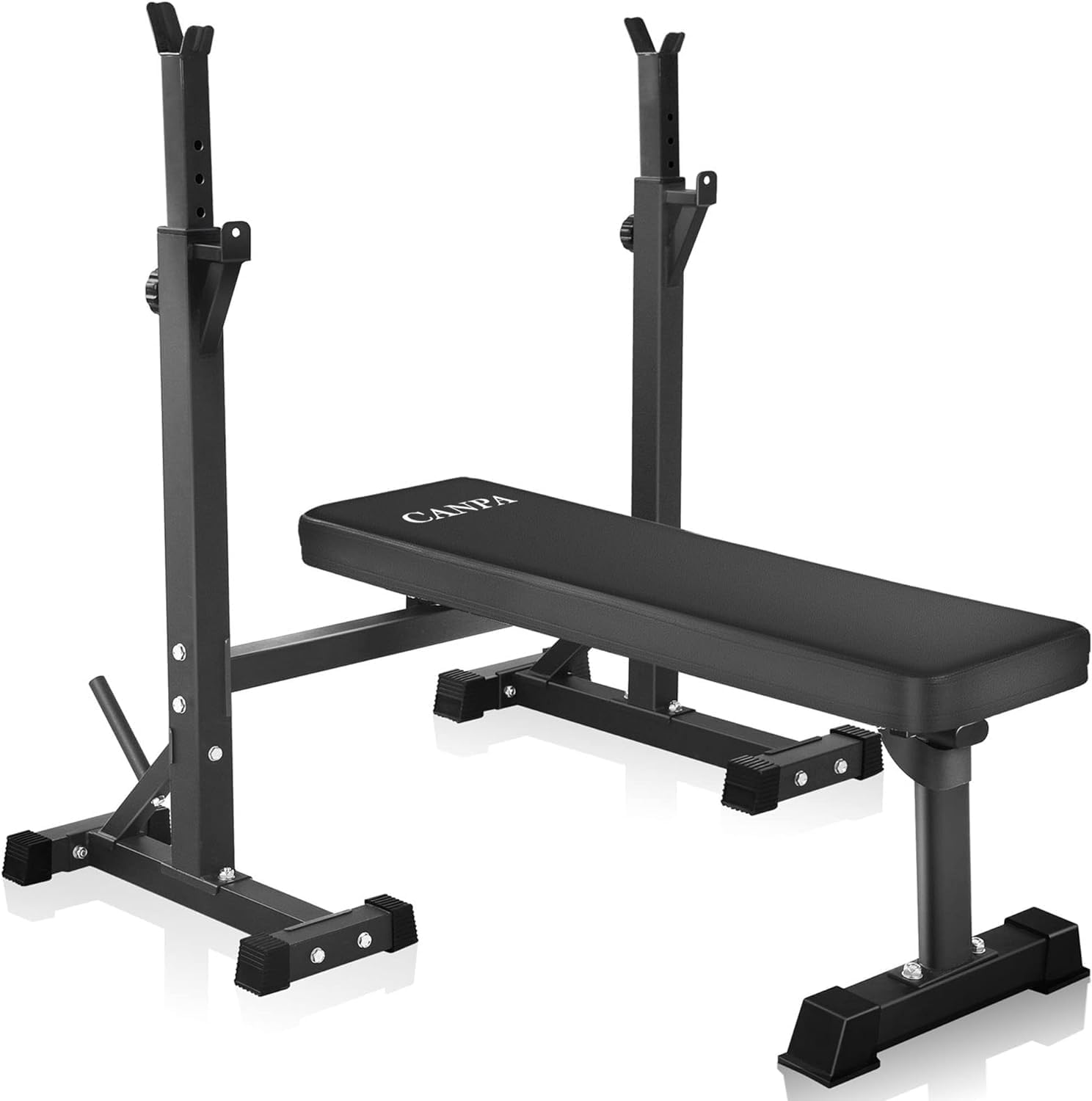
If your week is flat bench and squats, CANPA built the bench you actually need and left the rest off. It's a flat pad between two uprights that adjust through six heights for different arm lengths, on a 2-by-2-inch steel H-base, and the whole thing folds.

The pad doesn't incline or decline, and that's the trade: incline pressing, decline sit-ups and most of the accessory work the other benches here cover are off the menu. What you get in return is a frame of roughly 46 pounds that one person can set up, shift and put away, with no preacher pad or leg developer to bump into on the way past.

We think that's a fair trade for a garage that holds a car at 6 p.m. and a barbell at 7. The uprights do sit close, so a wide grip on a 7-foot bar puts your hands outside the posts, and a moderate grip on a 5- or 6-foot bar suits it better. Set up, it takes about 43 by 39 inches of floor, roughly half the depth our top pick wants.

Bottom Line

For flat bench and squats in a room that has to stay a room, this folding bench-and-stand does the job without extra bulk.

Check Latest Price

Best For First home bench

Our Score 8.6/10
MAIDOMA Foldable Weight Bench Set

MAIDOMA

MAIDOMA Foldable Weight Bench Set

  • Back Pad 4 positions
  • Footprint 63"D x 54"W x 37"H
  • Max Capacity 750 lb
  • Leg Developer Extension and curl
Check Price on Amazon

This is the least expensive way into a full set here, and it doesn't feel stripped down: a 750-pound rating, four back pad positions from incline through flat to decline, a leg extension and curl attachment, and a frame that folds.

We see it as a starter set, and we mean that kindly. The frame is just over 44 pounds, which makes it easy to move and easy to assemble solo, but it also gives a light, slightly springy feel that's happiest at moderate loads. The padding is adequate for a session and not much more.

The leg developer is the piece to look at closely. It sits low and close to the bench, so long-legged users get a short, cramped range of motion; if leg curls are the reason you want a set rather than a bench, look for a higher pivot. As a bonus attachment for light work, it does what it says.

Folding is the surprise here: pull the pin, the frame drops, and the whole set lives in a corner. That, plus the price position, is what we picture in a spare bedroom or a first apartment, where equipment has to earn its floor space every week.

Bottom Line

A sensible first set for a new lifter who wants a rack, adjustable angles and a leg attachment without spending much.

Check Latest Price

How We Tested Olympic Weight Benches

We started with 14 benches sold as Olympic-capable—meaning the frame is rated for an Olympic bar and plates—then cut it to nine based on stated weight capacity, footprint, available back angles, and whether replacement pads or hardware were sold. We left out anything with vague load ratings or a frame that looked too thin for its stated load rating. None of the benches included a bar or plates, so we priced a basic 300-pound Olympic set alongside each one to judge real value.

Each bench arrived unassembled, and I timed the build solo with the included tools—one took under 20 minutes, another needed a second person and nearly two hours. Once built, I cycled every back pad and seat through its full range, noting whether the pop pins lined up without forcing, whether the pad wobbled at incline, and which benches stopped at flat only. I also measured footprint with the bench flat and folded, then rolled or carried each one into a 10-by-12-foot garage bay to see how much floor it really ate. Fit got checked by three testers—5-foot-4, 5-foot-10, and 6-foot-2—who noted pad width, legroom, and where the bar sat relative to their handoff.

Over nine months, we used them for bench press, incline press, dumbbell rows, and split squats, working up to a tester plus 250 pounds on the bar. I watched for side-to-side walk, listened for hinge creak, and checked the pad for compression after each session. Foldable models got folded and unfolded before and after every workout for a week straight, then twice a week after that, to see if the latch loosened or the finish wore at the pivot. We also dragged each bench a few feet across concrete to see if the feet marred or the frame shifted.

How to Choose

Rack width comes before capacity

Every rep is shaped by how far apart the uprights sit. A 7-foot Olympic bar has room for a wide grip, but the rack has to let your hands get there; on the narrowest sets here the posts sit close enough that a tall lifter ends up pressing close-grip, which moves the work off the chest and onto the triceps. The widest of these is the YOLEO FORGE1980 at 47.44 inches across the frame, and the Core 1+X states a 40-inch inner grip. Before you buy, measure your normal bench grip on the bar and compare it with the space between the posts.

Read the capacity number carefully

An advertised total can bundle several structures. The FORGE1980's 1,980 pounds is 880 for the bench, 660 for the rack and 440 for the leg frame, and the rack figure is the one that limits what you press. Ratings here run from 500 pounds at the low end to that 1,980 total, and a set's pad and its uprights rarely carry the same number. Compare the rack's own rating with your working weight plus a margin, not with the biggest figure on the page.

Fold it away or build it in

Folding sets trade a little rigidity for floor space, and whether that's worth it depends on the room. The CANPA sets up in roughly 43 by 39 inches and folds; the FORGE1980 occupies 93.7 inches of depth and doesn't fold at all. In a garage that parks a car, a folding bench is the only realistic option. In a dedicated gym, a fixed frame with more steel in it is the better long-term buy, and you'll notice the difference when you set your feet for a heavy set.

How much adjustment you'll actually use

Four back pad positions cover flat, a couple of inclines and a decline; eight give you finer steps between them. The flat-only CANPA is the outlier here, and it's fine if your training really is bench and squats. If incline pressing or decline sit-ups are part of your week, buy the adjustment up front, because it's the one thing you can't add later. Check the decline angle as well: the FORGE1980 goes to a 30-degree decline, which is enough for anchored sit-ups.

Attachments, storage posts, and clutter

Preacher pads, leg developers and plate posts look like free extras and aren't. They add assembly time, bulk behind the bench and things to walk around in a small room. Our advice is to buy the frame and rack width you need and treat the attachments as a bonus. Rear plate storage in particular needs clearance, as it does on the Core 1+X, so leave room to get past the back of the bench. A simpler set is often the one you use more.

Frequently Asked Questions

Final Verdict

Start with the YOLEO FORGE1980 unless floor space says otherwise. The 47.44-inch rack, the four catches and the eight-position pad cover flat, incline and decline pressing off a full-size Olympic bar, and the 660-pound rack rating leaves room to add weight as you get stronger. It's the one here that behaves like a piece of gym equipment rather than a folding compromise.

If the bench has to disappear between sessions, the Core 1+X keeps a 40-inch inner grip on a frame that folds. If your training is flat press and squats only, the CANPA costs less and takes up half the floor.