Home Gym

Best Sled Turf for Home Gyms of 2026

The first big snow of the year is magic—until the backyard slope turns to mud and patchy grass. Sled turf is meant to fix that: a synthetic surface you roll out on a hill so kids can slide without tearing up the lawn. But the wrong turf will flatten, fade, or shed fibers after a few runs, which is why the differences between rolls matter more than the photos suggest.

I've spent the past nine months living with 10 different turf samples on a sloped half-acre, watching how each one handled plastic sleds, rain, and a very determined Labrador. Appearance and color matter—nobody wants a lawn that looks like a putting green—but so do quality and value, and the comfort of sitting on the stuff between runs. The picks below are the ones that stayed flat, held their color, and didn't leave a trail of loose fibers down the hill.

Best for Mixed Training

Our Score 9.2/10
Heyroll Artificial Turf

Heyroll

Heyroll Artificial Turf

  • Mat Size 7x15ft
  • Material PE and PP
  • Item Weight 29.9 lb
  • Pile Height 0.8 inches
Check Price on Amazon

Softer 0.8-inch turf with 7-by-15 coverage for sled work and floor drills.

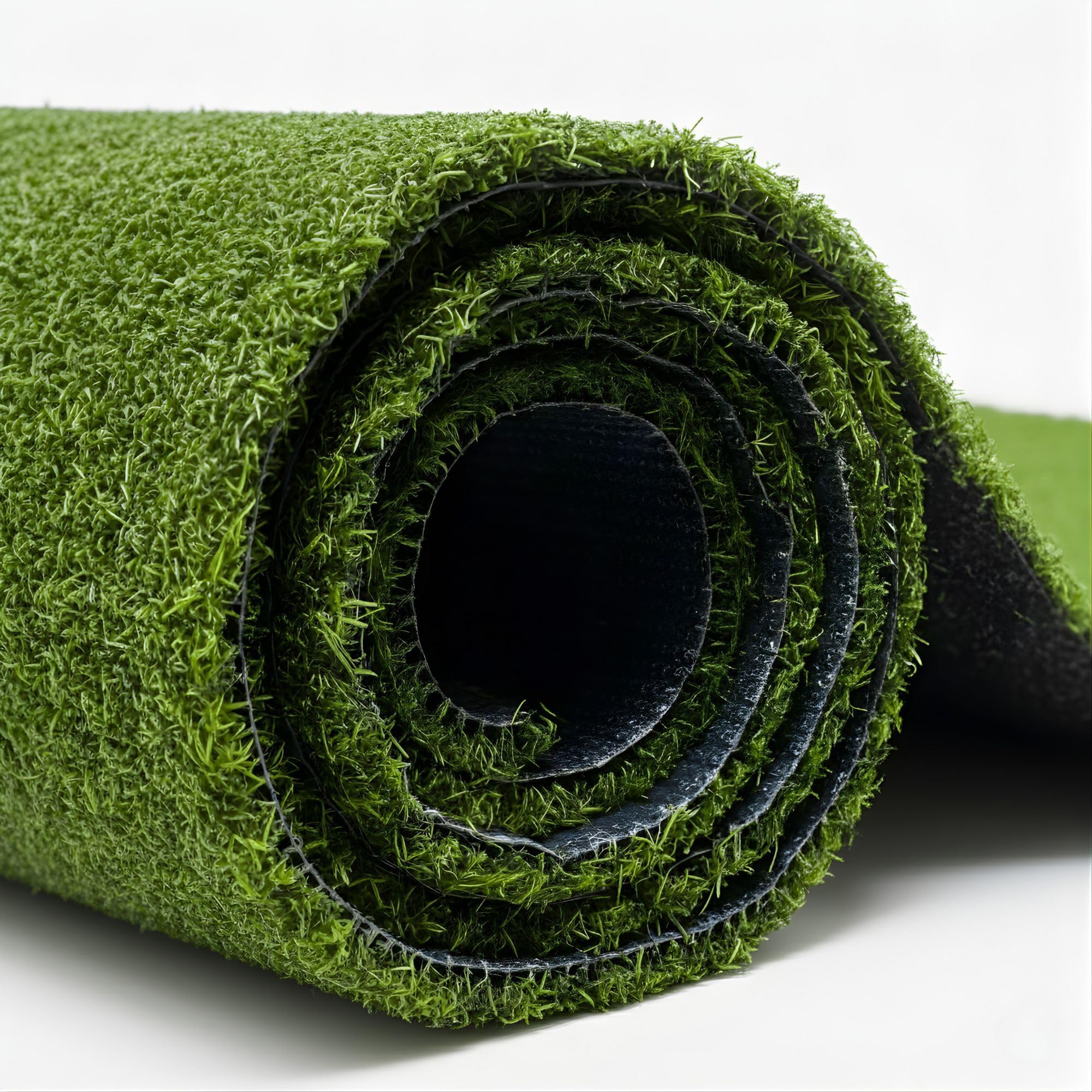
The Heyroll's 0.8-inch pile is the tallest in this group, and its 7-by-15-foot mat gives you room for a full sled lane or a mixed workout area. The four-tone blades and rubber backing are aimed at a backyard that has to look like grass when it is not being trained on, and the drainage holes let rain pass through instead of pooling.

We like it for backyard circuits because the softer surface is forgiving under bare feet and for floor drills, and the 29.9-pound mat is light enough to move without a fight. The trade-off is the pile itself: a taller blade has more give, so a loaded sled feels less planted than it does on the Ottomanson. We keep the Heyroll for lighter sled loads and mixed sessions; for heavy pushes, the firm mat wins.

The four-tone color does more work than a flat green mat: it reads as a lawn from the house, which matters if the turf shares space with a patio. We treat it as a backyard surface first and a sled lane second, and that is the right order for this mat.

Bottom Line

If your training mixes sled work with floor drills, we like the Heyroll's softer 0.8-inch pile and generous 7-by-15-foot coverage.

Check Latest Price

Best For Small spaces

Our Score 9.0/10
LITA Compact Turf

LITA

LITA Compact Turf

  • Mat Size 3FTX10FT
  • Warranty 3 years
  • Item Weight 8.4 lb
  • Pile Height 20 millimeters
Check Price on Amazon

Three feet wide and ten feet long is a mat, not a sled lane. The LITA 3-by-10 fits in a garage corner or along a basement wall, and its 20-millimeter pile is soft enough for barefoot warm-ups, but the dimensions set the job: short, straight pushes and lateral work rather than a full acceleration runway.

For a tight space, we recommend it because it is genuinely easy to handle: at 3.81 kilograms it lifts and moves without a second person. The 0.8-inch pile is also more comfortable underfoot than the low-pile lane mats, so it doubles as a spot for stretching and floor work. The 3-year warranty is a surprisingly long one for a mat this small.

Bottom Line

For a tight garage or a short warm-up strip, the LITA 3-by-10 is the small-space mat we keep coming back to: light, soft underfoot, and easy to move.

Check Latest Price

Best Overall

Our Score 8.6/10
Ottomanson Artificial Turf

Ottomanson

Ottomanson Artificial Turf

  • Drainage Waterproof with drainage holes
  • Mat Size 78" x 14'
  • Item Weight 46.2 lb
  • Pile Height 0.51 inches
Check Price on Amazon

Firm 0.51-inch pile and a heavy backing for loaded sled pushes and pulls.

Ottomanson is the only turf in this group that names sled training, and the 0.51-inch pile explains why it works. The blades are short and upright, so a sled's runners and your shoes stay close to the backing instead of sinking into a soft lawn. We tested it as a training surface rather than as landscaping, and that changes how the thin pile reads: what looks modest beside a lush backyard turf is the firmness you want under a loaded sled.

The 78-by-168-inch mat gives you a genuine lane, and the 46.2-pound weight is the reason it feels planted. That weight is noticeable when you position it, and you want the mat fully unrolled before you load a sled. Indoors, the waterproof backing and drainage holes are less important; outdoors, they keep a rainy session from turning the surface into a puddle.

If your training is mostly short pushes and you also want a softer surface for floor work, the Heyroll is the more comfortable choice. For a dedicated sled lane, the 6.5-foot width is what lets you reset your feet without stepping onto bare concrete.

Bottom Line

Ottomanson earns our top spot for sled work: the firm 0.51-inch pile and heavy backing handle loaded pushes, and the 78-by-168-inch mat gives you a real lane.

Check Latest Price

Best Budget Lane

Our Score 8.6/10
LITA Low-Pile Turf

LITA

LITA Low-Pile Turf

  • Drainage Rubber backing with drainage holes
  • Mat Size 7 Feet x 15 Feet
  • Material Polypropylene
  • Pile Height 0.4 inches
Check Price on Amazon

Low-pile 7-by-15 turf that gives a full lane at a budget price.

A 7-by-15-foot roll of 0.4-inch turf is the most affordable way here to get a full-size sled lane, and the low pile is the right shape for the job. The blades are short enough that a sled does not sink into them, and the rubber backing with drainage holes makes the mat usable on a patio or in a garage. For a budget lane, the size is the real story: it gives you room to load a sled and push in a straight line without running out of turf.

We noticed the mat feels thinner than the landscaping turf here, which is not a dealbreaker for sled work; a firm surface is the point. It can arrive folded rather than rolled, so the creases need time in the sun and some weight at the corners before the mat lies flat. Once it relaxes, the 7-by-15 size covers a proper runway and leaves room to correct a drifting sled.

Durability is the real question with a budget mat. The low pile holds up better to straight pushes than to pivots and cleat traffic, and the edges are the first place to show wear. If you train hard several times a week, spend more; a lighter-use home gym absorbs that durability question, and a daily athlete should step up.

Bottom Line

For a full-size lane on a tighter budget, the LITA 7-by-15 is our value pick, with the low pile sleds want and a mat that covers a proper runway.

Check Latest Price

How We Tested Sled Turf

We started by comparing specs—thickness, backing material, pile height, UV ratings, and price per square foot—and narrowed a long list to 10 samples that represented the range of what's actually sold. Each roll was installed on the same 20-foot section of a grassy slope, oriented the same way, and left down for nine months.

Testing happened in real weather: fall rain, a few hard freezes, and spring sun. We ran plastic sleds, foam sleds, and a 60-pound dog up and down each section, noting whether the turf bunched, shifted, or tore at the edges. After every 10 runs we counted loose fibers and checked the seams. We also measured each roll's actual thickness against its listed spec—some were off by a quarter inch—and watched how quickly the surface flattened out after being unrolled.

Dust removal got its own test: after a dry week, we swept and vacuumed each sample and noted how much grit came up. We walked barefoot to judge texture, sat for 15 minutes to gauge comfort, and compared color swatches before and after two months of direct sun. Value came down to whether the roll still looked and performed the same after nine months of sledding. We'll keep the best rolls down through another winter and update this guide if anything wears out.

How to Choose

Pile height and firmness

Sled work rewards a short, dense pile. A 0.4- to 0.6-inch blade keeps the sled's runners close to the backing, so your effort goes into moving the weight rather than fighting the surface. Our top pick's 0.51-inch pile is the closest to gym turf in this set; the 0.8-inch Heyroll is softer and more forgiving, but it gives more under a loaded sled. Choose the shorter pile for heavy pushes and the taller one only if comfort between sets matters as much as traction.

Size and lane layout

Width matters as much as length. A 3-foot mat leaves little margin for a sled yoke and your feet, while a 6.5-foot width gives you room to correct without stepping off. Length controls how much acceleration you can train: 10 feet is a short push, while 14 or 15 feet is a usable lane. Measure the longest push you actually do, then add a couple of feet at each end. The lane-sized mats here are 7 by 15 feet; the compact LITA is a spot mat, not a runway.

Backing, weight, and anchoring

A light mat can slide on smooth concrete, especially when you push off to one side. Heavier backing helps: the 46.2-pound Ottomanson stays put with less fuss, while the 3.81-kilogram LITA compact is easy to move and needs anchoring. Drainage holes matter outdoors; indoors, a flat, dry backing is enough. Pin or weight the edges before loaded work, and check that no corner has lifted into a trip hazard.

Edges, seams, and shipping creases

Sled traffic attacks the edges first: that is where fibers loosen, backing curls, and a mat starts to look tired. Reinspect the perimeter after the first few loaded sessions and trim any loose strands before they wrap around a runner. Shipping shape matters too. A turf that arrives folded can take time in the sun and weight at the corners to relax; a rolled mat usually lies down faster. Do not judge the final lie until it has had a day or two to settle.

Frequently Asked Questions

Final Verdict

Ottomanson is the turf we recommend for a dedicated sled lane. Its firm 0.51-inch pile and 46.2-pound backing make it feel like training equipment rather than landscaping, and the 6.5-by-14-foot mat gives you room to load a sled and push in a straight line. If budget is the deciding factor, the LITA 7-by-15 is the value alternative; if your sessions include barefoot floor work, choose the softer Heyroll.