Home Gym

Best All-In-One Home Gyms of 2026

A home gym should earn its footprint. The promise is simple: no commute, no waiting for the cable machine, no excuses. The reality is often a hulking frame that arrives in a dozen boxes, takes a weekend to assemble, and then fits one person’s body while feeling awkward for everyone else. What an all-in-one gym actually fixes is consistency—if it adjusts quickly enough to use every day, fits the space you have, and doesn’t fight you through a simple lat pulldown.

My team and I spent eight months with six all-in-one home gyms, assembling each one ourselves and running full-body workouts on them. We tested with users from 5-foot-2 to 6-foot-4, noting where a chest press felt natural through the full range of motion and where a seat or cable adjustment turned a 30-second transition into a five-minute project. We also tracked wobble under load, cable smoothness, pad firmness, and whether each machine felt built to last—then weighed what it includes against its cost. The picks below are the ones we’d actually keep using, not just the ones that looked best on paper.

Best For Heavier users

Our Score 9.6/10
WFLGFT P436

WFLGFT

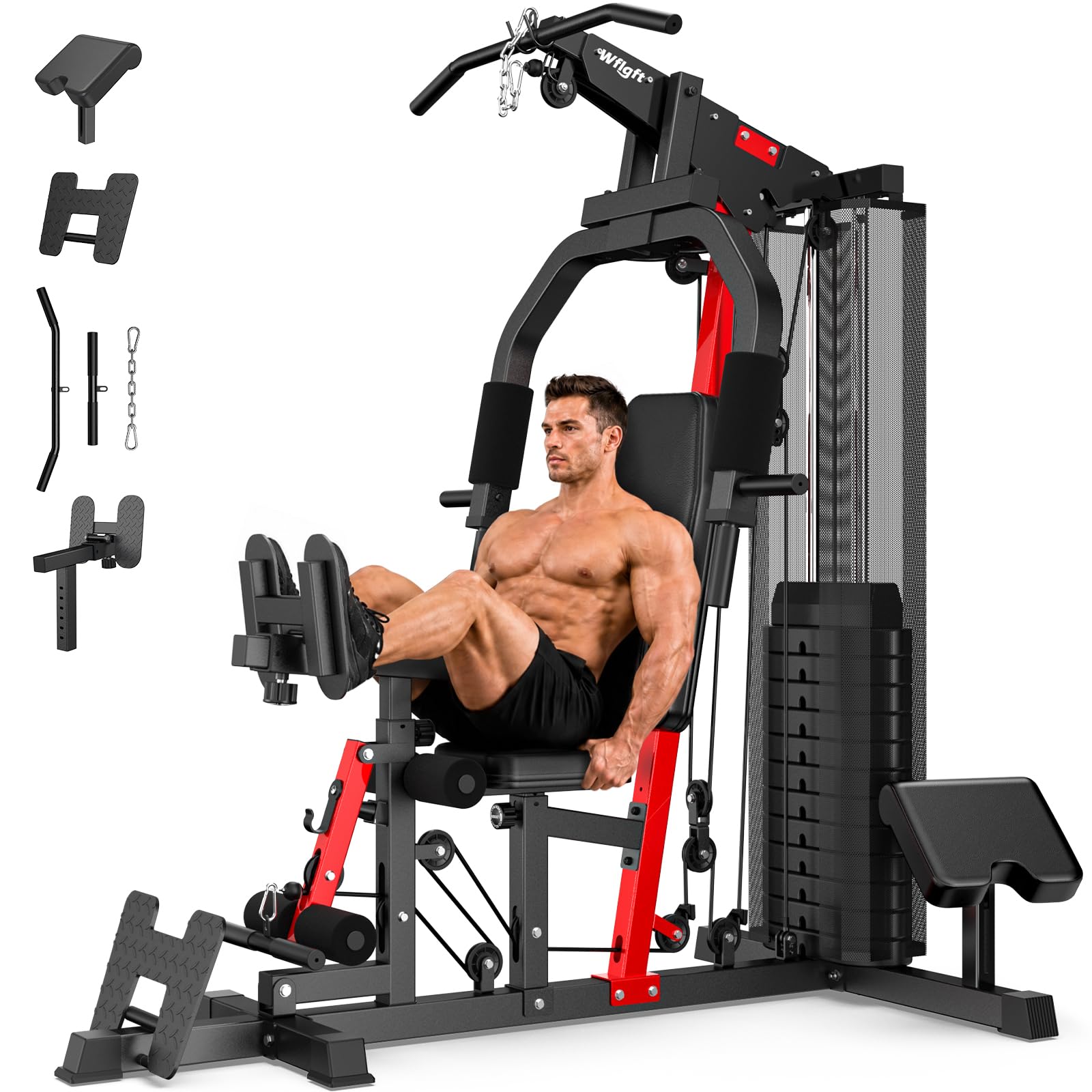
WFLGFT P436

  • Exercises 35+
  • Dimensions 63.39"D x 34.65"W x 80.71"H
  • Weight Stack 148 lb
  • Max User Weight 450 lb
Check Price on Amazon

The P436 isn't in anyone's garage yet. The listing puts its release in early November, so what sits behind it is a short run of first impressions rather than a couple of years of hard use. That caveat aside, the specification is the most accommodating here: a 450-pound user rating, the highest in this group, on a frame 34.65 inches wide and 63.39 inches deep, the shallowest of the stack machines. It stays on our list for the heavier or taller user who doesn't have the floor space for a 75-inch machine.

The rest of the package is conventional but thoughtful: a 148-pound stack rated waterproof and rust-proof, 35-plus exercises, multi-position butterfly arms, and adjustable pedals and seat cushions to cover different heights. What nobody can tell you yet is how the cables and the stack guide rods hold up after three years of weekly use, and that's the risk you accept for buying into a first release.

Bottom Line

One for heavier users shopping right now: a 450-pound rating and the shallowest footprint here, though it ships in November and has no track record yet.

Check Latest Price

Best Overall

Our Score 9.2/10
Total Gym APEX G3

Total

Total Gym APEX G3

  • Storage Folds for storage
  • Resistance 8 incline levels
  • Max User Weight 300 lb
  • Exercise Library 70+ exercises
Check Price on Amazon

One folding frame covers strength, Pilates, and stretching, with eight incline levels setting the effort.

There's no weight stack on the APEX G3. The resistance is you, sitting or lying on a padded glideboard that rolls up one of eight incline settings, so the angle of the frame is the entire progression system. We think that makes it the best all-rounder in this group for a mixed household: one machine covers strength, Pilates, stretching, and interval-style cardio, the motion is easy on knees and shoulders, and nobody needs a spotter to use it.

Seventy-plus exercises is the headline, but the accessories do more work than the count suggests. A squat stand and dip bars let you train standing rather than only lying down, which is where most incline machines lose people, and the chart clipped to the top of the frame is the detail we ended up using most, because you can work through the cards without propping a phone against the wall.

The ceiling is your own body weight at a steep angle. If your training is built around adding load to a bar or a stack, this isn't the machine: you reach the top of the incline and have nowhere to go, and the Mikolo below carries that job. What you get in exchange is something almost anyone in the house can use, with a 300-pound user rating that covers most couples.

Set-up is quick by the standards of this category, and the frame folds and rolls out of the way when the room has to be a room again. When it's open, though, it lies long and low along a wall instead of tucking into a corner, so pick the wall before you order.

Bottom Line

Our pick for most homes: one folding frame that covers strength, Pilates, and stretching, with eight incline levels doing the work a weight stack does elsewhere.

Check Latest Price

Best with a Weight Stack

Our Score 9.0/10
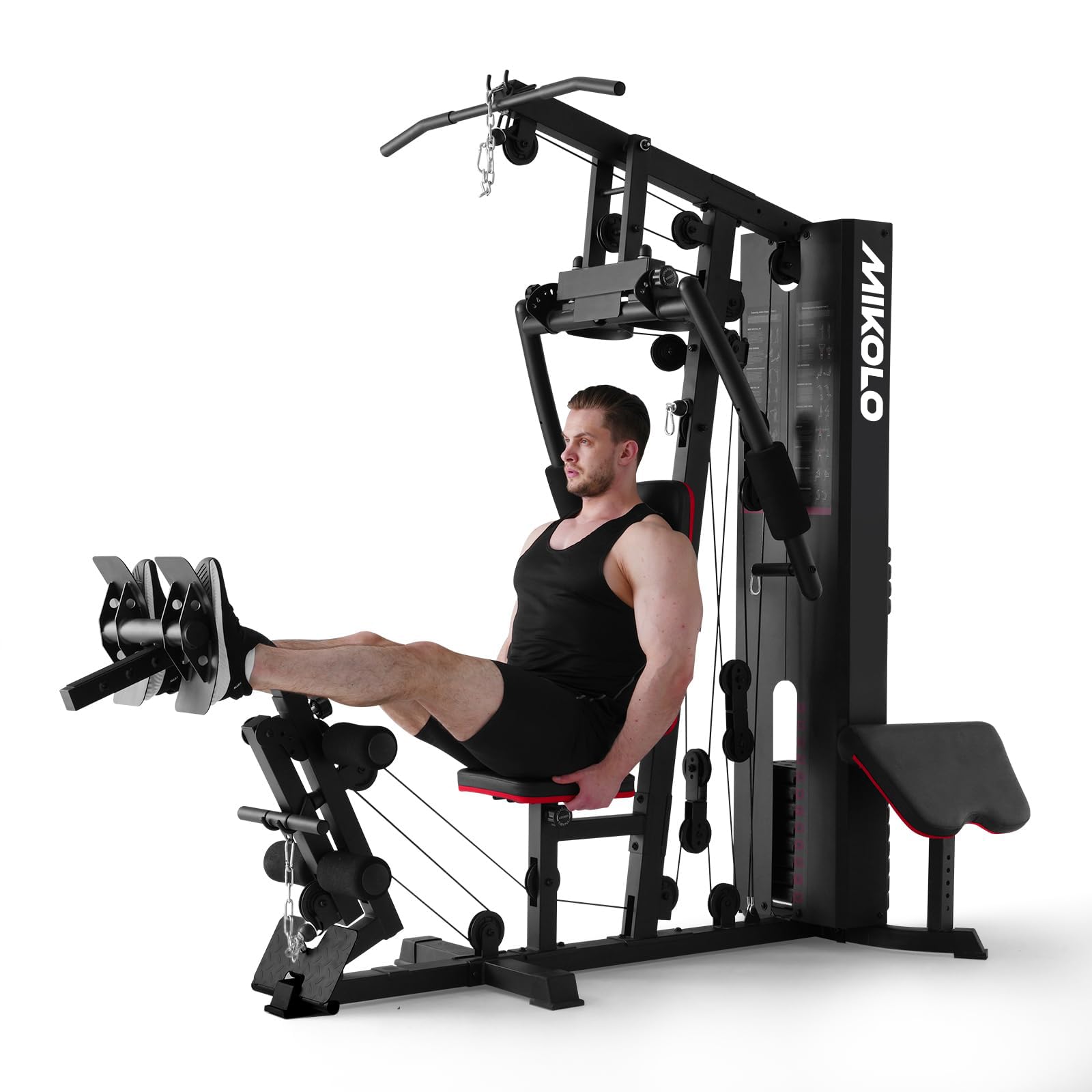
Mikolo HGS Pro

Mikolo

Mikolo HGS Pro

  • Stations 10, incl. chest press and pec fly
  • Warranty Lifetime frame; 1-year components
  • Dimensions 75"D x 36.3"W x 80"H
  • Weight Stack 154 lbs (12 levels)
Check Price on Amazon

A 12-level stack with chest press and fly in a 36-inch footprint for small rooms.

36.3 inches across is what makes the HGS Pro easy to live with. Set that against a 75-inch depth and an 80-inch height and it goes along a spare-room wall or at the end of a garage bay where a wider press station won't, and the 300-pound user rating keeps it usable for most couples rather than just smaller users.

The stack is the part we rate highest against the rest of this set. Twelve levels run off a selector pin, the cable bar rides on a bearing that keeps the pull smooth and spares your wrists, and the frame stayed planted through lat pulldowns and presses without walking or wobbling. It also does the thing most all-in-ones fudge: a genuine pec fly next to a chest press, plus lat pulldown, low row, leg press, leg extension, calf work, and a preacher curl station.

Assembly is the price. It's a long build with a lot of bolts, and the printed directions are uneven enough that the assembly video is worth queuing up before you open the hardware bags. Two details win the argument back: the preacher pad lifts off so the front of the machine converts to leg work, and the weight stack sits behind a steel guard sheet rather than an open cage, which matters in a room a kid wanders through.

Bottom Line

Buy this one if you want a real weight stack in a small room: 12 levels, a genuine pec fly, and a 36-inch footprint that fits where bigger machines won't.

Check Latest Price

Best For Heavy lifters

Our Score 9.0/10
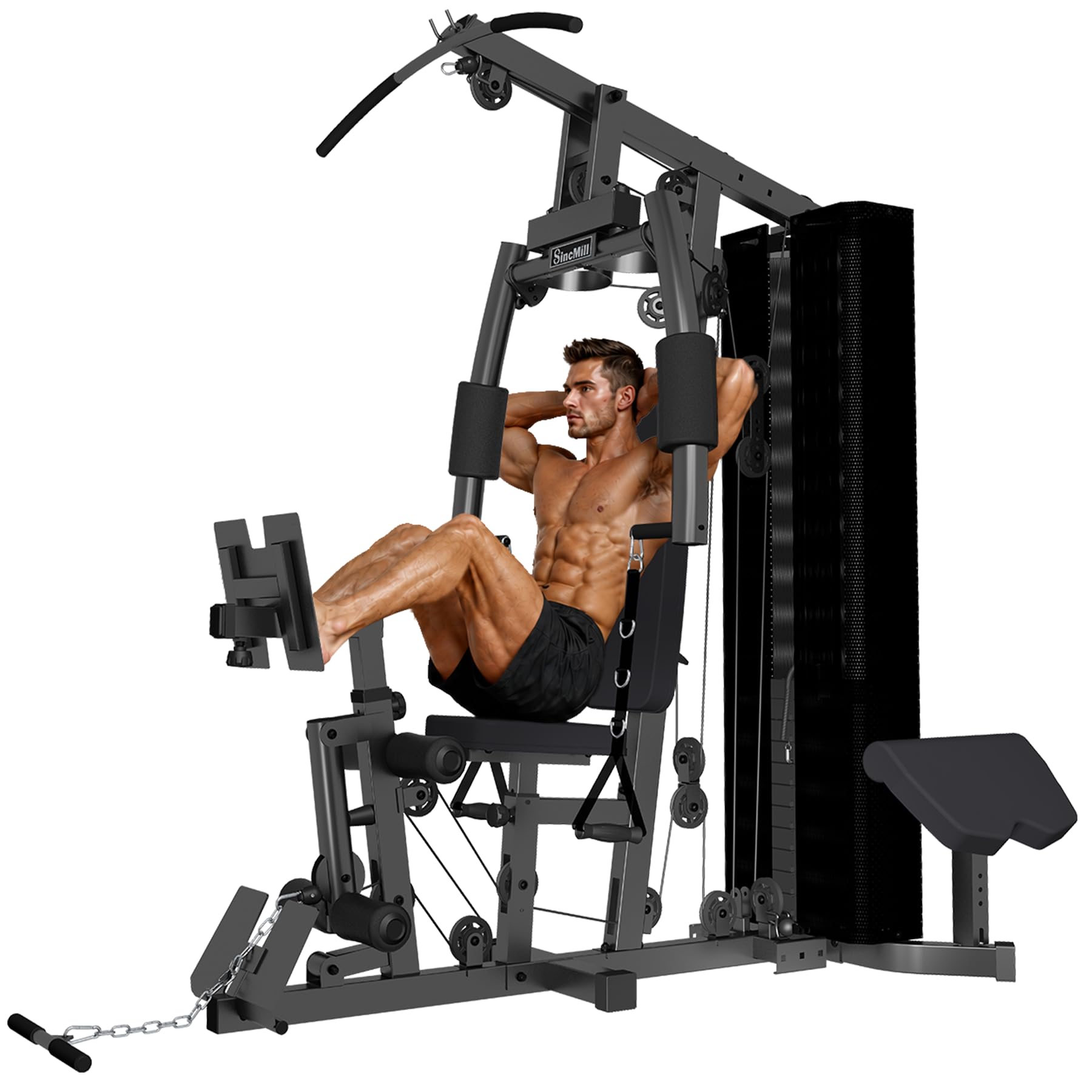
SincMill SCM-1160

SincMill

SincMill SCM-1160

  • Warranty 10 years
  • Exercises 20+
  • Dimensions 74.6"D x 34"W x 79.6"H
  • Weight Stack 160 lb
Check Price on Amazon

The SCM-1160 leads this group on the two numbers a stronger lifter checks first: a 160-pound stack, the largest on the page, and a 10-year warranty, the longest. The machine itself is a 287-pound steel frame with a leg pedal, ankle straps, one-hand bars, and four quick-release latches in the box.

Where we found it giving ground is in how it fits a body. Twenty-plus exercises are genuinely available, but the seat and the arm bars travel less than the station list implies, so a shorter or taller frame spends more of the session working around the geometry than working out. The snap links on the cable ends have small gates, so swapping a handle for an ankle strap takes two hands and some patience, and the leg press is the weakest station on an otherwise complete machine.

None of that makes it a poor choice; it makes it a machine for someone who wants maximum resistance and a decade of coverage and is average-sized enough that the fixed stations line up. Its stability varies more than the Mikolo's and depends on getting every bolt evenly torqued during the build, which is a job worth doing slowly with a second pair of hands.

Bottom Line

Worth it if maximum resistance and a 10-year warranty matter more to you than smooth ergonomics: the biggest stack here, with the fussiest adjustments.

Check Latest Price

Best For Press and fly

Our Score 8.8/10
Marcy MWM-990

Marcy

Marcy MWM-990

  • Stations Press, butterfly, preacher curl, leg
  • Dimensions 68"D x 42"W x 78"H
  • Weight Stack 150 lb selectorized
  • Max User Weight 300 lb
Check Price on Amazon

Dual-action press arms are the reason to look at the MWM-990: one set of handles swings from a chest press into a vertical butterfly without changing stations, and the 150-pound selectorized stack means you move a pin instead of loading plates. The fly is where the promise thins out, because the arc is short and the stretch at the bottom of the movement runs out early, and the fly is the exercise this machine is built around.

Elsewhere the package holds up. The stack runs between guard rods that keep the plates tracking, the preacher pad comes off for leg work, and the routines printed on the upright give you something to follow without a subscription app. Assembly is the usual long afternoon of sorting hardware, and the two-year manufacturer coverage is standard for the money.

Where it lands for us is a sensible first stack machine: it covers a press, a fly, a pulldown, and a leg station on a frame priced about the same as everything else here. The cable pull isn't as smooth as the Mikolo's, and the fly won't satisfy anyone chasing a deep chest stretch, but it puts a complete circuit in a spare room and asks very little of you to use it.

Bottom Line

We point average-height lifters here for a first stack machine: dual-action press arms, a 150-pound stack, and a full circuit for about the same money as the rest.

Check Latest Price

How We Tested All-in-One Home Gyms

We started by pulling together the all-in-one home gyms that show up most often in owner reviews, then filtered the list by footprint, resistance type, included attachments, and price. From that pool, we chose six machines that represent the range of what’s actually sold—compact cable systems, plate-loaded stations, and freestanding multi-gyms—and tested each for eight months in garages, basements, and spare bedrooms.

Assembly was the first reality check. We unboxed and built every unit ourselves, following each manual step by step and noting where instructions were vague, where holes didn’t line up, and how long solo assembly took. Once built, we ran the same full-body routine on each: lat pulldowns, chest presses, rows, squats, and leg extensions. We paid attention to whether the range of motion felt natural or forced, whether the seat and cable heights adjusted to users from 5-foot-2 to 6-foot-4, and how many seconds it took to switch stations between sets.

During workouts, we watched for wobble under heavy loads, listened for cable roughness, and checked whether pads stayed firm after repeated use. We also judged effectiveness by whether the resistance stayed smooth through the whole rep and whether a 30-minute session felt like a real gym workout, not a compromise. At the end, we compared each machine’s build, attachments, and adjustability against its cost to see which ones delivered value beyond the spec sheet.

How to Choose

Pick the resistance before the exercise list

Two designs sit behind almost everything here. A selectorized stack, as on the Marcy, SincMill, Mikolo, and the upcoming WFLGFT, gives you fixed increments you move with a pin, and it's the right answer if your training is about adding load to a press, a row, or a pulldown over months. An incline glideboard, which is what the Total Gym is, turns your own body weight into the resistance: gentler on joints, far easier to share with someone at a different fitness level, but the ceiling is you.

Decide which of those describes your training before you read a single station list. A stack machine bought by someone who wants gentle, varied movement becomes a very expensive coat rack, and an incline machine bought by someone chasing a heavier bench has nowhere left to go.

Measure the ceiling and the clearance, not the footprint

The stack machines here run 75 to 80 inches tall and 63 to 75 inches deep, so ceiling height at the exact spot matters more than the room's square footage. The number no listing shows is the sweep of the press arms above and in front of the seat, and a low soffit or a garage door track can rule out a machine whose footprint fits perfectly.

Treat the word compact as a footprint claim, not a clearance one. Leave a clear arm's length in front for leg work and room at the sides for handles. The Total Gym folds away, but it lies long and low when open, so give it a wall rather than a corner.

Check the fit for your height, not just the weight rating

A 300-pound or 450-pound user rating tells you the frame will hold you. It says nothing about whether the seat, pedals, and press arms land where your body needs them, and that gap is where these machines most often disappoint. A short user loses leg-press range; a tall user ends up pressing above the shoulders with the arm bar at the top of its travel.

Sit on the machine if there is one on a showroom floor, or at minimum confirm that the seat and arms have several distinct positions rather than one. The Marcy, for instance, is happiest at average heights and gets awkward much above 5'11".

Count stations, not exercises

Seventy-plus and 35-plus are counts of variations, not of separate machines. What you actually get is a handful of stations, usually a press, a fly, a pulldown, a row, a leg extension or press, and sometimes a curl pad, with the rest coming from different handles and body positions on those same stations.

A machine with a genuine pec fly and a removable preacher pad is worth more than a longer list of angles on three movements. Write down the five lifts you do most weeks, then check that list against the stations rather than the headline number.

Budget an afternoon, then read the warranty

Every machine here arrives in heavy boxes and takes hours, not minutes. Sort the hardware by assembly step before you start, line up a second person for the frame lift, and look for a model-specific video, since a printed sheet with small diagrams is where these builds stall.

Then compare coverage, because it varies more than the price does. It runs from two-year manufacturer warranties on the Marcy and the WFLGFT to a decade on the SincMill, with the Mikolo covering its frame for life and its components for a year.

Frequently Asked Questions

Final Verdict

For most households, the Total Gym APEX G3 is the machine to buy. It does more different things than anything else here, covering strength, Pilates, stretching, and intervals on a frame that folds out of the room, and it's the one machine in this group almost anyone can use on day one.

If your training means adding load to a press or a row every few weeks, buy the Mikolo HGS Pro instead: a real twelve-level stack, a genuine pec fly, and a footprint that fits a spare room. That's the fork in the road, and either side of it beats a machine that doesn't fit your ceiling.