Recovery

Best Peanut Massage Balls of 2026

A foam roller is a blunt instrument on a sore back — it presses on the whole landscape, including the bones you'd rather it avoided. A peanut massage ball fixes that with one design choice: a groove around the middle, so the two lobes sit either side of your spine instead of on top of it. That same shape makes it easier to pin a single knot in a glute or a hamstring, which is where most of the payoff actually is.

That said, the category covers a wide range: cheap palm-sized rollers, near-solid ones that feel like leaning on a golf ball, and cordless vibrating versions whose motor is either genuinely useful or a buzzy novelty. The groove only does its job if it's wide enough for your spine, and on soft balls it collapses under your own body weight. We spent four months working through 16 of them, rolling calves and glutes and leaning into walls, and the keepers earned it on firmness, comfort, and how much pressure they took without squashing flat. The picks below split between the manual workhorses and the powered ones.

Best for Neck and Spine

Our Score 9.2/10
RAD Original Peanut Massage Ball

RAD

RAD Original Peanut Massage Ball

  • Weight 12 oz
  • Material Medium-density silicone
  • Dimensions 6 x 2.5 x 2.5 inches
Check Price on Amazon

Grippy silicone and an extra inch keep both lobes working along the spine.

The RAD is the priciest manual ball in this guide, and the money buys silicone instead of rubber: a medium-density surface with a slight tack to it, so it holds your skin and stays where you put it rather than skidding away when you lean in. It's 6 inches long, a full inch more than our top pick, with the same 2.5-inch lobes.

That extra length is what we noticed first on the neck and the strip beside the spine. As you roll, both lobes stay in contact instead of one lifting off, and the grip means you can move slowly through a tight section without resetting the ball every few seconds. For the occipital ridge and the mid-back, it's the first one we pick up.

It does ask for some patience. The density is unforgiving until you learn how much of your weight to hand over, and the shape rewards slow movement rather than a brisk roll. What you get in return is a surface that wipes clean with a damp cloth and holds its shape session after session, which matters on a tool that spends its life against bare skin.

Bottom Line

Worth the premium if your trouble sits in the neck and along the spine — the grippy silicone and the extra inch keep both lobes working as you move.

Check Latest Price

Best Vibrating

Our Score 9.2/10
Rolling With It Vibrating Peanut Ball

Rolling

Rolling With It Vibrating Peanut Ball

  • Speeds 4-speed motor
  • Weight 2 lb
  • Battery Rechargeable lithium-ion
  • Dimensions 3.75 x 3.75 x 6.75 inches
Check Price on Amazon

Four speeds and real power let the motor do the work on stubborn knots.

Switch this on, lean back into it, and the work changes. The motor takes over the small back-and-forth, so you can hold a spot on a stubborn shoulder knot without rocking to keep the pressure up. It's 6.75 inches long and 2 pounds, with four speeds and a built-in rechargeable battery.

The top setting is strong — strong enough that the middle speeds get most of the use in our hands — and the double-lobed shape still does the job the manual balls do along the spine. Cordless is the other half of the appeal: nothing to trip over while you're flat on the floor, and the battery charges from the wall rather than a disposable cell.

Two pounds is the trade. It's the heaviest thing here, and that weight is what a motor costs you in a gym bag. What you get back is the only pick in this guide that can work a knot while you lie still and breathe, which is why it comes out on the evenings when a manual ball feels like one more chore.

Bottom Line

The one to buy when pressing manually is the problem: four speeds, genuine power, and cordless freedom to work a knot while you lie still.

Check Latest Price

Best for Feet

Our Score 9.2/10
Sports Medica Peanut Massage Ball

Sports

Sports Medica Peanut Massage Ball

  • Weight 8 oz
  • Includes Workout guide
  • Material High-density, latex-free
Check Price on Amazon

A light, latex-free ball that straddles an arch for plantar fasciitis work.

Foot work asks something different of a peanut. You want it small enough to sit under an arch while you're at a desk, firm enough to reach the fascia, and light enough that rolling it doesn't turn into a calf workout of its own. This one is 8 ounces, high-density and latex-free, and it arrives with a short workout guide.

It's the ball we point to for plantar fasciitis and tight calves. Seated with the ball under the arch, the two lobes straddle the middle of the foot so you can work the length of the fascia without chasing it around the room; the same ball rolls a calf against a wall with no fuss at all, and the guide gives you a sequence if you've never done it before.

High density is the reason it reaches an arch instead of squashing against it, and it's also why the first week feels sharp — start with more of your weight on the chair and less on the ball. Give the two halves a twist in your hands before the first session, too. The waist is a moulded joint, and on some units it can work loose, so it's worth knowing early whether yours is sound.

Bottom Line

The pick for arches and calves: light, latex-free, and shaped to straddle the middle of the foot while you sit and roll.

Check Latest Price

Best Overall

Our Score 9.0/10
5BILLION Peanut Massage Ball

5BILLION

5BILLION Peanut Massage Ball

  • Weight 12.6 oz
  • Includes Carry bag and workout guide
  • Material 100% natural rubber
  • Dimensions 5 x 2.5 x 2.5 inches
Check Price on Amazon

Natural rubber with a little give, sized to bracket the spine without bruising.

The gap between the two halves is the whole point. It lets the ball sit either side of the spine while your own body weight does the pressing, so the muscles beside the vertebrae get worked and the bone doesn't. At 5 inches long with 2.5-inch lobes it's sized for the places most of us can't reach alone — the strip beside the shoulder blades, the base of the neck, the top of the glutes — and it's the peanut we hand people who have never used one, because nothing about it is hard to figure out.

The material is why it keeps its place. It's 100% natural rubber, firmer than a tennis ball but with a little give at the surface, so it presses into a knot without the sharp, knobbly feel of a hard plastic tool. Pressure stays under your control as well: you shift a hip or lift a shoulder to ease off rather than stopping and repositioning the ball.

We get the most out of it on the floor, knees bent and hands behind the head, extending slowly over the ball to open the thoracic spine, and propped against a wall for the upper back on days when the floor is unappealing. One boundary worth knowing: 5 inches reads small across a broad pair of shoulders. The 6-inch RAD below covers more ground per pass, and on a bigger frame that extra inch is noticeable.

It ships with a carry bag and a short workout guide, and the guide earns its spot for the positioning sequence alone — more than we can say for the bag, which is a bag. It's the ball that stays out on the floor rather than in a drawer, which is the highest compliment a recovery tool gets.

Bottom Line

Our default pick: natural rubber with a little give, a 5-inch body that brackets the spine, and enough control that a first-timer can use it on day one.

Check Latest Price

Best For Large muscle groups

Our Score 9.0/10
TriggerPoint Universal Double Massage Ball

TriggerPoint

TriggerPoint Universal Double Massage Ball

  • Surface Textured pattern
  • Material EVA foam
  • Warranty 1 year
  • Dimensions 8 x 5 inches
Check Price on Amazon

This one isn't rubber. The Universal Double is an 8-inch EVA foam roller with a textured pattern across it, and that changes the job: it's built for broad muscle bellies — glutes, quads, hamstrings, lats — rather than fine work either side of the spine.

Size is the appeal. At 8 inches long and 5 inches across it stays put under you and covers more of a big muscle in one pass than a 5-inch ball manages in three, and the textured surface is designed to work the tissue as it rolls. It's water-resistant, wipes clean, and carries a one-year manufacturer's warranty.

Firmness is the wildcard. Foam gives where rubber doesn't, so a deep, sustained hold feels softer than the same move on a rubber ball — and at the other end, dropping full body weight onto it on a hard floor can bruise at first. Take some of the load on your hands and build up over a few sessions rather than going straight to a full press.

Where it earns its place is after leg day: glutes and quads, where a small ball takes forever and a flat roller is too broad to reach around the shape of the muscle. We keep it for that and reach for a rubber peanut for the neck. The one-year warranty is also the most concrete backing on anything in this guide.

Bottom Line

Choose it for glutes, quads, and hamstrings: a wide foam roller that covers more muscle per pass than any ball here.

Check Latest Price

Best for Travel

Our Score 8.8/10
AllPlay Peanut Massage Ball Roller

AllPlay

AllPlay Peanut Massage Ball Roller

  • Weight 9.59 oz
  • Material Thermoplastic rubber
  • Dimensions 5.51 x 2.36 x 2.36 inches
Check Price on Amazon

Light enough for a gym bag and firm enough to matter on the road.

At 9.59 ounces, the AllPlay is around a third lighter than our top pick, and that's exactly why it's here: it's the one that disappears into a gym bag and comes back out on trips. It's also longer and slimmer — 5.51 inches with 2.36-inch lobes — which puts it a touch deeper between the shoulder blades.

Thermoplastic rubber, and the lighter build doesn't feel flimsy in the hand; it holds up under body weight, and it doesn't carry the rubber or chemical smell that some balls in this category do. That last part matters more than it sounds when the thing lives in a bag with your gym clothes.

It's the practical second ball: one for the floor at home, this one for the car, the office, or the gym. It costs less than the top pick and well under the silicone and vibrating options, which is the right math for something you're buying to leave in a bag.

Bottom Line

A light, no-smell ball for the gym bag — firm, easy to travel with, and priced below the top pick.

Check Latest Price

Best For Longer cordless sessions

Our Score 8.8/10
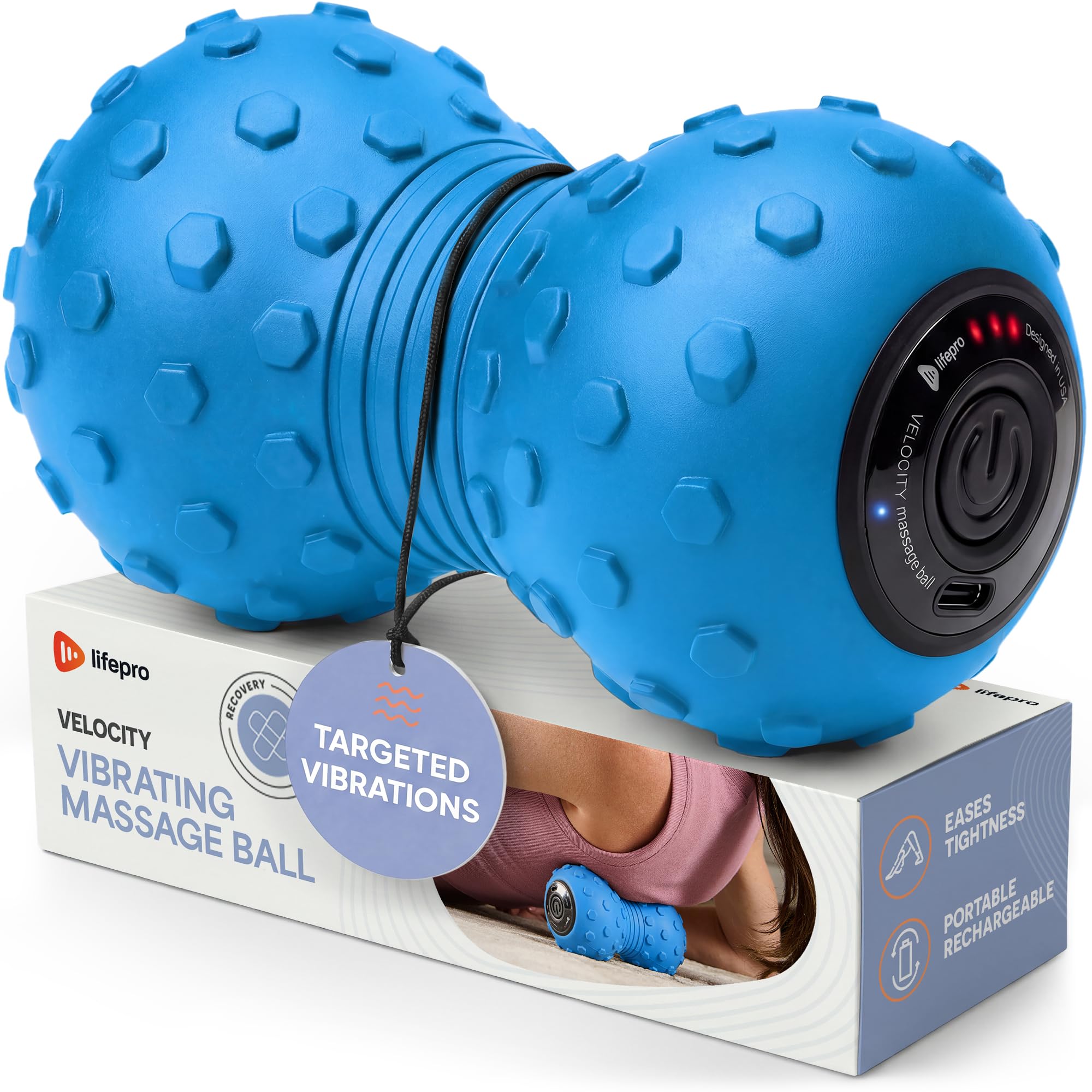
LifePro Velocity Vibrating Peanut Ball

LifePro

LifePro Velocity Vibrating Peanut Ball

  • Speeds 4 vibration levels
  • Weight 1.5 lb
  • Battery Up to 2-4 hours per charge
  • Dimensions 6.5 x 3.7 x 3.7 inches
Check Price on Amazon

LifePro lists 2 to 4 hours of run time and four vibration levels, and that pair of numbers is why this one is in the guide: it's the vibrating peanut for someone who wants to work through a long session without hunting for a charger. It's 6.5 inches long, 1.5 pounds, and covered in ridged silicone rather than the smooth surface of the Rolling With It.

The ridges are the interesting part. On glutes, quads and hamstrings they add a second kind of pressure on top of the vibration, and the four levels step up sensibly from a gentle pulse to something that will get through a tight thigh.

The thing to check early is the battery. It's built in and charges from a cable, and a unit that stops holding a charge becomes dead weight in a bag rather than fading gradually — so run it flat and recharge it once in the first couple of weeks, while returning it is still simple.

We like it best for big muscles after a heavy session, where the size and the texture both work in its favour, and the lighter body makes it easier to move around than the 2-pound option. For detail work in the neck and along the spine, the smooth manual balls still do it better.

Bottom Line

Buy it for long sessions on big muscles — four speeds, a textured surface, and the longest listed run time in this guide.

Check Latest Price

Best For Hard, intense pressure

Our Score 8.8/10
SIMPLECOOL Hard Peanut Massage Ball

SIMPLECOOL

SIMPLECOOL Hard Peanut Massage Ball

  • Length 4.7 inches
  • Weight 4.94 oz
  • Diameter 2.4 inches
  • Material TPR with non-slip texture
Check Price on Amazon

There's firm, and then there's this. The TPR is genuinely hard — the listing says so outright — and it doesn't dent under a thumb, with a non-slip texture across the surface. If you've been disappointed by balls that squash before they reach a knot, this is the correction.

It's also the smallest thing in the guide: 4.7 inches long with 2.4-inch lobes, under 5 ounces. That makes it the easiest of the set to slot under a hamstring or a calf and the least useful across a wide back, where it takes a lot of passes to cover the ground. What it does well is find a trigger point fast — it barely needs any body weight behind it.

We point lifters, runners, and anyone who simply likes a hard tool at this one. If you're new to self-massage, or you know you flinch, start with the rubber ball at the top of this list and come back to this when you want more bite. It's a cheap way to find out which side of that line you're on.

Bottom Line

The hardest, smallest, least expensive ball here — a great match for dense muscle and a poor first tool for anyone who flinches.

Check Latest Price

How We Tested 16 Peanut Massage Balls Over Four Months

Every ball here went through the same filter. I pulled every peanut-shaped roller I could find — hollow shells, solid-core rubber, foam, and the growing pile of cordless vibrating models — then cut anything with a groove narrower than a thumb, no listed dimensions, or a review pattern that mentioned the thing flattening within a month. That left 16, which my team and I used for four months, most of them several times a week.

Most of the testing happened on the floor of my living room, where I rolled calves and quads after runs, and against the hallway wall during the workday when my lower back tightened up. Each ball got at least three ten-minute sessions, two on a rug and one on bare hardwood, so I could feel how much the surface changed the grip. I also pressed each one under a hip for a full two minutes, then checked whether it sprang back to shape, and noted whether I could position it one-handed and whether it stayed where I put it.

Firmness got the closest attention, since a ball that's too hard makes you flinch away from the exact spot you're trying to reach. I recorded whether pressure felt sharp or broad, whether I could breathe through it, and how the muscle felt the next morning. I measured every groove and rolled slowly along the spine to see whether vertebrae touched the floor. Stickiness showed up in use — a few skidded out from under a hamstring mid-roll, and the tackier ones collected lint and pet hair within a week. On the vibrating models I ran each speed against a calf, timed how long top speed held, listened for motor whine, and put a stopwatch on daily ten-minute sessions until the battery died, then checked the recharge time. Value came down to wear: seams separating, shiny worn patches, motors that got louder.

How to Choose

Density Decides How Much It Hurts

Rubber, silicone, TPR and foam all behave differently under a shoulder blade, and the label matters less than the give. Natural rubber like our top pick compresses a little at the surface, which buys you a margin for error on the first few sessions. Hard TPR, as on the SIMPLECOOL, barely dents, so it reaches deep tissue faster and punishes sloppy positioning. Silicone sits in the middle and adds grip.

Choose the forgiving end if you're new to self-massage or working near the neck, and the hard end if soft balls have never reached your knots. If you're between the two, start softer — a ball you use every day beats a ball that hurts too much to touch.

Lobe Spacing and Length Are Separate Questions

The waist is a spinal channel. Two lobes of roughly 2.4 to 2.5 inches with a shallow gap sit either side of the vertebrae; a ball that's too wide across rides on the bone instead. Length is different: 5 inches covers the mid-back in short passes, while the 6-inch RAD and 8-inch TriggerPoint handle more tissue per stroke and suit broader frames.

The common mistake is assuming bigger means deeper. It doesn't. A narrower ball concentrates pressure, which is why the 4.7-inch SIMPLECOOL bites harder than the 8-inch foam roller.

Manual or Vibrating

Vibration doesn't make a ball better at releasing tissue; it makes the work easier to keep up. A motor holds the small movements while you stay put, which helps on days when you're stiff or working your back with no leverage. The cost is weight — both vibrating picks here are over a pound, one is two — plus a battery to charge and less precision in a small spot.

Buy manual first if you're undecided. Add vibration if you already know you quit on a manual ball after a few seconds.

Weight and Where You'll Actually Use It

A recovery tool is only useful if it's with you. Under 10 ounces rides in a gym bag unnoticed; 2 pounds is a decision you make every time you pack. Think about the surface too. Floor work gives the most control and the most pressure, a wall behind the shoulder blades is kinder to the neck, and a chair against a wall turns the ball into a desk-side tool for feet and calves.

If you travel often, weigh portability against vibration: the lightest pick here is a manual ball, and the motorized ones need charging before a trip.

Grip, Lint, and Cleaning

Grippy is good on skin and maddening on fabric. Silicone and rubber surfaces hold a cotton shirt in place, so the shirt rucks up your back instead of letting the ball roll; use them on bare skin or a fitted top. Rubber also collects lint and pet hair, so don't bury one in a bag full of clothes.

Most of these wipe clean with a damp cloth, and the foam TriggerPoint needs the least attention. Textured, non-slip surfaces like the SIMPLECOOL's are the most forgiving on a smooth floor.

Frequently Asked Questions

Final Verdict

For most people the 5BILLION is the one to buy. It's the size a back and a neck actually want, the natural rubber gives just enough to keep a first session bearable, and it costs little enough that you can find out whether you'll use it before spending more.

Spend up only for a specific job: the RAD if your trouble sits along the spine and neck and you want silicone grip, or the Rolling With It if you need the motor to keep the pressure on while you lie still.