Recovery

Best Massage Balls of 2026

A massage ball's whole job is to dig into the knot your own thumbs can't reach, which is also the problem. The ones that work make you swear the first time you roll onto them; the ones that feel polite on day one tend to do nothing by day three. I spent four months with 16 of them under my calves after runs, against my upper back after long desk days, and on the spots my physical therapist keeps pointing at. The right ball fixes what a foam roller can't: it gets into glutes, arches, and shoulder blades with actual precision, and it disappears into a carry-on.

Firmness is the whole ballgame. Too hard and you're nursing a bruise; too soft and you're rolling on a pillow with ambitions. Size is the quiet decider, since a grapefruit-sized ball is lovely on a back and useless under a foot arch, and a few of the rubber ones smelled like a tire aisle for a week. What's below is what my team and I kept reaching for once the testing log closed — for real pain relief, and for the ten minutes of not being hunched.

Best for Tender Spots

Our Score 9.6/10
Yoga Tune Up Therapy Balls

Yoga

Yoga Tune Up Therapy Balls

  • Weight 5.29 oz
  • Diameter 2.5 inches
  • Material Natural latex
  • Set Contents 2 balls and mesh tote
Check Price on Amazon

A grippy, forgiving pair for necks and knots that flinch from hard rubber.

A lacrosse ball is unforgiving; these are not, and that is the whole reason we keep a pair in the rotation alongside one. The Tune Up balls match the 2.5-inch size, but the shell is natural latex over a pliable core, so the surface has a tacky grip that holds tissue instead of sliding over it, and the ball gives just enough that you can lean your full weight in without seeing stars.

That give makes them the pair to start with on a neck, a jaw, or a shoulder that flinches at the first touch. They roll a foot beautifully too, just with more forgiveness than solid rubber, and the tacky surface stays put on a wall while you move under it. The drawstring mesh tote looks like packaging and turns out to be the reason they travel well.

Where they lose ground is pressure: on a stubborn glute knot the softer shell takes longer to get where solid rubber goes immediately, so budget a few more passes. And because the shell is natural latex, anyone with a latex allergy should pick a rubber ball instead. Set against that, these are the pair that gets a full session finished rather than abandoned at the first wince.

Bottom Line

Our choice when hard rubber is too much: the same 2.5-inch size with a grippier, more forgiving shell that keeps you working instead of wincing.

Check Latest Price

Best Overall

Our Score 9.4/10
Kieba Lacrosse Ball Set

Kieba

Kieba Lacrosse Ball Set

  • Weight 5.1 oz
  • Diameter 2.5 inches
  • Material Solid rubber
  • Set Contents 2 balls
Check Price on Amazon

Firm solid-rubber pair that handles back, glutes, and feet for very little.

Two balls, two colors, and a simple arrangement: the blue one stays by the sofa and the red one lives in the gym bag. That is the appeal of the Kieba set before you even press into it, because a massage ball is only useful if it is within reach. Each ball is 2.5 inches across, the official lacrosse size, and solid rubber all the way through.

Firm is the word we keep coming back to. There is essentially no give, so when you lean into the ball against a wall, your body weight goes into one small point. That is exactly what you want on a glute, a calf, or the arch of a foot, and exactly what you do not want over a rib, where a lighter lean and a towel between ball and skin solve it. The rubber does not skate the way hard plastic does, so it stays where you put it.

Nothing about them feels cheap: no chemical smell out of the bag, no seam to catch on a sock, and no mark left on the wall you lean against. And when they are not on a knot they are still a lacrosse ball, so they survive being stood on, dropped on concrete, and thrown for a dog. It is the least precious piece of recovery gear we own, which is why it is the one that actually gets used.

Bottom Line

The default pick: a firm, near-indestructible pair that handles back, glutes, and feet, and costs little enough to keep one in every bag.

Check Latest Price

Best for Hips and Glutes

Our Score 9.4/10
TriggerPoint MB5 Foam Ball

TriggerPoint

TriggerPoint MB5 Foam Ball

  • Weight 6.38 oz
  • Diameter 5 inches
  • Material Multi-density EVA foam
Check Price on Amazon

Five inches of dense foam that covers a whole hip in one pass.

Five inches across is the largest ball here by a wide margin, and that number is the whole proposition. The MB5 is a dense EVA foam ball aimed at hips, thighs, and the muscle around the shoulder blade, the areas where a 2.5-inch ball works one small patch at a time while you hunt for the spot.

The foam is layered rather than uniform, and it compresses to grip tissue instead of skidding off it. At 6.38 ounces it is light enough to toss in a gym bag, and it does not have the sting of solid rubber when you first put weight on it.

We got the most out of it on the glute and the outside of the hip, where the width lets you move through a stroke instead of holding one point and hoping. That is a different job from a lacrosse ball, not a replacement for one, and it is the reason this stays in the bag next to a small ball rather than instead of one.

Dense is the right word, though. First contact can feel harder than foam suggests, so start with part of your weight and build over a few sessions before you judge it. Once you are leaning in fully, the width is what you notice, not the firmness.

Bottom Line

The wide foam ball for hips, glutes, and thighs, and the pick when small balls keep missing the muscle you are trying to reach.

Check Latest Price

Best for Jaw and Wrists

Our Score 9.2/10
RAD Rounds 3-Ball Set

RAD

RAD Rounds 3-Ball Set

  • Material Silicone
  • Densities Soft, medium, and firm
  • Ball Sizes 2.2, 1.6, and 0.75 inches
  • Set Contents 3 balls
Check Price on Amazon

Three sizes and densities for jaw, forearms, and other small stubborn spots.

Three-quarters of an inch sounds like a typo next to a lacrosse ball, and then you press it into the muscle at the base of your jaw and stop laughing. The RAD set is the precision instrument here: a green ball at 2.2 inches and soft, a blue one at 1.6 inches and medium, and a black one at 0.75 inches and firm, all in smooth silicone.

Matching density to the spot is the trick we appreciated most. The soft green ball goes on a neck or a hip that is already irritated, while the black one goes after a forearm knot or an IT band that wants real pressure. With three in the bag you do not have to guess which one your body wants today, which sounds fussy until you are the one deciding at seven in the morning.

The silicone glides more than rubber, pleasant on skin and less so on a polished floor, where a mat helps, and it does not hold a wall the way a tacky shell does. What we kept coming back to is the black one: at 0.75 inches it gets into the wrist and the jaw in a way nothing else on this list can.

Bottom Line

A three-density set for the small stuff, jaw and wrists and forearms, where a full-size ball is simply too blunt to be useful.

Check Latest Price

Best for Feet

Our Score 9.2/10
TriggerPoint MobiPoint

TriggerPoint

TriggerPoint MobiPoint

  • Surface Raised tips
  • Diameter 2 inches
  • Material Plastic
Check Price on Amazon

Nubbed two-inch ball that grips the arch instead of skidding across the floor.

The most useful place for a massage ball, in our experience, is under a desk. The MobiPoint is built for exactly that: two inches across, covered in raised tips, and firm enough that a slow roll from heel to the ball of the foot actually does something before your attention drifts.

We used it on the arch and the heel, where plantar fasciitis tends to settle in, and on the palm after a long stretch at a keyboard. What we appreciated most is the texture. The raised tips grip the skin so you can steer the ball without looking down, and they stop it rolling away the moment you shift your weight.

Solid rather than rubbery, it holds its shape under a full lean, and the surface wipes clean in a second, which matters for something that lives on a floor. It is small enough to disappear into a desk drawer or a coat pocket between uses.

The tips are firm, though, not sharp but firm enough that a thin sock is a sensible first move if your arch is sensitive. Give it a week of short sessions and the pressure stops registering as much.

Bottom Line

The foot ball we keep coming back to: two inches of nubbed plastic that grips the arch and stays where you put it.

Check Latest Price

Best Starter Kit

Our Score 9.2/10
Plyopic Massage Ball Set

Plyopic

Plyopic Massage Ball Set

  • Weight 10.6 oz
  • Set Contents 3 balls and carry bag
  • Rubber Ball Size 2.6 inches
Check Price on Amazon

Three ball types in one bag, so you can find your density.

The hardest part of buying a massage ball online is that you cannot feel it first. Plyopic answers that by sending three balls of different types in one drawstring bag, so the decision happens in your hands rather than on a screen.

The kit runs from a dense rubber ball to a grey spiked one, and the difference between them is bigger than the difference in size. We got along with the rubber ball immediately, since it takes weight without turning sharp, and less with the spiked one, which is hard plastic and skates across a hardwood floor unless there is a mat under it.

As a first purchase this makes a lot of sense: three shapes in one bag, and within a week you know whether you are a soft-ball person or a hard-ball person. If you already know, skip the kit and buy the single ball that matches, because the extra shapes will just live in the bag.

Bottom Line

A try-three-at-once kit for anyone who has not worked out whether they want soft, smooth, or spiked under a sore muscle.

Check Latest Price

Best For Sore feet

Our Score 9.2/10
Due North Foot Rubz

Due

Due North Foot Rubz

  • Weight 2.08 oz
  • Diameter 1.9 inches
  • Material Dense rubber with flat spikes
Check Price on Amazon

Out of the package it is underwhelming: a knobbly bit of rubber that looks like it belongs in a dog's toy basket. Then you roll your arch over it and stop caring what it looks like.

The spikes are flat-topped rather than pointed, and that is the detail that makes it work. You get grip on the sole without the needle feeling sharper spiky balls have, and the dense rubber gives under your weight so it adjusts to how hard you press instead of fighting back.

At just over two ounces it disappears into a desk drawer or a dopp kit, and the rubber body will not mark a wood floor the way a hard plastic ball can. For anyone who kicks their shoes off at a desk, that combination is most of the argument.

What we did not expect to like is how well it works in the hand, rolling out a palm or a forearm while you read. It is the least expensive pick here and the one we leave out where we will trip over it, which is the highest compliment a recovery tool gets.

Bottom Line

The small flat-spiked ball for feet and hands: light, inexpensive, and far kinder to bare floors than most spiky balls.

Check Latest Price

Best For Gentle neck work

Our Score 9.0/10
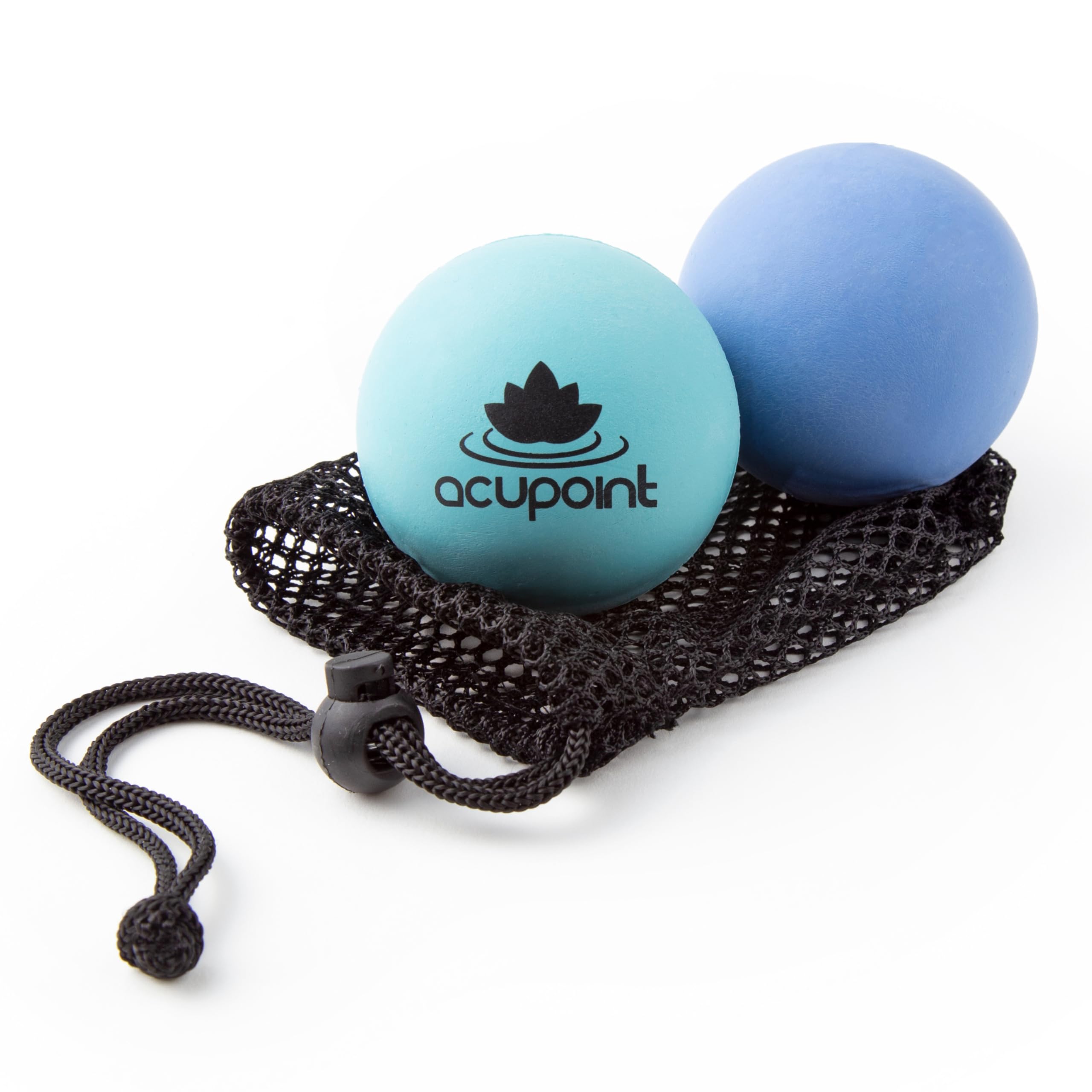
Acupoint Therapy Ball Set

Acupoint

Acupoint Therapy Ball Set

  • Diameter 2.5 inches
  • Material High-grade rubber
  • Set Contents 2 balls and mesh bag
Check Price on Amazon

Soft is the first thing you notice. The Acupoint balls are 2.5 inches across, the same as a lacrosse ball, but the rubber squashes under a thumb, and that changes what they are good for.

Under a tender shoulder blade or along a neck, the give is a kindness. You can breathe out and let the muscle release instead of bracing against a hard point, and the squash spreads pressure over a wider patch so you feel a muscle let go rather than one hot spot.

That same give works against you on a stubborn glute knot, where the ball deforms and you end up pushing harder than you meant to. There is also a rubber smell that can hang around for days even after airing them out, worth knowing before these go into a gym bag next to your clothes.

Two balls and a mesh bag make this an easy first set for someone who finds the whole idea of self-massage a bit much, and it is the pair we hand over when a hard ball has already been tried and abandoned. Just do not expect it to dig.

Bottom Line

The soft option: forgiving on tender tissue and a decent first set, though the give and the rubber smell both take some getting used to.

Check Latest Price

How We Tested (and How You'd Actually Use Them)

We started by pulling every massage ball we could find that listed a diameter and a material, plus a handful of best-sellers that list neither, and cut anything sold only in mismatched multi-packs or described in language that never commits to how firm it is. That left 16 balls, from palm-sized lacrosse-style spheres to spiky silicone ones, and we spent four months with them.

Testing happened wherever the knots do. I rolled my calves on the living room rug after every run, leaned into a wall for my upper back between meetings, worked my arches under the desk during calls, and sat on the firmest ones after long bike rides. My partner, who won't go near a foam roller, used the medium ones on her shoulders before bed, and two balls went into a carry-on for a week of travel.

At every stage we recorded what happened rather than what the packaging promised. We pressed a thumbnail into each ball to gauge how much give it had, then compared how it felt on first contact against how it felt after a week of daily use; a few were too aggressive to put on bare bone, and the softest ones stopped doing anything once our muscles adjusted. We sniffed each one out of the packaging and again seven days later, checked whether it stayed put on hardwood or skittered across the room, and read whatever instructions came in the box to see if a placement chart made the first session easier. The ones that held their shape, lost the smell, and were comfortable to steer with a hand or a hip are the ones that made the list.

How to Choose

Match the firmness to the tissue

Pressure from a massage ball comes from your body weight, not your hands, so a ball with no give turns a lean into a very sharp point. Solid rubber, like the Kieba and other lacrosse-style balls, suits glutes, calves, and the arch of a foot, where the muscle is thick and a decisive point helps. For a neck or a shoulder that is already irritated, a pliable ball lets you lean in without bracing.

The trap is buying the hardest ball you can find and then avoiding it. Start softer than you think you need, then add a firm ball for the areas that want one, and keep it on muscle rather than on the spine or a bony point.

Size decides where the ball can go

A 2.5-inch ball is the all-rounder and where most people should start: it fits under an arch, a glute, and a shoulder blade. Balls from 0.75 to 2 inches are precision tools for the jaw, wrist, and the muscle beside the shoulder blade. A 5-inch ball covers a hip in one stroke but cannot get into a tight corner.

If you are buying one ball, buy 2.5 inches. If you already own one, add a small ball before you add a big one, because precision is the harder thing to fake with a larger tool.

Check the surface, not just the spikes

Texture does two jobs: it grips skin so you can steer, and it changes how the ball behaves on a floor. A tacky rubber or silicone shell holds a wall; a hard plastic spiky ball can skate across hardwood the moment you shift. Spikes are not automatically more effective either, since flat-topped rubber nubs grip without the sting of a sharp point.

If your ball slides, put a yoga mat or a folded towel under it before you decide it is the wrong ball.

One ball, a pair, or a kit

A pair of identical balls is more useful than it sounds: one stays home, one goes in the bag, and you stop hunting. A multi-density kit such as RAD Rounds or the Plyopic set suits anyone who has not yet worked out what they like, because you get to try soft, medium, and firm before committing. A single premium ball makes sense once you already know the size and density you want.

Frequently Asked Questions

Final Verdict

The Kieba pair is the ball we point almost everyone to, and the reason is simple: at 2.5 inches of solid rubber it handles back, glutes, calves, and feet without asking anything of you, and having two means one is always where you need it. Buy it first.

If solid rubber makes you flinch, the Yoga Tune Up balls are the same size with a grippier, more forgiving shell that lets you stay on a sore neck long enough to matter. And if the muscle you are chasing is a hip or a thigh, skip both and go straight to the 5-inch TriggerPoint MB5, where the width does work a small ball cannot.