Recovery

Best Massage Sticks of 2026

A massage stick is about as low-tech as recovery tools get: a row of rollers on a handle, with all the pressure coming from your own hands instead of a motor. That's the appeal — you can work a tight calf while standing in the kitchen, no mat, no outlet, no twenty-minute commitment. The catch is that the gap between a stick that actually helps and one you never touch again comes down to things a product photo can't show you: how freely the rollers spin, how hard they press, and whether the texture works a knot loose or just digs into your shin.

I keep one in my gym bag and one behind the couch, and over the past four months my team and I have put 14 of these through daily use — post-run calves, desk-tight shoulders, and a few skeptical volunteers who don't usually bother with recovery gear at all. The lesson that surprised me most is that harder isn't better. A dense roller feels productive for about ten seconds, and then you find reasons not to pick it up. What matters is a smooth, quiet spin and a firmness you'll come back to tomorrow. The picks below run the full range, from gentle to genuinely aggressive, so there's one for how you actually recover.

Best Overall

Our Score 9.4/10
Tiger Tail Original 18

Tiger

Tiger Tail Original 18

  • Length 17.75 inches
  • Roller One firm, non-flexible foam drum
  • Weight 11.2 oz
Check Price on Amazon

A firm one-piece roller that pushes real pressure into knots and won't flex away.

Nine plastic wheels on a loose pin do part of the work for you: they skate over a knot instead of pressing into it. The Tiger Tail takes the opposite approach — one firm, non-flexible foam drum on a rigid core — and that single decision is why it's the stick we reach for first. Whatever pressure you put in with your hands goes into the muscle, because nothing in the tool gives way. On a tight quad, or a calf that's been cramping since a long run, you feel the spot rather than the equipment.

The drum is 1.4 inches across, which concentrates force into a narrow band instead of spreading it over a plate. That's exactly right for a knot behind the shoulder blade or the outside of a shin, and less right when you want to sweep a whole thigh in three long strokes — the ridged THERABAND below covers ground better. The firmness cuts both ways, too: on a fresh bruise, a bony shin, or the day after a hard session, it's unforgiving until you learn to use less of your body weight behind it.

At 17.75 inches and 11.2 ounces it drops diagonally into a carry-on and disappears into a gym duffel, and ours has come out of both with no wobble at the ends and no soft spot worn into the foam. Standing or seated, you can work most of your own legs and arms; a partner gets the rest. It's the least forgiving stick here and also the most convincing one.

Bottom Line

If you want one stick that does genuine deep tissue work on calves, quads, and a partner's back, and won't flex away from the muscle, this is the one.

Check Latest Price

Best for Large Muscle Areas

Our Score 9.4/10
THERABAND Roller Massager

THERABAND

THERABAND Roller Massager

  • Weight 16 oz
  • Dimensions 22 x 2 x 1 inches
  • Roller Surface Ridged, firm
Check Price on Amazon

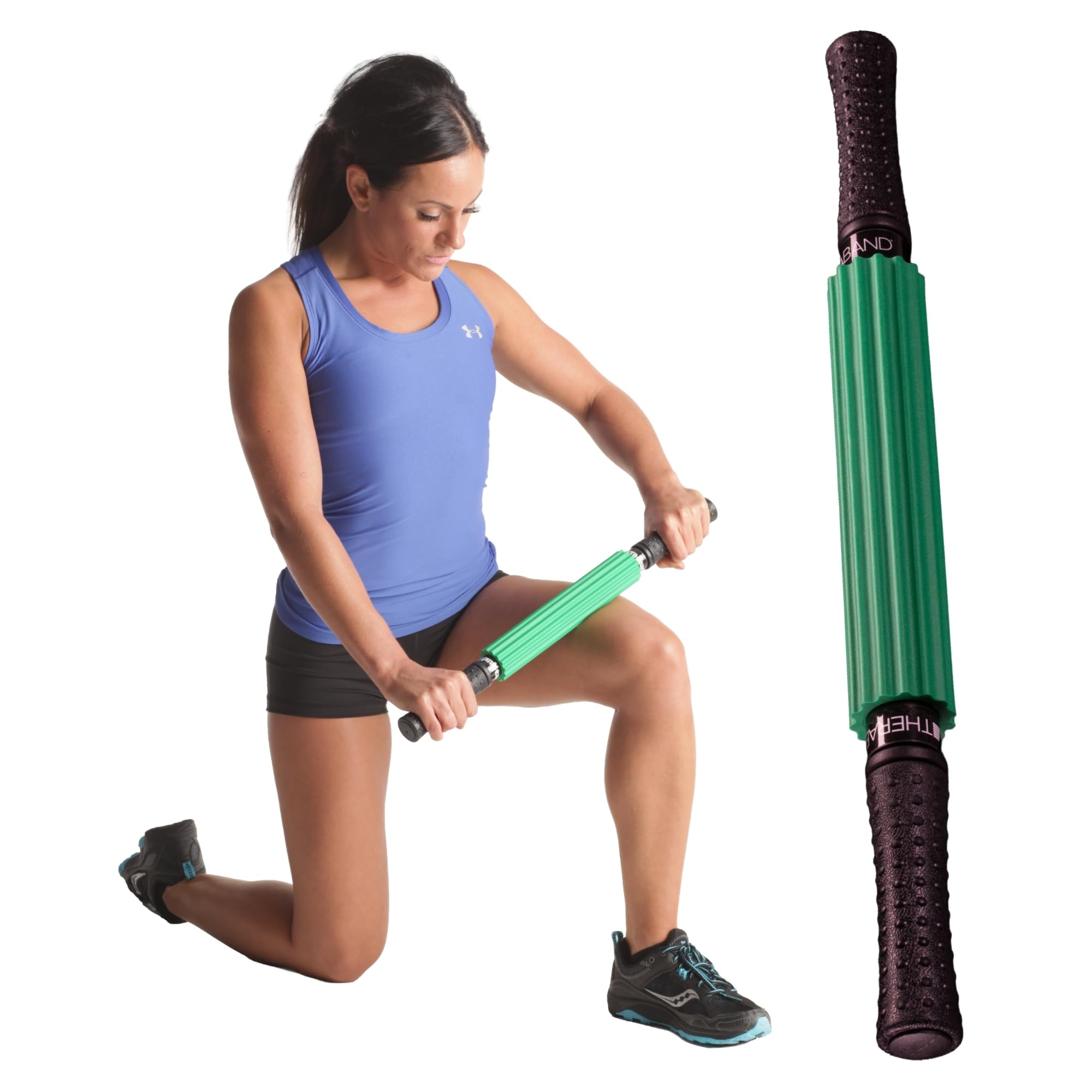
Long and ridged, built to sweep a whole quad or reach your own back.

Twenty-one inches is long enough to sit across both calves at once, and long enough that you can get it onto your own back without wrecking a shoulder. That length is why this is the stick we point people toward when they want to sweep a whole quad or hamstring rather than pick at a single knot.

The ribbed rubber roller is the other half of the appeal. Where smooth plastic skates over dry skin, the ridges grip and stay where you put them, and the difference shows up most over the IT band and along the outside of the thigh, where a hard plastic stick slides off course. Press in and the ribs find tissue instead of gliding past it. The feel is firm rather than harsh — wide, shallow ribs rather than sharp knobs, so it works a muscle without the sting a knobbly roller leaves.

Two hands fit comfortably at the ends of the shaft, which makes it the best stick here for working on somebody else: a partner's back, their hamstrings, their calves after a race. It's happiest over a wide muscle belly; on thinner ground, like the front of a shin or around an ankle, the ridges are more than we want.

Bottom Line

For big muscle groups and your own back, this is the one — a long, ridged roller that grips the skin instead of sliding over it.

Check Latest Price

Best Wooden

Our Score 9.2/10
Deston Wooden Massage Roller

Deston

Deston Wooden Massage Roller

  • Weight 9.14 oz
  • Rollers 9 independent, 360-degree
  • Material Natural wood on a steel shaft
  • Dimensions 15.3 x 2.3 x 2.3 inches
Check Price on Amazon

Warm wood and a flexible core that follows the curve of a thigh.

Wood is the whole reason to consider this one. It warms in your hand within a minute, it stays smooth against skin, and the nine wheels are finished well enough that we ran the thing over a forearm without a second thought. If you dislike the feel of hard plastic on bare skin, that alone is worth the look.

The wheels turn independently on a steel core that flexes slightly, and the give matters more than it sounds. A rigid stick fights the curve of a thigh and lifts away at the edges; this one stays in contact along the length. The wheels also hold where you put them, so you can drag it as well as roll it — which is how we ended up using it across an abdomen and along the top of a shoulder, spots where a rolling stroke is awkward.

Fifteen inches is short. A full quad takes noticeably more passes than it does with the Tiger Tail or the THERABAND, and you feel that on a long muscle. What you get in exchange is control: each pass lands exactly where you aim it. At just over nine ounces it's the lightest stick here, which is why it's the one that goes in a weekend bag.

Bottom Line

Buy it if you want a wooden roller for abdomen and limb work and prefer control over coverage — it's the lightest, shortest stick we recommend.

Check Latest Price

Best Budget

Our Score 9.0/10
IDSON Muscle Roller Stick

IDSON

IDSON Muscle Roller Stick

  • Weight 10.4 oz
  • Handles Thermoplastic rubber and polypropylene
  • Dimensions 17.5 x 1.5 x 1.5 inches
Check Price on Amazon

Light, grippy handles, and cheap enough to keep a second one at the gym.

The handles are thermoplastic rubber over polypropylene, and they're the reason this stick feels less disposable than its spot at the bottom of the price list suggests. Your hands don't slip when you're working a sweaty quad after a run, and the whole thing is light enough that holding it overhead for a shoulder doesn't tire your arms before the muscle gives.

Nine rollers on a steel pin turn independently, the same arrangement as every other budget stick here, and it's where the compromises surface. Rolled along the length of a quad on smooth skin, ours turned freely. Press hard at an angle, over a knee, or through leg hair, and the wheels bind and skip, so you feel individual plastic edges instead of one continuous pass. Moderate pressure, rolling with the grain of the muscle, keeps it behaving.

Legs are its home ground: calves, quads, hamstrings, the outside of the hip. It's the stick to hand a first-timer who isn't sure they'll keep the habit, and the one to buy twice — one for the gym bag, one for the living room — because a second one isn't a decision at this price.

Bottom Line

The cheapest sensible way to start: light, grippy in the hand, and good enough on legs that most people never need to upgrade.

Check Latest Price

Best For Firm pinpoint pressure

Our Score 9.0/10
YANSYI 9-Roller Massage Stick

YANSYI

YANSYI 9-Roller Massage Stick

  • Weight 11 oz
  • Rollers 9 independently rotating
  • Dimensions 17.68 x 1.69 x 1.55 inches
Check Price on Amazon

The gaps between the nine wheels are the point: roll across a knot and a wheel sits either side of it, so pressure lands around the tight spot instead of on top of it. On a calf that's a real difference, and it's where the hardness question starts, because plastic with no give behaves very differently on a shin than on a quad.

There's no cushioning here at all. Over a big muscle at moderate pressure the wheels turn freely and the effect is pleasantly aggressive; over an ankle, a shin, or a spot that's already sore, it's too much, and the gaps can catch skin and hair. If you know you like firm pressure, that's a feature rather than a flaw. If you're new to rolling, start somewhere else.

Just under eighteen inches and eleven ounces make it a gym-bag stick, and ours has survived a season of exactly that. The handle is the part to look after — it's plastic, and a hard floor is not its friend. As a second stick to leave in the car or take to the field, it asks very little of you.

Bottom Line

Worth it if you want firm, pinpoint pressure on big muscles and already know you like it; beginners should start with something softer.

Check Latest Price

How We Tested 14 Massage Sticks

We started with every massage stick we could find from brands we already trust for recovery gear, plus a handful of cheap, well-reviewed options, and cut the list by roller material, handle length, and weight — the specs that decide whether something fits in a gym bag or feels clumsy in your hands. That left 14 sticks, which we used for four months. The first thing we did with each was spin every roller by hand and listen: several ground audibly right out of the box, and one had a center roller that wobbled on its axle before it ever touched a leg.

From there they went into real routines. One stayed at the desk for tight shoulders after long workdays, others went into gym bags and onto the living room floor for calves and quads after runs, and we deliberately rolled shins, IT bands, and the bony spots around the knee where hard tools turn unpleasant. Testers noted whether the rollers pinched skin or caught leg hair at the gaps, whether the handle flexed when they leaned their full weight into a stubborn knot, and how the leg felt walking down stairs ten minutes later. Everyone rated discomfort during use and again the next morning, since a stick that leaves you sore gets abandoned no matter how good it looks.

Texture caused the most argument: nubbed and spiky rollers felt more stimulating for the first minute and then became something to endure, while smooth and lightly ridged ones got picked up far more often — our usefulness test was simply noticing which stick we reached for without thinking. At the end we checked every one for loosening grips, splitting seams, and rollers that had stopped spinning freely, then weighed that wear against price to judge value. A couple of the most expensive sticks finished mid-pack.

How to Choose

Start With the Roller Surface

Hard plastic sends force straight through and concentrates it at the edge of each wheel, which feels precise on a big quad and sharp on anything thin. A firm foam drum spreads the same effort across a band and never flexes away from the muscle, while ridged rubber grips skin that smooth plastic slides over. Wood sits in between: warm, smooth, and slightly forgiving.

If you're new to rolling, or working near a healing injury, choose foam or wood and use less pressure than you think you need. If you already like deep work on calves and quads, a firm drum or hard wheels do more per stroke. Our advice: avoid anything so soft it compresses to nothing — that's a decoration, not a tool.

One Drum or Nine Wheels

A single roller covers ground predictably and won't catch anything. Nine separate wheels straddle a knot and press around it rather than on top of it, which is genuinely useful on a calf or a hamstring. The catch is that budget multi-wheel sticks thread those wheels onto a loose pin, and under angled pressure they bind and skip instead of turning.

For sweeping strokes and sensitive skin, take the single drum — the Tiger Tail is the clearest version of that idea here. For pinpoint work on big muscle bellies, take the wheels, then run the stick over your forearm the day it arrives: if the rollers catch rather than spin, send it back.

Length Decides What You Can Actually Reach

Fifteen to eighteen inches handles your own legs and arms plus a partner's back. Twenty-one inches and up is what it takes to get across your own back and sweep a whole quad in one pass. Under about fifteen, you make extra passes on every long muscle, which is fine for control and tiring for coverage.

The trap is your upper back. No straight stick reaches between your shoulder blades however long it is — the angle is wrong, not the length. If that's the spot that bothers you, plan on a partner, a hook-shaped tool, or the floor, and buy the stick for the legs and arms it can honestly serve.

Weight, and Where the Stick Will Live

Our picks run from about nine ounces to a pound. Nine ounces disappears into a gym bag; sixteen ounces is a two-handed tool that wants to live near the couch. Neither is better, but a heavy stick you don't carry is a stick that stays home when you're at the field.

Check packed length against the bag you actually use, too. A 17-inch stick fits a carry-on or a duffel on the diagonal, not a laptop sleeve, and 'portable' in a product title usually means exactly that much.

Frequently Asked Questions

Final Verdict

Buy the Tiger Tail. Its firm, non-flexible drum is the whole argument: every bit of pressure you put in reaches the muscle instead of flexing away, and months in and out of a gym bag haven't softened the foam or loosened the ends.

If budget is the deciding factor, the IDSON costs a fraction and does honest work on legs, provided you keep your strokes straight and don't ask it to reach your back. And if the muscle you can't reach is your own upper back, go straight to the THERABAND for the length.