Tech & Wearables

Best Heart Rate Monitors of 2026

A heart rate monitor is only worth wearing if you believe the number it shows, and that's the one thing you can't confirm by glancing down. I've had chest straps lose the plot mid-interval and wrist sensors that were flawless at my desk and pure guesswork the moment I started moving. What a good monitor fixes is doubt: you stop guessing which zone you're in and start training on evidence. The catch is that accuracy, comfort, and battery life pull against each other.

My team and I have spent six months wearing 11 monitors through treadmill intervals, cold morning runs, bike commutes, and overnight sleep, and the gaps showed up quickly. Wrist models won on comfort and easy pairing; chest straps held steadier during hard efforts, though a few wrist units came close enough that most people wouldn't notice. Battery claims rarely matched real life, and two fabric straps went scratchy after a few dozen washes. Below are the ones worth strapping on, sorted by how you'll actually use them.

Best for Data-Driven Training

Our Score 9.0/10
Garmin HRM 600

Garmin

Garmin HRM 600

  • Battery Life About 2 months
  • Battery Type Rechargeable
  • Running Dynamics Stride length, step speed loss
  • Onboard Recording Yes
Check Price on Amazon

Adds running dynamics and onboard recording for athletes who want more than heart rate.

The HRM 600 costs about twice as much as our top pick, and it earns that premium with data the simpler straps cannot match. It sends heart rate and HRV, but it also captures running dynamics such as stride length, vertical ratio, and step speed loss, the kind of metrics a runner can use to spot a form change over time. It can record a workout when you cannot wear a watch, then sync the file later, which is genuinely useful for team sports or gym sessions where a watch is in the way.

What we appreciate most is how complete the package feels: a wider, comfortable strap, a rechargeable battery, and a pod that detaches for washing. The rechargeable cell removes the battery-swap ritual, and the machine-washable band is easy to keep fresh. The wider strap also stayed put through hard efforts, which is the part that makes the extra data worth having.

If you only want a live heart rate number on a watch or bike computer, the HRM 200 does that with less complexity. The HRM 600 makes sense when you review your training, care about running form, or need a workout recorded without a watch on your wrist. It is a specialist's tool, and it is built for the athlete who will use the file.

Bottom Line

We reach for the HRM 600 when the workout itself is the data project: it adds running dynamics, HRV, and onboard recording for athletes who want a deeper training file.

Check Latest Price

Best Overall

Our Score 8.6/10
Garmin HRM 200

Garmin

Garmin HRM 200

  • Data Output Heart rate and HRV
  • Strap Sizes XS–S and M–XL
  • Battery Life Up to 1 year
  • Water Rating 3 ATM
Check Price on Amazon

The dependable chest strap we reach for first: accurate, comfortable, and simple to live with.

A one-year battery and a machine-washable strap are the kind of details we notice only when they are missing, but they set the tone for the HRM 200: this is a chest strap you can leave in a gym bag and forget about until the next session. We wore it for road runs and indoor rides, and what stood out was how little thought it required. The two strap sizes, XS–S and M–XL, give more people a chance at a secure fit, and the pod clicks onto the band without fuss. That low-maintenance feel is exactly why it earns our top spot.

The accuracy story is simpler than the spec sheet makes it sound. The strap reads the electrical signal across your chest, so it tracks a changing effort more immediately than an optical wrist sensor. It sends real-time heart rate and HRV data to compatible Garmin watches, cycling computers, fitness equipment, and apps, which covers the training most of us actually do. The 3 ATM rating handles sweat and rain, and the machine-washable band is easy to rinse and hang dry.

The battery is another quiet win: it is user-replaceable, so a dead battery is a quick swap rather than a missed workout. For a runner who wants trustworthy heart rate without another cable, that simplicity is the point. It is the monitor for someone who wants the numbers to be right without turning training into a hardware project.

Bottom Line

We recommend the HRM 200 as the default chest strap for most training because it pairs quickly, reads consistently, and asks almost nothing of you between workouts.

Check Latest Price

Best Armband

Our Score 8.4/10
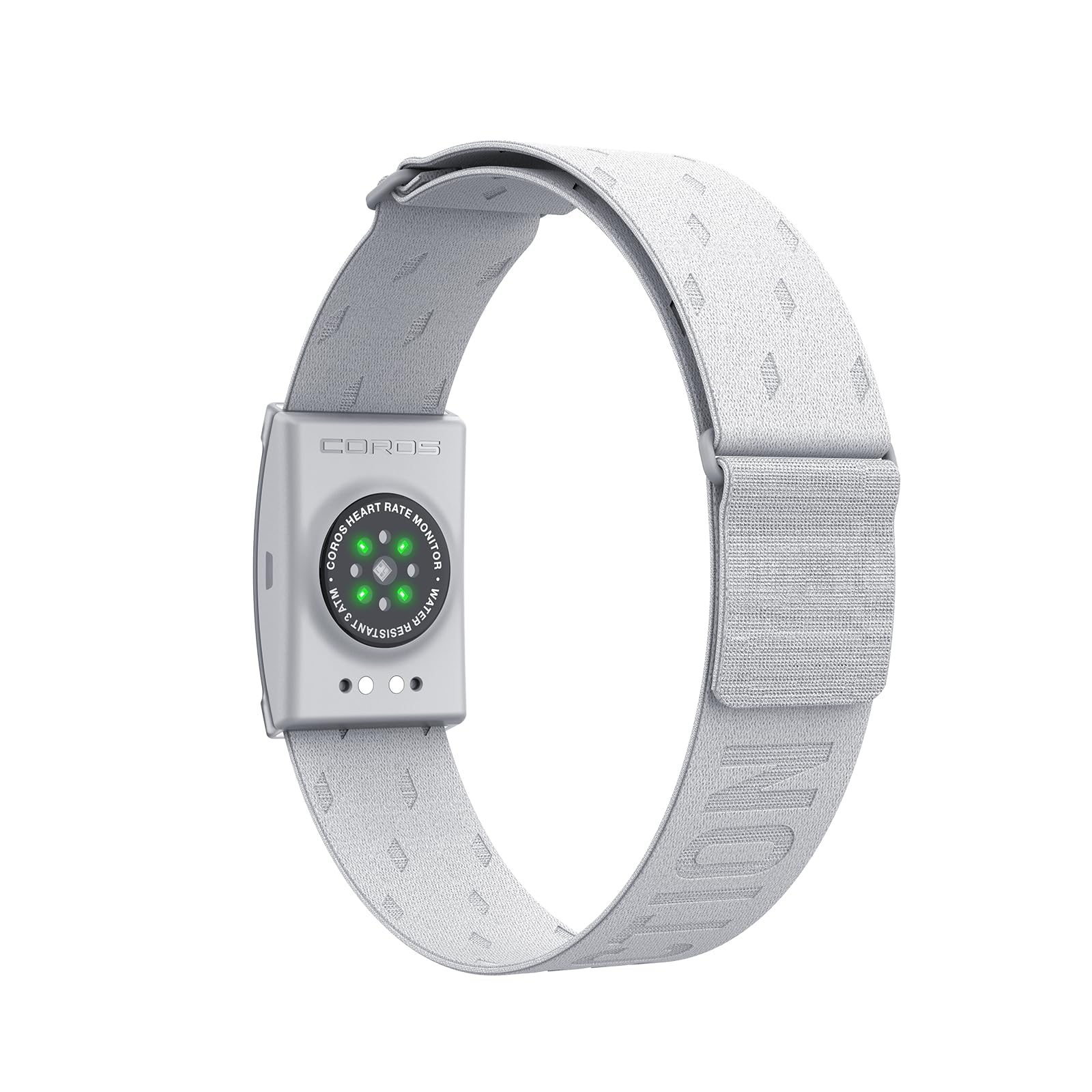
COROS Heart Rate Monitor

COROS

COROS Heart Rate Monitor

  • Weight 1.76 oz
  • Battery Life 38 hours
  • Device Pairing Up to 3 devices
  • Large Band Fit 9.4 to 16.9 inches
Check Price on Amazon

A comfortable armband that avoids chest-strap pressure and pairs with up to three devices.

The COROS is an armband rather than a chest strap, and the first thing we noticed is how little it feels like a heart rate monitor. The fabric band wraps around the upper arm, lays flat, and locks with a textured surface, so there is no chest strap to tighten or moisten before a run. It is designed for training, and that focus shows in the fit: light, breathable, and easy to forget. For anyone who has given up on chest straps because of pressure or chafing, this is the pick we point to first.

The sensor pairs with up to three devices at once, which is more useful than it sounds if you run with a watch and a phone or switch between a bike computer and an app. In our sessions, the readings tracked effort closely and adjusted quickly when the pace changed. The 38-hour battery is rechargeable and lasts through a training week without a cable, and the band is easy to remove and rinse after a sweaty session.

The one place to slow down is pairing: with non-COROS devices, connect inside the training app rather than through your phone's Bluetooth menu, and give it a moment. For strength work, cycling, and treadmill sessions, the armband stays out of the way in a way a chest strap never quite does. That comfort is the reason it earns a place here.

Bottom Line

We recommend the COROS armband to anyone who wants a chest-free heart rate monitor; it is comfortable, quick to wear, and pairs with three devices at once.

Check Latest Price

Best Budget

Our Score 8.4/10
COOSPO H6

COOSPO

COOSPO H6

  • Weight 1.94 oz
  • Battery Life 300 hours
  • Connectivity Bluetooth 4.0 and ANT+
  • Water Rating IP67
Check Price on Amazon

A low-cost chest strap with dual Bluetooth and ANT+ that covers the basics.

The H6 is the budget strap here, and it arrives as a plain chest strap and pod with no case and no charging cable, because there is nothing to charge. That is fine by us: the job is to send heart rate to a phone, bike computer, or gym machine, and it does that at a fraction of the cost of the premium straps here. The dual Bluetooth and ANT+ radio gives you more ways to pair than you might expect at this end of the market, and the IP67 rating covers sweat and rain.

The sensor is light, the strap is comfortable enough for long sessions, and the listed 300-hour battery life is a long runway. The CR2032 is replaceable, so a dead battery is a quick swap. We used it for indoor rides and treadmill intervals, and the numbers were consistent once we were connected. The LED and beep give you a quick confirmation that the pod is awake, which is more helpful than it sounds when you are already on the bike.

What the H6 lacks is polish. The setup can be frustrating, and pairing can take a few tries, especially if you start in the phone's Bluetooth menu instead of the training app. Those are the kinds of annoyances that matter more when you are late for a class than when you are setting up at home. As a first strap, a spare for a second setup, or a low-cost way to get heart rate into Peloton and Zwift, it makes sense. It is not the monitor we choose when the training block matters.

Bottom Line

We keep the H6 in the budget conversation because it brings dual Bluetooth and ANT+ to a very low price, and it covers the basics for indoor training.

Check Latest Price

Best For Spare or backup

Our Score 8.4/10
GEOID HS500

GEOID

GEOID HS500

  • Battery Life 800 hours
  • Connectivity ANT+ and Bluetooth
  • Wake-Up Time Under 1 second
  • Water Rating IP67
Check Price on Amazon

An 800-hour battery is the kind of number that makes a monitor easy to live with, and it is the first reason the HS500 caught our eye. The sensor wakes in under a second, flashes an LED when it is on, and carries an IP67 rating for sweat and rain. On paper, it covers the basics for a very low price, and the replaceable battery means you are not tied to a charger. For a spare strap or a first step into heart rate training, that is a sensible combination.

In use, the HS500 is a simple strap: it pairs over ANT+ or Bluetooth, and the LED takes some of the guesswork out of whether it is awake. We found it best suited to a gym bag or a second bike, where a missed reading is annoying rather than race-changing. The chest strap stayed put during steady indoor rides, and the quick wake-up meant we were not standing around waiting for a number. It is not the monitor we reach for when the session is the priority.

The HS500 is a basic strap, not a training computer, and that is the right way to read it. If you want a monitor to leave in a locker or use on a second bike, it is easy to justify. For a PR attempt or a race, we reach for one of the Garmins.

Bottom Line

We see the HS500 as a cheap spare or a first dip into chest-strap training, not the monitor we trust for every key session.

Check Latest Price

How We Tested 11 Heart Rate Monitors Over Six Months

We started by pulling every monitor we could find that logged heart rate continuously, exported data, and paired with both a phone and a watch, then cut the list by price and sensor type until 11 were left — a mix of chest straps, wrist bands, and armbands shared among four staffers for six months.

Each unit was worn alongside a chest strap we already trusted during the same sessions: 30-second treadmill intervals, easy outdoor runs in cold weather, bike commutes, lifting, and full nights of sleep. We watched for lag, timing how long a reading took to catch up when heart rate spiked or dropped, and for dropouts, which usually landed when a sensor lost skin contact or a strap crept loose.

Comfort got checked the unglamorous way: a full day of wear, straps tightened and loosened mid-run, and fabric bands washed repeatedly to see which went stiff or frayed. We timed how long pairing took with a phone and a watch and noted how often Bluetooth or ANT+ cut out mid-workout. Battery life was logged from full charge to shutdown with continuous tracking on, along with whether the app's remaining-battery estimate was anywhere near the truth.

Durability came down to small things — clasps that worked loose, pods that survived a drop on a gym floor, straps that stretched out of shape. Value we judged on what you actually get: a pricier monitor that leans on a clunky proprietary app lost ground to a plainer one that simply worked.

How to Choose

Chest Strap or Armband?

A chest strap reads the heart's electrical signal and tends to respond quickly when your effort changes. An optical armband reads blood flow at the arm, which can be more comfortable and easier to put on, especially if you dislike pressure around the ribs. We choose a chest strap for intervals, cycling, and anything where we want the reading to track a surge immediately; we choose an armband for steady sessions and strength work where a chest strap feels restrictive. Neither design works if the fit is loose.

Fit and Contact Matter More Than the Marketing

A heart rate monitor is only as good as its contact with your skin. Chest straps need to sit against the sternum, with the electrodes dampened before a dry start; armbands need to sit flat on the upper arm or forearm, snug enough not to shift but not so tight that they leave a mark. If readings start low and climb, or spike and fall, check placement before you blame the sensor. A strap that slips will eventually give you a bad number.

Match the Radio to Your Gear

Most dedicated monitors use Bluetooth, ANT+, or both. Bluetooth is the safer bet for phones and apps; ANT+ is common on bike computers, gym equipment, and older watches. Dual-protocol monitors are the flexible choice because they can talk to a phone and a head unit without changing settings. The catch is that pairing happens inside the app or device menu, not in your phone's general Bluetooth list. Check the protocol your main training device expects before you buy.

Battery, Data, and the Cost of Ownership

A replaceable battery can run for hundreds of hours, while a rechargeable pod may need a cable every few weeks or months. Neither is automatically better: replaceables are forgettable until they die, and rechargeables save battery purchases but add another charging habit. Data depth is the other long-term cost. HRV, running dynamics, and onboard recording are useful if you review them; otherwise they add price and complexity. We prefer a simple strap that fits well to a feature-heavy one that sits uncharged.

Durability and Care

Sweat is the enemy of straps and pods. Rinse the strap after hard sessions, follow the maker's washing instructions, and let it air-dry. A machine-washable strap is a genuine convenience, but only if you remove the pod first. Even with care, straps stretch and electrodes wear; replacement straps are part of ownership, not a sign you bought badly. We treat a monitor as a consumable piece of kit, which is why a replaceable strap and a clear warranty matter.

Frequently Asked Questions

Final Verdict

For most people, the Garmin HRM 200 is the heart rate monitor we recommend. It reads consistently, pairs with the gear most of us already own, and runs for a year on a replaceable battery, so it disappears into the training routine instead of becoming another device to charge. If you want running dynamics, HRV, and onboard recording, the Garmin HRM 600 is the upgrade that earns its premium. If a chest strap is the part you dread, the COROS armband is the comfortable alternative. Everyone else can buy the HRM 200 and stop thinking about it.