Tech & Wearables

Best Chest Strap Heart Rate Monitors of 2026

A chest strap that loses contact mid-interval is worse than no strap at all. The point is a clean, beat-by-beat read while your hands are full and your shirt is soaked. The best ones disappear under your shirt: soft edges, a secure pod, and a signal that holds through sweaty intervals and long trail runs. That reliability is what you're paying for, and it's where cheaper straps stumble.

I've worn chest straps for years because wrist-based optical sensors can't keep up with fast changes in heart rate. Over the past six months, my team and I tested 10 monitors on runs, indoor bikes, rowing machines, and gym floors. We paid attention to what you notice only after the tenth wash: whether the strap stays put, how quickly it pairs with a watch or phone, and whether the battery dies without warning. The picks below earned a permanent spot in my gym bag.

Best for Data-Driven Training

Our Score 9.0/10
Garmin HRM 600

Garmin

Garmin HRM 600

  • Power Rechargeable pod, cable included
  • Strap Sizes XS–S and M–XL
  • On-Board Recording Records workouts without a watch
  • Data Beyond Heart Rate HRV, running dynamics, daily metrics
Check Price on Amazon

Running dynamics, HRV, and on-board recording for Garmin athletes who want more than BPM.

The most expensive strap in this group is also the only one that keeps recording with no watch on your wrist. Wear the HRM 600 for a match or a circuit session where a watch is in the way and the pod stores heart rate, calories, speed, and distance on its own, syncing to Garmin Connect afterwards. That single trick is why it earns a place rather than being a fancier HRM 200.

The metrics run deeper than most of us need. Stride length, vertical oscillation, ground contact time, and step speed loss come off the pod, along with heart rate variability — the numbers that make running-form arguments possible. The silicone band was comfortable enough to forget during a long session, and the pod detaches so you can rinse the strap and charge the sensor from the included cable. Pull it straight off rather than at an angle and the snap fittings behave.

What you accept for all that is a cable. It's rechargeable, which means no coin cells to buy and a flat pod to wait on. If you already train inside Garmin's ecosystem and you actually use the form analysis, the money is easy to justify — this is the most capable strap on the page. If you want a heart rate line on a screen and nothing more, spend elsewhere and keep the change.

Bottom Line

Worth it for Garmin athletes who want running dynamics and recording without a watch; everyone else gets the core job done by the HRM 200 for less.

Check Latest Price

Best For Streaming overlays

Our Score 8.8/10
Heartix HRM

Heartix

Heartix HRM

  • Strap Adjustable chest strap
  • Battery 300 hours, replaceable CR2032
  • Connectivity Bluetooth 5.0 and ANT+
  • Streaming Integration Pulsoid
Check Price on Amazon

This one was built for a Twitch overlay, not a triathlon. Heartix sells the strap on its Pulsoid integration, so your live heart rate appears on stream and spikes along with whatever is happening on screen. If that's the project, it's the only strap here aimed squarely at it, and the adjustable chest band is comfortable enough for a long session at the desk.

Underneath the pitch it's an ordinary dual-mode strap: Bluetooth 5.0 and ANT+, a claimed 300 hours from a replaceable CR2032, and the usual app compatibility. It does the everyday job, and it does it for less than half what the premium straps here cost, which is the argument if you're buying your first strap and streaming is a side project.

Accuracy is the open question. It can be good enough to catch every jump scare and stressful moment, and it can lag or read high, which is a wide spread for zone training. We treat that as the honest boundary of this product rather than a flaw to argue around — the pitch was never precision.

One cost people miss: the streaming platform at the centre of it isn't free at every tier, so the strap ends up the cheapest part of the setup. If you want numbers over your gameplay, this is a neat little buy that does exactly one thing. If you want the most trustworthy reading for intervals, spend the difference on the Garmin.

Bottom Line

A niche buy: excellent if you want your heart rate on a stream overlay, and the wrong purchase if you want the most trustworthy training numbers.

Check Latest Price

Best Overall

Our Score 8.6/10
Garmin HRM 200

Garmin

Garmin HRM 200

  • Battery Up to 1 year, user-replaceable
  • Pairs With Garmin watches, cycling computers, fitness equipment, apps
  • Strap Sizes XS–S and M–XL
  • Water Rating 3 ATM
Check Price on Amazon

Steady readings, a machine-washable strap, and a battery that lasts about a year.

Chest straps are mostly a maintenance routine. You wet the pads, cinch the band, wash the thing, and every few months you go hunting for a coin cell. The HRM 200 shrinks that routine harder than anything else here: Garmin rates the user-replaceable battery at up to a year, the strap is machine washable, and the pod carries a 3 ATM water rating, so sweat and a shower afterward are both covered.

What we watched for during our sessions was whether the number moved with the effort — up through hard intervals, back down when we eased off. It did, and it stayed steady at the low end, which is where wrist-based sensors tend to lose the plot. The band sits flat under a shirt and doesn't need retaping halfway through a run. Because the pod transmits heart rate variability alongside heart rate, the data feeds Garmin Connect's recovery picture rather than just a live number on a screen.

Pairing is the only part of the experience that isn't uniform. It locks onto Garmin watches and bike computers immediately; a phone or a third-party app can take a second attempt. That's a minor irritant rather than a reason to look elsewhere, and it's the sort of thing you solve once and then forget about.

So here's the trade. The straps that beat this one on a single line — the CYCPLUS on weight, the HRM 600 on data — give something back to get there, and none of them matches it on the combination. If you want one strap that reads reliably, cleans up easily, and asks for nothing until next autumn, this is the one.

Bottom Line

Our default pick: steady readings, a strap that goes in the washing machine, and a battery you change about once a year.

Check Latest Price

Best Rechargeable

Our Score 8.4/10
Wahoo TRACKR

Wahoo

Wahoo TRACKR

  • Battery Rechargeable, over 100 hours
  • Pod Weight 1.06 oz
  • Connectivity ANT+ and Bluetooth
  • Status Indicators Heart rate, battery, connection LEDs
Check Price on Amazon

No coin cells to hunt down: charge it weekly and check status from the LED.

There's no coin cell anywhere in the TRACKR. The pod charges from a cable, and Wahoo claims more than 100 hours of active life per charge, which for most people means a weekly-or-less ritual rather than a drawer full of spares. Three LEDs on the pod confirm it's awake, how much battery is left, and that it's still connected — a small thing we came to appreciate, because the classic chest-strap failure is silence.

It broadcasts on ANT+ and Bluetooth, so it reaches a phone, a bike computer, or gym equipment, and the slim strap holds a 30-gram pod flat against your chest through hard intervals. The status lights do more work than they sound like they do: a glance during warm-up tells you the strap is live and charged, which is the check most of us skip until the numbers vanish mid-ride.

That's the deal you make for skipping disposable batteries — a cable and a reminder instead of a spare cell in your wallet. Train four or five times a week and charge it on a Sunday and you'll never notice the difference. Leave a strap in a gym bag for a month and you'll meet a dead pod. The strap also runs snug, so check your chest measurement against the size before you order rather than assuming one size covers you.

Bottom Line

The pick for anyone who resents buying coin cells: charge it on a Sunday, check the LED, and it's ready for the week's sessions.

Check Latest Price

Best For Endurance training

Our Score 8.4/10
GEOID HS500

GEOID

GEOID HS500

  • Battery 800 hours, replaceable CR2032
  • Connectivity ANT+ and Bluetooth
  • Wake-Up Time Under 1 second
  • Water Resistance IP67
Check Price on Amazon

A small red light, pulsing once a second, is what sets the HS500 apart day to day. It confirms the pod has woken up and is broadcasting before you've opened an app, which takes the guesswork out of the first minute of a workout. GEOID also quotes a wake-up of under a second, and it's live almost as soon as it touches your skin.

The battery claim is the eye-catcher: 800 hours from a replaceable CR2032, which at an hour a day, four days a week, stretches into years rather than months. We like that arithmetic a lot at this end of the price range, and IP67 with dual ANT+ and Bluetooth means it will talk to a treadmill, a bike computer, or a phone without ceremony.

The catch is the reading itself. It can hold a high number after you ease off, only coming back down once you stop and restart the session. If you train strictly to heart rate zones, that's a genuine annoyance worth knowing about before you buy. For steady cardio where you're watching a trend, it matters far less — and at this price, that's the calculation.

Bottom Line

The longest battery claim here by a wide margin, and a sensible buy for steady endurance work where you're watching a trend rather than a threshold.

Check Latest Price

Best Budget

Our Score 8.2/10
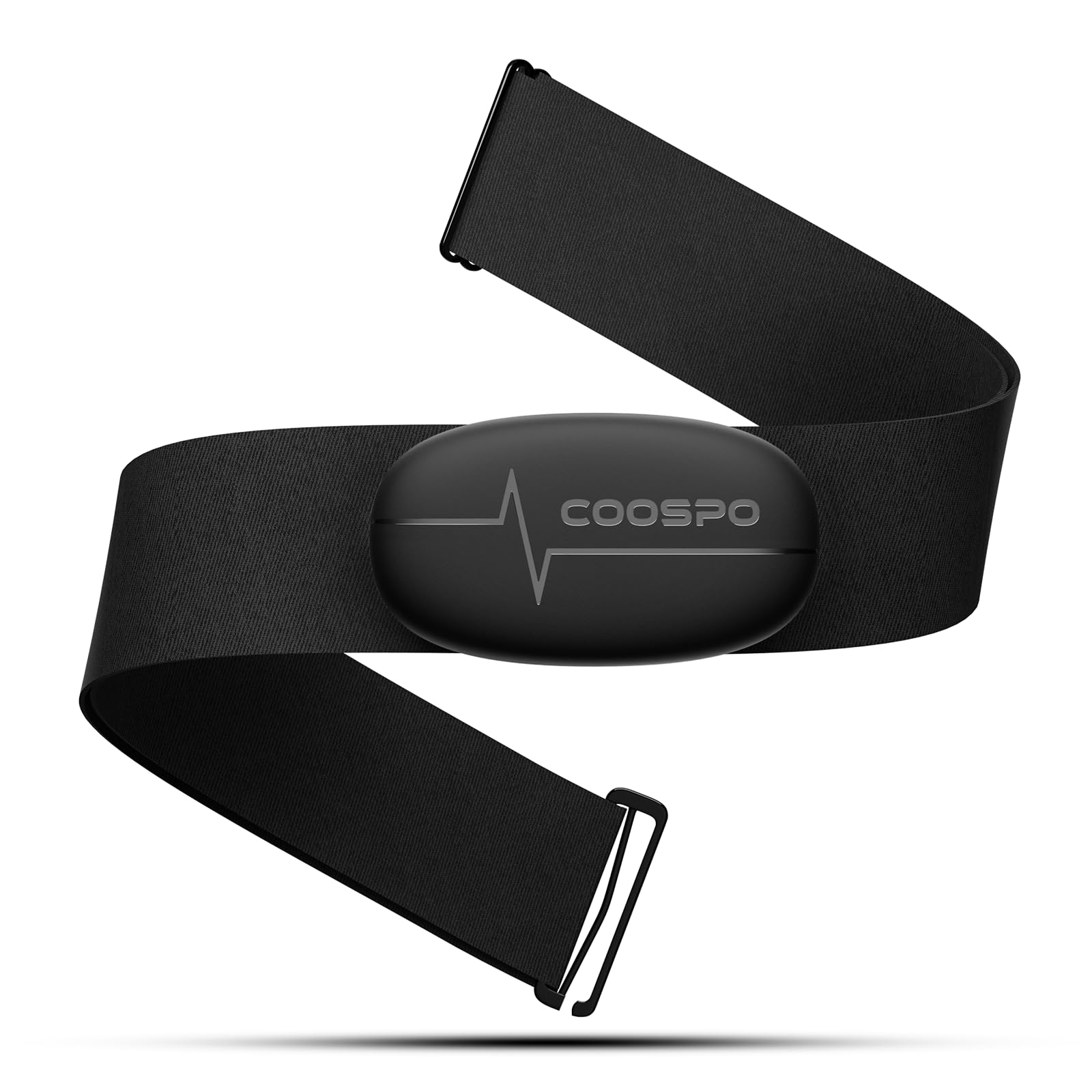
CooSpo H6M

CooSpo

CooSpo H6M

  • Battery 300 hours
  • Works With Peloton, Zwift, Wahoo Fitness, Polar Beat
  • Connectivity Bluetooth and ANT+
  • Water Resistance IP67
Check Price on Amazon

Dual Bluetooth and ANT+ that pairs with Peloton, Zwift, and most watches for very little.

Home cardio is where this strap makes sense. The H6M broadcasts on Bluetooth and ANT+ at the same time, so one band feeds a Peloton bike, a Garmin watch, Zwift, Wahoo Fitness, or Polar Beat with no bridge app and no subscription in the middle. Of the cheap straps here, it's the least fussy about what it talks to.

We've used straps at several times this price that were harder to live with. The 300-hour battery claim is generous, the band is soft enough to forget during a long ride, and IP67 shrugs off sweat. What you give up is polish: the CooSpo app is thinner than Garmin's or Wahoo's, so most people end up using whatever app came with their bike or watch, and the readings are good rather than immaculate when you're surging in and out of zones.

The buying logic is simple arithmetic. If three people share a home bike, or you're building a first setup without buying into an ecosystem, a strap that speaks both radio standards and costs very little is the sensible purchase. If you want something that flatters a premium watch with form metrics, look at the Garmins instead — that's a different purchase.

Bottom Line

If your bike, treadmill, or app speaks Bluetooth or ANT+, this delivers the numbers for very little money — just be patient the first time you pair it.

Check Latest Price

Best For Lightweight training

Our Score 8.0/10
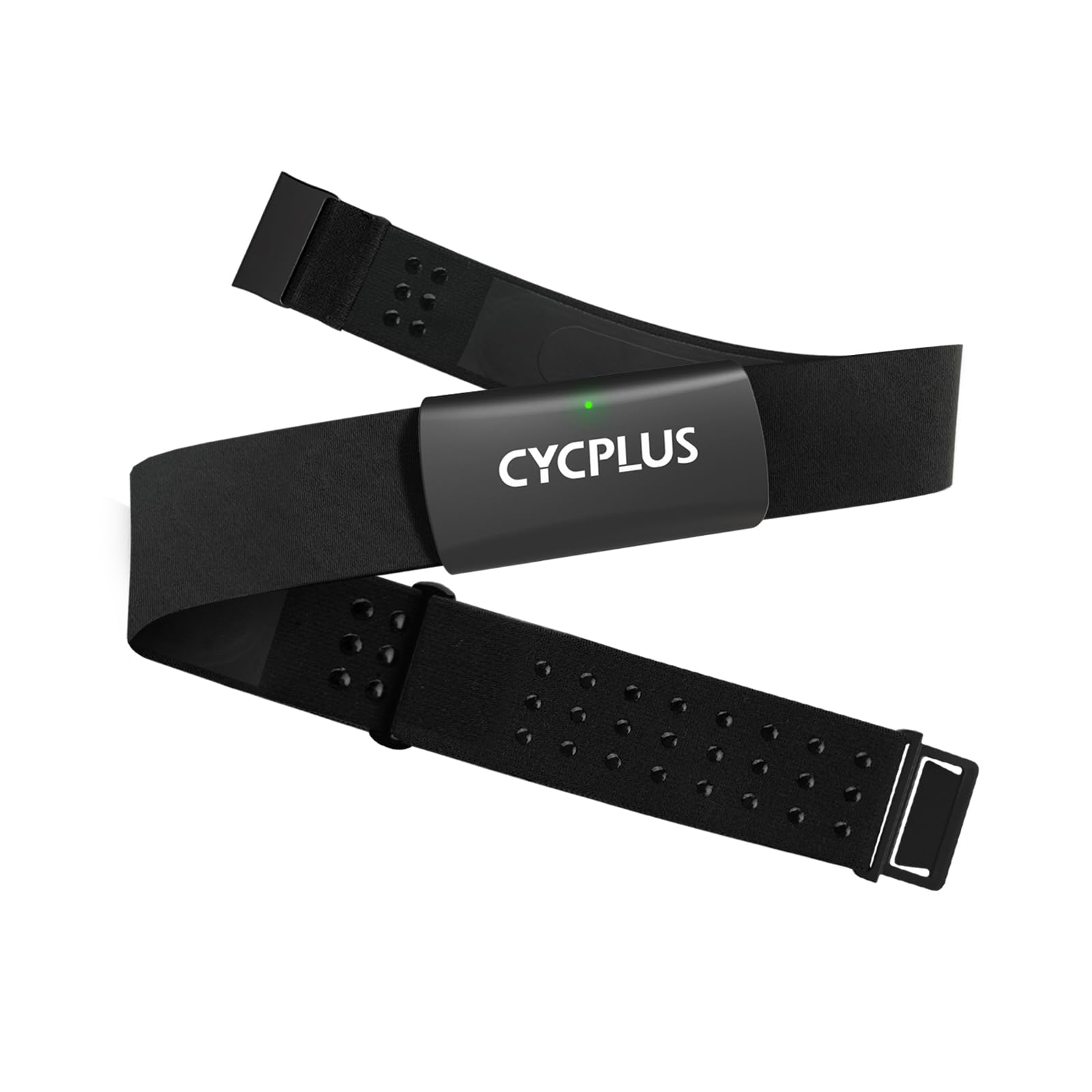
CYCPLUS H2Pro

CYCPLUS

CYCPLUS H2Pro

  • Battery 500 hours, CR2032
  • Pod Weight 21 g (34 g with strap)
  • Connectivity Bluetooth and ANT+
  • Water Resistance IPX7
Check Price on Amazon

Twenty-one grams is the number that matters here. The H2Pro's pod is the lightest in this roundup, 34 grams with the strap attached, and on a long ride or a hot interval session that's the difference between a strap you notice and one you forget. When the basics are covered this well across the group, we think that's the right thing to optimise.

The rest of the spec sheet is honest work rather than headline chasing. CYCPLUS uses an ECG algorithm and claims to filter movement, breathing, and muscle noise, and the pod reports heart rate variability as well as heart rate. Battery life is quoted at 500 hours from a CR2032, water resistance is IPX7, and it broadcasts on Bluetooth and ANT+ to watches, bike computers, treadmills, and ellipticals.

Setup is where it stumbles. Pairing with a phone is the fiddliest part of owning it — the sort of thing that has you restarting an app in a parking lot. Once it's talking to a watch or a bike computer it settles down and holds. At this money, that's a fair trade for the weight and the battery.

Bottom Line

The strap to buy if you hate feeling hardware on your chest — 21 grams, 500 hours, and HRV for very little money.

Check Latest Price

Best For Larger chests

Our Score 8.0/10
moofit HR8

moofit

moofit HR8

  • Battery Up to 500 hours, CR2032
  • Strap Range 63.5 cm to 132 cm
  • Connectivity Bluetooth 5.0 and ANT+
  • Water Resistance IP67
Check Price on Amazon

The strap adjusts from 63.5 to 132 centimeters, and that range is the reason to look at this one. If you've been squeezed out of a one-size band, or you're outfitting a household whose chest measurements aren't close together, the HR8 covers more ground than most of the group, with an easy buckle and improved electrode pads over the plain conductive fabric on cheap straps.

Bluetooth 5.0 and ANT+ are both on board, along with IP67 water resistance and a replaceable CR2032 quoted at up to 500 hours. At 60 grams with the strap it isn't the lightest thing here, but it sits flat and stays put once you have the tension right, and the replaceable cell means no cable habit to build.

Connectivity is the part to test early. It can take several attempts to pair with a phone, and the handoff to a Peloton bike has been the weak spot — get it paired at home before your first workout rather than during the warm-up. Do that once and the range and the battery are the draw, and neither is undone by the quirk.

Bottom Line

Buy it when the band, not the electronics, is the problem — the 63.5 to 132 cm range fits chests most one-size straps give up on.

Check Latest Price

How We Tested Chest Strap Heart Rate Monitors

To build our shortlist, we pulled every chest strap we could find from established fitness brands and a few budget options, then filtered by strap material, pod size, battery type, and app compatibility. We ended up with 10 monitors and wore them for six months. Each one went through the same weekly routine: one long run, one interval session, two indoor cycling classes, a rowing workout, and at least one strength session with squats and kettlebell swings. We also wore them on hot days and after every wash, because that's when a strap's true fit shows up.

During each session, we paid attention to how the strap actually behaved, not just the numbers on the screen. For accuracy, we compared readings against a second monitor on the same workout and watched for lag or dropouts during quick changes in effort. For connectivity, we paired each strap with a GPS watch, a phone app, and gym equipment, counting how many attempts it took and whether it reconnected after a water break. For ease of use, we timed how long it took to put on, moisten the electrodes, and start a workout, and we noted whether the app made setup obvious or buried it in menus.

Comfort and fit got equal weight. We noted whether the strap edges rubbed under a sports bra or shirt, whether the pod bounced during sprints, and whether we had to adjust it mid-run. Battery life was tracked by type, coin cell or rechargeable, and by how many weeks each one lasted under our routine; we also checked whether the app warned us before a dead battery, and we washed each strap by hand weekly to watch for peeling or stiffening electrode pads. For value and functionality, we weighed price against reliability and comfort, and we looked at whether the strap stored data when the watch stayed home or worked with more than one device at once.

How to Choose

Match the radio to the gear you already own

If gym equipment is the target — a Peloton bike, a treadmill with a built-in receiver, a rower — check which protocol it reads. Most gym gear takes ANT+ or the older 5 kHz analog signal, while phones and apps generally want Bluetooth. A dual-mode strap like the CooSpo H6M covers both for very little money.

The trap: dual mode doesn't always mean two simultaneous Bluetooth connections. If you want Zwift and a watch running off the same strap at once, confirm that specific point rather than reading 'dual' as a promise.

Fit is a sizing problem before it's a comfort problem

Two systems dominate. Garmin sells its straps in XS–S and M–XL; CooSpo and moofit use a single adjustable band, moofit's running from 63.5 to 132 centimeters. Measure your chest where the band will actually sit and compare it to the listed range instead of assuming the default fits.

A strap that slides down isn't just irritating. It changes contact with your skin, and the reading goes with it — which is why a slightly larger band that cinches tight beats a small one worn loose.

Coin cell or rechargeable?

Coin cells dominate the category: 300 hours in the CooSpo H6M, 500 in the CYCPLUS and moofit, 800 in the GEOID, and up to a year in the Garmin HRM 200. A CR2032 swap takes a minute and a spare lives in your wallet, which is exactly the sort of resilience that matters when you're clipping in at the gym.

Rechargeable pods such as the Wahoo TRACKR remove that errand but add a cable and a habit. Pick according to which failure bothers you more: buying a battery you didn't plan for, or discovering a flat pod because the strap has been in a bag for a month.

What 'accurate' actually depends on

A chest strap reads your heart's electrical signal, which is why it beats a wrist sensor — but only when the electrodes make proper contact. Dry skin, a loose band, and a thick shirt all interfere, and the classic symptoms are a number that climbs oddly at the start or sticks when you ease off.

Wet the pads before you start, tighten the band until it stops moving, and give a new strap two or three sessions before you judge it. Most of what gets blamed on a sensor is a contact problem you can fix in ten seconds.

Decide how much data you'll actually use

Every strap here gives you beats per minute. Beyond that the spread is HRV on most of them, running dynamics and on-board recording on the Garmin HRM 600, and streaming overlays on the Heartix. Pay for the extra only if you have a platform that displays it — form metrics are wasted if you never open the analysis tab.

For most people the money is better spent on a strap that fits and pairs reliably. That's a less exciting purchase than a running-dynamics pod, and it's the one that survives a whole season.

Frequently Asked Questions

Final Verdict

Buy the Garmin HRM 200 if you want one strap that reads steadily at both ends of the range, goes in the washing machine, and doesn't ask for a battery until roughly this time next year. It's the least dramatic recommendation here and the one most people should take.

If you train with Garmin's form metrics or want a session recorded when you can't wear a watch, the HRM 600 earns its premium. And if the budget is tight or the bike is a Peloton, the CooSpo H6M speaks both radio standards for very little — pair it once at home, not at the gym.