Strength & Weights

Best Dumbbell Sets with Racks of 2026

My home gym used to be a pile of mismatched dumbbells—until I admitted that hunting for a missing 15-pounder was ruining my workouts. A dumbbell set with a rack promises to fix that: everything in its place, ready when you are. But plenty of sets arrive with racks that wobble under load, weights that smell like a tire fire, and handles that chew up your palms. We've spent the past six months assembling and living with 10 different sets to find the ones that get the basics right.

The best sets nailed the details: accurate weight plates, comfortable knurling, solid welds, and a rack that goes together without a second person or a missing bolt. They looked decent enough to leave out in a garage, and they didn't cost a fortune. We ran each set through weeks of squats, presses, and carries, noting assembly time and how the rubber smelled after a week. The picks below are the ones we kept reaching for.

Best For Light toning, rehab

Our Score 9.4/10
HolaHatha 3-15 lb Set with Rack

HolaHatha

HolaHatha 3-15 lb Set with Rack

  • Rack Compact storage rack
  • Coating PVC over cast iron
  • Total Weight 106 lb
  • Pairs Included Six pairs, 3 to 15 lb
Check Price on Amazon

Six pairs arrive colour-coded, so the 3s are one colour and the 15s are another, and you can grab the right weight mid-set without reading a stamp on the head. It is a small thing that stops mattering right up until your hands are full and you are swapping between a warm-up set and a working set.

Under the coating it is cast iron, with hex heads and a smooth PVC finish that looks tidy enough to leave out on the stand rather than stack in a corner. The colours are saturated and even, and the grip suits bare-handed high-rep work: a 15-pound dumbbell does not need knurling, and this handle does not slip when your palms get damp.

What it will not do is grow with you. Fifteen pounds is the ceiling, which makes this a toning, rehab, aerobics and warm-up set — genuinely useful for a shoulder recovery or a cardio circuit, frustrating the first time you want to press something heavier. The stand is a light frame holding twelve dumbbells and deserves a flat, hard floor and properly tightened fasteners; it is the piece of this package we trust least.

Bottom Line

A well-made, colour-coded set for rehab, warm-ups and light toning — just do not expect it to carry your strength work past 15 pounds.

Check Latest Price

Best Budget

Our Score 9.2/10
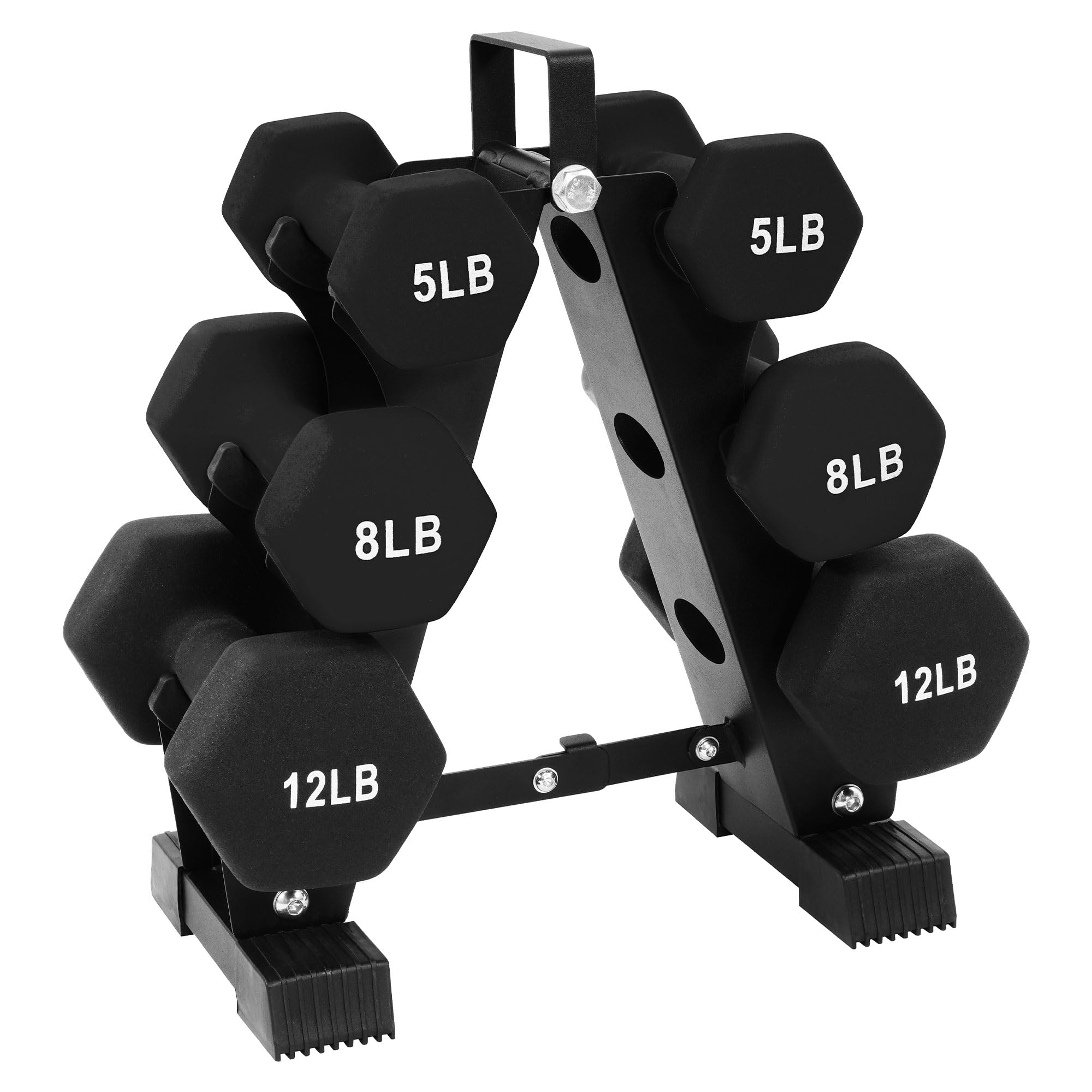
BalanceFrom 50 lb Neoprene Set with Rack

BalanceFrom

BalanceFrom 50 lb Neoprene Set with Rack

  • Rack Compact stand, tools included
  • Coating Neoprene over cast iron
  • Total Weight 50 lb
  • Pairs Included Three pairs, 5 to 12 lb
Check Price on Amazon

Three pairs and a compact stand for small spaces and smaller budgets.

The jump from 5 pounds to 8 is a 60 percent increase; the jump from 5 to 10 that most five-pair sets give you is 100 percent. That gap is why this small BalanceFrom set earns a place. For shoulders, arms and rehab work, a gentler step between pairs matters more than a big total on the box, and you get three pairs — 5, 8 and 12 pounds — in neoprene over cast iron, plus a stand.

The neoprene is soft and dry in the hand, the hex heads stop the dumbbells rolling off a bench, and the stand goes together in a few minutes with the tools that come in the box, no wrench hunt required. It holds all six dumbbells in a footprint you can shove into a closet corner or slide along a baseboard between sessions, which is the whole point of a set this size.

We were also surprised by how solid the stand feels at the budget end: it is a simple frame, but it takes the weight without the flex you get from the cheapest bundled racks, and that is the part of an inexpensive set that usually gives up first.

Bottom Line

Buy this if you are starting out or training small muscles at home: three pairs, a stand that assembles in minutes, and the gentlest first step between weights here.

Check Latest Price

Best For Tight home gyms

Our Score 9.0/10
PAPABABE 150 lb Set with Rack

PAPABABE

PAPABABE 150 lb Set with Rack

  • Rack Vertical storage rack
  • Coating Rubber-encased cast iron
  • Total Weight 150 lb
  • Pairs Included Five pairs, 5 to 25 lb
Check Price on Amazon

Same weight range as our top pick, same rubber-encased cast-iron build, same five pairs from 5 to 25 pounds. The Papababe set differs in the stand and in a couple of details that only show up after a week of use, and those differences are what keep it behind the CAP rather than beside it.

The rack is a tall vertical frame instead of a low A-frame, and if your training space is a narrow strip of wall between a car and a shelf, that shape is easier to live with. Assembly is straightforward, the weights sit securely once they are loaded, and the whole set stacks into a tall, narrow footprint rather than a wide one.

The handle is where to look first. The encasement sits close to the grip on the heavier pairs and there is not much clearance if your fingers ride high on the handle, so check where your knuckles land before you commit to a working set of presses. Count the pairs against the packing slip before the boxes go to the curb, too — a set this heavy arrives in more than one delivery, and a short shipment is far easier to sort out while the packaging is still in the house.

Bottom Line

The same 150-pound range as our top pick in a tall vertical rack, worth a look if the CAP stand will not fit the strip of floor you have.

Check Latest Price

Best Overall

Our Score 8.8/10
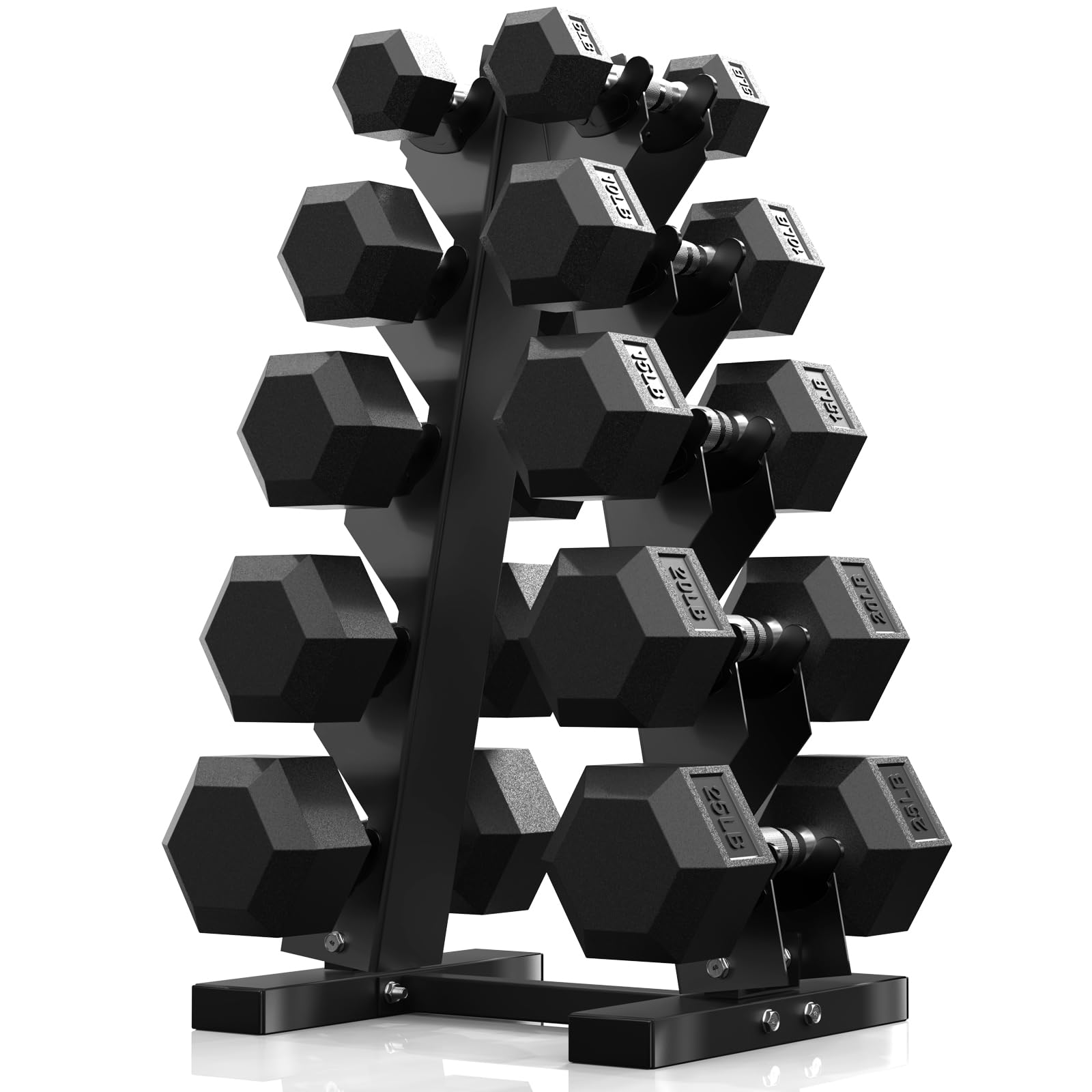
CAP 150 lb Rubber Hex Set with Rack

CAP

CAP 150 lb Rubber Hex Set with Rack

  • Rack Metal A-frame
  • Handles Knurled steel
  • Total Weight 150 lb
  • Pairs Included Five pairs, 5 to 25 lb
Check Price on Amazon

Five pairs to 25 lb on a metal rack that stays planted.

The rack is the part of a bundled set that usually lets you down, so it is where we started with CAP's 150-pounder. The frame is metal, A-shaped, and rated to the full weight of the set rather than to some fraction of it, and it sits flat on the floor instead of rocking on four skimpy legs. We loaded all five pairs and lifted the 25s off the top without the stand walking across the floor — which is exactly the moment most bundled racks give themselves away.

The dumbbells are the rubber hex shape that became standard for good reason: no rolling between sets, quieter when you put them down, and enough coating that a dropped 20 does not take a divot out of a garage floor. The knurled steel handles are the pleasant surprise. The texture is fine enough to use bare-handed and grippy enough that sweat does not turn a 25 into a bar of soap, and the five-pound jumps from 5 to 25 mirror what you would find on a gym rack.

Two things to plan for. The set ships in several boxes and the rubber smells strongly for the first few days, so open everything in the garage or on a porch, let it air out, then carry the pieces inside. Assembly takes a wrench, though the hardware comes in the box, and the frame goes together in one sitting.

What you are left with is a set that does not have to be hidden. The frame is narrow enough to tuck against a wall in a room you actually use, and the black-on-black finish reads more like furniture than gym equipment — the sort of thing you leave out rather than fold into a closet between sessions.

Bottom Line

We keep this one set up in a corner and pull from it every week: five pairs in five-pound steps, and a metal rack that does not flinch when you lift the 25s off.

Check Latest Price

How We Tested Dumbbell Sets with Racks

Over the past six months, we researched the market and narrowed a shortlist of 10 sets based on price, weight range, rack footprint, and materials—skipping any model with a pattern of missing-parts complaints. Each set was assembled in a one-car garage with a standard socket set, and we timed every build while noting whether the instructions were clear enough to follow solo. Before turning a single bolt, we inventoried every box against the parts list, counting washers and rack feet, because missing hardware can stall a build before it starts.

Once assembled, each set lived through a six-week strength block: goblet squats, farmer's carries, bench presses, and bent-over rows. We weighed every dumbbell on a digital kitchen scale to check accuracy, then shook the loaded rack to see how much it wobbled. Handles were tested bare-handed and with chalk, noting hot spots or slippery knurling. We also sniffed the weights out of the box and again after a week to track whether the rubber smell faded.

Appearance got judged the way you'd actually live with it: would we leave this rack visible in a finished basement, or hide it in the garage? We moved each rack across a concrete floor and onto a mat to see if it stayed stable and rolled without drama. Value came down to what you get for the price—accurate plates, a sturdy frame, and hardware that doesn't strip—not just the number on the tag.

How to Choose

Start With the Heaviest Pair, Not the Total

A 100-pound set sounds generous until you see it is four pairs topping out at 20 pounds, and a 50-pound set gives you a 12-pound ceiling. What you can actually do with a bundle is decided by the top pair and by how big the steps are between pairs. Five-pound jumps from 5 to 25 mirror what you find on a gym rack; sets that skip from 5 to 10 ask small muscles to take a 100 percent increase in one go.

Work backwards from the heaviest dumbbell you expect to press or row within six months. If you can already move 25s, a set that stops at 20 will annoy you inside a month; if you are starting from nothing, a lighter set with smaller first steps gets used more often.

The Rack Decides Whether You Keep It Out

Most bundled racks fail in the same moment: you lift the heaviest pair off the top and the empty frame tips or skates. Look for a wide base and a frame rated to the weight of the set it ships with — the CAP stand is rated to 150 pounds, exactly what its five pairs weigh — and treat a rack that is only described as compact as an unknown until you read the capacity.

Shape matters as much as strength. A low A-frame takes a patch of floor and is easy to reach into; a tall vertical rack trades width for height and suits the gap between a car and a shelf. Both work, but only one of them fits the spot you have.

Coating, Grip, and Your Floor

Rubber-coated hex heads are the safer choice for a garage, a basement, or any floor you care about: they do not roll, they land quietly, and the coating spreads the impact of a set-down. Neoprene is softer in the hand and better for light dumbbells used bare-handed, though it is usually found on the lighter sets.

Handles follow the same logic. Knurled steel holds through sweat and chalk and is what you want once the weights get heavy; coated handles are kinder on high-rep work with 10-pounders. Either way, a hex head on a rubber or neoprene body will protect the floor far better than a bare metal hex.

Assembly, Delivery, and Getting It Inside

A 150-pound set arrives as several boxes, often on different days, and the heavy pairs are the ones you want to carry in with two people rather than one. Hardware is usually included; a proper wrench makes the job quicker than the stamped tool in the box.

Assemble the rack where it will live, before the dumbbells are loaded, and keep the packaging until you have counted every pair against the packing slip. Sorting out a short shipment is much easier while the cartons are still in the hallway.

Frequently Asked Questions

Final Verdict

For most homes the CAP 150 lb set is the one to buy: five pairs in gym-style increments, rubber heads that protect the floor, and a metal A-frame that holds all of it without wandering while you lift. If the budget or the room is small, the BalanceFrom 50 lb set does the same job at a fraction of the weight and footprint, and it is the better first purchase for anyone new to lifting.

Light toning and rehab work is the one case where the HolaHatha set earns its higher price. Strength training past 15 pounds is not.