Strength & Weights

Best Squat Racks for Low Ceilings of 2026

A low ceiling turns a home gym into a geometry problem fast. You want a rack that feels planted under a heavy bar, but most full-size cages assume eight feet of clearance and a room you don't share with bins. The right low-ceiling squat rack solves that tension: short enough to clear joists and ductwork, stiff enough to trust its rated capacity. We tested six racks over eight months in basements, garages, and spare rooms, and the gap between “fits” and “works” was real.

Low ceilings expose every shortcut. Short uprights can feel twitchy unless the bracing and feet are sorted, and a rack that cannot be moved or adjusted is a poor fit for a room with two jobs. I care less about a long attachment list than whether the J-hooks move cleanly, the frame stays quiet after months of use, and assembly does not require a second person and a free weekend. Value here is not the lowest sticker price; it is the rack you still trust when the novelty wears off. The picks below earned their spot.

Best Half Rack for 8-Foot Ceilings

Our Score 9.2/10
FLYBIRD SR1 Squat Rack

FLYBIRD

FLYBIRD SR1 Squat Rack

  • Height 83 in
  • Safety 16.7-in safety arms
  • Barbell Fit 6- and 7-ft bars
  • Weight Capacity 950 lb
Check Price on Amazon

A compact half rack for closer to 8-foot ceilings, with long safety arms.

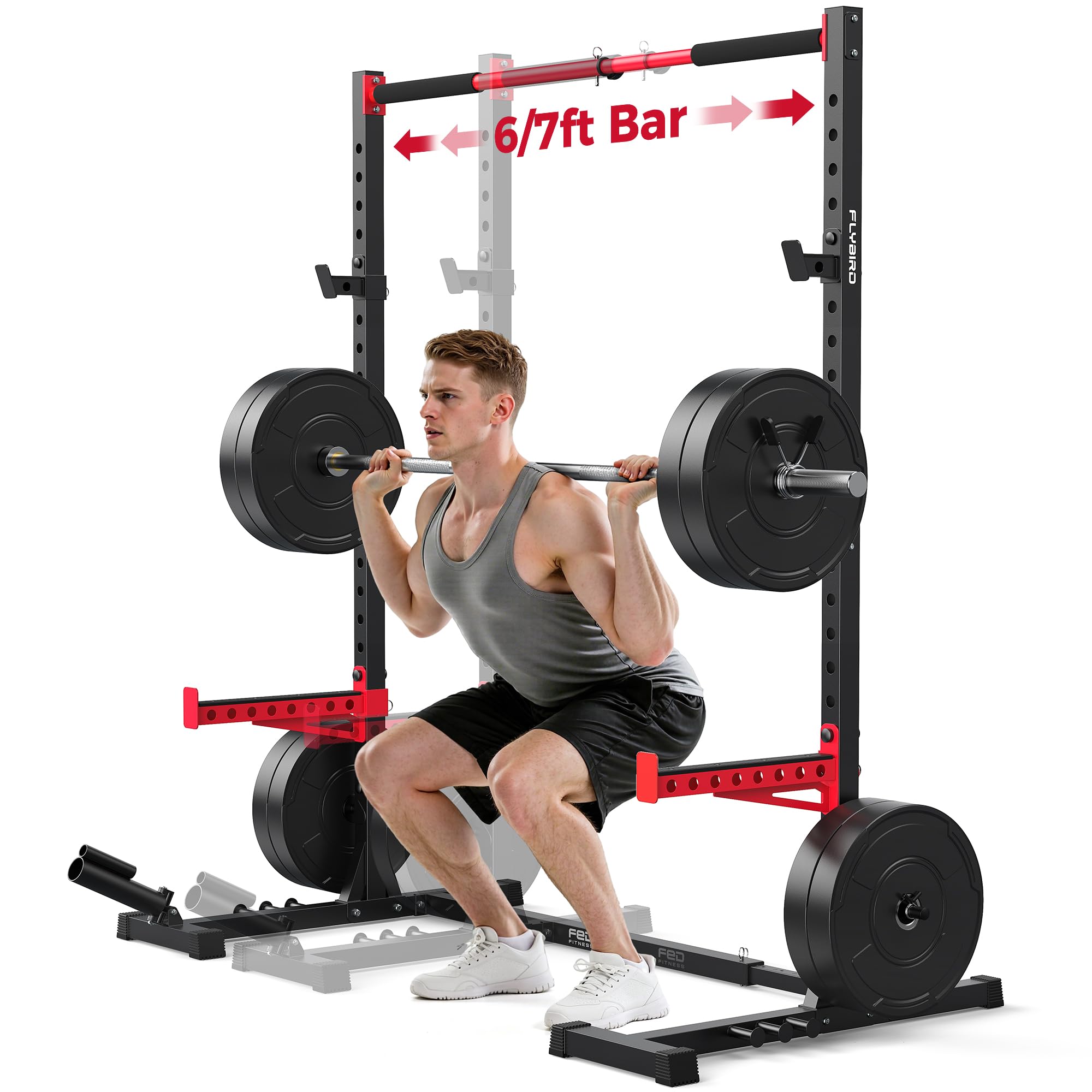
The 83-inch half-rack frame is the number to start with. It is not the shortest rack here, but it is the most complete package that still fits under a standard 8-foot ceiling. The frame uses 2-by-2-inch steel, rates to 950 pounds, and gives you 22 height settings, adjustable width for 6- and 7-foot bars, 16.7-inch safety arms, a landmine, band pegs, and a padded pull-up bar. We like that it does not ask you to choose between safety and a small footprint.

The catch is the ceiling itself. An 83-inch rack leaves only an inch under a 7-foot ceiling, and while it will physically fit, the pull-up bar is effectively out of commission and assembly gets tight. We think of this as a 7.5- to 8-foot-ceiling rack, not a true low-ceiling answer. If your ceiling is 7 feet, the JX or F2C is the safer starting point.

For the space it takes, the SR1 is a serious home-gym piece. The safety arms are long enough to be useful, the width adjustment covers common bar lengths, and the landmine adds rows and presses without another machine. The frame is still a half rack, so it does not have the enclosed feel of a full cage, but it gives you most of the safety with far less visual bulk.

Assembly is manageable with two people, and the parts are clearly marked. The half-rack design also leaves more open floor than a full cage, which makes the room feel less crowded. That matters when the rack shares space with a car or a workbench.

Bottom Line

This is the half rack we recommend when you want real safety arms, a landmine, and a pull-up bar in one compact frame.

Check Latest Price

Best Overall

Our Score 9.0/10
JX FITNESS Squat Rack

JX FITNESS

JX FITNESS Squat Rack

  • Storage Folds for storage
  • Footprint 48 x 44 in
  • Height Range 41–57 in
  • Weight Capacity 660 lb
Check Price on Amazon

The best low-ceiling default: 57 inches tall, 660-pound capacity, and a foldable frame.

The 57-inch top height is the first thing we check on any low-ceiling rack, and it is why the JX belongs at the front of this group. The uprights adjust from 41 to 57 inches in five steps, and the width moves across four settings, so you can set the hooks for squats and then drop them for bench press. The H-shaped frame gives it a planted stance on a flat floor, and the foldable design means the rack can come down when the space has to serve as a garage or laundry room again.

That low top height is also the trade-off. At 57 inches, the bar sits at a natural catch height for shorter lifters, but taller users will find the top setting below their squat position and the bench setup low. We noticed the difference most in the press: a long-torsoed lifter will want more room. Measure your shoulder height before you order, and if you are around 5-foot-8 or taller, look at the 66- to 70-inch stands below.

What we did not expect from a rack this short is how much capacity it carries. JX rates it to 660 pounds, and the steel frame feels more substantial than the compact dimensions suggest. It is not a competition cage, and we do not treat it like one, but for home-gym squats and presses at moderate loads it has enough margin. The foldable design is a real convenience, not a gimmick: the rack can be broken down and tucked aside when the workout is over.

Assembly is straightforward, with clear directions and tools included, and one person can manage it. The frame is light enough to move before you load it, but once it is set, the rack stays put on a level floor. For a low-ceiling room that has to do double duty, that combination of quick setup and easy storage is the useful part.

Bottom Line

For a true low-ceiling home gym, this is the short adjustable rack we recommend first: it tops out around 57 inches, holds 660 pounds, and folds away.

Check Latest Price

Best for Very Low Ceilings

Our Score 9.0/10
CANPA Adjustable Squat Rack

CANPA

CANPA Adjustable Squat Rack

  • Width Range 35.1–41.8 in
  • Height Range 50–57 in
  • Weight Capacity 600 lb
Check Price on Amazon

The lowest workable option here, with a 57-inch top and 600-pound capacity.

Fifty inches is low enough that the CANPA can sit under a basement ceiling that would swallow a normal squat stand. The uprights adjust from 50 to 57 inches in six steps, and the width moves from about 35 to 42 inches, so you can fit it around a shorter bar or a narrow corner. We were surprised by how much heft the 2-by-2-inch steel and H-base give it; it does not read as a toy, and the 600-pound rating gives it more headroom than the height suggests.

The missing piece is safety support. There are barbell hooks and a base, but no long spotter arms to catch a failed rep. We minded that because the rack is otherwise a smart low-ceiling solution; solo lifters have to be deliberate about load and know how to bail. The F2C pair is the alternative when catches are essential, but it costs you several inches of height.

Assembly is one of the better parts of the package: clear diagrams, simple hardware, and a frame that goes together without much fuss. The rack is also compact enough to move aside after a session. It is a specialist pick, but for the right basement it solves a problem the taller racks cannot.

Bottom Line

For a basement ceiling that rules out almost everything, this low 50-to-57-inch rack is the one we reach for first.

Check Latest Price

Best For 7-foot full rack

Our Score 9.0/10
Bongkim Power Rack

Bongkim

Bongkim Power Rack

  • Height 81.9 in
  • Feature Pull-up bar
  • Footprint 47.6 x 43.3 in
  • Weight Capacity 660 lb
Check Price on Amazon

Bongkim's 81.9-inch height is the number to check first. It gives you a cage-like frame, a pull-up bar, and 660-pound capacity without going over 7 feet. The rack is adjustable at the front and rear barbell shelves, and the overall frame feels sturdy for squats and presses. We found the assembly straightforward, with clear instructions and hardware, and the rack settles into a basement without the cramped feeling of a narrow stand. The footprint is 47.6 by 43.3 inches, so it still wants a dedicated corner.

The pull-up bar is a useful extra, and the cage-style frame gives you more places to mount accessories than a pair of stands. For squats and bench work, the adjustable shelves let you dial in bar height. The rack is not the easiest to move once assembled, so pick the corner before you build it.

What makes this one worth considering is the combination of a full-rack shape and a ceiling-friendly height. You get the enclosed feel and the pull-up bar without the 85-inch uprights of a standard power cage. That is a narrow window, but it is a useful one for a basement with exactly 7 feet of clearance.

Bottom Line

This is the full-rack option we recommend for a 7-foot basement ceiling, with the caveat that the 81.9-inch frame leaves only a couple of inches to spare.

Check Latest Price

Best For Light-load budget

Our Score 8.8/10
BARWING Adjustable Squat Rack

BARWING

BARWING Adjustable Squat Rack

  • Storage Weight-plate storage
  • Width Range 29–49 in
  • Height Range 34–58 in
  • Weight Capacity 350 lb
Check Price on Amazon

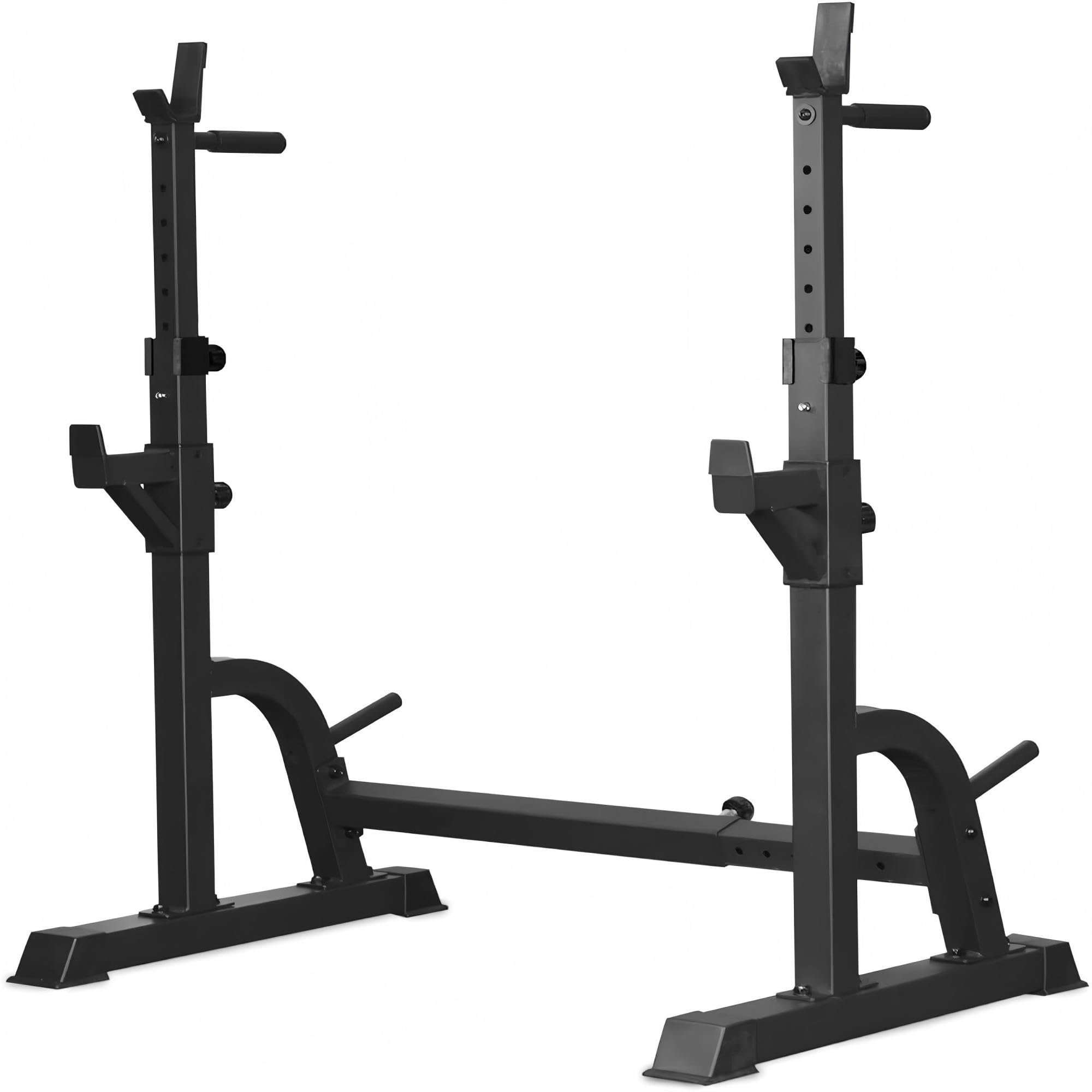
The 34-inch bottom setting is unusually low, and that is the point of the BARWING. It adjusts from 34 to 58 inches and from 29 to 49 inches in width, so it can sit in a basement or attic gym where even a 66-inch stand feels too tall. We appreciated the pop pins and locking knobs: changes between squat and bench height are quick, and you do not need to unbolt the frame.

The capacity is where the mood changes. The stated maximum is 350 pounds, even though the promotional text talks about 1,250 pounds. We go by the stated maximum, which puts the BARWING in moderate-load territory. For a lighter lifter or a beginner working with standard plates, it is fine; for a heavy squatter, it is not the rack to stretch.

The frame is compact and includes weight-plate storage, which helps keep the base loaded and the floor clear. Assembly is straightforward, and the rack is light enough to move aside. It does not have the long safety arms of the F2C or the height range of the Yaheetech, but it solves the lowest-ceiling problem at a budget price.

Bottom Line

We like this short adjustable stand for genuinely low ceilings and moderate loads, but its 350-pound stated capacity is the limit to plan around.

Check Latest Price

Best For High-capacity short stand

Our Score 8.8/10
PASYOU SR30 Pro Squat Rack

PASYOU

PASYOU SR30 Pro Squat Rack

  • Height 58 in
  • Feature Spotter arms and storage
  • Footprint 36 x 43 in
  • Weight Capacity 2,400 lb total
Check Price on Amazon

The 2,400-pound total capacity claim is the first number on the PASYOU SR30 Pro, and it needs context. That is a total-capacity figure for the frame, not a bar-load rating, so we do not read it as permission to pile 2,400 pounds onto a barbell. What matters for a low ceiling is the 58-inch top height, which puts this rack in the same compact class as the JX and CANPA, and the 63-pound frame, which feels more substantial than the height suggests.

The feature set is generous for a short stand: spotter arms, push-up handles, and dumbbell storage, all in a footprint of about 36 by 43 inches. We like that it can handle more than squats in a small garage gym, and the adjustable height helps dial in the bar. The spotter arms are not as long as the FLYBIRD's, which matters for solo lifters who want a wide catch.

For squats and presses at moderate loads, the PASYOU covers the basics and then some. The storage is genuinely useful because it keeps plates off the floor and adds a little weight low in the frame. The rack is not as simple to interpret as the JX, though: the capacity claim is ambitious, and the design asks you to trust a total rating rather than a clear bar-load number. If you want the most straightforward low-ceiling pick, the top rack is easier to recommend.

Bottom Line

This short 58-inch rack is worth a look if you want a high advertised capacity and built-in storage, though we rank it behind our top picks for everyday lifting.

Check Latest Price

Best with Safety Arms

Our Score 8.6/10
F2C Adjustable Squat Stands

F2C

F2C Adjustable Squat Stands

  • Safety 13-position spotter arms
  • Footprint 20.1 x 17.7 in per stand
  • Height Range 40–66 in
  • Weight Capacity 550 lb
Check Price on Amazon

A short pair with 13-position safety arms for solo lifts at moderate loads.

The pair of 13-position safety spotter arms is what makes the F2C stands worth a closer look. Each stand adjusts from about 40 to 66 inches, so the bar hooks can sit low for bench press or higher for squats, and the spotter arms give you a catch point below the bar path. The two stands are independent, which means you can set them around a bench or spread them to match your bar instead of being locked into one width.

We like that independence for a small gym. The footprint is compact at roughly 20 by 18 inches per stand, and the pair is light enough to move out of the way when the floor needs to be clear. The 550-pound rating is respectable for the size, but these are not heavy, bolted-down stands. At the top of that load range, the frame can feel less planted than a full rack, especially on an uneven floor. We treat them as moderate-load stands, not a platform for max attempts.

The safety arms are the feature that separates this pair from most short stands in this price range. You can set them just below your bottom position and have a real place to dump a failed rep, which matters more in a basement gym than a long list of attachments. The trade-off is that the catches add bulk and take a few minutes to dial in.

For a low-ceiling gym, the F2C pair covers squats, bench, and presses without asking for much floor space. The spotter arms are the reason to choose it over the simpler short stands; the independent design is the reason it works around a bench. That combination is hard to find at this height.

Bottom Line

If you want safety catches without giving up a low profile, these independent stands are the pair we point to first, provided you keep the load in the moderate range.

Check Latest Price

Best for Taller Lifters

Our Score 8.6/10
Yaheetech Adjustable Squat Rack

Yaheetech

Yaheetech Adjustable Squat Rack

  • Safety 14-position safety pins
  • Footprint 21.5 x 19.9 in
  • Height Range 44–70 in
  • Weight Capacity 550 lb
Check Price on Amazon

A 70-inch-top pair that gives taller lifters more room under a low ceiling.

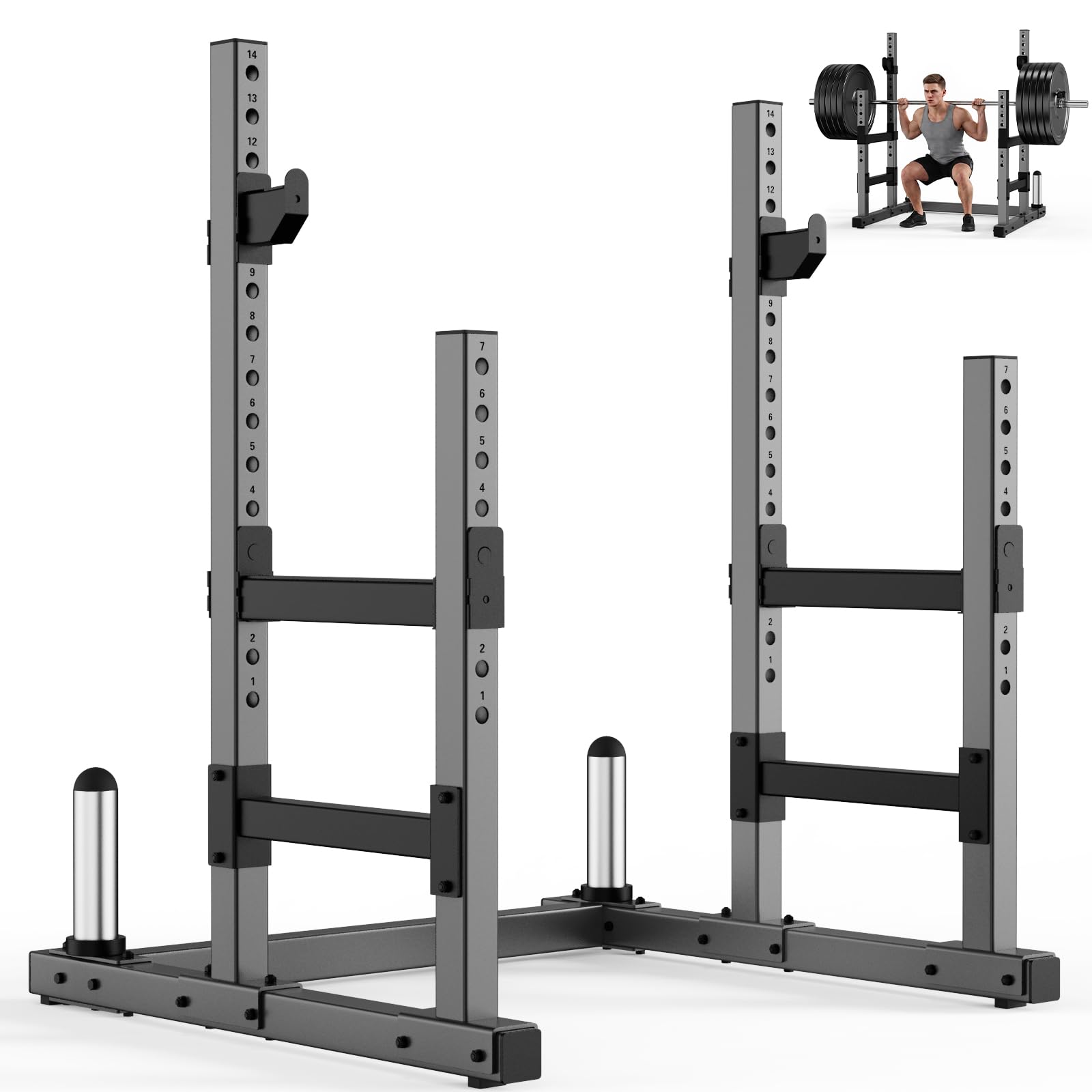
The 70-inch top setting is what makes the Yaheetech pair the taller lifter's low-ceiling option. The stands adjust from 44 to 70 inches, with 14 safety-pin positions on each post, and the two pieces can be spaced around a bench or a bar. That extra height over the 57-inch racks matters if your shoulders sit high: the bar can be closer to a natural squat position without the rack hitting the ceiling.

The trade-off is that the base needs help. These stands are light enough to move easily, and a loaded bar can make them feel front-heavy if the uprights are set wide or the floor is not level. Adding plates to the base or using the safety pins correctly makes a real difference. We also like the anti-skid feet for keeping the frame from sliding on concrete or rubber mats.

For the size, the 550-pound capacity is adequate for home training, and the H-frame gives the pair a wider stance than a simple A-frame stand. The 14 safety-pin positions are useful for bench press and squat setups, though the pins are not a substitute for long spotter arms. The pair is compact enough to store against a wall, and the height range covers more lifters than the shortest stands here.

This is not the rack for near-limit squats. The frame is simple to break down and tuck against a wall, which helps in a room that has to serve more than one purpose.

Bottom Line

This is the short stand we choose when the ceiling is low but the lifter is taller, thanks to a 70-inch top setting and 14 safety pins on each post.

Check Latest Price

How We Tested Low-Ceiling Squat Racks

We started by narrowing the field to racks with published height, footprint, and weight-capacity specs that could fit under a residential ceiling, then filtered out models with vague hardware details or no clear safety ratings. That left six racks, which we assembled and used for eight months in basements, garages, and spare bedrooms. Each one lived where a home gym actually lives: on rubber mats, near a water heater or storage shelf, with the same bar and plates cycling through squats, bench presses, and the occasional overhead check that made us duck.

We timed assembly solo, with no extra hands unless the instructions demanded it. We noted whether the hardware bag matched the manual, how much clearance we needed to tip uprights into place, and whether it wobbled when we shook the frame. Stability got the same treatment: we racked and unracked a loaded bar, pushed the frame from the side, and watched for feet lifting or walking across the mat. For weight capacity, we checked the manufacturer's rating against the hardware and steel, then loaded each rack near that number with a spotter and listened for creaks.

Adjustability and versatility showed up in daily use. We moved J-hooks and safety catches through their full range, checked hole spacing against bench and squat positions, and noted whether attachments interfered with a low ceiling or a short bar path. Mobility mattered whenever the room had a second job: we rolled or dragged each rack out of the way, then checked whether the feet scratched the floor or caught on mats. Durability came down to eight months of weekly sessions—loose bolts, powder-coat chips, and any wobble after the first week. Quality and value we judged together: clean welds, useful hardware, and features that actually got used rather than a longer spec sheet.

How to Choose

Start With Ceiling Clearance

A 7-foot ceiling is 84 inches, and the rack does not get the whole number. Leave at least a few inches above the frame for assembly and for getting the bar on and off the hooks. That is why a 57-inch stand like the JX or CANPA is the easy answer for a true 7-foot room, while an 81.9-inch full rack like the Bongkim is a fit you measure twice. If you want a pull-up bar, remember that the bar is at the top of the rack, so your head and knees need room too.

Do Not Buy Too Short

Once the rack fits, the next question is whether you can squat in it. A 50- to 57-inch top height can put the J-hooks below shoulder level for a taller lifter, which makes unracking a squat awkward. Measure your shoulder height and your bench-press bar height before you choose. If you are around 5-foot-8 or taller, a 66- to 70-inch stand such as the F2C or Yaheetech gives you more usable height without breaking a 7-foot ceiling.

Stability and Safety Catches

Short stands are not automatically unstable, but they have less mass and a smaller base than a full cage. Look for an H-frame or a wide footprint, and expect to load the base or anchor it if the maker provides a way. Safety catches matter more when you train alone: the F2C's 13-position spotter arms and the FLYBIRD's 16.7-inch arms give you a place to dump a failed rep. The CANPA is a clever low-ceiling rack, but it does not have that kind of catch.

Width, Bar Fit, and Storage

Width is the spec that surprises people. A rack can fit your ceiling and still be awkward with your bar or bench, so check the adjustable width against the distance between your bar's sleeves. Independent stands, like the F2C and Yaheetech pairs, are the most flexible because you set the spacing yourself. Fixed racks list a range for a reason: the FLYBIRD is built for 6- and 7-foot bars, while the CANPA spans about 35 to 42 inches. Folding or breaking down the rack is a bonus in a shared room.

Frequently Asked Questions

Final Verdict

For most low-ceiling home gyms, the JX FITNESS squat rack is the one we recommend first. Its 57-inch top height leaves real breathing room under a 7-foot ceiling, and the 660-pound capacity and foldable frame make it more useful than its size suggests. If you want safety spotter arms, choose the F2C pair; if you are taller, the Yaheetech's 70-inch top is the better fit. The FLYBIRD SR1 is the upgrade for an 8-foot ceiling and a fuller half-rack setup.