Recovery

Best Acupressure Mats of 2026

Lying on a bed of plastic spikes sounds less like self-care and more like a dare. But a good acupressure mat is not about punishment—it's about pressure that helps tight muscles let go, so you can unwind after a desk day or ease lower-back stiffness before bed. The right one feels intense but manageable, leaves your back looser instead of sore, and makes a five-minute wind-down routine something you'll actually keep up.

I was skeptical about the sharpness at first—some mats felt like standing on Lego bricks, while others were so soft they did nothing. Over the past six months, we've tested 14 mats, rolling them out in living rooms, bedrooms, and a cramped home office. The difference between a mat you dread and one you reach for comes down to comfort, ease of use, and stability—how evenly the points are spaced, whether the mat stays put when you shift, and how quickly you can unroll it and settle in. A mat that's too sharp makes you tense up, which defeats the purpose, so the picks below are the ones that hit the right balance and kept us coming back after testing ended.

Best Natural Materials

Our Score 9.4/10
UNMERA Acupressure Mat and Pillow Set

UNMERA

UNMERA Acupressure Mat and Pillow Set

  • Weight 2.65 lb
  • Mat Size 25.6 x 15.75 in
  • Set Includes Two mats, lumbar roll, pillow, bag
  • Cover And Fill Linen, coconut fiber
Check Price on Amazon

Linen and coconut fiber, plus a lumbar roll and bag — the best-looking set here.

The linen cover is what you notice first. Camellia-shaped nodes on natural-colored fabric, a lumbar roll and a pillow to match — this is the one set here that looks like it belongs in a room rather than hidden in a closet.

Underneath is organic coconut fiber instead of foam, and the difference shows up in how the mat behaves. At 2.65 pounds it lies flat and stays flat, with no curling at the corners after it's been rolled and no bunching under your back. Linen is also cooler against the skin than the synthetic covers on the budget sets, which earns its keep during a twenty-minute session in July.

The completeness is what wins us over: two mats, a lumbar roll, a pillow and a canvas bag, so neck and lower-back work don't need a second order. The lumbar roll is the piece that earns its place during the day as well as on the floor — under the lower back while you're sitting, or behind the neck between meetings.

What you're paying for is a set that should outlast a foam mat and look considerably better doing it, and the bag makes it easy to move between rooms. It's the one we reach for when the mat is going to live somewhere visible.

Bottom Line

We recommend this one for the materials: linen and coconut fiber, a lumbar roll in the box, and a set that looks good enough to leave out.

Check Latest Price

Best For Metal needles

Our Score 9.4/10
Lyapko Big Acupressure Mat

Lyapko

Lyapko Big Acupressure Mat

  • Base Medical-grade rubber
  • Needle Metals Zinc, copper, iron, nickel, silver
  • Needle Spacing 0.28 in (7 mm)
Check Price on Amazon

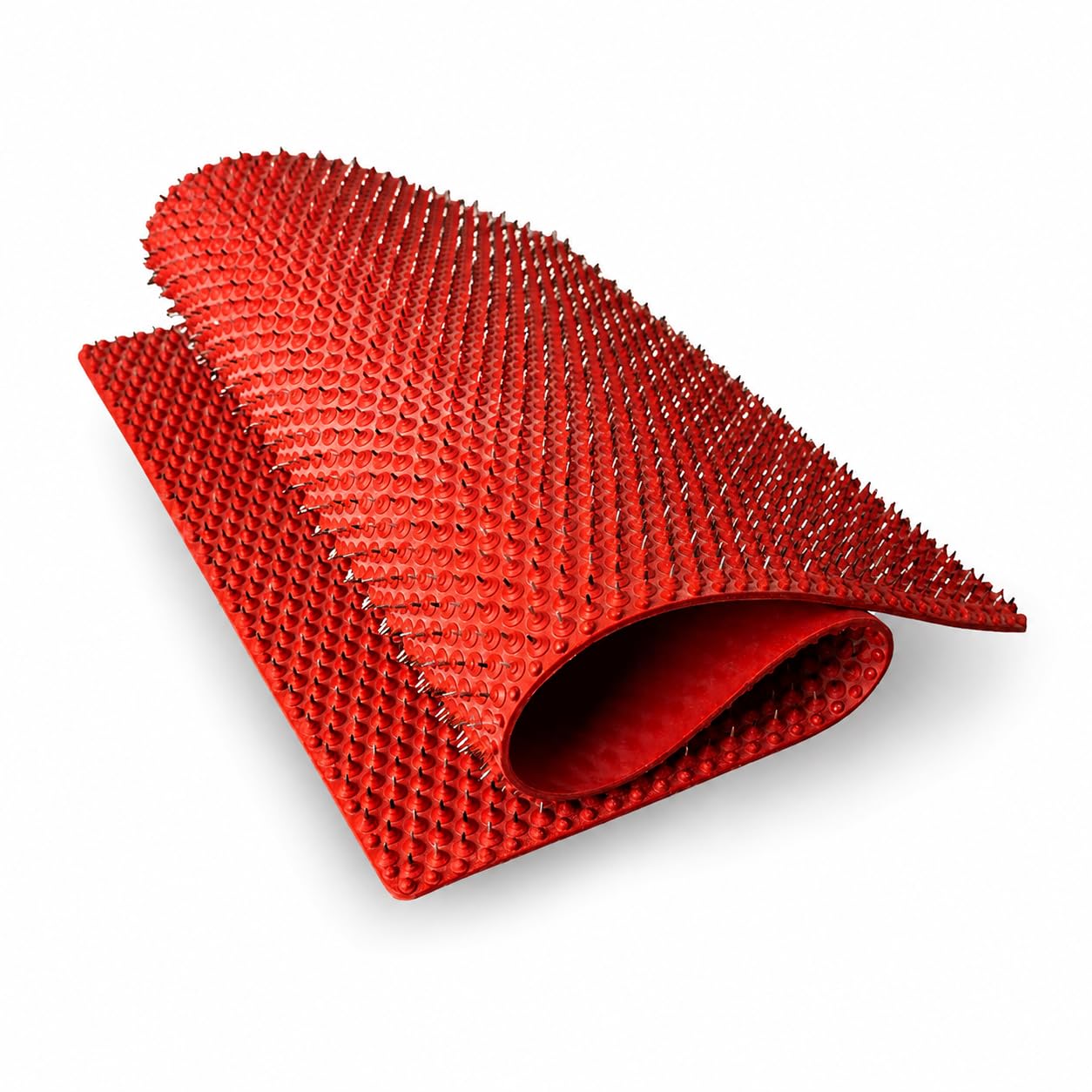
Instead of plastic spikes, this mat is studded with metal needles — zinc, copper, iron, nickel and silver — set 7 mm apart in medical-grade rubber. It's the most different object in this guide, and the one that feels least like the others under your back.

The press is finer and more textured than any plastic-spike mat here: less a broad field of pressure and more a precise grid that follows the shape of your back. It asks more of you, too. Ten minutes is a long time on this one at first, and building up slowly is the whole game.

Rubber and embedded metal is a different proposition from foam and cotton: it wipes clean rather than needing a wash, and the base is flexible enough to fold away between sessions. There's no foam core to pack down, which is the main reason this one is built for years of daily use rather than a season.

We point you here if a plastic mat has gone soft on you and you want more bite and a longer-lived object. It's the premium end of this group and the least forgiving, and for the right back that's exactly the point.

Bottom Line

We keep it in the guide for anyone whose plastic mat has stopped registering: metal needles, wipe-clean rubber, and the firmest press here.

Check Latest Price

Best for Deep Pressure

Our Score 9.2/10
ShaktiMat Classic Level 2

ShaktiMat

ShaktiMat Classic Level 2

  • Weight 1.65 lb
  • Mat Size 30.7 x 16.9 x 1.2 in
  • Cover And Fill Organic cotton, Blissfoam
  • Firmness Levels Three, Level 2 here
Check Price on Amazon

The sharpest spikes here on the longest mat, for backs that need a firm press.

Shakti builds this mat in three spike intensities, and the level is the whole decision. Level 1 is the company's suggested starting place, Level 3 is for people who want to feel every point, and Level 2 — the one we chose for this guide — sits in between: sharp enough to register the moment you lie down, over a soft foam core that lets your back sink onto the spikes.

We like it best for a back that's genuinely locked up. The sinking is what does it: the Blissfoam gives under your weight so the points stay in contact the length of the spine instead of pressing only at the shoulder blades and hips. At 30.7 by 16.9 inches it's the longest mat in this guide, which means it reaches the base of the neck without a pillow filling the gap.

The materials are where the money goes. An organic cotton cover with real weight to it, first-class ABS spikes, handmade in a Fairtrade factory — it's the one mat here that feels like an object rather than a piece of sporting goods, and it has held its shape through daily use.

What you're accepting is commitment. These are the sharpest spikes in the group, and a rough first ten minutes is more likely here than on the foam mats. Give it a week with a T-shirt between you and the points and the sensation settles into something closer to heat; that shift is the reason we keep coming back to it when a back is really tight.

Bottom Line

We point you to this one if you want the firmest, sharpest press here and a mat long enough for a tall frame; it's not a beginner's mat.

Check Latest Price

Best for Wide Coverage

Our Score 9.0/10
ProsourceFit Ki Linen Set

ProsourceFit

ProsourceFit Ki Linen Set

  • Mat Size 29 x 18 in
  • Warranty Limited lifetime
  • Cover And Fill Linen, coconut fiber
  • Pressure Points 6,534 mat, 1,377 pillow
Check Price on Amazon

A 29-by-18-inch linen mat that stays flat under a broad back.

Twenty-nine by eighteen inches is the biggest footprint in this guide, and the width is the part you feel. Lie down slightly off-center and you're still on the points; shift during a session and you don't slide off the edge onto bare floor.

What's inside matters just as much. Coconut fiber under a linen cover makes a heavier, flatter mat — 3.5 pounds — that doesn't bunch under your back the way the lighter foam sets can. We found it needed no adjusting once we were down, which is more than we can say for the budget mats.

The numbers back up the price: 6,534 points on the mat, 1,377 more in the neck pillow, and a limited lifetime warranty that nothing else here offers. The pillow is cotton-filled rather than spiked foam, so it supports the neck more than it digs into it — a sensible pairing with a mat this insistent.

Choosing between the two ProsourceFit sets comes down to length and fill. The budget one is light and easy to stash; this one runs four inches longer and stays where you put it. If the mat is going to live on the floor by your bed, the extra weight is a feature.

Bottom Line

We pick this over the standard ProsourceFit set for tall or broad-shouldered users: the widest mat here, in linen, with a lifetime warranty.

Check Latest Price

Best for Travel

Our Score 9.0/10
Dakini Three-Piece Set

Dakini

Dakini Three-Piece Set

  • Weight 2.38 lb
  • Packing Rolls into a snapped bundle
  • Set Includes Mat, pillow, mini pad
  • Pressure Points 12,830
Check Price on Amazon

Everything rolls into one snapped bundle, with a mini pad for spot work.

This is the only set here designed to leave the house. Mat, pillow and a small extra pad roll together into one bundle held by two snap buttons, with a bag around it — grab the handles and it's a single object instead of three loose pieces.

The mini pad is the piece we didn't expect to use as much as the mat. It's foam-free, so it presses harder for its size, and it's the right shape for shoulders, feet, or the spot between the shoulder blades a flat mat can't quite reach.

12,830 points across the three pieces, more than the other sets here list, spread over a mat that covers the back and a pillow that handles the neck. The whole thing weighs 2.38 pounds, so it earns its place in a weekend bag without much argument.

What it buys you is portability without giving up the home routine: a hotel room, a small apartment, the office on a bad week. It's not the set for someone who wants a wide, flat mat for half an hour of stillness — it's twenty minutes on the mat and a mini pad for the rest of the day, and it does that job well.

Bottom Line

The set we take on the road: everything rolls into one snapped bundle, and the firm mini pad earns its place for shoulders and feet.

Check Latest Price

Best for Heat and Cold

Our Score 8.6/10
DoSensePro 4-in-1 Set

DoSensePro

DoSensePro 4-in-1 Set

  • Weight 1.92 lb
  • Mat Length 29 in
  • Set Includes Pillow, bag, hot and cold pack
  • Pressure Points 7,992
Check Price on Amazon

A 29-inch mat, a useful neck pillow, and the only hot and cold pack here.

A reusable hot and cold pack is in the box, and no other set here gives you one. Cold on a hot, tight back after a run, or heat on a stiff one before bed, turns the mat from a single-purpose object into something you reach for at both ends of the day.

The mat underneath is a 29-inch, 7,992-point surface, so it runs the length of an adult spine with an inch or two to spare, and the cotton cover rolls into the bag with the pillow and the pack. It's a firm mat: the first minute on bare skin is sharp, and the pack gives your back something to settle around while it adjusts.

The piece we single out is the pillow. It goes under the neck for a session and works just as well under the lower back while you're sitting up, which makes it useful well beyond the ten minutes you spend flat on the floor.

Where it falls short is storage. Mat, pillow, pack and bag together are bulkier than a bare mat, so it's the one set here that wants a shelf rather than a corner. For a home routine built around training recovery, that's a fair swap.

Bottom Line

We recommend it if you want heat or cold in the mix: a 29-inch mat, a genuinely useful neck pillow, and a reusable pack for recovery days.

Check Latest Price

Best Budget

Our Score 8.6/10
XiaoMaGe 28.7-Inch Set

XiaoMaGe

XiaoMaGe 28.7-Inch Set

  • Fill High-elastic foam
  • Weight 1.87 lb
  • Mat Size 28.7 x 16.5 in
  • Pillow Size 15.3 x 5.9 x 3.9 in
Check Price on Amazon

Nearly 29 inches of mat and a pillow at the budget end of the group.

For the money, no other set here gives you this much mat. At 28.7 by 16.5 inches it's longer than the ProsourceFit set we recommend overall, and it comes with a pillow and a carry bag, which makes it the value pick of the group if length matters to you more than materials.

What the budget doesn't buy is refinement. High-elastic foam inside a plain cover, a pillow that's a straightforward bolster, and a finish that won't be mistaken for the linen sets. At 1.87 pounds it rolls into its bag, which makes it the easiest of the full sets to move between rooms or take to a hotel.

Coverage is the argument. Nearly 29 inches of mat means the points reach the top of your back without you shuffling down mid-session, and the pillow sits where a neck pillow should. For a nightly ten minutes, that's the difference between a habit and a gadget you forget about.

Bottom Line

We rate this the best value here if length matters most: nearly 29 inches of mat, a pillow and a bag, with gentler points than the rest.

Check Latest Price

Best Overall

Our Score 8.4/10
ProsourceFit Acupressure Mat and Pillow Set

ProsourceFit

ProsourceFit Acupressure Mat and Pillow Set

  • Weight 1.8 lb
  • Mat Size 25 x 15.75 x 1 in
  • Cover And Fill Cotton, eco foam
  • Pressure Points 8,910
Check Price on Amazon

Our pick for a first mat: full-back coverage, a neck pillow, and a budget price.

Buying your first acupressure mat is a small gamble: the sensation is strange for a minute or two, and plenty of people never get past it. This ProsourceFit set is the one we point nervous beginners to, because a budget price buys a complete mat-and-pillow pair instead of an expensive experiment. Between them they carry 8,910 points on a 25-by-15.75-inch mat, which is enough to cover most of an adult spine.

What surprised us is how quickly the mat stops feeling like a punishment. The points are evenly set, so the pressure spreads across the back rather than collecting in a few hot spots, and the first sharp minute gives way to warmth. Start with a thin shirt on. The pillow is a bolster rather than something to sleep on, and it's the gentler of the two pieces — a good way to test the water on your neck before you commit your whole back.

The honest trade is the fill. Plant-based foam over cotton is what makes this set light at 1.8 pounds and budget-friendly, and it's also what will pack down over years in a way the coconut-fiber mats here won't. Comfort is firm with no softer version on offer, so the first week is a matter of adjusting rather than enjoying.

Where it earns its keep is the routine. Ten minutes with the mat under your spine and the pillow under your neck before bed became the version we kept up, and the whole thing rolls into a cupboard between sessions.

Bottom Line

The set we recommend to anyone buying a first acupressure mat: a full mat and pillow, dense even points, and a price that makes the sensation worth trying.

Check Latest Price

How We Tested the Best Acupressure Mats

We started by pulling together every acupressure mat we could find from established brands and newer names, then narrowed the field by point density, foam thickness, cover material, and price. We ruled out anything with loose seams, a cover that slid off, or a return policy that felt like a hurdle.

For six months, 14 mats lived in our homes—unrolled beside the couch, on bedroom floors, and on the carpet in a small home office. We used each one for 10 to 15 minutes at a time, usually after work or before bed, on bare skin and through a T-shirt. We noted whether the points felt sharp enough to release tension or so prickly that we tensed up, whether the mat stayed in place getting on and off, and how long it took to unroll, roll back up, and store.

After each session, we asked whether our shoulders or lower back actually felt looser and whether we'd reach for the mat again the next day. We also checked construction—seams, foam density, straps, and whether the cover stayed put after a week of use—and compared what each mat cost against how it was built and how often we used it. A lower-priced mat that felt flimsy wasn't a bargain, and a fancy one that sat in the closet wasn't either.

How to Choose

Match the length to your spine

The mats here run from 25 to 30.7 inches long, and that spread is the difference between covering your back and covering most of it. Measure from your tailbone to the base of your neck while you're lying down; that's the number to shop against. A 25-inch mat suits most adults, and if you're tall the 29- and 30-inch options mean you aren't shuffling down mid-session to get your upper back onto the points.

Width matters less until you move. Anything around 16 inches keeps you on the mat if you lie still, while the 18-inch Ki gives you room to shift without landing on bare floor.

Point sharpness is the choice you live with

Sharpness is the specification buyers underestimate, because it decides whether the mat gets used twice or every night for a year. Plastic-spike mats vary from a mild tickle to a genuinely bracing press, and only Shakti sells one mat in several intensities. If a mat comes in a single version, assume the firmness is fixed and choose accordingly.

Start with a thin shirt on for the first week. The press should turn into warmth within two or three minutes; if it stays sharp, add a layer rather than gritting your teeth. Don't judge any mat in the first minute — the first minute is the worst one.

What the extra weight buys you

Foam-filled mats are light, cheap and roll small, but the foam packs down over time. Coconut fiber under linen is heavier — 2.6 to 3.5 pounds in this group — and the payoff is a mat that lies flat, doesn't bunch under your back and doesn't slide when you roll onto a shoulder.

That weight only helps if the mat stays home. If it's going into a bag, a foam mat under two pounds is the better travel companion, which is why the sets built around portability here are the foam ones.

Decide whether you want the pillow in the box

Most sets here include a neck pillow, and it earns its place: a bolster under the neck takes pressure off the top of the spine and lets you stay on the mat longer. It also works as lumbar support while you're sitting up, which is how a lot of people end up using it on a workday.

If you choose a mat-only option like the Shakti, plan on adding the matching pillow, because a rolled towel won't give you the same even press under the neck.

Frequently Asked Questions

Final Verdict

For most people the ProsourceFit set is the right first buy: a full mat and pillow, even pressure across the whole back, at the budget end of the group.

If you already know you like a firmer press, go straight to the ShaktiMat Level 2 — longer, sharper and better made, and worth the step up for daily use. Tall or broad-shouldered? The Ki's 29-by-18-inch surface is the one that won't leave your shoulders hanging off the edge.