How to Test Squat-Proof Leggings Before You Keep Them
Leggings are squat-proof only if the worn garment remains acceptably opaque at the actual stretch, lighting, and movement you will use. Start with an off-body contrast test, then check the correct size on your body during a squat, hip hinge, lunge, and step-up under bright diffuse light.
“Squat-proof” is not one universal retail grade. Nike describes measuring light transmission at several stretch levels with a spectrophotometer, and textile research has found meaningful opacity differences among leggings after stretch. Price, thickness, or a black color alone cannot replace a movement test.
Use This Four-Stage Opacity Test
- Flat inspection: hold the garment under bright diffuse light. Check thin zones, seam holes, print cracking, and mismatched panels.
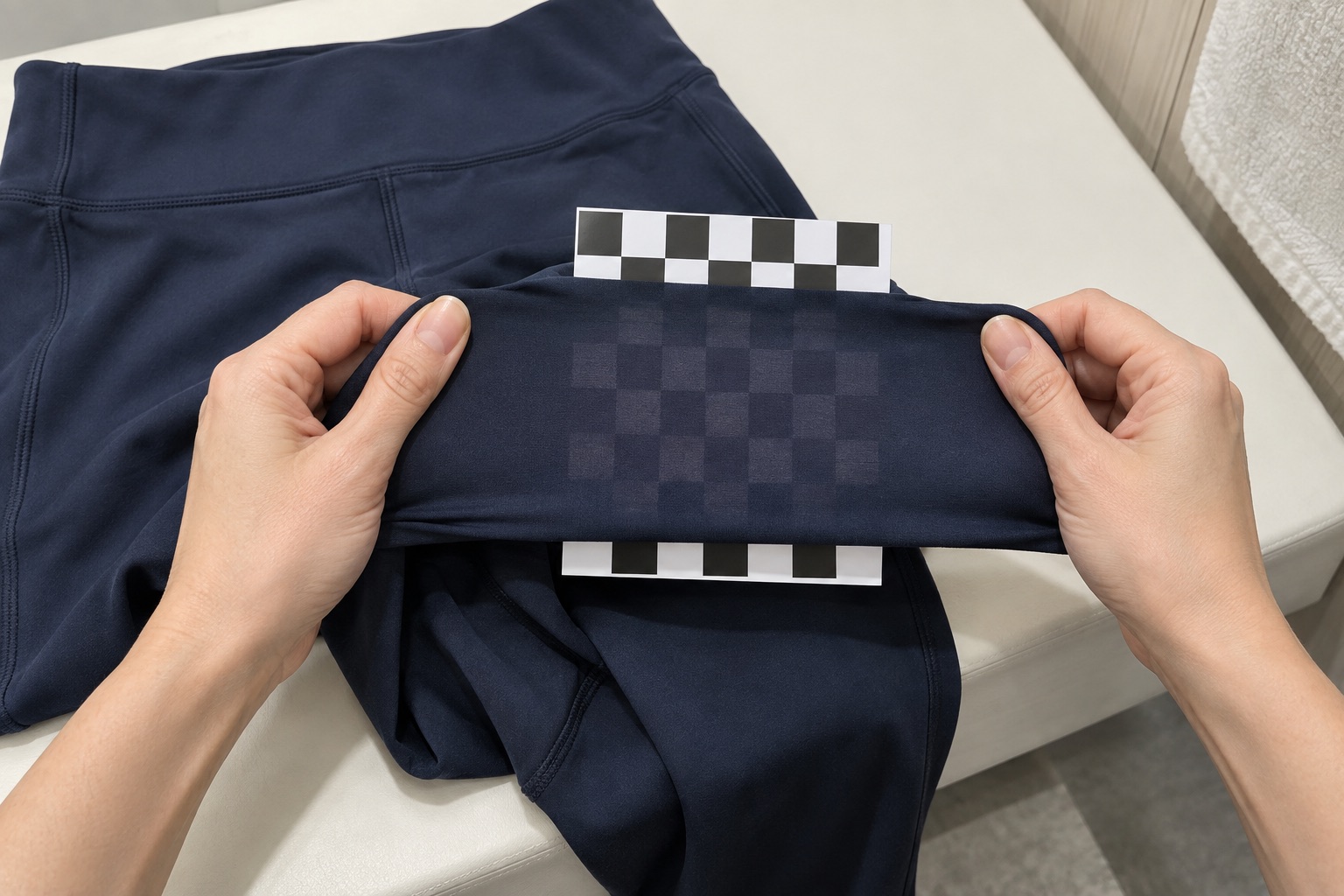
- Contrast-card stretch: place a black-and-white card behind one layer of fabric and stretch it gradually in two directions. Compare the seat, thighs, and any mesh or printed panels.
- Private wear test: wear the intended underwear and view the garment from behind in a mirror or with a locally saved photo that you control. Do not upload a private fitting image to an unknown service.
- Movement test: perform a deep squat, hip hinge, forward lunge, wide stance, and step-up under the strongest realistic light.
Score More Than the Bottom of a Squat
| Check | Pass | Fail or reconsider |
|---|---|---|
| Seat opacity | Underwear color and outline remain acceptably concealed through full movement | Color, pattern, skin contrast, or underwear becomes clearly visible |
| Seams | Stitches lie flat with no widening holes or popping sounds | Needle holes open, thread strains, or seam allowance shows |
| Print and color | Color remains visually consistent when stretched | White backing or faded-looking lines appear; this can be print grin even without full transparency |
| Waistband | Stays in place while breathing and bending | Rolls, slides, gaps, or requires constant pulling |
| Range of motion | You can squat and lunge without restriction or painful compression | Fabric limits depth, pinches, or pulls the garment downward |
| Wet appearance | Coverage remains acceptable after a small water test on an inconspicuous area | Sweat-darkened or wet fabric reveals a contrast you would not accept |
Why Leggings Pass on the Hanger and Fail in Motion
| Cause | What changes | Useful response |
|---|---|---|
| Garment too small | Fabric extends farther and knit gaps open more | Compare the next size without assuming a looser waistband is inevitable |
| Low-density or open knit | More background contrast passes between yarns under stretch | Reject the garment if the worn test fails; a material label alone cannot fix it |
| Printed surface over pale backing | The exterior print separates visually and the pale base appears | Test every colorway separately |
| High-contrast lighting | Backlight reveals transmission hidden by dim fitting-room light | Repeat near a bright window and under overhead gym-like light |
| Pattern or seam concentrates stretch | One local zone extends more than the rest | Test the finished garment, not only a loose fabric sample |
| Wear and washing | Elastic recovery, surface, or seams may change | Retest older leggings rather than trusting the original result |
Make the Test Repeatable
Use the same contrast card, underwear color, lighting positions, and movement sequence for every pair. If comparing photos, lock exposure rather than letting a phone automatically brighten one image. A pass means the coverage works for you in those conditions; it is not a laboratory certification.
Keep tags attached and protect the garment until the test is complete. Follow the retailer's try-on and return rules.
Opacity Is Only One Part of a Good Training Legging
After opacity passes, check waistband stability, seam placement, pocket bounce, moisture comfort, pilling risk, and whether the fabric recovers after a deep squat.
Sources and Manufacturer Guidance
Requirements can vary by product, model, and situation. These primary sources informed this guide; official instructions for your exact product and current authoritative guidance take priority.
- Nike: Spectrophotometer testing of legging opacity at multiple stretch states
- Journal of Textile Science & Fashion Technology: Laboratory comparison of athleticwear leggings
- China National Standard GB/T 42698-2023: Textiles—Testing and evaluation for anti-seeing-through property
- Patagonia: Product care and the effects of waxy softener residue on performance fabric
Frequently Asked Questions
-
It usually means the garment remains acceptably opaque during a deep squat. Because the term lacks one universal retail threshold, verify it under your own stretch, lighting, underwear, and movement conditions.
-
No. Dark color can reduce visible contrast, but an open knit, excessive stretch, thin panel, damaged seam, or pale print backing can still show through.
-
No. Fabric mass is relevant, but knit structure, yarn, color, finish, pattern, fit, and amount of stretch also affect opacity.
-
Wear, heat, incompatible care products, damaged elastane, seam changes, and surface abrasion can alter fit or appearance. Follow the label and retest periodically.
-
Price is not a reliable opacity test. A laboratory comparison of four leggings found significant differences after stretch and did not find a simple price ranking.