How to Lubricate a Treadmill Belt Without Damaging It
The short answer: unplug the treadmill, confirm the lubricant and amount in your model’s manual, apply it to the deck beneath the walking belt—not to the top surface—and then follow the manufacturer’s instructions for distributing it.
That first manual check is the part many tutorials skip. Some treadmills call for 100% silicone at regular intervals. Others use a proprietary lubricant, arrive with a pre-waxed deck, or have a self-lubricating belt that should not receive routine silicone. The wrong product or too much of the right one can create belt slip, contaminate rollers, and complicate a warranty claim.
This guide gives you a safe general method, plus the decision points that should send you back to the manual instead of pressing ahead.
First, Confirm That Your Treadmill Should Be Lubricated
Find the model number on the frame label, then open the maintenance section of the owner’s manual. Search for lubrication, walking belt, running deck, or maintenance. Do not assume that instructions for another model from the same brand apply to yours.
If the manual is missing, use the manufacturer’s support site and enter the full model number, including the version suffix when one is shown. A model family name alone may cover several different decks and belts.
| Manual language | Your next step | Do not do this |
|---|---|---|
| Use 100% silicone treadmill lubricant | Use the listed amount and interval. A non-aerosol squeeze bottle with a long applicator is easier to control. | Do not substitute a general-purpose spray. |
| Use the manufacturer’s lubricant or maintenance kit | Use that specified formula and follow the model instructions. | Do not assume every silicone product is equivalent. |
| Self-lubricating, lubrication-free, maintenance-free, or pre-waxed | Do not add routine lubricant unless the manufacturer issues a model-specific instruction. | Do not add silicone just because the belt feels dry on top. |
| No clear instruction | Contact support with the full model and serial number before applying anything. | Do not copy an interval from a different treadmill. |
How Often Should You Lubricate a Treadmill?
There is no responsible one-size-fits-all interval. Horizon tells owners of applicable models to lubricate every three months or 150 miles. LifeSpan’s general belt-lubrication instructions use a three-month interval and a measured application, while some newer LifeSpan walking treadmills advertise a lubrication-free belt.
Your own interval may also be expressed in hours, miles, months, or a console reminder. Heavy use, heat, dust, and a dry environment can justify more frequent inspection, but they do not justify exceeding the manufacturer’s quantity.
| Situation | What to follow |
|---|---|
| The console displays LUBE or LUBE BELT | Perform the maintenance first, then use the model-specific reset sequence. Do not clear the reminder and keep running. |
| The treadmill is used by several people | Track mileage or operating hours rather than relying only on the calendar. |
| The room is dusty or has pet hair | Inspect and clean around the belt more often. Dust control is not a reason to pour in extra lubricant. |
| The machine is new | Check the setup section. Many treadmills arrive lubricated and do not need an immediate application. |
What You Need
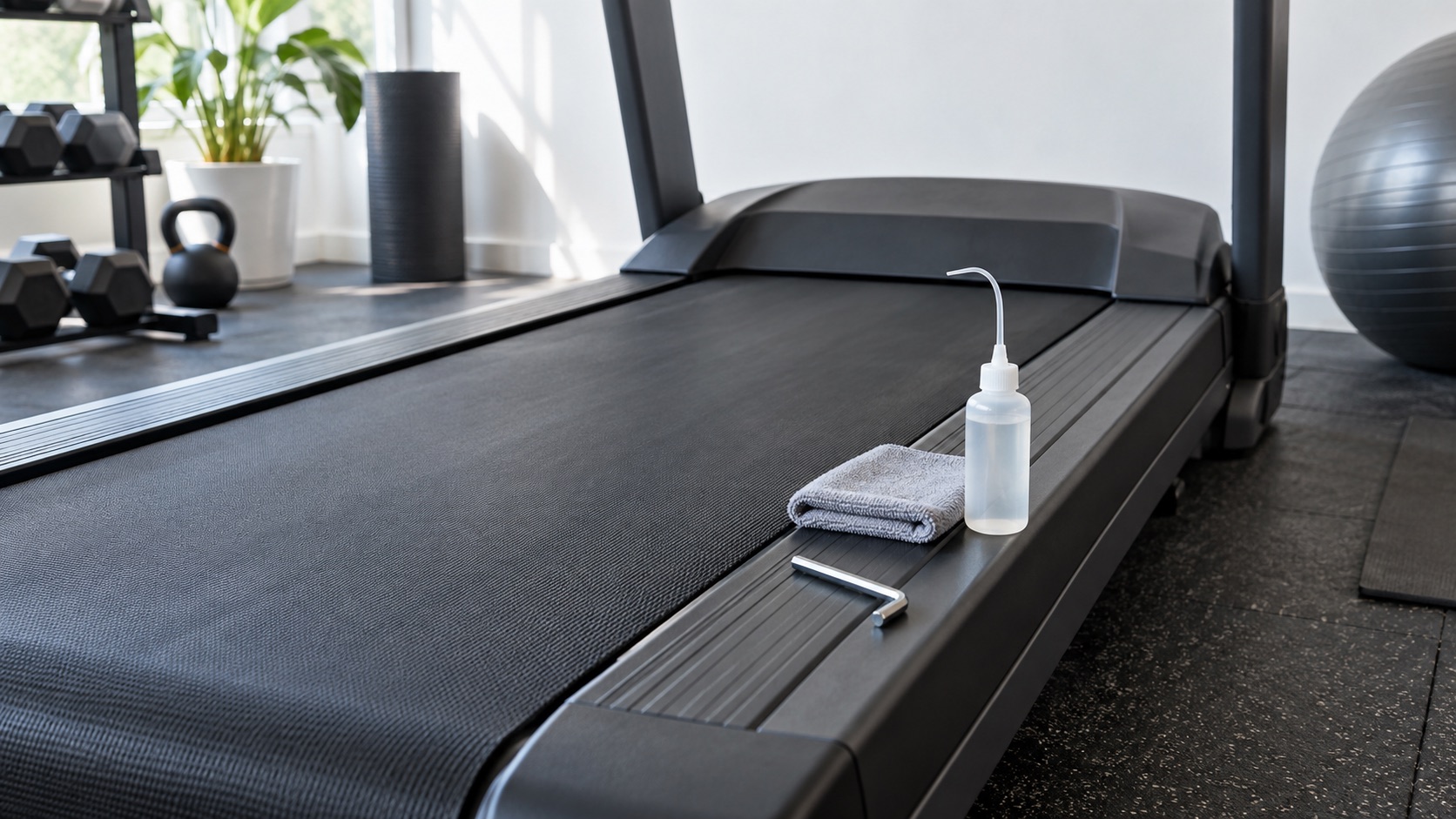
- The lubricant specified by your manual. For models that call for silicone, use a treadmill-specific, 100% silicone product unless the manufacturer specifies otherwise.
- A long applicator tube. It helps place lubricant near the center of the deck instead of flooding the outer edge.
- The supplied Allen key or the correct hex wrench. You may not need to loosen the belt, but keep the correct tool nearby in case the manual requires it.
- A clean microfiber cloth. Use it to remove dust before the job and wipe away excess afterward.
- A washable floor covering. Silicone is slippery and difficult to remove from some flooring.
Do not use WD-40, penetrating oil, household grease, cooking oil, or an unapproved aerosol. These products are not interchangeable with treadmill belt lubricant.
How to Lubricate a Treadmill Belt: Step by Step
- Read the model instructions all the way through. Note the lubricant type, amount, application pattern, interval, and reminder-reset procedure. If any of those details are unclear, pause and contact the manufacturer.
- Stop the machine, remove the safety key, and unplug it. Wait until the belt is completely still. Keep children and pets out of the work area.
- Clean before adding lubricant. Wipe dust and grit from the exposed belt edges and side rails. Do not spray cleaner into the motor compartment or soak the belt.
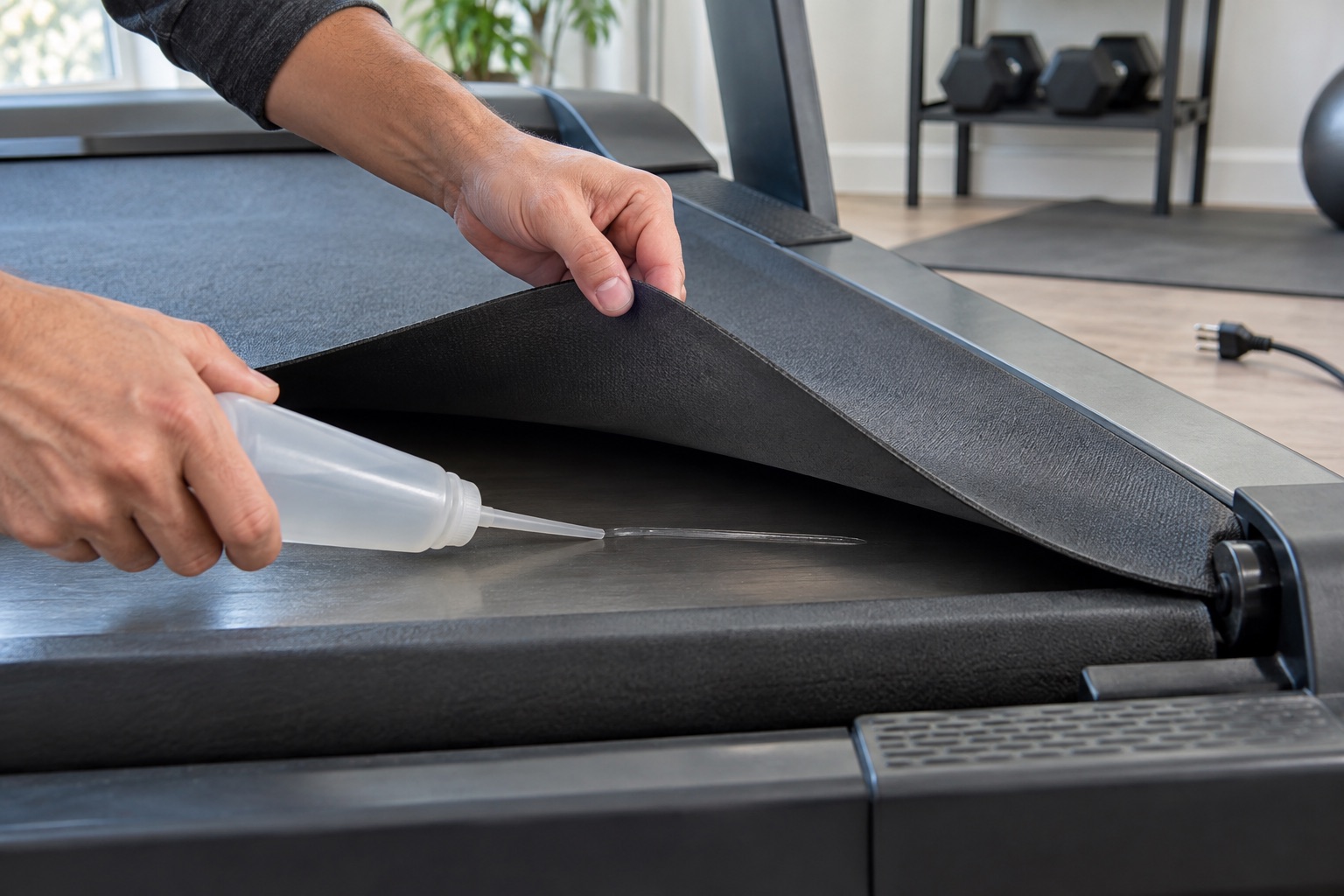
- Check belt access. At the middle of the deck, lift one edge of the walking belt with your fingers. If the manual tells you to loosen the rear roller bolts, count the exact number of equal turns on both sides so you can restore the original tension. Do not loosen the belt merely because another brand’s tutorial does.
- Apply the specified amount beneath the belt. Guide the applicator toward the center of the deck and lay down a thin, controlled line in the pattern shown in your manual. Repeat from the other side if directed. The lubricant belongs between the underside of the belt and the deck—not on the walking surface.
Finish the Job and Check the Belt
- Restore any belt tension you changed. If you loosened each rear bolt by the same number of turns, tighten each by that same count. This is not the moment to guess at a tighter setting.
- Distribute the lubricant exactly as directed. Some manufacturers instruct you to run the treadmill unloaded at a low speed for several minutes; others add a short walking period. Stand off the moving belt until the instructions say otherwise, keep hands and clothing away from the rollers, and insert the safety key only when you are ready to power on.
- Watch the belt from the rear. It should remain centered and move smoothly. Stop immediately if it surges, drifts rapidly, rubs a side rail, or makes a new grinding sound.
- Wipe away visible excess. Power off and unplug again before cleaning. Remove lubricant from the side rails, frame, and floor. The top of the walking belt should not feel oily.
- Reset the maintenance reminder. Use the sequence for your exact console only after the work is complete. A reset does not lubricate the machine; it only restarts the counter.
For reference, Horizon instructs owners of applicable models to run the belt at 3 mph for three minutes, then walk for another three minutes while checking tension and alignment. LifeSpan’s general instructions call for a three-to-five-minute distribution run. Those are examples—not universal settings.
Which Treadmill Lubricant Should You Use?
The bottle must match the deck and belt system. The word silicone alone is not enough: concentration, carrier solvents, and delivery method matter. A controlled non-aerosol applicator also reduces overspray near flooring and electronics.
| Product | Use it? | Why |
|---|---|---|
| 100% silicone treadmill lubricant | Only when the manual calls for it | Common on many home treadmills and easy to apply in a measured line. |
| Manufacturer-specific lubricant or wax | Yes, when explicitly specified | Some belts and decks are designed around a proprietary formula or application system. |
| Silicone aerosol spray | Usually no unless specifically approved | Overspray is difficult to control and may contain carriers the manual does not permit. |
| WD-40 or penetrating oil | No | It is not a treadmill deck lubricant and may damage or contaminate belt-system materials. |
| Household oil, grease, or cooking oil | No | These products attract debris, can degrade materials, and create an unsafe walking surface. |
Signs of Too Little—or Too Much—Lubricant
Possible signs of high friction
- The belt hesitates or feels less smooth under a normal load.
- The deck or belt area becomes unusually warm.
- A lubrication reminder appears at the expected service interval.
- The treadmill produces an error associated in the manual with belt friction or motor current.
These symptoms are not proof that lubricant is the answer. Incorrect belt tension, a worn deck, a glazed belt, roller trouble, or motor problems can feel similar.
Signs you may have applied too much
- Lubricant appears on the top surface or side rails.
- Droplets or a slick patch appear on the floor.
- The belt slips even though tension was correct before maintenance.
- Lubricant is visibly migrating toward a roller or motor cover.
Stop the treadmill and unplug it before wiping accessible excess. Do not keep tightening the belt to compensate for an oily contact surface.
Troubleshooting After Lubrication
If the treadmill behaves differently after maintenance, the timing is useful evidence. Work through the symptom rather than adding a second dose.
| Symptom | Likely checks | When to stop |
|---|---|---|
| Belt slips underfoot | Check for excess on the walking surface, confirm you restored the original rear-bolt turns, and follow the manual’s tension test. | Stop if the belt surges or cannot hold a normal walking load. |
| Belt drifts to one side | Use the model’s tracking procedure with small, equal-to-instruction adjustments. Lubricant does not correct alignment. | Stop if the belt contacts a side rail or folds at an edge. |
| Squeak remains | Check whether the sound follows belt speed and whether it comes from a roller, joint, deck, or floor contact point. | Stop for grinding, scraping, metal-on-metal noise, or a worsening sound. |
| Burning smell, smoke, or repeated error | Disconnect power. Inspect only the user-serviceable areas listed in the manual. | Do not restart; contact the manufacturer or a qualified treadmill technician. |
| Lubricant leaks from the machine | Unplug, protect the floor, and wipe accessible excess without opening electrical areas. | Seek service if lubricant entered the motor compartment or electronics. |
A Simple Treadmill Maintenance Schedule
Lubrication works best as one part of a small maintenance routine. Adjust this schedule to your manual, environment, and weekly use.
| Interval | Maintenance |
|---|---|
| After sweaty sessions | Power down and wipe the console, handrails, side rails, and exposed belt surface with the method approved by the manufacturer. |
| Monthly | Check belt tracking, listen for new noises, inspect the power cord and safety key, and remove dust around—not inside—the machine. |
| At the manual’s mileage, hour, or calendar interval | Inspect lubrication condition and apply only the specified product and amount when required. |
| After moving the treadmill | Confirm the machine is level, the cord is undamaged, the belt remains centered, and no transport debris is trapped near the deck. |
| When friction, heat, error codes, or burning odor appear | Stop using the treadmill and diagnose the cause. Do not wait for the next scheduled service. |
Sources and Manufacturer Guidance
Requirements can vary by product, model, and situation. These primary sources informed this guide; official instructions for your exact product and current authoritative guidance take priority.
Frequently Asked Questions
-
No. WD-40 and similar penetrating or water-displacing sprays are not substitutes for treadmill belt lubricant. Use only the product specified by the treadmill manufacturer.
-
Use the exact quantity in your owner’s manual or approved maintenance kit. Manufacturer instructions vary, and free-pouring extra lubricant can cause belt slip and contamination.
-
No. Many home treadmills specify 100% silicone, but others use a proprietary formula, a waxed deck, or a self-lubricating belt. Check the full model number before applying anything.
-
On models designed for routine lubrication, it normally goes between the underside of the walking belt and the deck, generally toward the center—not on top of the surface you walk on. Follow the model’s application pattern.
-
Most applicable models require a short low-speed distribution run, sometimes followed by a brief walking check. Follow the manufacturer’s speed and time, watch belt alignment, and wipe excess before a normal workout.
-
Possible causes include excess lubricant on the belt surface, failure to restore the previous tension, or a pre-existing worn belt or deck. Stop and inspect rather than automatically tightening both rear bolts.