How Should a Hydration Vest Fit? A Loaded Fit Test
A hydration vest should sit high and close enough that the loaded pack does not bounce, but loose enough for a full deep breath and unrestricted arm swing. Fit it with the water, layers, food, phone, and safety gear you will actually carry.
Do not transfer your size between brands. Some charts use chest circumference, others use a different torso point, and pocket and strap geometry varies by model.
Measure for the Exact Brand Chart
- Read the model's measuring instructions before taking a number.
- Use a soft tape, keep it level, and measure over the clothing you normally run in.
- Stand naturally—do not inflate the chest or pull the tape tight.
- If you fall between sizes, compare the maker's torso or fit notes and try both sizes loaded when possible.
- Choose a size that leaves meaningful adjustment in both directions; straps already at their limit cannot adapt to layers or load.
Fit the Vest Loaded, Not Empty
Fill the soft flasks or reservoir to the amount you plan to carry, remove excess air from a bladder when the maker recommends it, and load your usual kit. Water is often the heaviest item and changes how the vest sits.
Put the vest on, settle it high on the torso, and distribute dense items close to the body. Tighten side or body adjustments evenly, then set the sternum cords or straps. They should stabilize the front without sitting on the throat or creating a pressure point.
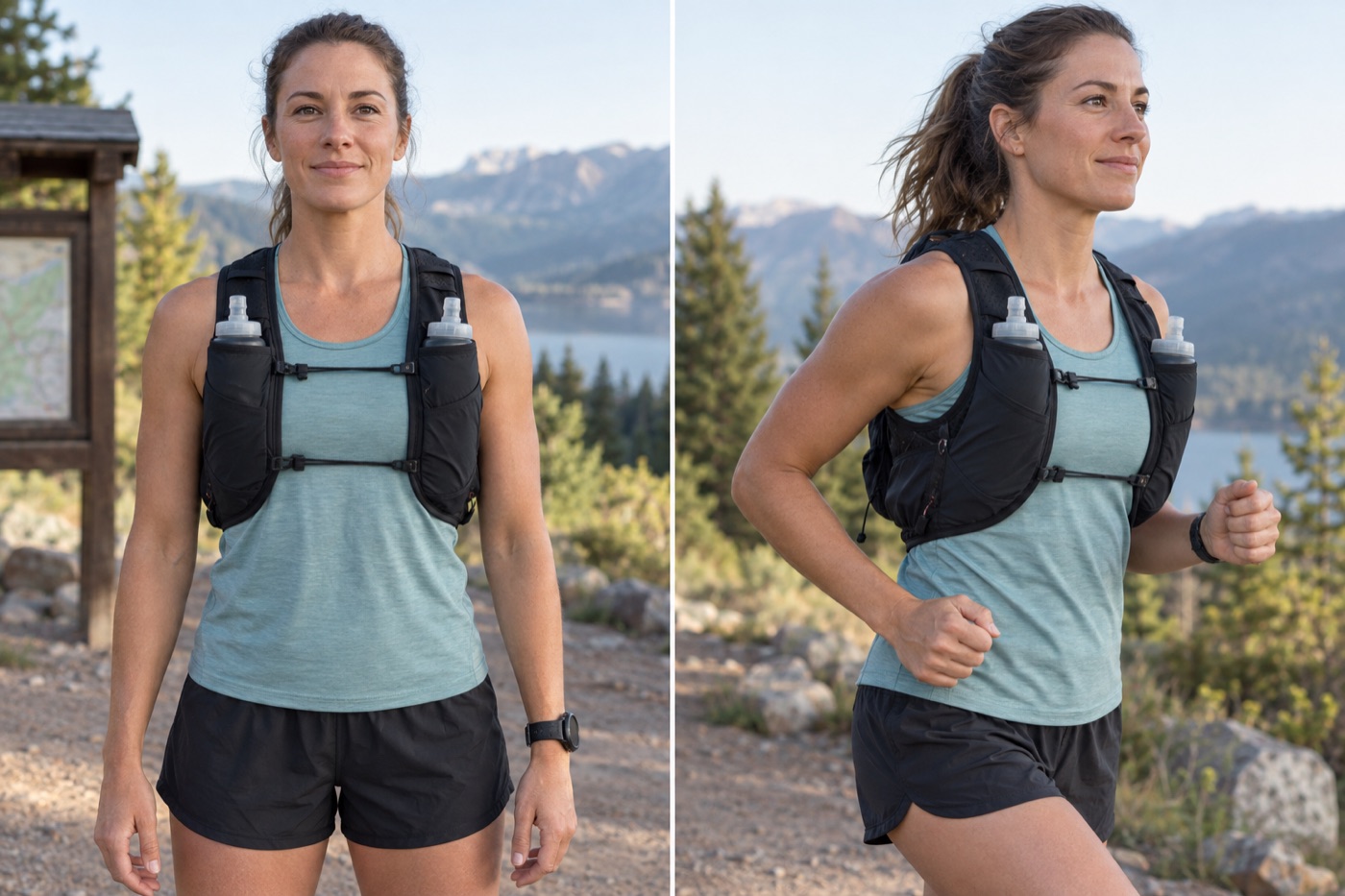
Six Fit Checkpoints
| Area | Good fit | Problem sign |
|---|---|---|
| Breathing | You can inhale fully and speak normally | Chest restriction or needing to loosen immediately |
| Shoulders | Panels lie close without a hard edge | Large gap, strap digging, numbness, or tingling |
| Armholes | Full forward and backward swing | Repeated rub at neck, armpit, or upper arm |
| Front straps | Stabilize without crossing throat or sensitive tissue | Pinching, upward migration, or local pressure |
| Back load | Moves with torso | Vertical bounce or side-to-side sway |
| Pockets | Reachable without distorting posture | Must twist sharply or loosen vest to access essentials |
The Five-Minute Dynamic Test
- Take five slow, full breaths.
- Reach both arms overhead and across the body.
- Jog in place for 60 seconds.
- Walk up and down stairs or a safe incline.
- Lean forward as you would on a climb, then return upright.
- Retrieve a flask, phone, food, and one rear-pocket item.
- Check the skin and clothing at the neck, collarbones, sternum, ribs, and armpits.
If possible, repeat outdoors for 10 to 20 minutes before committing to a long run. Sweat and repetitive motion reveal friction that a mirror cannot.
Troubleshoot the Symptom
| Symptom | Try first | Likely size issue when |
|---|---|---|
| Vertical bounce | Seat vest higher, balance front/back load, snug sides evenly | All adjusters are at their limit |
| Bottle movement | Seat flask fully and use its retention loop | Pocket is incompatible with the intended flask |
| Neck rub | Lower or reroute sternum strap if allowed; check collar and load | Vest neckline cannot clear the area in motion |
| Chest pressure | Loosen front and side tension; move strap position | Full breathing still feels restricted |
| One-sided sway | Balance dense items and equalize adjustments | Panels sit asymmetrically with an even load |
| Back sloshing | Expel reservoir air and secure it | Reservoir is unsupported by the compartment |
Fit Problems You Should Not Run Through
Stop and adjust for numbness, tingling, breathing restriction, sharp pressure, broken skin, a buckle that opens, or a reservoir or flask that cannot be secured. Anti-chafe products may help normal friction, but they should not be used to disguise the wrong size, damaged fabric, or a hard edge pressing on the body.
Sources and Manufacturer Guidance
Requirements can vary by product, model, and situation. These primary sources informed this guide; official instructions for your exact product and current authoritative guidance take priority.
Frequently Asked Questions
-
It should be snug enough to move with your torso, not tight enough to restrict a full breath or create numbness, pinching, or hard pressure.
-
Common causes are an empty fit test, trapped air in a reservoir, uneven load, a vest sitting too low, loose adjustments, or the wrong size.
-
Most running vests sit high and close on the torso so the load follows body movement. Use the maker's photos and adjustment sequence for the exact model.
-
Measure over the layers you will use and preserve adjustment range. Do not size up automatically if it makes the loaded vest bounce over lighter clothing.