Accessories

Best Hydration Packs for Running We Tested of 2026

A hydration pack fixes one problem and invites another: the more water you carry, the more weight has to stay put while you run. I've worn packs that slapped against my shoulder blades at every stride and others that rode so high they rubbed my collarbone raw by mile four. The difference usually isn't the bladder. It's the harness, the fit, and whether the stated capacity matches what you can actually stuff inside.

Over the past six months, my team and I have run in 12 packs, from bare-bones bottle vests to reservoir setups with room for a shell and a day's snacks. The lesson that surprised me most is that sizing up is the most common mistake — a pack bigger than your longest run just gives the extra fabric somewhere to bounce. What you want is a harness that disappears once you're moving, and the picks below are the ones that did.

Best Race Day Vest

Our Score 9.4/10
MOKURA Running Vest

MOKURA

MOKURA Running Vest

  • Pockets 5
  • Hydration 500 ml soft flask
  • Chest Straps 3 adjustable
  • Empty Weight 9.6 oz
Check Price on Amazon

A 9.6-ounce race vest with a flask that shrinks as you drink.

The flask in this vest collapses as you drink, and an elastic cinch takes up the slack so it never becomes a half-full bottle slapping against your chest. That is a small piece of design that matters more the longer you run, and it is typical of the MOKURA: 9.6 ounces, five pockets, and very little on it that doesn't earn its place.

This is our race-day vest. Three adjustable chest straps and stretch waist panels hold it flat against the torso, the phone holder has a retractable coiled lanyard so you can glance at a screen without unzipping anything, and the pockets are sized for gels rather than for a picnic. It goes on over a base layer in seconds and is light enough that you stop thinking about it after the first mile.

The rear pocket will take a larger bladder than the flask it ships with, so a hot training week doesn't demand a second vest. For a 10K with a water table at the halfway point, though, it is enough exactly as it comes — which is the point of a vest this light.

Bottom Line

A race-day vest for runners who want the flask and nothing else, with a harness that holds flat at pace.

Check Latest Price

Best Overall

Our Score 9.0/10
SWIFTVEST Running Vest

SWIFTVEST

SWIFTVEST Running Vest

  • Pockets 6
  • Hydration 500 ml soft flask
  • Empty Weight 10.1 oz
  • Phone Pocket Zippered, waterproof
Check Price on Amazon

A 285-gram, three-size vest with a waterproof phone pouch that stays put at pace.

The pocket that settles this one for us is the zippered, waterproof phone pouch on the front. Most of what a runner carries is a phone, a key, and a gel, and this vest is built around getting those onto your chest rather than into a pack swinging behind you. It ships with a 500 ml soft flask, has six pockets, and the spec sheet puts it at 285 grams, but the case for it isn't the parts list: the whole thing stays quiet when you run.

Three sizes and adjustable chest and shoulder straps do most of the anti-bounce work, with neoprene padding sitting between the harness and your collarbone. What we noticed at pace was how little there is to fiddle with. The flask rides high on the chest, the rear mesh pocket takes a light shell or a pair of gloves, and the phone stays against your ribs instead of thumping. Reflective detailing across the front and back earns its keep on early and late runs.

One detail to check before you order: the pouch is snug, and a large phone in a thick case just fits. If yours is borderline, a slimmer case solves it more cheaply than a different vest. The flask is the collapsible sort, so it shrinks as you drink and stops sloshing in the back half of a long run — the kind of thing you notice around the hour mark, when a rigid bottle would be knocking against your chest.

Bottom Line

Our pick for most runners: the waterproof phone pouch, three-size fit, and 285-gram harness add up to a vest you forget you're wearing.

Check Latest Price

Best Value

Our Score 9.0/10
N NEVO RHINO Hydration Backpack

N NEVO RHINO

N NEVO RHINO Hydration Backpack

  • Hydration 2 L bladder
  • Dimensions 11.8 x 16.5 in
  • Empty Weight 8.5 oz
  • Pack Capacity 12 L
Check Price on Amazon

A 2-liter bladder and 12 liters of storage at 8.5 ounces, for one-bag runners.

Eight and a half ounces of empty pack, a 2-liter bladder, and 12 liters of storage is the arithmetic behind this one, and nothing else here gives you that much capacity for that little weight. That is why the NEVO RHINO is our value pick: one bag for a long run, a day hike, and the ride to work.

The harness is vest-style rather than a pair of shoulder straps, with pouches on the shoulder straps that put a phone or a couple of gels within reach without stopping. Shoulder and chest straps adjust over a wide range, and the back panel is mesh-covered for airflow. Two liters is a lot of water, and a full bladder is the heaviest thing on the pack; the other 12 liters fill up fast if you let them, so pack it like a running bag rather than a daypack.

The bladder wants a rinse before the first run. New PEVA carries a plastic taste that fades after a couple of fills, and doing it the night before saves you a mouthful on the trail. The drinking side works well otherwise: the bite valve flows fast and the hose clamp keeps the line where you left it instead of swinging at your chin.

Bottom Line

If you want one pack for runs, hikes, and the commute, start here: a 2-liter bladder and 12 liters of storage at 8.5 ounces.

Check Latest Price

Best for Trail Days

Our Score 9.0/10
Teton Oasis Trailrunner

Teton

Teton Oasis Trailrunner

  • Pockets 6
  • Hydration 2 L bladder
  • Rain Cover Sewn in
  • Empty Weight 14.4 oz
Check Price on Amazon

A sewn-in rain cover and six pockets for runs that turn into trail days.

A sewn-in rain cover is the sort of feature you don't think about until a trail day turns wet, and it is the first thing we look at on the Oasis Trailrunner. Add six pockets, a 2-liter bladder, and a low-profile athletic cut, and you have a pack that is as happy on a two-hour run as on a five-hour hike that starts with a jog.

The drinking hardware is the best-sorted in this group: a wide 2-inch opening that takes ice and a bottle brush, a kink-free tube, and a push-lock cushioned bite valve you can shut off between sips. At 14.4 ounces empty it sits mid-weight here, which is the trade for the extra fabric and the rain cover. It looks small when it arrives and then swallows a shell, gloves, and a day of snacks.

Where it wins for us is the ambiguity. It doesn't try to be a race vest: it is a trail pack you can run in, and for mixed days that is easier to live with than a stripped-down vest with two pockets. The rain cover lives in its own compartment, so it is there when the weather turns rather than in a drawer at home.

Bottom Line

Trail runners who want a rain cover, six pockets, and a 2-liter bladder in one low-profile pack should start with this one.

Check Latest Price

Best For Gear-heavy days

Our Score 9.0/10
Criuage Hydration Vest Backpack

Criuage

Criuage Hydration Vest Backpack

  • Pockets 8
  • Hydration 2 L bladder
  • Empty Weight 1.65 lb
  • Pack Capacity 5 L
Check Price on Amazon

This isn't a vest, it's a chest rig. Four pockets across the front, four around the back, a 2-liter bladder in its own compartment, and cross-body straps that pull the whole thing tight against your sternum. If you have been trying to carry tools, a phone, and water at once, the layout makes immediate sense.

The front pockets are the point: you can reach a phone, a gel, or a multi-tool without unclipping anything, and the pack layers over a chest protector or under a jacket depending on what you are doing. The bladder sits in a dedicated rear compartment, so refilling doesn't mean unpacking the front. It is built to be loaded rather than to disappear, and the fabric and hardware are where that shows.

Think of it as a gear pack that happens to hydrate. On a mountain bike, or on a long day where water is the smallest thing you are carrying, that is exactly right; at mile ten of a half marathon the extra structure is weight you feel. Buy it for the days when hydration is the least of your packing problems.

Bottom Line

Buy it for gear-heavy days on the bike or trail; at 750 grams empty it isn't the pack we recommend for racing.

Check Latest Price

Best for Marathon Training

Our Score 8.8/10
Zelvot RUNV-3 Running Vest

Zelvot

Zelvot RUNV-3 Running Vest

  • Pockets 9
  • Hydration 500 ml soft flask; two flask pockets
  • Chest Straps 3 adjustable
  • Empty Weight 12.3 oz
Check Price on Amazon

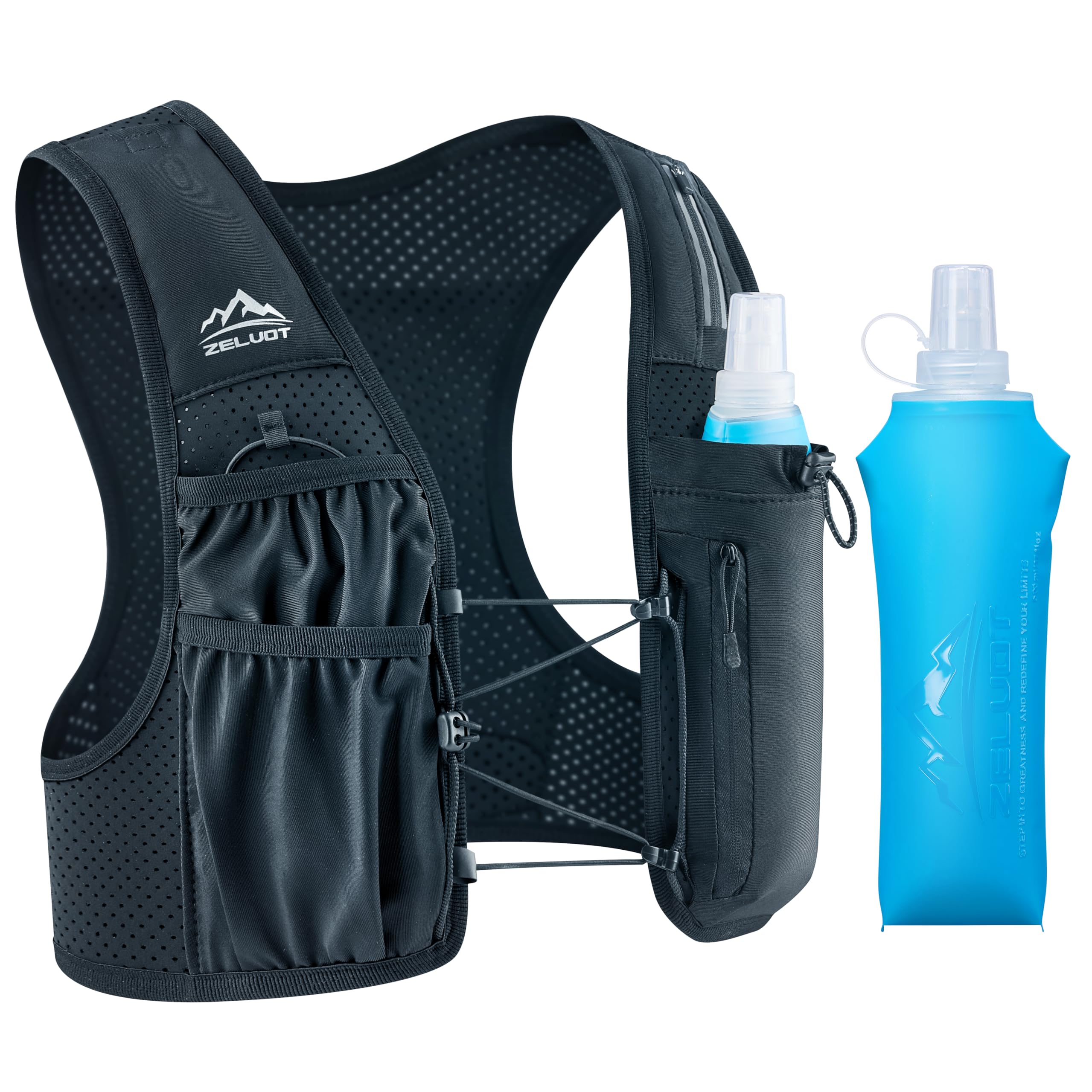
Two flask pockets carry a liter, making it the vest for long training blocks.

Two soft-flask pockets are the reason this vest is here. The 500 ml flask it ships with goes in one; the other takes a second flask or a standard bottle, which gets you to a liter without a bladder, a hose, or anything sloshing around behind your ribs. Nine pockets and 0.35 kg of empty weight round out a vest built for the long end of a training block.

We reach for this one when a run is going past ninety minutes and a single flask stops being enough. Three adjustable chest straps and stretch panels hold it against the torso, and the front pockets put gels, a phone, and a key where your hands already are. The two rear pockets are for a shell, a hat, or a towel — the things you want with you but not in your hand.

What takes adjusting is the weight distribution. With both flasks full, the load sits high on the chest, which keeps the vest from swaying but feels odd if you have only ever run in a backpack. It also rewards travelling light: for a short run, one flask and a phone in the front pocket is all it needs to carry, and it doesn't feel like overkill the way a two-liter pack does.

Bottom Line

Two flask pockets make this the vest for a marathon training block, when a single 500 milliliters stops being enough between refills.

Check Latest Price

Best For Bike commutes

Our Score 8.8/10
Maelstrom Hydration Backpack

Maelstrom

Maelstrom Hydration Backpack

  • Pockets 4
  • Hydration 2 L bladder
  • Empty Weight 1.1 lb
  • Chest Strap Range 22.4–61 in
Check Price on Amazon

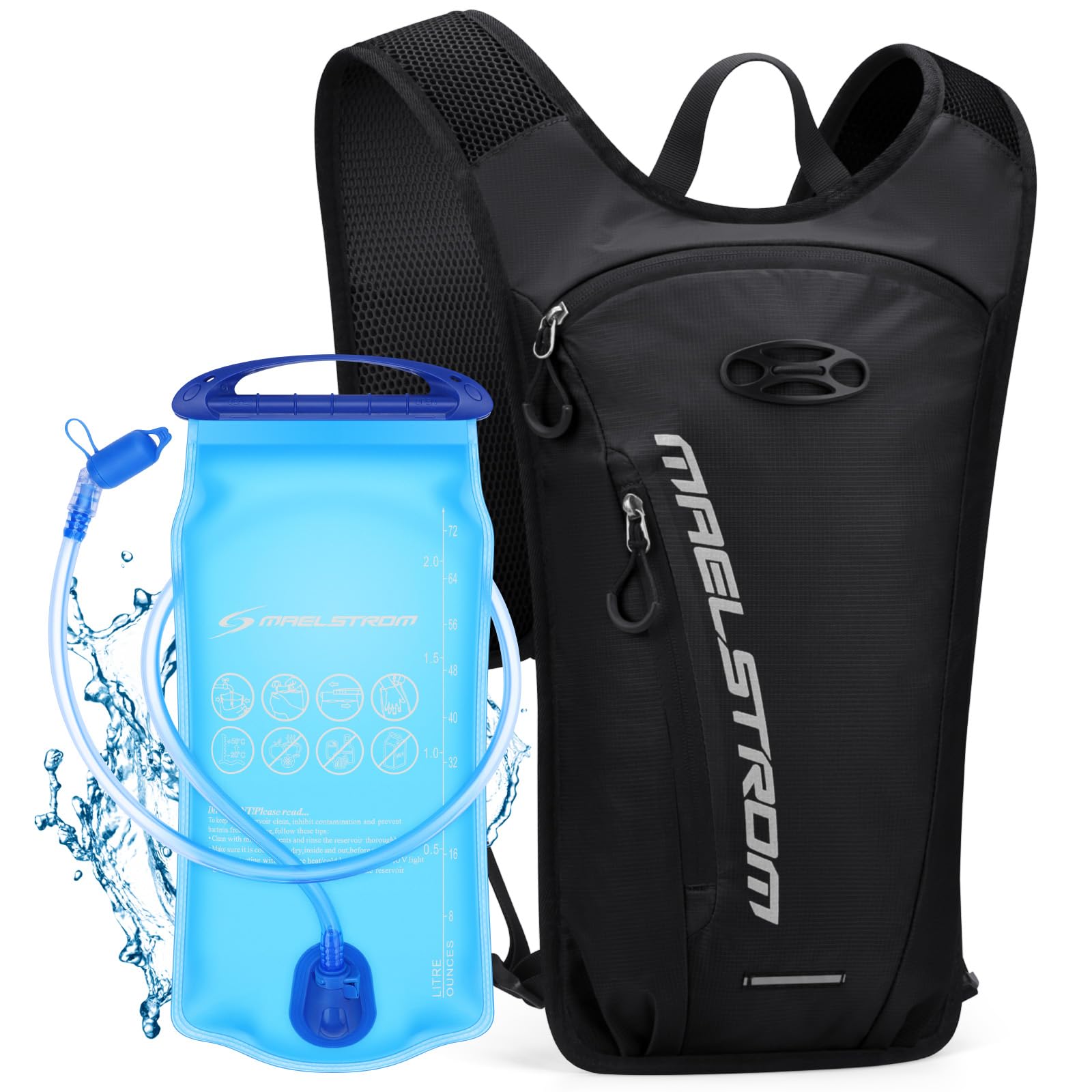
External helmet clips are the tell: this is a pack for the ride as much as the run. Clip your helmet on for the walk back from the trailhead, or leave it off and use the four pockets for a phone, keys, and tools.

The rest is conventional in a way we don't mind. A 2-liter bladder sits in the main compartment, the back panel is ventilated, and the chest strap adjusts from 22.4 to 61 inches — a range wide enough for a big frame or a winter jacket. At 1.1 pounds empty it is more pack than a 5K needs and about right for a two-hour ride.

The bite valve is the part to watch. Fold forward to tie a shoe and the mouthpiece can dribble down your front, so keep it shut between sips and check that it is seated before a long ride. Do that and it stops being a story.

For running on its own, a vest wins every time — this sits like a small backpack and swings a little when you pick up the pace. But if your week is two rides and one run, it covers both without a second bag, and the reflective strips do their job on the way home.

Bottom Line

A budget two-liter pack that doubles as a bike bag, as long as you treat the mouthpiece as the weak link.

Check Latest Price

How We Tested 12 Running Hydration Packs Over Six Months

To build the shortlist, I started with the vest-style packs runners recommend to each other, the reservoir-first designs, and a few hybrids, then filtered by reservoir size, empty weight, harness adjustability, and price. That left 12 packs spanning budget to premium, which my team and I ran in for six months.

Each pack logged long Sunday runs, weekday tempo sessions on pavement, a handful of muddy trail runs, and one memorably wet 10-miler. We weighed every pack empty and again with a full reservoir, because listed weight tells you very little about how a pack feels at mile eight. Fit was checked at pace: I tightened the sternum strap and side cinches, then reached for a flask mid-stride and noted whether the pack rotated, bounced, or pulled at the shoulders, and how much strap range was left once it was snug.

Storage got measured by what actually went in — a rain shell, phone, keys, and four gels — and whether the phone could come out without unpacking the whole bag. Every bladder was filled, inverted over a dry towel for an hour, then run with, and we watched for drips down the back and valves that leaked on the bite. After each wash we inspected seams, zipper pulls, and mesh for fraying or stretch. Value was judged last: a pack earned it by finishing six months without a seam giving out or a valve that still tasted like plastic.

How to Choose

Bladder or soft flask

A bladder rides on your back and lets you sip through a hose without breaking stride. A soft flask sits on your chest, shows you how much is left, and collapses as you drink so there is nothing to slosh. That is the trade: capacity against convenience.

Pick from your longest regular run rather than your shortest. A 2-liter bladder suits unsupported efforts and hot days; a 500 ml flask covers about an hour, and a vest with two flask pockets gets you to a liter without adding a hose, which is why the Zelvot RUNV-3 is our long-training pick.

Fit is most of the bounce control

The harness decides whether the pack moves with you. A vest wraps the torso with two or three chest straps and stretch panels; a shoulder-strap pack leans on a waist belt and swings more when you pick up the pace. Three chest straps, as on the Zelvot and the MOKURA, give you more places to take up slack than a single sternum strap.

Measure your chest rather than guessing a size, and try the pack over the layer you wear in cold weather. A vest that fits snugly over a t-shirt can be uncomfortable over a jacket, and that is the fit problem people blame on the pack.

Empty weight against carried weight

The number on the listing is the empty pack. Two liters of water is roughly two kilos before you add a phone, which is why a heavier pack with a good harness can feel better on the move than a flimsy light one.

Empty weight still matters. This set runs from 8.5 ounces to 750 grams, and the light end is where race vests live. If you are lining up at a start line, stay near 10 ounces; if the pack has to cover a day out, spend the weight on storage instead.

The pockets that actually matter

Three things need to be reachable without stopping: fluid, a phone, and something to eat. Front chest pockets are worth more than a bigger rear compartment, and a zippered, water-resistant phone pocket is worth more than a stretchy one — pack fabric being water-resistant tells you nothing about the phone inside it.

Check the phone pocket against your actual phone and case before you commit. Several vests here are snug on a large cased phone, and a thinner case is the cheapest fix you will find.

What wears out first

Valves, hose connections, and strap anchors fail before fabric does. A bite valve that drips or a hose that will not stay seated ends a run faster than a scuff, so fill and squeeze the bladder in the sink before your first outing and check the connection at the base of the hose.

Bladders are replaceable and often interchangeable; harnesses and seams are not. That is the part worth paying for.

Frequently Asked Questions

Final Verdict

For most runners, the SWIFTVEST is the pack to buy: 285 grams, three sizes, a waterproof phone pouch, and a harness that stays flat whether you are doing a park loop or a half marathon.

If your long runs go past 90 minutes without a refill, switch to the Zelvot RUNV-3 and its two flask pockets. And if the pack also has to cover trail days and hikes, the Teton Oasis Trailrunner is the one that won't feel like a compromise.