Yoga & Mobility

Best Yoga Straps of 2026

A yoga strap looks like the least important thing in your bag — a strip of webbing with a buckle — right up until the moment you can't reach your toes and the pose falls apart. The strap closes that gap: it extends your reach so your shoulders stay open and your spine lengthens instead of rounding forward. What separates a good one from a frustrating one shows up fast. Thin webbing digs into your palms during a long hold, buckles slip under load, seams fray, and some straps stretch so much mid-pose that you end up chasing your own hands.

I went through a regrettable towel phase before I understood any of this. Over the past four months, my team and I have worked through 14 straps — cotton, nylon, buckled, looped — and the differences aren't subtle. Stretchiness is the sneaky one: a strap with too much give flatters your range in the moment and quietly robs you of the feedback you need to actually progress. The picks below are the ones that held up, whether you stretch on a living-room floor or carry one to class three times a week.

Best D-Ring Strap

Our Score 9.6/10
Tumaz D-Ring Yoga Strap

Tumaz

Tumaz D-Ring Yoga Strap

  • Buckle 4 mm welded D-ring
  • Length 6 feet
  • Material Cotton
  • Thickness 2.5 mm
Check Price on Amazon

Textured cotton and a D-ring that locks a loop at whatever length a pose needs.

Cotton webbing is the first thing we notice: it has a texture to it, so it doesn't slide through a sweaty hand the way slick nylon webbing can. The D-ring is the real argument for it, though. Thread the tail through the two rings, pull, and you have locked a loop at whatever length the pose needs — long for a bound side angle, short to lasso a foot in a seated fold.

Six feet is the length we tested and it covers most seated and supine poses; the strap is also sold in eight and ten feet if you are tall or you like to loop it around both feet. The rings feel substantial rather than stamped and thin, and the buckle holds where you set it through a long hold. Colors run past a dozen, which sounds like marketing until you are the one picking a strap to match a mat.

Where it gives ground to a loop strap is speed. Changing grip mid-stretch means rethreading, and if you are switching feet every thirty seconds that's a beat of fiddling the sewn-loop straps don't ask for. For studio practice, where you set a length and hold it, that hardly registers.

Bottom Line

If you want a strap that cinches to any length, this is the one we keep coming back to: soft cotton webbing and a D-ring that holds where you set it.

Check Latest Price

Best Premium Pick

Our Score 9.6/10
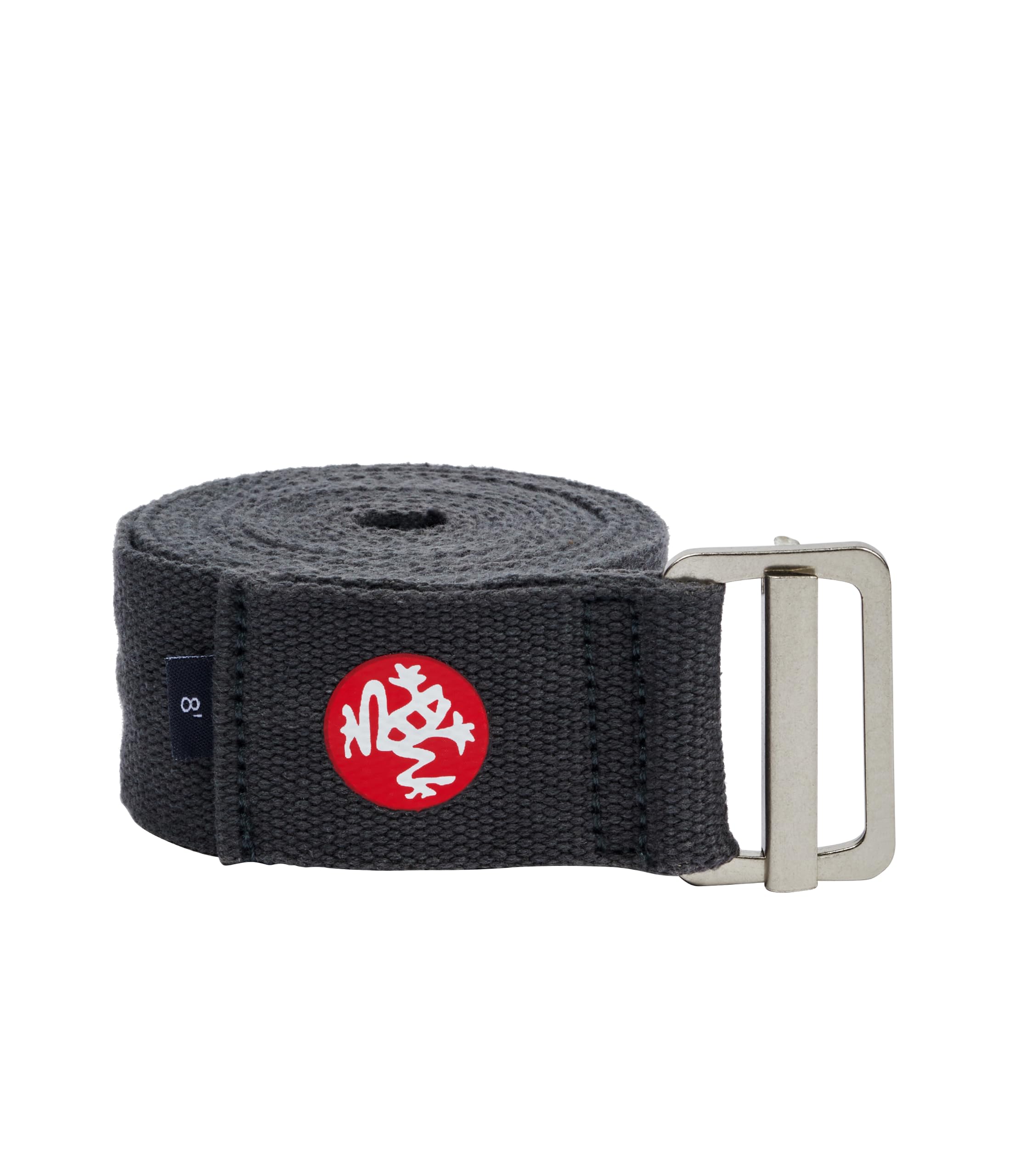
Manduka Align Yoga Strap

Manduka

Manduka Align Yoga Strap

  • Width 1.75 inches
  • Buckle Zinc alloy
  • Length 8 feet
  • Material Unbleached cotton
Check Price on Amazon

A 1.75-inch cotton strap with a buckle that holds through the hardest pulls.

At 1.75 inches, this is the widest strap in our group, and the webbing is unbleached cotton rather than the coated nylon most clinic straps use. You feel the difference under a foot before you notice anything else.

We reach for it when a stretch involves the arch. That extra width spreads the pull across the foot instead of concentrating it in a thin line, and after a few poses we stopped thinking about the strap at all, which is about the highest compliment a prop can earn. The zinc alloy buckle has a middle bar that keeps the tail from creeping, so a loop set for a long hold stays set.

Eight feet is generous — a tall practitioner can loop it around both feet in a seated fold and still have tail to spare — and the cotton feels good against bare skin in a way slick webbing doesn't. The catch is the width itself: 1.75 inches is a lot of strap to wrap around a wrist in a bind, where a narrower one threads more easily. We think the trade is worth it if you practise often; if you stretch twice a week, the loop straps here do the same mechanical job.

Bottom Line

We think it's worth the premium if you want one strap for the next decade: wide cotton and a buckle that doesn't slip make hard poses easier to hold.

Check Latest Price

Best Overall

Our Score 9.4/10
OPTP Stretch Out Strap

OPTP

OPTP Stretch Out Strap

  • Weight 4 oz
  • Made In USA
  • Included Exercise book
  • Material Nylon
Check Price on Amazon

Sewn loops, a printed exercise book, and four ounces of nylon that travels anywhere.

The booklet is the part most people skip past, and it's the first thing we point to: a printed exercise book comes in the bag, showing where the strap goes for a hamstring, a calf, a shoulder, so a beginner isn't guessing at floor level. The strap itself is deliberately plain — green nylon, four ounces, a row of sewn loops down its length — and it has been sold since 1993, which is why it's the strap a lot of people first meet on a physical therapist's table.

What settles it for us is the loops. There's no buckle to thread and no tail to chase: you move your hand up one loop and the stretch deepens by a couple of inches, which is the amount of control you want when a hamstring is tight. The loops also let you hold a position with a relaxed grip — hook a foot, pull with straight arms, and the strap does the reaching your hands can't manage on their own.

Fixed spacing is the trade-off. A buckle lets you cinch a loop at any length, including around a thigh, and this one can't do that; you work with the loop nearest your hand. For floor stretching and therapy homework that rarely matters. Ours has been folded into a gym bag and pulled on most days, and the webbing is still firm rather than stretched out, which is the quality that counts in a strap you pull against.

Bottom Line

We recommend the Stretch Out Strap as the default buy: the sewn loops do the reaching your hands can't, and the included booklet means you're not guessing where to start.

Check Latest Price

Best for Tall Users

Our Score 9.4/10
SANKUU 12-Loop Yoga Strap

SANKUU

SANKUU 12-Loop Yoga Strap

  • Loops 12
  • Width 1.57 inches
  • Length 8 feet
  • Material Nylon
Check Price on Amazon

Eight feet of webbing and 12 loops give long-limbed stretchers room to work.

Twelve loops over eight feet is a lot of handholds, and the spacing is the point: there is almost always a loop where your arm happens to be, so you can deepen a stretch in small steps rather than one jump between grips.

The webbing is 1.57 inches wide and softer in the hand than stiff canvas clinic straps, and the loops are double-stitched along their length. It arrives with a carry bag and a poster of stretches, which is more useful than it sounds if nobody has ever shown you what to do with a strap.

Tall bodies are where this one earns its place. If your hands don't reach past your knees in a seated fold, the extra two feet means you are never tugging the last inch of webbing, and someone around six feet tall can work through a full range of motion without improvising. Shorter users end up with a lapful of spare strap, which is why we don't hand it to everyone.

Bottom Line

Our pick for tall bodies and floor work — 8 feet of webbing and 12 loops mean there's always a handhold within reach.

Check Latest Price

Best Padded Grip

Our Score 9.4/10
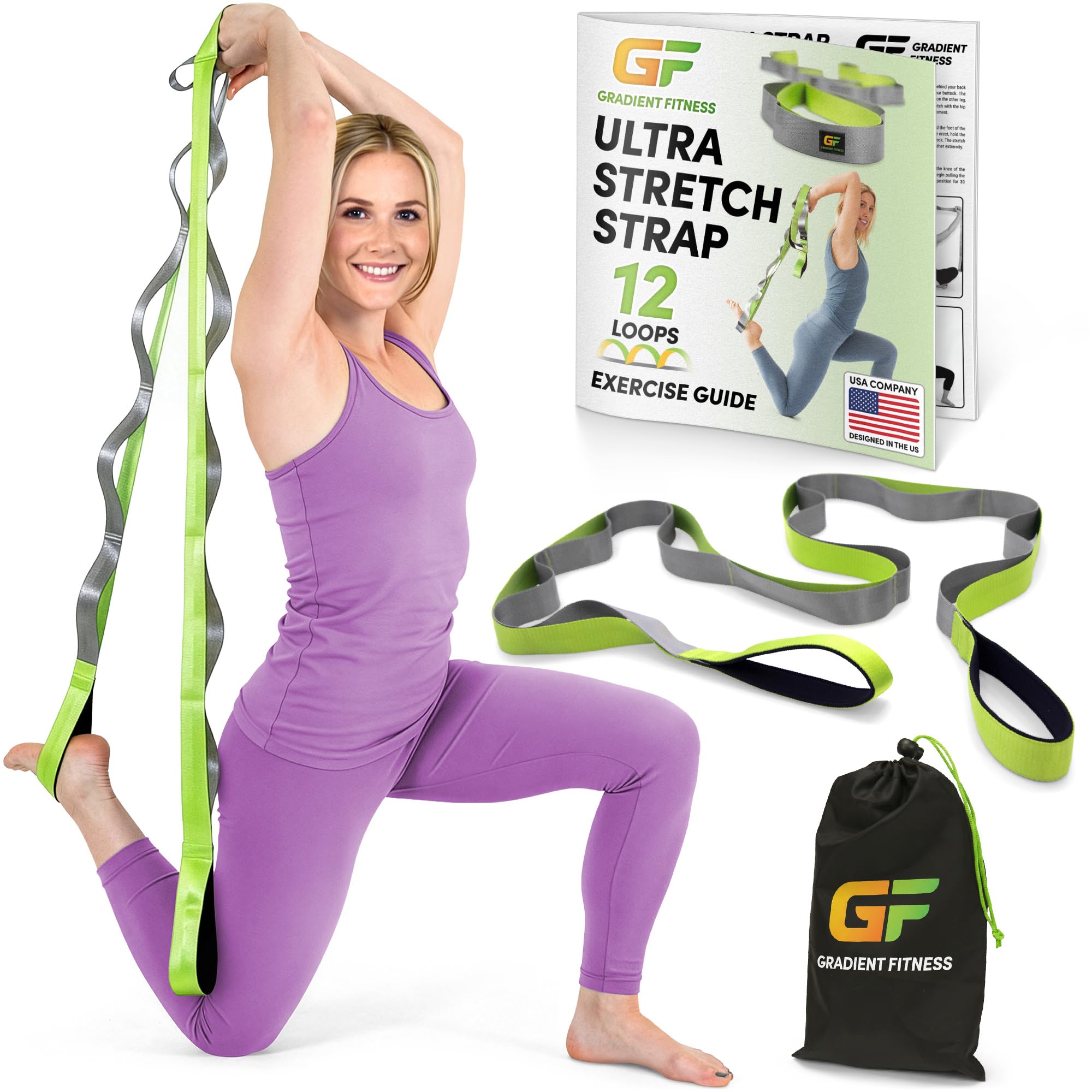
Gradient Fitness 12-Loop Strap

Gradient Fitness

Gradient Fitness 12-Loop Strap

  • Loops 12
  • Width 1.5 inches
  • Length 8 feet
  • Material Neoprene, nylon
Check Price on Amazon

Padded foot loops and wide webbing that are kind to hands and arches.

Padded foot loops are what sold us. The SBR lining at each end means a hard pull lands on a soft surface rather than the edge of nylon webbing, and if you have ever quit a stretch because it hurt the arch of your foot, that is the detail worth paying attention to.

Twelve loops over eight feet gives fine gradations between grips, the webbing runs 1.5 inches wide so it doesn't cut in, and the whole thing rolls into the included bag with a printed instruction sheet. We hand it to people with limited hand strength and to anyone working through a recovery program, because holding it doesn't require a tight fist.

The length is the thing to check. Eight feet is generous, and shorter users end up doubling it in seated poses, which is fine on a mat and awkward in a crowded class. If you are well under average height and you mostly work on the floor, a six-foot strap is easier to live with.

Bottom Line

The padded loops make this the strap we suggest to anyone whose hands or feet have hurt during stretching; the eight-foot length is the catch.

Check Latest Price

Best Budget

Our Score 9.4/10
Trideer Stretching Strap

Trideer

Trideer Stretching Strap

  • Width 1 inch
  • Length 75 inches
  • Weight 3.2 oz
  • Material Polypropylene
Check Price on Amazon

A no-frills clinic-style loop strap that covers the basics for very little.

One inch is narrow, and that is most of the story of this strap. It is 75 inches of woven webbing with evenly spaced loops and a width that concentrates the pull into a thinner band than the 1.5-inch straps we also recommend.

What you get in exchange is the thing a therapy patient actually needs: a non-elastic strap that behaves like the one on the clinic table, plus a small brochure showing positions. At 3.2 ounces it disappears into a bag, which is why one of ours lives in a desk drawer for midday hamstring work.

As a first strap, we think it's the bargain of the group — the mechanics are identical to straps that cost noticeably more, and nothing about the webbing feels cheap in the hand. You will feel the narrowness on a hard pull; grip closer to the loop, or wear socks, and it stops mattering.

Bottom Line

We think it's the best first strap here: a clinic-style loop strap that covers the basics for very little money.

Check Latest Price

Best For Hand comfort

Our Score 9.4/10
CTRL Sports Stretch Strap

CTRL

CTRL Sports Stretch Strap

  • Loops 10
  • Width 1.5 inches
  • Length 78 inches
  • Handles Neoprene-covered
Check Price on Amazon

Neoprene covers the handles on this strap, and the difference shows up in the last ten seconds of a hold, when bare nylon starts to bite into your palm.

Ten loops over 78 inches and 1.5-inch nylon webbing put it in the same territory as the other loop straps here; what separates it is the finish. The seams at the loops carry substantial stitching, and the whole thing rolls into a drawstring bag that keeps it out of the way in a gym bag.

The guide is where it thins out — a printed sheet of basic stretches plus video access, rather than the full illustrated booklet that comes with our top pick. If you already know the exercises, that is irrelevant.

We hand this to anyone whose hands are the reason they quit a stretch early; the padding turns a hold you are enduring into one you can relax into. It costs more than the plain webbing straps here, and the covered handles are what that money buys.

Bottom Line

We recommend it if the last ten seconds of every hold is what stops you: padded handles and a carry bag make this the easiest loop strap to live with.

Check Latest Price

Best For Tracked rehab

Our Score 9.4/10
KneeSled Ultra Stretch Strap

KneeSled

KneeSled Ultra Stretch Strap

  • Loops 10 numbered
  • Width 1 inch
  • Length 80 inches
  • Material Nylon
Check Price on Amazon

Numbers are printed on the loops — one through ten — and that small detail changes how the strap gets used. Instead of guessing whether you are pulling from the same place as last week, you write down loop six and repeat it exactly.

The rest is a well-made 80-inch nylon strap with 1-inch webbing, double- and triple-stitched at the loops, plus an illustrated stretch chart. It handles heel slides, leg raises, and the unglamorous range-of-motion work that follows knee or hip surgery as readily as a hamstring stretch.

What it isn't is a premium yoga prop. One inch of nylon is one inch of nylon, and in a studio class the numbering doesn't buy you anything a plain strap doesn't already do.

Where it earns its place is a structured recovery program: the numbered loops make progress something you can see and record, and the chart means you are not inventing exercises. If you are working through a protocol with a therapist, we think the numbering has real value; if you are buying your first strap for forward folds, it is more strap than the job needs.

Bottom Line

We like it best for a structured rehab program, where the numbered loops earn their keep; for reaching your feet in a fold, a cheaper strap does the same job.

Check Latest Price

How We Tested 14 Yoga Straps

We started with a list of about 40 straps pulled from studio recommendations, specialty yoga shops, and the most-reviewed options at major retailers, then narrowed it by webbing material, buckle type, length, and price. Fourteen made the cut, and we spent four months with them — not on a lab bench, but in living rooms, on studio floors, on gym carpet, and in the trunk of a car between classes.

To check stretchiness, we looped each strap around both feet, leaned back into a supine hamstring hold, and marked where the buckle sat at the start and again after ten minutes of holds; a few had crept a full inch. We threaded and adjusted every buckle one-handed mid-pose to see how quickly we could shorten a loop, then hung our weight off the end to watch for slipping. Durability got less gentle treatment: straps were stuffed into totes with keys and water bottles, dragged over mat edges, machine-washed, and snapped open and shut dozens of times while we watched for frayed edges, pulled stitching, and cracked hardware.

Versatility came down to how each strap handled being asked to do several jobs in one session — a hamstring stretch, a shoulder opener behind the back, a partner-assisted fold, and hauling a rolled mat to class. We noted which lengths felt clumsy in a small room, which webbing turned slick once our palms got sweaty, and which buckles were sturdy enough to trust but light enough not to swing into a shin.

How to Choose

Loops or a Buckle?

A loop strap hands you a fixed ladder of grips. Hook a foot, take the loop nearest your hand, pull; to go deeper you move up one rung. There is nothing to thread, which matters when one hand is weak or you are flat on your back. A buckle strap adjusts continuously: thread the tail through the rings and you can lock a loop at any length, including around a thigh — which is why buckled straps suit yoga poses and binds.

Choose loops for therapy exercises, hamstring and quad work, and anything done lying down; choose a buckle if you want one strap that can also wrap a limb. The trap with loops is spacing: the handholds sit where the maker sewed them, so run through the two or three stretches you actually do and check a loop lands where you need it.

Length Is About Reach, Not Height

Six feet covers most people for seated and supine poses. Sit on the floor with your legs straight, loop the strap around both feet, and hold the ends with straight arms and an upright back. If you can't, go up a length. Eight feet is the safer choice above roughly six feet tall, and the one we favor if you do a lot of floor work or like to loop both feet at once.

More strap is not free. Eight- and ten-foot straps leave a coil in your lap during short poses and take longer to gather in a crowded studio. If you are on the shorter side and stretch mostly at home, six feet is easier to live with.

Width, Padding, and Hands That Hurt

Straps here run from one inch to 1.75 inches wide. Narrow webbing concentrates the pull into a small band, which you notice on a hard hamstring pull or across the arch of a foot; wider webbing spreads the load but is bulkier to wrap around a wrist.

If hand or foot pain is why you stopped stretching, padding is worth seeking out. A strap with lined foot loops or covered handles lets you hold a position without gripping hard, and post-surgical hands do better with a wide, soft strap than a thin, firm one.

Webbing, Grip, and Stitching

Cotton has more surface texture than nylon and feels softer against skin; nylon is firmer, slicker, and wipes clean, and polyester blends sit between them. None of them should give under a pull — a strap that lengthens leaves you fighting the strap instead of relaxing into the stretch. When a listing calls webbing stretchy, it usually means it flexes, not that it grows.

Check the loops before you trust them: look for bar-tacked or double-stitched seams and, on a buckled strap, welded metal rings rather than thin stamped ones. One hard pull at home tells you more about a strap than the packaging does.

Frequently Asked Questions

Final Verdict

Buy the OPTP Stretch Out Strap if you want one strap for therapy homework, hamstring work, and a Sunday stretch on the floor: the sewn loops do the reaching your hands can't, and the included booklet means you are not guessing where to start.

If your practice is studio yoga rather than rehab, the Tumaz D-ring adjusts to any pose and costs less. If you want a strap you'll still be using in ten years and don't mind paying for it, the Manduka Align's wide cotton and locking buckle are the ones we reach for on a mat.