Yoga & Mobility

Best Non-Slip Yoga Mats of 2026

Halfway through class, your hands start creeping toward the front of the mat, and the rest of the hour becomes a quiet fight with your own equipment. A mat with real grip ends that — you stop readjusting and start practicing. The catch is that the stickiest surfaces aren't always the cushiest, and the thickest mats can feel like balancing on a marshmallow in a standing pose.

We spent five months with 14 mats, unrolling them on hardwood, on studio floors, and on a hotel carpet, and the differences showed up fast. Here's what I wish someone had told me years ago: grip changes once a mat gets wet, so a surface that feels tacky in a dry room can turn slick by the second flow. The ones below survived sweat, repeated washing, and a daily commute stuffed in a tote bag, and each one suits a slightly different practice.

Best for Dry, Stylish Flows

Our Score 9.4/10
Gaiam Premium 6mm Print Mat

Gaiam

Gaiam Premium 6mm Print Mat

  • Size 68 x 24 in
  • Material PVC
  • Warranty Lifetime
  • Thickness 6 mm
Check Price on Amazon

A 6mm sticky-surface mat with a lifetime warranty and prints that feel personal.

The Gaiam Premium is the mat that looks like it belongs in the room, not hidden in a closet. The print is the first draw, but the surface is the reason we keep it in the rotation: the 6mm PVC has a textured, sticky feel that gives you traction in dry, slower flows. Once your hands get damp, that grip fades, so it is not the mat we choose for a heated class.

At 68 by 24 inches, it is a standard-size mat with a little more cushion than a travel mat. We appreciate the lifetime warranty, which is rare in this group, and the 6P-free PVC claim gives you one less thing to worry about. The mat is light enough to carry under your arm, though it is not as portable as the YOGATI.

We like it best for a home practice where you unroll the mat and leave it out. The surface rewards dry hands and bare feet, and the print makes a small space feel less like a gym. It is a mat for slow mornings and bare feet, not a gym towel.

Bottom Line

For dry, slower flows, we like the Gaiam Premium's sticky 6mm surface, lifetime warranty, and a print that doesn't need to hide.

Check Latest Price

Best for Beginners

Our Score 9.4/10
NewMe Fitness Pose Mat

NewMe Fitness

NewMe Fitness Pose Mat

  • Size 68 x 24 in
  • Material PVC
  • Thickness 5 mm
  • Printed Poses 70
Check Price on Amazon

Seventy printed poses turn the mat into a built-in guide for home practice.

The NewMe mat is the only one here that tries to teach while you practice. Seventy illustrated poses are printed directly on the surface, so you can check a lunge or a twist without propping up a phone. For a beginner who practices alone, that is a real convenience.

We like it most for a first home practice. The 5mm PVC gives you enough padding for kneeling poses, but it is not a plush mat; if your knees need a soft landing, the thicker Gruper or CAP is a better fit. The surface is textured for grip, and the poses are easy to see in a bright room.

The mat is 68 by 24 inches and weighs 2.6 pounds, so it is easy to roll up and store. It is made with BPA-free, latex-free, phthalate-free PVC, and a mild initial odor is normal. We keep it as a teaching mat for beginners, not a hot-yoga workhorse.

Bottom Line

We recommend the NewMe for beginners who want 70 poses printed under their hands; it turns a phone-free practice into a guided one.

Check Latest Price

Best Overall

Our Score 9.2/10
CAP Barbell 1/2-Inch Yoga Mat

CAP Barbell

CAP Barbell 1/2-Inch Yoga Mat

  • Size 68 x 24 in
  • Weight 2.16 lb
  • Material NBR foam
  • Thickness 0.5 in
Check Price on Amazon

The most stable everyday mat here, with 1/2-inch cushioning and a budget price.

Most mats here make you choose between a sticky surface and a soft landing. The CAP Barbell is the one that gets closest to both: its 1/2-inch high-density NBR foam has enough give for knees and wrists, and its textured surface is the steadiest in this group on a dry floor. We reach for it first for a home practice on hardwood or tile.

The 68-by-24-inch surface is standard yoga-mat size, and the mat weighs just under a kilogram, so rolling it up and tucking it into the included strap is not a chore. We appreciate that the foam springs back instead of staying compressed under a knee. It is also one of the least expensive thick mats here, which makes it an easy first mat or a spare for the living room.

If you are tall, the 68-inch length may feel short in poses where you reach overhead or take a wide stance; the CAMBIVO is the better fit for that. For everyone else, the CAP is the one we leave out for daily stretching. It does not ask for much beyond a wipe-down and a dry floor.

Bottom Line

The CAP Barbell is our default non-slip mat for home yoga and floor work: the steadiest surface in this set, with enough 1/2-inch cushioning for knees and wrists.

Check Latest Price

Best for Tall Yogis

Our Score 9.2/10
CAMBIVO Extra Long Wide Mat

CAMBIVO

CAMBIVO Extra Long Wide Mat

  • Size 84 x 30 in
  • Weight 5 lb
  • Material PVC
  • Thickness 6 mm
Check Price on Amazon

An 84-by-30-inch mat that gives tall and broad bodies room to move.

Most yoga mats stop at 24 inches wide. The CAMBIVO adds six inches and stretches to 84 inches long, which is the difference between fitting on the mat and hanging off it in a wide-legged pose. The extra room shows up first in seated folds and arm balances, where the mat stops being something you have to work around.

The 6mm PVC surface has a honeycomb bottom that is meant to grip the floor, and the top is textured for hands and feet. It rolls up with the included strap, and the size is the point.

We like it best for tall or broad yogis who want one mat that covers the whole floor area. Grip is not the strongest in this set once hands get damp, so a towel is worth keeping nearby. But if your main problem is that every mat feels too narrow, the CAMBIVO solves it before you notice anything else.

Bottom Line

We point tall and broad yogis to the CAMBIVO first: its 84-by-30-inch surface gives you room to move without hanging off the edge.

Check Latest Price

Best For Hard-floor cushioning

Our Score 9.2/10
Amazon Basics Extra Thick Mat

Amazon Basics

Amazon Basics Extra Thick Mat

  • Size 73.2 x 24.3 in
  • Weight 2.2 lb
  • Material NBR foam
  • Thickness 0.5 in
Check Price on Amazon

The Amazon Basics mat is the budget route to a half-inch of foam. At 73.2 by 24.3 inches, it is slightly longer and wider than a standard mat, and the NBR foam gives you a soft landing on hard floors without asking you to spend much.

The mat weighs 1 kilogram and rolls up with a carrying strap. The foam is thick enough for sit-ups, planks, and stretching, and it springs back after pressure.

Grip is the compromise: the surface is textured but not sticky, and it gets slick once hands and feet are damp. It is a hard-floor mat for light stretching, not a fast, sweaty flow.

We like it best as a spare pad for bodyweight circuits or a first mat in a dorm room. For the money, it is an easy way to stop doing planks on bare hardwood, as long as you are not expecting it to replace a dedicated yoga mat.

Bottom Line

We keep the Amazon Basics as the budget route to a half-inch of cushioning for hard floors and light stretching.

Check Latest Price

Best for Joint Support

Our Score 9.0/10
Fitvids 1/2-Inch Yoga Mat

Fitvids

Fitvids 1/2-Inch Yoga Mat

  • Size 71 x 24 in
  • Weight 1.8 lb
  • Material Foam
  • Thickness 0.5 in
Check Price on Amazon

A light, thick mat that cushions knees and rolls up for class.

The Fitvids mat is built for the kind of session that moves from standing poses to floor work without a break. At 1/2 inch thick and 71 inches long, it gives you more length than a standard mat and a soft landing for knees, hips, and elbows. The included strap is simple, but it works: roll the mat, cinch it, and carry it by the loop.

We reach for this one when comfort matters more than precision. The foam is dense enough to support you in a plank but soft enough that pressure points do not complain, and at 1.8 pounds it is easy to move between rooms or toss in the car. Grip is the compromise: it holds on dry floors, but hands and feet can slide once you work up a sweat. A towel at the top of the mat solves most of that.

The mat is not the one we choose for a hot, fast flow, but it is a strong value for Pilates, stretching, and home strength work. If you want a mat that doubles as a knee-friendly floor pad, this is the one to shortlist.

Bottom Line

We reach for the Fitvids when knees need a break and the mat has to travel easily; its 1/2-inch foam and strap make that combination work.

Check Latest Price

Best For Extra-thick cushioning

Our Score 9.0/10
Gruper 10mm Yoga Mat

Gruper

Gruper 10mm Yoga Mat

  • Size 72 x 24 in
  • Includes Bag and strap
  • Material NBR foam
  • Thickness 10 mm
Check Price on Amazon

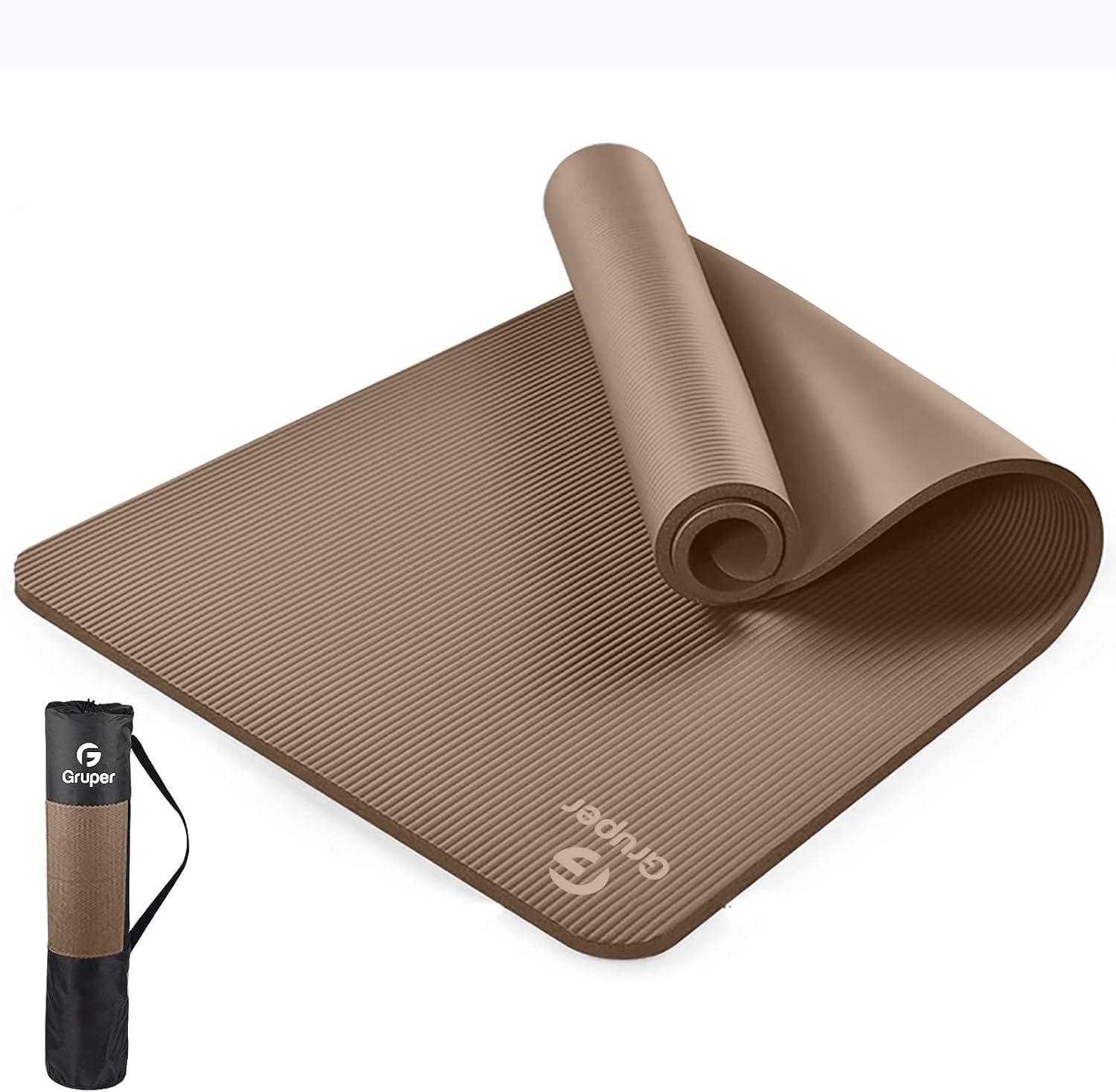
Ten millimeters is a lot of foam under your knees, and the Gruper gives you that plus a carry bag without a premium price. The 72-by-24-inch surface is longer than a standard mat, which helps in reclining poses and gives you a little room to sprawl.

The NBR foam is soft and thick, and the mat rolls up with the included strap and bag. We like the bag for storage: it keeps the mat out of the way and makes it easy to carry to a class or the backyard. The foam is also the reason the mat feels more like a floor pad than a precision yoga surface.

We reach for the Gruper when the floor is hard and the session is more stretching than balance. The same 10mm foam that cushions knees can feel vague in standing poses, and the mat is not the one we choose for a fast flow. For a home stretch, physical-therapy routine, or a knee-friendly floor workout, it earns its place.

Bottom Line

When knee comfort matters more than balance, we reach for the Gruper's 10mm foam and included bag.

Check Latest Price

Best For Alignment-minded beginners

Our Score 9.0/10
YOGATI Alignment Yoga Mat

YOGATI

YOGATI Alignment Yoga Mat

  • Size 72 x 24 in
  • Weight 1.81 lb
  • Material TPE
  • Thickness 6 mm
Check Price on Amazon

The YOGATI's center markings are the feature you notice first: they give your hands and feet a target without a phone propped nearby. That is a small thing that makes a big difference for a beginner who is still learning where to place a lunge or a downward dog.

The mat is 6mm thick and 72 inches long, and it weighs 820 grams. That is light enough to carry with the included shoulder harness, and the TPE surface is a practical choice if you want something that wipes clean and does not feel like a heavy PVC mat. The reversible two-tone design is a nice bonus.

Grip is the compromise. It holds for dry flows, but hands and feet can slide once they get damp. We keep it for slower home sessions and alignment practice, not a hot class.

We like the YOGATI for a first mat that travels well. The lines and low weight make it easy to use, and the price is reasonable for a TPE mat. If you already have a strong practice and sweat a lot, this is not the one to reach for.

Bottom Line

Our pick for alignment-minded beginners who carry a mat to class is the YOGATI, with center lines and an 820-gram weight.

Check Latest Price

How We Tested Non-Slip Yoga Mats

We started with more than 60 mats sold at major retailers and narrowed them by material, thickness, price, and whether a carrying strap came in the box. Cork, natural rubber, TPE, and PVC all behave differently under a sweaty hand, so the final 14 covered every material and thicknesses from 3mm to 6mm.

Each mat spent five months in rotation: morning flows on hardwood at home, weekly studio classes including a hot vinyasa, and sessions on carpet, where mats tend to skate. To test grip, we spritzed our palms and the mat mid-flow and watched whether hands crept forward in downward dog, then ran the same sequence dry for comparison. In balance poses we noted which mats felt planted and which squirmed under a single foot.

Comfort came down to kneeling. We held low lunges and cat-cow on each mat and paid attention to knee and wrist pressure, especially on the thinner ones, then timed how long curled corners took to lie flat after unrolling. Odor got sniffed straight out of the packaging, again after 48 hours of airing out, and once more a week later; two never lost their chemical smell. After a month of use we checked edges and surfaces for flaking and stretching.

Portability was measured, literally: we weighed each mat, timed the roll-up, and carried it on a bike commute, inside a tote, and crossbody where a strap was included, noting which straps slipped off a shoulder or cut in. We washed each one following the maker's instructions to see whether grip survived, and judged value by how it looked and performed after five months.

How to Choose

Grip Is a Dry-Floor and Damp-Hand Question

A textured surface can feel secure when you step on it dry and turn slick once your hands sweat. Look for a mat that describes both a textured top and a floor-gripping bottom, then test it with slightly damp palms before you commit. If you practice hot yoga or sweat heavily, plan on a towel at the top of the mat; no mat here is a substitute for a towel. The CAP Barbell is the steadiest dry-floor option here, while the Gaiam Premium is the one we choose for slower, dry flows.

Thickness Changes Balance as Much as Comfort

Four to six millimeters is the usual yoga-mat range: enough cushion for knees and wrists without turning standing poses into a balance challenge. Half-inch to 10mm foam is better for floor work, stretching, and sore joints, but it can feel vague underfoot in tree pose or a narrow lunge. Choose the thicker mat if your practice is mostly seated or supine; choose the thinner one if you spend time on one leg. The Gruper and CAP sit at the thick end, the Gaiam Premium at the middle.

Material Determines Odor, Care, and How Long It Lasts

PVC mats tend to have the stickiest dry surface and the strongest new-mat smell; unroll them in a ventilated room for a few days before use. NBR foam is softer and usually less expensive, but it is more porous and can show wear at the feet. TPE is lighter and often less odorous, though it may feel less planted. Whatever you choose, wipe the mat with mild soap and water, dry it flat, and keep it out of direct sun. The Gaiam Premium's lifetime warranty is the outlier here.

Size and Weight Decide Where the Mat Lives

A standard mat is 68 by 24 inches; longer mats help taller yogis, and wider mats help anyone who feels cramped in wide-legged poses. Extra length and width add weight, which matters if you carry the mat to class. Measure your height and arm span before you size up, and check the rolled diameter if it needs to fit a locker or tote. The CAMBIVO is the roomiest here at 84 by 30 inches; the YOGATI is one of the lightest at 820 grams.

Frequently Asked Questions

Final Verdict

For most people, the CAP Barbell is the mat we point to: it has the steadiest dry-floor surface in this set, enough 1/2-inch cushioning for knees and wrists, and a budget price. If you want a thinner, stickier mat for dry studio flows, the Gaiam Premium 6mm is the upgrade. Tall yogis should go straight to the CAMBIVO, and anyone shopping for a first guided practice can start with the NewMe.

The CAP remains the default because it makes the non-slip promise the least conditional. Start there unless your mat has to be thinner, wider, or more instructive.