Outerwear & Layers

Best Weighted Vests of 2026

The first weighted vest I tried was a sand-filled hand-me-down that bounced against my spine with every step. The idea is better than that: you load the movements you already do — walking the dog, squats in the living room, a local trail — without setting foot in a gym. A good one adds resistance quietly and stays put; a bad one chafes, shifts, and smells like a locker room by week two. What a vest actually fixes is convenience: no barbell, no rack, no commute — just a few more pounds on a bodyweight workout or a walk.

Over six months, I wore a dozen weighted vests through dog walks, lunch-break rucking, and living-room strength sessions. The number on the label mattered far less than how the load sat against my body, and the best ones were the vests I forgot I was wearing. Check the sizing chart before you buy — a vest that's too short rides up, and one that's too long digs into your hips. The picks below earned a permanent spot by the door.

Best Overall

Our Score 9.4/10
RUNmax 20 lb Adjustable Vest

RUNmax

RUNmax 20 lb Adjustable Vest

  • Load 20 lb, removable bags
  • Shell 1000D tear-resistant nylon
  • Warranty Lifetime
  • Chest Fit 28-48 in
Check Price on Amazon

Removable bags and a 28-to-48-inch chest range make it the one you won't outgrow.

The iron comes out of this vest in individual bags, and that is the whole argument for it. Weighted-vest training works by adding load slowly, and a fixed vest can only do that once: you buy twelve pounds, you get strong, you buy again. This one lets you start at ten and work up, which is why it is the pick we hand to most people.

The straps cover a 28- to 48-inch chest, a wider spread than anything else here, including the Zelus at 31.5 to 45 inches. The shell is 1000D tear-resistant nylon with mesh panels and it carries a lifetime warranty, which together make it the most substantial construction in this guide alongside the Eric Flag. What it is not is soft. The neoprene vests here wrap and mold to you; this one hangs like a piece of kit, and you feel that the first time you cinch it down. We think that is the right trade for a vest you plan to load rather than lounge in.

Two things to know before ordering. This version comes without shoulder pads, and at twenty pounds the padded-shoulder version of the same vest is worth the step up if you will wear it for an hour at a time. And keep the waist strap tight, because that is what stops the load swinging when you pick up the pace.

Bottom Line

Our default recommendation: one vest that keeps up as you get stronger, with bags you can pull for a light day and straps that fit a genuinely wide range of chests.

Check Latest Price

Best for Heavy Strength Work

Our Score 9.4/10
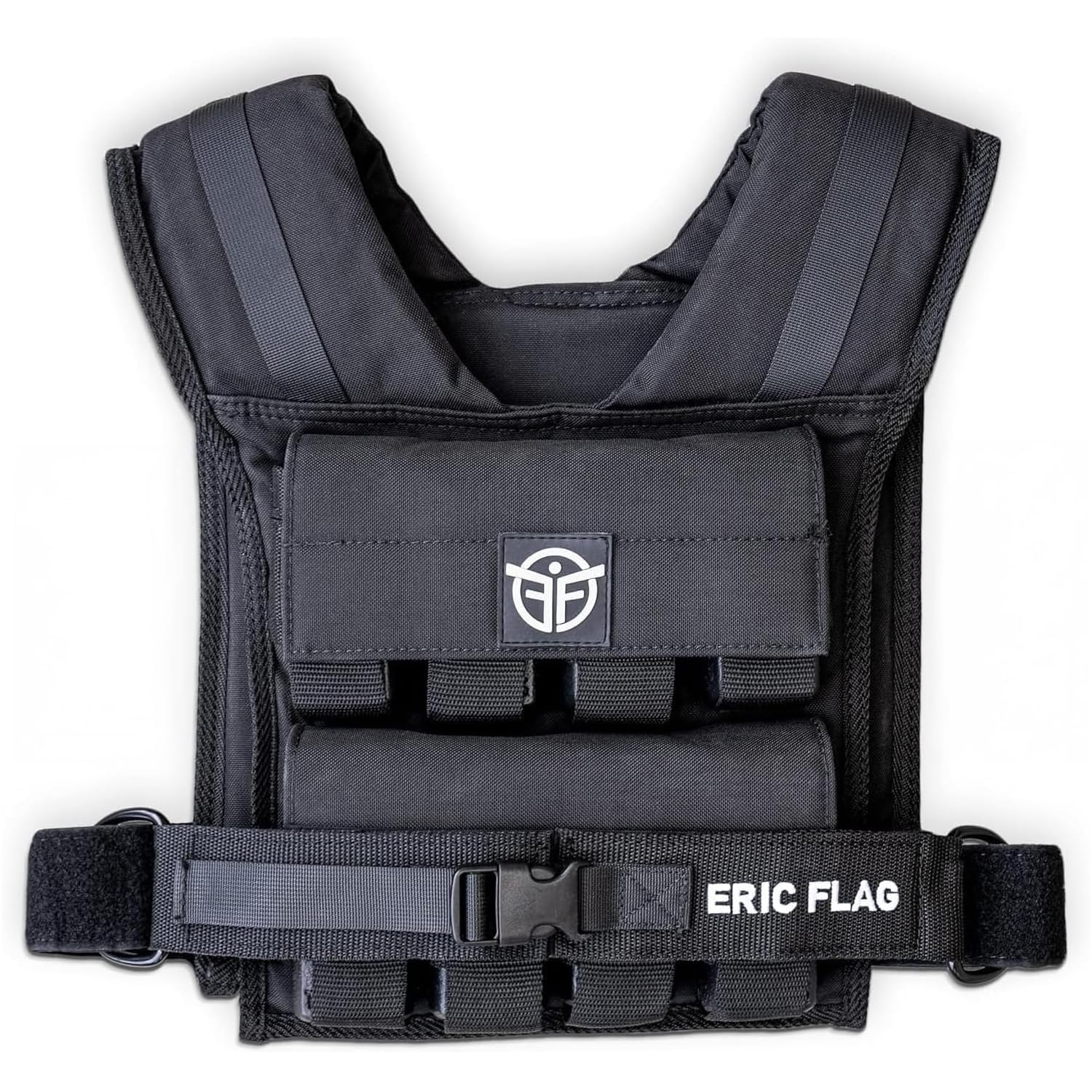
Eric Flag 40 lb Weighted Vest

Eric Flag

Eric Flag 40 lb Weighted Vest

  • Load 16 x 2.4 lb iron weights, up to 40 lb
  • Shell 1000D Oxford nylon
  • Pockets 8 front, 8 back
  • Empty Weight 1.6 lb
Check Price on Amazon

Sixteen 2.4-pound iron weights let you load up in small, precise steps.

Empty, this vest weighs about a pound and a half. That number tells you what you are buying: sixteen pockets, sixteen 2.4-pound iron weights, and a design that lets you carry almost nothing or the full 40 pounds on the same straps.

The pockets are split eight front and eight back, which is why the load sits flat against your torso instead of dragging you forward, and the 1000D Oxford shell is the toughest material in this guide. The harness stays snug without locking your arms down, which is what makes it usable for pull-ups and dips. The difference between this and a sand-filled vest is obvious the moment you pick it up.

It costs like a piece of equipment, and for plenty of people it is more vest than they need; if twelve pounds and a walk is the whole plan, the BAGAIL does that job for a fraction. But if you are chasing a heavier pull-up or loading squat jumps, sixteen pockets and 2.4-pound steps get you there without jumping twenty pounds at once.

Bottom Line

The vest we point to for calisthenics and heavy conditioning: it loads in small, even steps and stays flat against the torso at 40 pounds.

Check Latest Price

Best for Comfort

Our Score 9.2/10
BAGAIL Comfort-Fit Weighted Vest

BAGAIL

BAGAIL Comfort-Fit Weighted Vest

  • Fit Adjustable chest and waist straps
  • Load 12 lb, fixed
  • Shell Neoprene with iron sand
  • Extras Detachable phone pouch, reflective strips
Check Price on Amazon

Soft neoprene and a generous cut make this the most comfortable 12-pounder here.

Where the RUNmax feels like gear, this one feels like clothing. It is neoprene over fine iron sand with straps that run across the chest and around the waist, and of everything in this guide it is the vest that sits most easily on a fuller figure.

Comfort is why it earns a spot. The shoulder straps are wide and soft, the material does not rub under the arms, and twelve pounds is light enough that you stop thinking about it halfway through a walk. It is also easy to get on and off, which matters more than it sounds when you are heading out the door with a dog on a leash.

The load is sewn in, so there is no pulling a bag out on a tired day, and if you are already lifting seriously you want the RUNmax or the Eric Flag instead. What we kept coming back to is the little detachable pouch: it holds a phone and keys on the front strap, and it comes off when you would rather travel light.

Bottom Line

A soft, well-cut twelve-pounder for daily walks, and the one we suggest to anyone who wants comfort first and has no plans to change the load.

Check Latest Price

Best Budget

Our Score 9.2/10
Zikopomi Weighted Vest 12 lb

Zikopomi

Zikopomi Weighted Vest 12 lb

  • Load 12 lb, fixed
  • Shell Neoprene with iron sand
  • Straps Two adjustable elastic straps
  • Weight Options 6 to 30 lb
Check Price on Amazon

A generous cut and a low price make this an easy first vest.

A first vest does not need to be complicated, and this one is not: twelve pounds of iron sand in a neoprene shell, two elastic straps and a buckle. It is among the least expensive vests in this guide, and for walking, chores and light cardio it does everything the expensive ones do.

The cut is generous. It goes around a 3XL frame with a large chest without strain, and the elastic panels at the sides hug once you tighten the straps, which is more than most budget vests manage. If you wear a medium or smaller, though, the tightest setting will still hang on you; this is not the vest for a narrow frame.

The weight is fixed and the fill is sealed in, so there is no dialing it down and no washing machine. For the money that is a fair trade: it is the vest we point people toward when they want to find out whether they will actually wear one before spending real money on an adjustable.

Bottom Line

We recommend this to bigger frames on a budget: it is the least fussy vest here, and it costs about as little as they come.

Check Latest Price

Best For Tall, broad frames

Our Score 9.2/10
Poudee Weighted Vest 12 lb

Poudee

Poudee Weighted Vest 12 lb

  • Load 12 lb, fixed
  • Extras Reflective stripe
  • Filler Iron sand
  • Straps Adjustable with front clasps
Check Price on Amazon

This vest runs long and full. On a tall, broad frame it settles down over the hips and stays there; on a smaller one it hangs past the waist and moves when you do. That is less a defect than a cut, and it is the first thing to check against your own measurements before ordering.

For the body it is built for, it is a lot of vest for the money: twelve pounds of iron sand, a reflective stripe, adjustable straps and front clasps that hold the panels together. It is a walking and chores vest, and the shell is polyester rather than the softer neoprene used elsewhere in this guide.

Where it falls down is pace. Break into a jog and the extra length turns into bounce; walk, and it stays settled against you. The front clasps are the part we appreciate most, since they stop the panels flapping open every time you bend over to pick something up.

Bottom Line

A roomy, inexpensive twelve-pounder for tall and broad frames on daily walks; smaller wearers will find it swings.

Check Latest Price

Best Range of Weights

Our Score 9.0/10
Zelus Weighted Vest 12 lb

Zelus

Zelus Weighted Vest 12 lb

  • Load 12 lb, fixed
  • Extras Reflective stripes, armband pouch, mesh pocket
  • Chest Fit 31.5-45 in
  • Weight Options 6 to 30 lb
Check Price on Amazon

Seven weights from 6 to 30 pounds, reflective stripes, and a pocket for your phone.

Open the bag and the smell arrives before the vest does. That is the neoprene, and it is the most persistent of the vests here: hang it outside for a few days before your first workout, and do not stash it damp in a gym bag, because a sealed bag is where the smell settles in.

What it gets right is choice. The line runs from six pounds to thirty, so the same design can be your starter vest and your heavier one later, and the twelve-pounder we looked at fits chests from 31.5 to 45 inches on adjustable buckle straps. The spandex shell is soft against a t-shirt, and the iron sand sits evenly enough that it does not feel like a bag of gravel dropped on one side.

Reflective striping runs front and back, there is a mesh pocket at the rear and a detachable armband pouch for a phone or keys, and the whole thing wipes clean in under a minute. Stability comes down to how tight you run the straps: snug it up and it holds on a walk; leave it loose and it shifts when you pick up the pace.

Twelve pounds is a sensible starting load, and the ability to buy the same vest in twenty or thirty later is worth something. But the weight is sewn in, so this is a vest you replace rather than upgrade, and the smell is the price of the modest sticker.

Bottom Line

A wide weight range and reflective striping make it a strong first vest for evening walks; give it a few days outside before the first wear.

Check Latest Price

Best For Layering under coats

Our Score 9.0/10
Henkelion Weighted Vest 12 lb

Henkelion

Henkelion Weighted Vest 12 lb

  • Fit Adjustable strap with elastic waist
  • Load 12 lb, fixed
  • Filler Iron pellets and metal rock
  • Pocket Rear mesh pocket
Check Price on Amazon

This is the vest that disappears under a hoodie and a jacket. The twelve-pound version is compact enough to layer over a sweatshirt and under a loose outer layer, which makes it as much a cold-weather walking vest as a workout one.

The fill is iron pellets and metal rock rather than sand, packed into front and back panels, with a mesh pocket on the back for a key or a card. Worn snug, the weight sits close and pulls your shoulders back rather than down, which is why it works so well over a long walk.

One strap across the collarbone and elastic at the waist is a walking harness, not a running one. Walk an hour in it and it stays put; break into a jog and the load starts to shift, so this is the vest for the pavement-and-hills crowd rather than intervals.

At the bottom of the price range, it is the one we hand to someone who walks every morning and wants more work out of the same route. Treat it as a first vest or a winter one, because there is no way to add load later without buying a different vest entirely.

Bottom Line

An inexpensive, close-fitting vest for layering under winter clothing on walks, as long as you are not planning to run in it.

Check Latest Price

Best For Narrower frames

Our Score 9.0/10
Zeerun Weighted Vest 10 lb

Zeerun

Zeerun Weighted Vest 10 lb

  • Load 10 lb, fixed
  • Seams Double-stitched, sealed
  • Shoulders Thickened shoulder padding
  • Weight Options 6 to 30 lb
Check Price on Amazon

Order this one by chest measurement, not by weight. The cut runs small, narrow through the chest and snug at the armholes, and that single fact decides whether it works for you. On a compact frame it is one of the better-fitting vests here; on a broad one it is a return waiting to happen.

What you get for the money is more padding than most budget vests bother with: thickened shoulder panels, double-stitched seams with the filler sealed inside, and an elastic band with a buckle that pulls the whole thing in against your ribs. The line runs from six pounds to thirty, and reflective strips run front and back.

Ten pounds is the version we looked at, and it is a sensible walking load that the padding makes wearable for a full hour. If your chest measures toward the top of the range, put the money into the RUNmax instead; the 28-to-48-inch fit is the difference between a vest you forget about and one you fight with.

Bottom Line

Our pick for narrower frames: generous shoulder padding, sealed seams and a low price, provided the chest measurement works.

Check Latest Price

How We Tested a Dozen Weighted Vests

We started by pulling every weighted vest from brands with a track record, then filtered out anything with a fixed load under 10 pounds, a one-size shell, or a design that looked like it would swing during a squat. That left 12 vests, which I wore over six months in the same rotation: morning dog walks, lunch-break rucking, living-room squats and lunges, a weekly treadmill run.

For weight and stability, I loaded each vest to its max, then to half, and did 20 squats, 10 push-ups, and a one-mile walk; I noted whether the load sat on my shoulders or hips, whether it rode up, and whether it thumped during a slow jog. For fit and size, I adjusted every strap, tried each vest over a T-shirt and a hoodie, and watched where the bottom hem landed — too short crept toward my ribs, too long pressed into my hip bones. For comfort, I checked for chafing at the shoulders and ribs and how hot the vest felt after 30 minutes. For odor, I wore each one for a sweaty session, let it sit overnight in a gym bag, and sniffed it the next morning.

Quality came down to seams and filler: I checked stitching at the shoulder straps, looked for loose pellets or sand after a week in the car trunk, and noted whether the closure felt secure after a month. For value, I compared usable load — not the top number on the label — against how often I reached for each vest; a cheap vest that only worked for walks was worse value than a pricier one that handled rucking and squats. Versatility came down to whether I could dial the weight in small increments and wear the same vest for a walk and a strength session.

How to Choose

Fixed or removable weight comes first

These vests split cleanly. The RUNmax holds its iron in bags and the Eric Flag in plates, both removable; everything else here is sewn shut. Removable load is what lets one vest serve a beginner and a strong lifter, and it is the difference between buying once and buying twice.

Fixed vests have their own advantage: a thinner, softer panel that sits closer to the body, which usually makes them the more comfortable thing to walk in. If twelve pounds is your load, buy fixed and skip the complexity. If you expect to get stronger, buy adjustable.

Measure your chest, not your shirt size

One size fits most means the straps cover a range, and the ranges differ more than the sizing charts suggest: the RUNmax spans 28 to 48 inches, the Zelus 31.5 to 45. Measure around the widest part of your chest and compare it to the stated number, then think about torso length.

A vest cut for a long torso hangs past the waist on a short one and swings when you move, which is the whole story with the Poudee. A vest that pinches at the armholes, as the Zeerun does on broad chests, is the wrong size rather than a bad vest.

Pick a starting load you can recover from

Five to ten percent of body weight is the range RUNmax quotes for adding resistance, and it is a sensible place to begin: a 150-pound walker is looking at 8 to 15 pounds, which is why twelve is the size most of these vests come in. Add weight before you add speed, and do not load up and start running in the same week.

With a fixed vest you are choosing your ceiling at checkout. Twelve pounds is a walking and light-conditioning load; twenty and up is a strength tool.

Padding matters more as the load climbs

At twelve pounds almost anything is comfortable for half an hour. At twenty and up, the shoulder straps become the entire experience: wide, padded straps spread the pressure, and a waist belt takes load off your shoulders altogether. The Zeerun's thickened shoulder panels and the padded version of the RUNmax exist for exactly this.

If you plan to wear a vest for an hour at a time, padding is worth paying for. If it is twenty minutes on the treadmill, it is not, and a basic neoprene vest will do the job.

Smell, washing and the seams to watch

Most of these vests are neoprene or coated nylon over sealed filler, and new neoprene smells. Air a new vest outside for a few days rather than judging it on day one, and do not store it damp in a gym bag.

Because the filler does not come out on the fixed models, they are wipe-clean only; a washing machine will break the seams and let the sand or iron escape. Check the shoulder seams and the weight pockets periodically, and retire a vest that is leaking filler.

Frequently Asked Questions

Final Verdict

The RUNmax 20-pounder is the vest we recommend to most people, because it is the one that changes as you do: pull the bags for an easy day, load them all for a hard one, and the 28-to-48-inch strap range covers most of a household.

If you want a softer, simpler vest for daily walks and twelve pounds is your ceiling, the BAGAIL is the more comfortable buy. If the goal is calisthenics at 40 pounds, skip both and go to the Eric Flag.