Outerwear & Layers

Best Hydration Vests for Running of 2026

A hydration vest has one job that matters more than any spec sheet: it has to disappear on your run. The wrong one bounces at the shoulders, saws at the neck, or turns every sip into a wrestle with a soft flask—and suddenly your easy six-miler feels like a chore. The right one carries water, phone, keys, and a few snacks close to your body, stays put when you pick up the pace, and makes drinking while moving feel almost automatic.

I've spent the past six months running in 12 different vests, from stripped-down race models to roomier training packs, on road loops, gravel paths, and a few humid morning long runs. The best ones balanced storage capacity against weight, adjusted without loosening mid-run, and kept soft flasks from leaking into the main compartment. Fit mattered as much as function—a vest that gapes at the chest or rides up is one you'll resent by mile three. The standouts also felt worth the money. Below are the ones that earned a spot by my door.

Best with Soft Flasks

Our Score 9.4/10
MOKURA Running Vest

MOKURA

MOKURA Running Vest

  • Weight 9.6 oz
  • Pockets 5
  • Warranty 2 years
  • Hydration 500 ml soft flask
Check Price on Amazon

A 500 ml flask, a phone lanyard and almost no weight on your shoulders.

There are two kinds of runner in this category: the ones who want a hose and the ones who want to see how much is left in the bottle. This vest is built for the second kind. It comes with a single 500 ml soft flask in a chest sleeve, and the flask collapses as you drink, so the last mouthful is not sloshing around next to your ribs.

At 9.6 ounces with the flask in, it is the lightest thing we wore in this group. Three chest straps, each with a keeper to hold the loose tail, lock the front panel down without cranking it tight, and the stretch side panels do the rest.

The phone holder is the detail we did not expect to care about: a sweatproof sleeve on a retractable coiled lanyard, so you can pull the screen up to check a split and let it snap back without unzipping anything. Five pockets is enough for a phone, keys, a card and a few gels, and the reflective trim runs front and back.

What you give up is water volume. Half a liter is roughly an hour in mild weather, and there is no insulation, so a warm day hands you warm water for the second half. For a 10K, a parkrun or a half with aid stations it is plenty; for a self-supported two-hour trail run, plan a refill or step up to a bladder vest.

Bottom Line

If you want to see what you are drinking and refill at a fountain, this is the vest we recommend: one 500 ml flask, a phone lanyard and barely any weight.

Check Latest Price

Best For First vest

Our Score 9.4/10
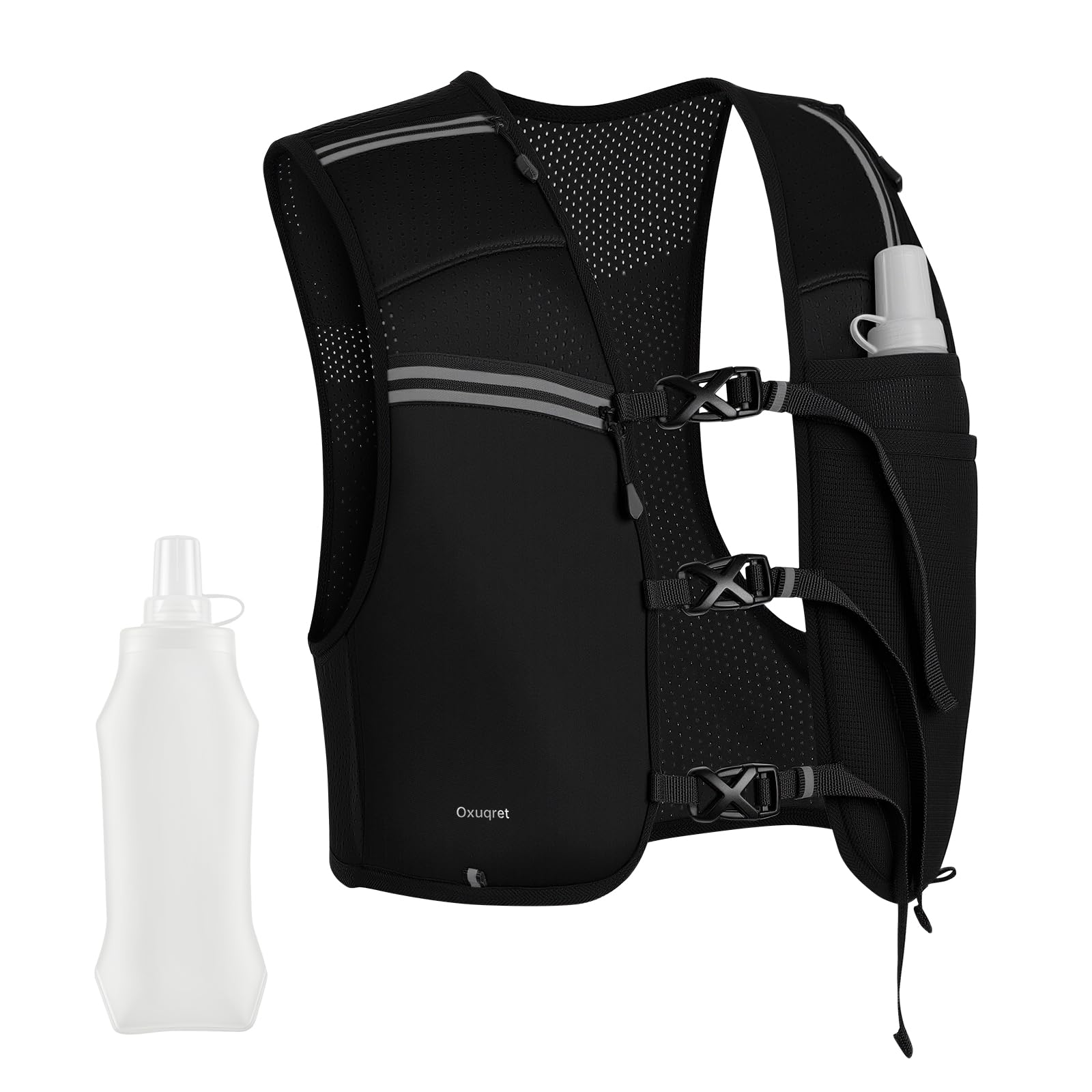
Dunquya Running Vest

Dunquya

Dunquya Running Vest

  • Weight Under 250 g
  • Pockets 6
  • Hydration 500 ml soft flask
Check Price on Amazon

The least expensive vest in this guide is also the simplest: one 500 ml soft flask in a chest sleeve, six pockets, reflective strips front and back, and a weight under 250 grams. Nothing is engineered beyond what the job needs.

We recommend it for the runner who is not sure yet whether they like wearing a vest, or who wants a spare for short runs. Elastic side panels and a single chest strap pull it snug without fuss, the pockets cover a phone, keys and gels, and the reflective strips are the real thing rather than a token stripe. The fabric is plain and will not shrug off a downpour the way the Oxford-fronted pick here does — at this end of the range, that is the deal.

Bottom Line

A first vest that does not ask much: under 250 grams, six pockets and reflective strips, with one small flask and no warranty behind it.

Check Latest Price

Best Overall

Our Score 9.2/10
NEVO RHINO 5L Running Vest

NEVO RHINO

NEVO RHINO 5L Running Vest

  • Weight 12 oz
  • Pockets 5
  • Hydration 1.5 L bladder
  • Pack Volume 5 liters
Check Price on Amazon

1.5 liters, 340 grams and five pockets: the vest most runners should start with.

A liter and a half of water on a pack that weighs 340 grams empty is the balance we look for in a running vest: enough for a long training run without the pack becoming the workout. That is the whole case for this one, and it is why it is the vest we hand most runners first.

The harness is a vest rather than a pair of backpack straps — wide mesh shoulder pieces, a chest strap that slides up and down, and five pockets you can reach without stopping. We ran with a phone in the front zip pocket, gels in the stretch ones and a light shell in the main compartment, and the load stayed close instead of dragging at the shoulders. The reflective strips and the whistle on the chest strap are the sort of detail that only matters on an early start, and then it really matters.

The bladder is the part to learn. Seat the slide closure all the way across and check it in the sink the first time rather than at the trailhead, and expect to give the bite valve a firm pull when you detach the hose to refill. Rinse the bladder and hang the hose to dry after every run; leave it sealed and damp and the plastic taste comes back.

The straps open up enough to wear over a shell and cinch back down for a singlet, which is more range than we expected at this price. Nothing about the vest feels expensive — plain nylon, simple mesh — but nothing about it gets in the way of a run either, and that is a trade we are happy to make.

Bottom Line

For most runners this is the one we point to: 1.5 liters, around 340 grams and five pockets that hold a phone, keys and a couple of gels.

Check Latest Price

Best for Big Days

Our Score 9.0/10
Criuage Hydration Vest

Criuage

Criuage Hydration Vest

  • Weight 1.65 lb
  • Pockets 8
  • Hydration 2 L bladder
  • Pack Volume 5 liters
Check Price on Amazon

Two liters and eight pockets for runs that carry a shell, food and a phone.

Three-quarters of a kilo before you add water is heavy for something you are going to run in, and that is the first thing to know. The second is what the weight buys: a 2 liter bladder, eight pockets and five liters of cargo space, which is more organized storage than anything else here.

Four pockets sit on the front and four on the back. Gels and a phone go in the front pair, a shell, hat and food in the rear compartments, and the layout means you are not unclipping the vest to get at a snack halfway up a climb. The nylon is thick, and the whole thing feels like it will take a scrape against rock.

Our take: this is the vest for the run that is really a small expedition — a three-hour trail day, a mountain-bike loop, a fast hike with a jog in the middle. It is not the one for tempo. Check the strap range before you commit, too: the waist belt and shoulder straps do not open up far enough for every broad-shouldered runner, especially over a jacket, while they cinch down nicely on smaller frames.

Bottom Line

Buy this one when your run carries two liters and a shell: the best storage here, in a vest that suits slim to medium frames better than broad shoulders.

Check Latest Price

Best Waterproof Phone Pocket

Our Score 9.0/10
SWIFTVEST Running Vest

SWIFTVEST

SWIFTVEST Running Vest

  • Weight 10.1 oz
  • Pockets 6
  • Hydration 500 ml soft flask
  • Phone Pocket Zippered, waterproof
Check Price on Amazon

A zippered waterproof phone pocket for training through rain.

The reason to pick this vest over the others here comes down to one pocket: a zippered, waterproof phone sleeve on the front that keeps a screen dry through rain and sweat. Everything else is a variation on what the rest of the group does — six pockets, reflective detailing, a 500 ml flask in the chest.

It weighs 285 grams and comes in three sizes, with a neoprene body, heat-dissipation panels and quick-dry mesh where it sits against your back. On the run it is quiet: no bounce, no strap tails flapping, no pressure across the shoulders. The rear mesh pocket takes a light jacket if you fold it small.

Where it gives ground is capacity. Six pockets sounds generous until you have packed a phone, keys and two gels; there is no room for a shell up front and only the rear mesh for anything bulky. As a wet-weather vest for runs up to a half marathon, though, it is the pick — your phone stays dry and you forget you have it on.

Bottom Line

The vest we hand runners who train through rain: a waterproof zippered phone pocket, 285 grams, and a harness that stays quiet on the shoulders.

Check Latest Price

Best For Run-commuting

Our Score 9.0/10
NEVO RHINO 12L Hydration Backpack

NEVO RHINO

NEVO RHINO 12L Hydration Backpack

  • Weight 8.5 oz
  • Warranty 365 days
  • Hydration 2 L bladder
  • Pack Volume 12 liters
Check Price on Amazon

Same brand as our top pick, different job. This is a 12 liter daypack with vest-style shoulder straps and a 2 liter bladder, built for the run-commute, the long day out and the hike you start at a jog rather than for intervals.

At 8.5 ounces empty it is remarkable for the volume, and the front pockets and shoulder pouches keep a phone and snacks within reach without stopping. We kept coming back to it for days when the run was also the transport: water, food and a shell for a full day out, on a pack that weighs less than most of the vests here.

The bladder needs a rinse and an airing before the first use, because the plastic taste out of the bag is strong and fades over a few fills. And 12 liters of cargo rides like a backpack rather than a vest once it is full, so cinch the straps down and keep it for steady miles.

Bottom Line

The cheapest way here to carry two liters and a full day's gear: excellent for run-commutes and long days out, not for chasing a pace.

Check Latest Price

Best Race-Day Vest

Our Score 8.8/10
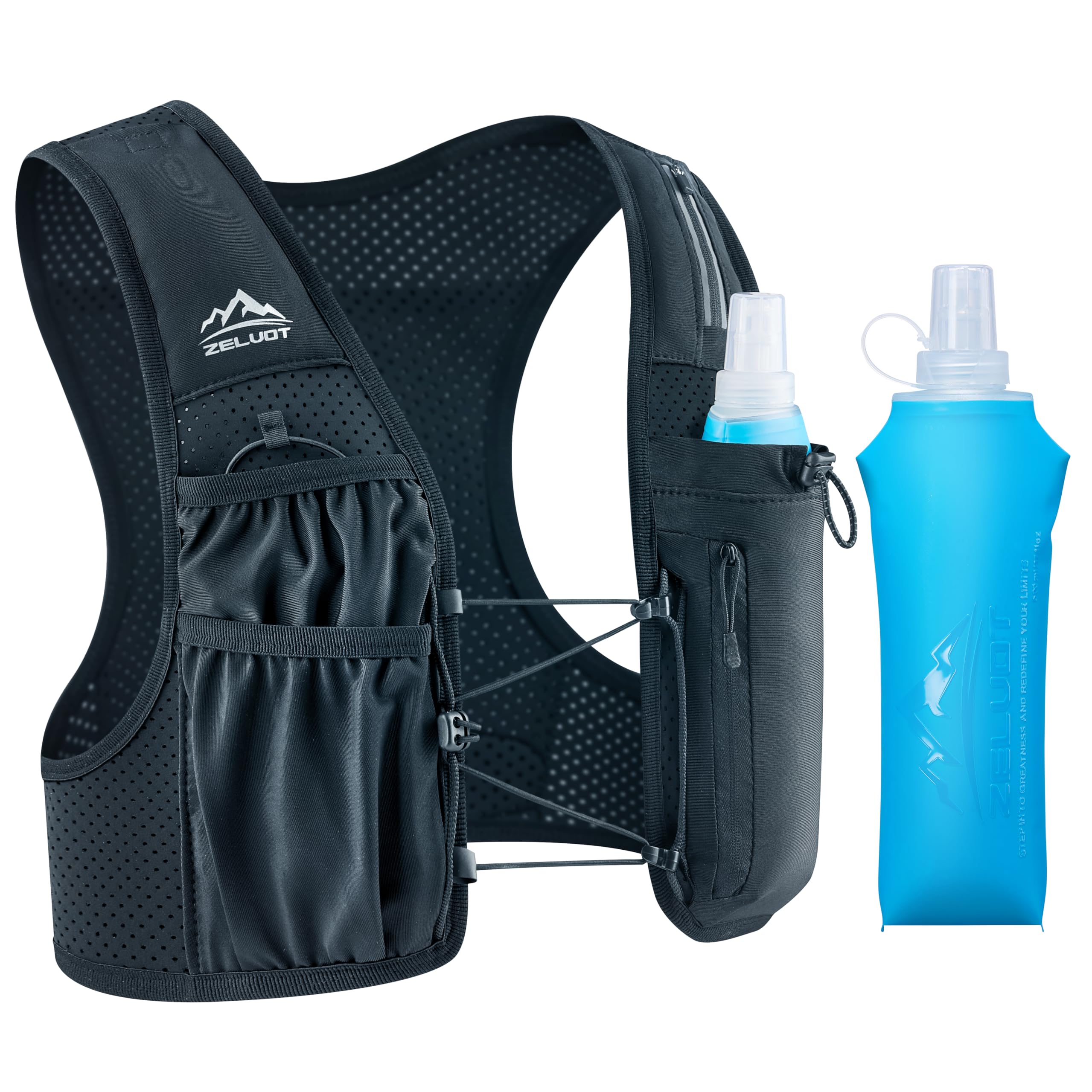
Zelvot Running Vest 500 ml

Zelvot

Zelvot Running Vest 500 ml

  • Weight 12.3 oz
  • Pockets 9
  • Hydration 500 ml soft flask
  • Back Storage 2 large pockets
Check Price on Amazon

Nine pockets and two flask sleeves that stay put at pace.

Nine pockets on a vest that weighs 350 grams is the pitch: seven across the front and two large ones in the back, laid out so a gel, a phone, a card and a key each have somewhere to go that is not your waistband.

Two of the front sleeves are cut for soft flasks, so you can run a liter across your chest if you add a second one. The sleeves sit high and the three chest straps pull the front panel flat against you, which is why nothing swings when you pick up the pace.

The back has a zippered pocket for a shell or a towel and a stretch mesh one for whatever you want to stuff in a hurry. Reflective strips run front and back, and the perforated neoprene does not turn into a wet belt by mile ten.

We reach for this one on race day. It sits still at pace, the pockets land where your hands already go, and it disappears under a singlet — the closest thing here to a race flat for your torso.

Bottom Line

Our race-day choice: nine pockets, two flask sleeves and a fit that stays put at pace, provided you measure your chest first.

Check Latest Price

Best For Wet trail runs

Our Score 8.8/10
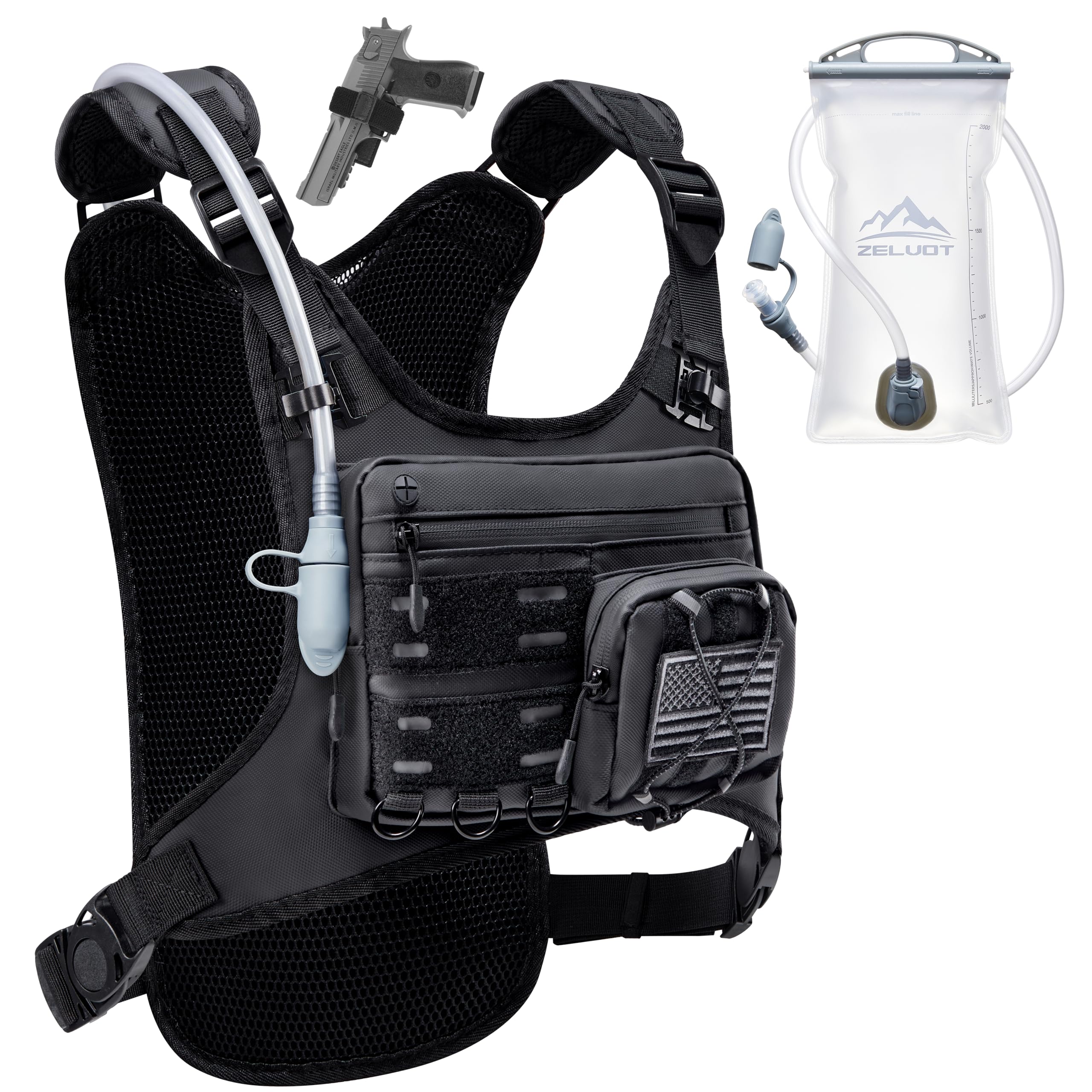
Zelvot 2L Hydration Vest

Zelvot

Zelvot 2L Hydration Vest

  • Weight 1.43 lb
  • Material 900D Oxford fabric
  • Hydration 2 L bladder
  • Front Pockets 3 zippered
Check Price on Amazon

The front of this vest is 900D Oxford fabric, the sort of weave used on work bags, and three zippered, water-resistant pockets sit on it. For wet, gritty trail days that is the build we trust most in this group: set it down in mud and hose it off afterwards.

The trade-off is weight — 0.65 kg before water. Load the 2 liter bladder and you are carrying a serious amount across the chest and back, which is fine for a hike-and-run or a long day and noticeable on anything faster. Wide padded shoulder and waist straps spread it better than the number suggests.

Two annoyances. The strap ends slide out of their buckles while you are putting it on, so you re-thread them more often than you should. And the bladder is the part to inspect: early seam failures take the whole vest out of service until you buy a replacement, so fill it at home before a long day rather than at the trailhead.

Bottom Line

For wet, gritty trail days we trust this one's build most: an Oxford front panel and water-resistant zips, carried at a weight you feel.

Check Latest Price

How We Put These Running Vests Through Their Paces

To build the shortlist, I started with the vests runners actually mention to each other, then filtered by capacity, flask count, available sizes, strap layout, and price. I ruled out anything with a fixed fit, a history of leak complaints, or pockets that only worked with one flask shape. That left 12 vests, which I ran in for six months on road loops, gravel paths, and weekend long runs—including a few muggy mornings when chafing shows up fast.

Each vest carried the same load: a full reservoir or two soft flasks, a phone, keys, two gels, and a light shell. I weighed them empty and loaded, then noted whether the weight sat close to my ribs or pulled at my shoulders. For fit and adjustability, I set the sternum straps before starting, then checked at mile three whether anything had loosened or started to ride up. I also wore each over a T-shirt and a light rain shell to see how the straps behaved with different layers.

Functionality, storage, and ease of use got tested on the move, not in my kitchen: I reached for gels without stopping, stowed a shell one-handed, and drank from flasks on the run. I squeezed filled flasks upside down before heading out, then checked the main compartment after each run for leaks. Durability came down to repeated sweaty runs and rinses—I looked at seams, mesh, zippers, and strap edges for fraying or stretching, which told me more about build quality than any spec. At the end, I compared what each vest included against its price to judge value.

How to Choose

Bladder or Soft Flask

A bladder carries more and lets you drink without breaking stride, but you cannot see how much is left, refilling means stopping and opening the pack, and the hose is the part people forget to dry. A soft flask sits in a chest sleeve, shows its level, refills at a fountain in seconds and collapses as it empties so nothing sloshes.

The trade is volume. Most flasks are 500 ml, so two chest sleeves give you a liter. Our top pick runs a 1.5 liter bladder; the race vest we like runs two flask sleeves. Settle the format first, then shop the vest around it.

Fit, Bounce and Sizing

Bounce is a fit problem before it is a pack problem. Look for three points of contact — two chest straps plus a waist or side adjustment — and strap keepers, the small loops that stop a loose tail from whipping your arm for an hour.

Vests are sized by chest measurement rather than T-shirt size, and several here run small, so measure around the ribs under the arms and go up if you are between sizes. If you plan to wear it over a shell in winter, size for the layer rather than for your summer singlet.

How Much Water to Carry

Plan on roughly half a liter to a liter an hour depending on heat, pace and how much you sweat, then add a margin. A single 500 ml flask is about an hour of running: fine for a 10K, thin for a half unless there are aid stations.

A 1.5 to 2 liter bladder covers two to three hours unsupported, and it is what we carry on trail days when water is not guaranteed. Carrying more than you need costs weight on every stride, so match the reservoir to your longest regular run rather than your once-a-year epic.

Pockets, Phones and Weather

Work out what has to come with you before counting pockets. A phone in a thick case needs a measured sleeve rather than a stretchy one, a shell needs a rear compartment, and keys need a zip. A water-resistant zip on the phone pocket is worth having if you run in rain or sweat heavily.

Front pockets should be reachable one-handed while moving. If you have to stop and unclip the vest to get at a gel, that pocket is storage, not access, and you will stop using it around mile eight.

Keeping It Clean

The bladder or flask is what fails first, and usually because of what was left in it. Empty and rinse after every run, especially after sports drink, and dry the bladder open with the hose hanging so water does not sit in the line.

Soft flasks clean faster: a drop of dish soap, warm water, a shake, then air-dry upside down. A bite valve that tastes sour or a hose with dark spots is finished — replace it rather than scrub it.

Frequently Asked Questions

Final Verdict

For everyday running, the NEVO RHINO 5L is the vest we hand people. It carries a liter and a half at a weight you forget, the pockets are laid out for a phone and gels, and it costs less than the premium vests here without giving up anything you would notice on a Tuesday run.

Two changes shift the choice. If you would rather drink from a bottle than a hose, the MOKURA vest is lighter still and refills in seconds. If your run needs to carry a shell, food and two liters into the hills, the Criuage has the storage — provided its straps fit your frame.