Yoga & Mobility

Best Pull-Up Assist Bands of 2026

The first pull-up is less about strength than trust: you need to know the band under your foot will not snap, roll, or drop you. A good assist band gives just enough lift to get your chin over the bar without doing the work for you. I have used bands for years, and over the past four months my team tested 14 on home doorway bars, gym rigs, and park pull-up stations. The right one closes the gap between wanting to do pull-ups and training them with clean form.

Color codes are not standardized, so the printed resistance rating matters less than how the band stretches underfoot. The keepers felt thick and grippy without being stiff, held their length after repeated stretching, and gave a steady assist rather than a sudden boost at the top. We weighed value against durability, tried each one for assisted pull-ups, dips, rows, and stretching, and noted which bands bunched under a sneaker or slipped on the bar. The picks below earned their place.

Best Overall

Our Score 9.4/10
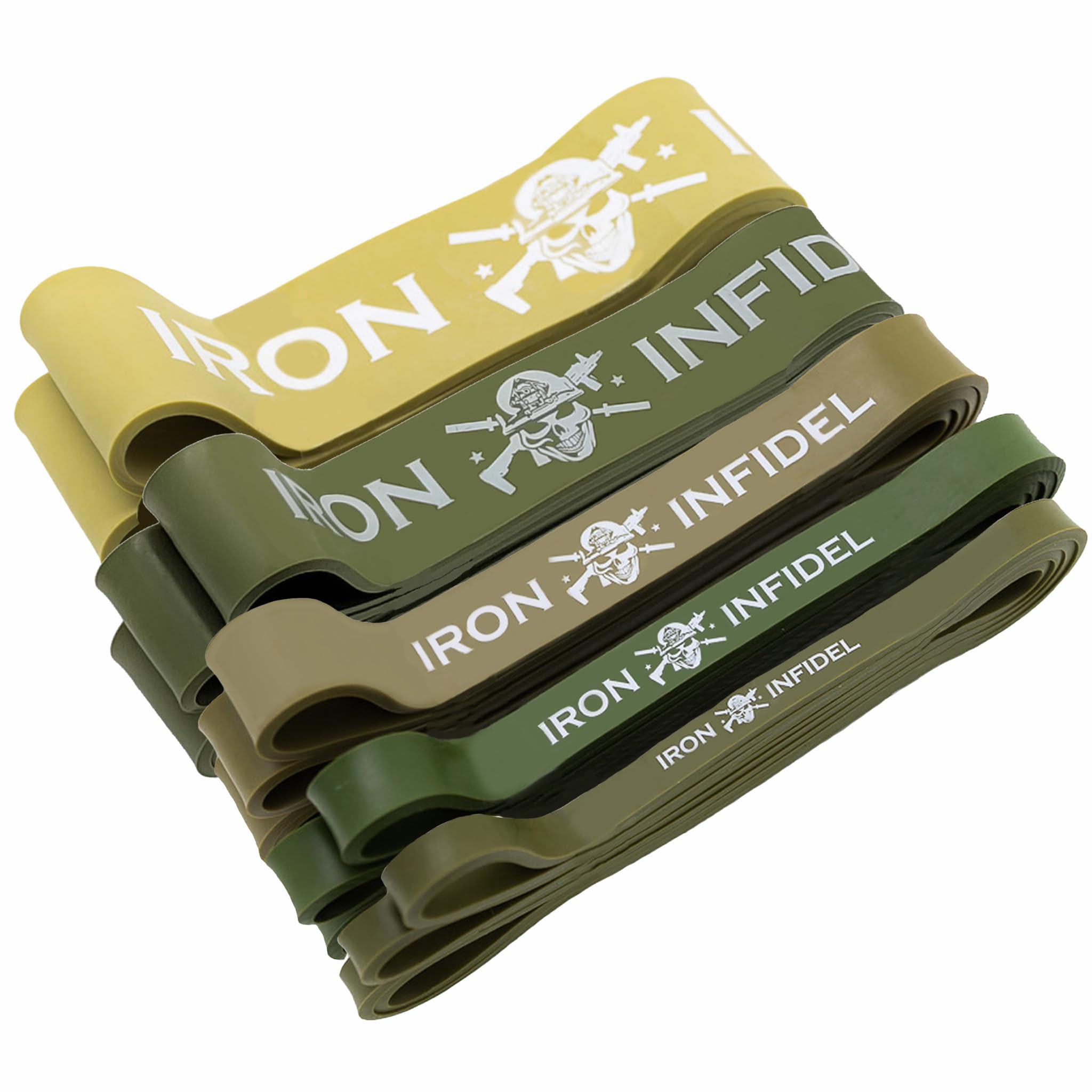
Iron Infidel Resistance Bands Set

Iron

Iron Infidel Resistance Bands Set

  • Set Weight 3.2 lb
  • Total Tension 150 lb
  • Bands Included 5
  • Resistance Levels 5
Check Price on Amazon

Five stackable bands to 150 pounds, with the best durability showing in this group.

The Iron Infidel set is the most expensive thing on this page, and we still recommend it first. Five bands, five resistance levels, 150 pounds of tension between them, and a layered construction rather than a single molded sheet. That last part is the reason it sits at the top. A band that is built up in layers spreads the load across its whole width instead of thinning at the same spot every time you stretch it.

What struck us in use is how little these bunch. Set one under the arch of your foot and it stays flat, which matters more than it sounds, because a band that rolls sideways pulls you off line halfway through a rep. The five levels also stack without a cliff between them. We spent most of our sessions on the two middle bands, and there is enough room between them to add a couple of clean reps before moving up.

Durability is what you are paying for. Bands fail, and that is the anxiety hanging over every assisted pull-up. Of everything we covered, this is the set where a split is the exception rather than a running theme, and ours still look uniform, with no cloudy patches starting along the stretch line.

The catch is arithmetic: if you only want one light band for stretching, or you are not sure pull-ups will stick, this is a lot of money for rubber. Start with the WSAKOUE set and come back when you know the habit is real. For anyone already chasing a strict pull-up and tired of replacing split bands, the extra spend buys the thing you actually want, which is not thinking about the band at all.

Bottom Line

Buy this if you want a set that will still be in your bag next year: five stackable levels and the most convincing durability of anything here.

Check Latest Price

Best Value

Our Score 9.2/10
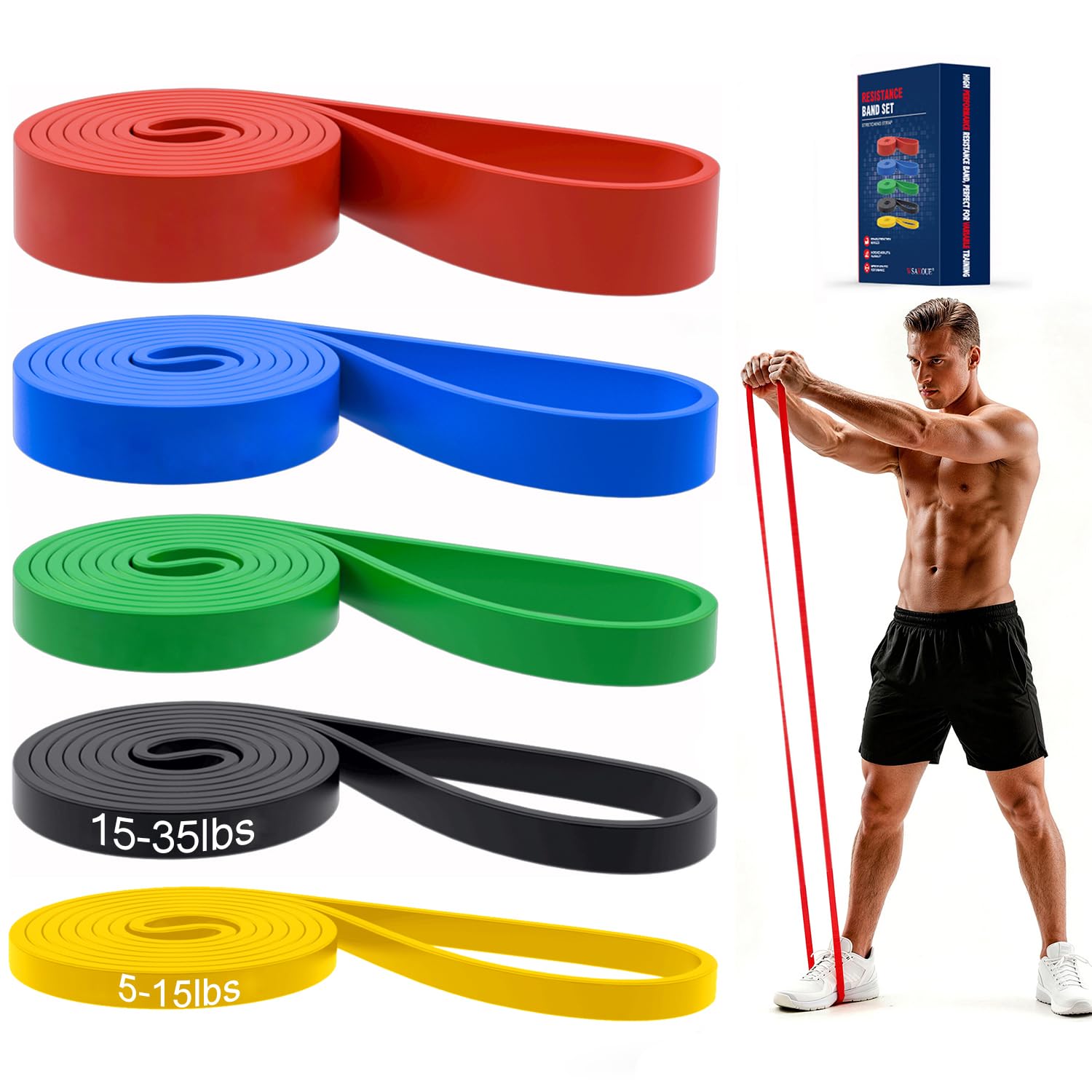
WSAKOUE Pull Up Bands Set

WSAKOUE

WSAKOUE Pull Up Bands Set

  • Band Size 82"L x 2"W
  • Band Thickness 0.2 inches
  • Bands Included 5
  • Resistance Range 5-125 LBS
Check Price on Amazon

Five color-coded levels from 5 to 125 pounds, wide bands, and a low entry price.

Five colored loops, a storage bag, a folded instruction sheet, and a one-year warranty. The WSAKOUE set is what we hand to someone who wants the whole ladder without committing much money. The bands run 5 to 125 pounds, they are 82 inches around, and at two inches wide they are the widest of the multi-band sets here. Long and wide is the right combination for pull-up work: more surface under the foot, and more stretch before the loop goes taut.

The judgement is simple. If this is your first set and you are not certain it becomes a habit, buy this one. Five levels means gentler steps than a four-band kit, and the long loop rigs more comfortably than a short 41-inch band if you are tall or you are anchoring low rather than over a bar.

What you trade is lifespan. This is a set where a split is a real possibility rather than a fluke, and 0.2 inches of thickness is mid-pack here rather than reassuring. Rotate which section of the loop sits under your foot so the wear spreads, and check the stretch line for cloudy patches every few weeks. At this price, replacing a single band a year in still leaves you well ahead of the premium set.

Bottom Line

The set to buy when you want every resistance level without spending much: five bands, wide and long, with a shorter working life as the trade.

Check Latest Price

Widest Resistance Range

Our Score 9.2/10
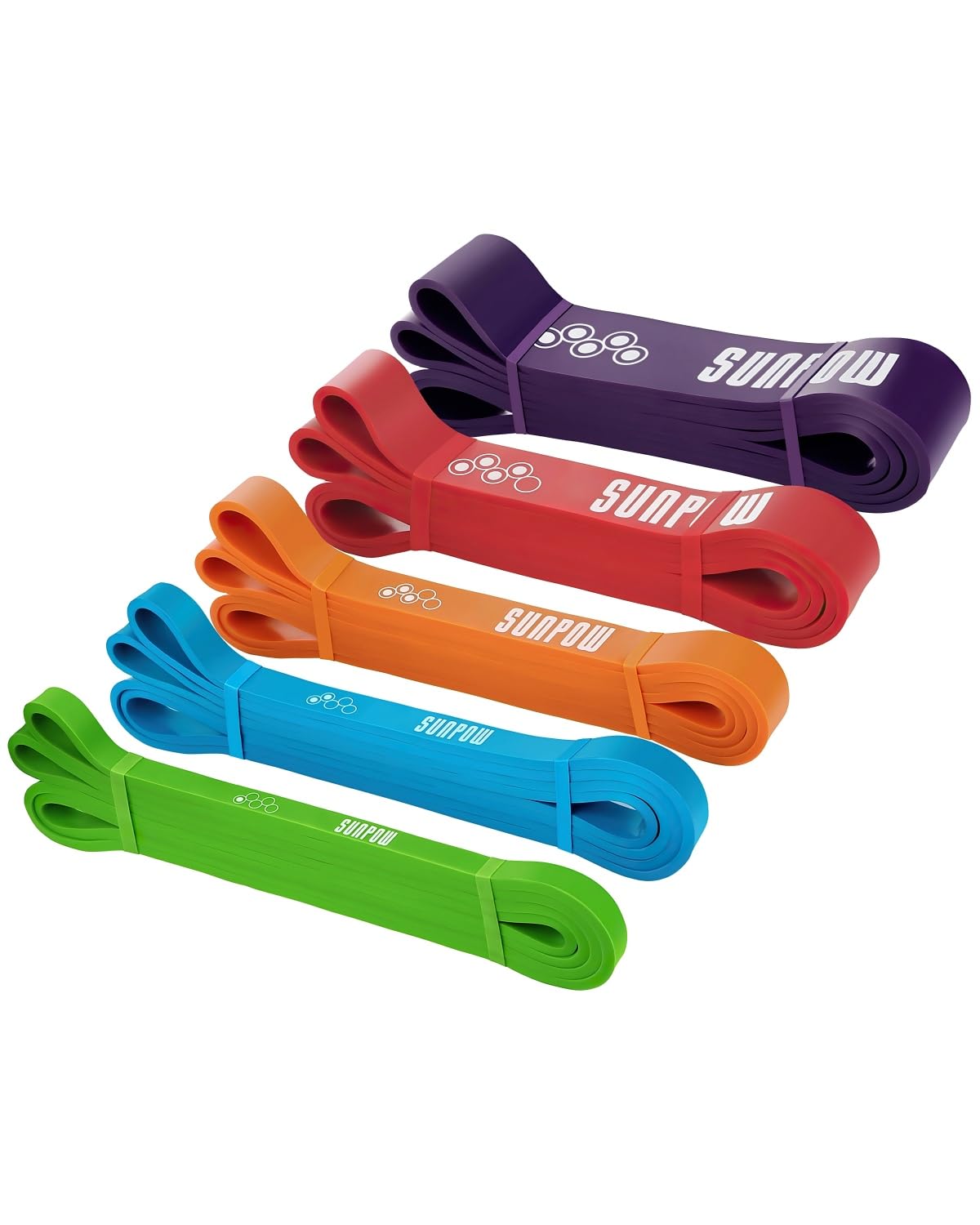
SUNPOW Pull Up Assistance Bands

SUNPOW

SUNPOW Pull Up Assistance Bands

  • Material Natural latex
  • Set Weight 2.58 lb
  • Bands Included 5
  • Resistance Range 5-145 lbs
Check Price on Amazon

Five bands spanning 5 to 145 pounds, from shoulder warm-ups to heavy assistance.

The green band in this set is rated 5 to 30 pounds, which is genuinely light, light enough for shoulder dislocates and band pull-aparts and the warm-up work a heavy assist band is useless for. That bottom end is why we keep coming back to SUNPOW. It starts where a rehab band starts and finishes at 145 pounds.

Five color-coded levels sit in between, spaced sensibly: blue at 15 to 50, orange at 25 to 75, then two heavier loops. The material is natural latex with a low-allergen claim on the listing, and the kit ships with a carry bag and an instruction manual. At 1.17 kg it packs into a gym bag without argument.

Our reservation sits at the top of the range. The two heavy bands are the ones you use for assisted pull-ups, and a year of regular loading can end in a split on those. For a lighter lifter who will live on green and blue, that barely registers, and this is a better buy than the heavier premium set. If the heaviest band is your working band three sessions a week, spend more and get the Iron Infidels.

Bottom Line

Buy this if you want one set that covers shoulder warm-ups and heavy assistance, and you are willing to watch the two heaviest bands for wear.

Check Latest Price

Best Latex-Free

Our Score 9.2/10
LEEKEY Resistance Bands Set

LEEKEY

LEEKEY Resistance Bands Set

  • Material Latex-free synthetic rubber
  • Band Thickness 3.5 millimeters
  • Bands Included 4
  • Resistance Range 15-125 lb
Check Price on Amazon

Synthetic rubber instead of latex, with four levels from 15 to 125 pounds.

If natural latex leaves you itchy or sneezing, start here. The LEEKEY bands are a layered synthetic rubber, latex-free, and 3.5 millimeters thick, which is the thickest band in this group by a comfortable margin. That thickness is the whole argument: a thicker wall spreads stress across more material, and it is why these feel closer to a strap than a rubber band the first time you pull one out of the bag.

Four levels cover 15 to 125 pounds, coded red through green, and they stack. We found the purple-and-green pairing enough for full assistance at bodyweight. The 15-pound red is fine for stretching and too light for pull-up work, so this is not the set for rehab-level resistance. Where it wins is the material question settled outright: if latex is the problem, this set solves it without asking you to give up thickness or a useful range.

Two small things to know. The bands carry a faint rubbery smell for the first week, which fades, and the synthetic surface has a drier feel against skin than latex does. Four levels also means wider gaps between them than the five-band sets, so you may occasionally want a resistance that sits between two loops. Neither is a dealbreaker, and the thickness makes the gaps easier to live with than they sound.

Bottom Line

The set for anyone who reacts to latex: synthetic rubber, 3.5 millimeters thick, and four levels that reach 125 pounds without compromise.

Check Latest Price

Best Single Heavy Band

Our Score 9.2/10
POWER GUIDANCE Pull Up Assist Band

POWER GUIDANCE

POWER GUIDANCE Pull Up Assist Band

  • Tension 175 lb
  • Band Size 41"L x 2.5"W
  • Band Weight 12.8 oz
  • Bands Included 1
Check Price on Amazon

One 175-pound band for lifters who already know the level they need.

One band, one level, and a tension chart. POWER GUIDANCE sells these individually, which is either exactly right or completely wrong depending on how much you already know. Our band is rated to 175 pounds, comes in at 41 inches around and 2.5 inches wide, and ships with a storage bag and nothing else.

Forty-one inches is the classic short loop, and short means stiff at the bottom. For pull-ups that is not a problem, since you want a band that is already loaded while you hang. It is a poor choice for anything needing a long, gentle pull, like floor work or a low anchor. The width is the real plus: two and a half inches sits across the foot without digging in and does not roll the way a three-quarter-inch band does.

The case for it is arithmetic. A single heavy band costs less than a full set, and an intermediate lifter who only ever reaches for the heaviest loop is paying for four bands they will never touch. Our caveat is selection: get the level wrong and you own a band you cannot use. Read the tension chart, start one level lighter than your ego suggests, and treat the anchor point as the place to watch for wear.

Bottom Line

Worth it if you already know the exact level you need: one 175-pound band, 2.5 inches wide, for less than a full set.

Check Latest Price

Best For Travel kit

Our Score 9.2/10
Alllvocles Resistance Bands Set

Alllvocles

Alllvocles Resistance Bands Set

  • Set Weight 15.9 oz
  • Bands Included 4
  • Resistance Range 5-100 lbs
Check Price on Amazon

Four bands, a waterproof bag, and 0.45 kg on the listing. Under a pound for the whole kit is the reason this one travels: it disappears into a gym bag or a carry-on, and it is the budget set with the strongest durability showing of the ones we covered. That combination is unusual at this end of the price range.

The levels run yellow 5 to 10 pounds, red 15 to 30, black 30 to 60, and purple 60 to 100, which covers a beginner through an intermediate lifter doing assisted pull-ups. The colors are distinct enough to grab the right band out of a bag without reading anything, and the loops are long enough to rig over a bar and step into without a fight.

The ceiling is the limit. A hundred pounds at the top is near the bottom of this group, and a strong lifter will run out of assistance on the purple band well before they run out of pull-up. Above that line, the SUNPOW set reaches 145 pounds for a little more money. Everyone else gets a set that does the job, takes up no space, and does not feel like a compromise.

Bottom Line

The set to keep in a suitcase: 0.45 kg for four bands up to 100 pounds, with the best durability showing among the budget sets here.

Check Latest Price

Best For Cheapest starter set

Our Score 9.2/10
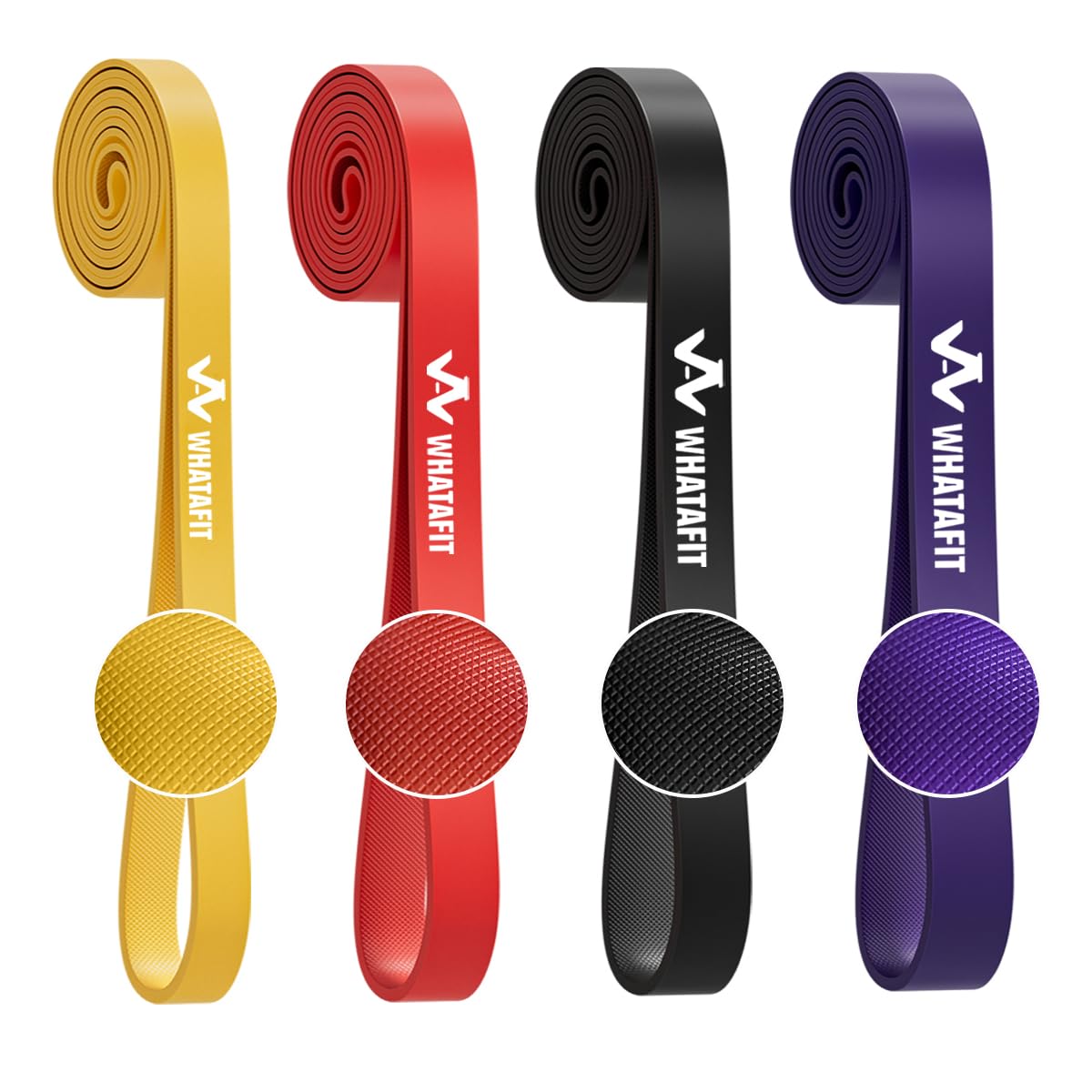
WHATAFIT Pull Up Assistance Bands

WHATAFIT

WHATAFIT Pull Up Assistance Bands

  • Set Weight 1.2 lb
  • Bands Included 4
  • Resistance Range 5-85 lbs
Check Price on Amazon

This is the least expensive set here, and it does not pretend otherwise: four bands, a mesh carry bag, a manual, and a 5-to-85-pound range. For a teenager, a first apartment, or a maybe-I-will-try-this purchase, that package is hard to argue with.

Four levels means bigger jumps between them than the five-band sets offer, and the top of the range stops at 85 pounds. That is enough for a lighter lifter working toward a first strict pull-up and not much beyond it, because a heavier lifter will bottom out on the heaviest band quickly.

We also noticed these run firm. They take real effort to get into a stretch, which is fine for squats and presses and awkward for anything needing a long, soft pull. If you have ever used a band that felt like it was fighting you, this is that feeling, and it is the main reason we rank it below the Alllvocles set.

So buy it as a cheap experiment, not as the set you will still be using in three years. It is a reasonable way to find out whether banded training fits your routine, and if it does, the money you save now pays part of the upgrade later.

Bottom Line

A fair first experiment for a light lifter on a tight budget, and the wrong set for anyone who needs serious counterweight.

Check Latest Price

Best Budget Single Band

Our Score 9.0/10
Amazon Basics Resistance Pull-Up Band

Amazon Basics

Amazon Basics Resistance Pull-Up Band

  • Material Natural rubber
  • Band Size 41.5"L x 0.75"W
  • Resistance 30 to 60 pounds
  • Bands Included 1
Check Price on Amazon

One 30-to-60-pound band for the least money here, enough to start with.

No bag, no guide, no second band. The Amazon Basics loop is 41.5 inches of natural rubber, three-quarters of an inch wide, rated 30 to 60 pounds, and it is the least expensive thing here. If you want to learn whether banded pull-ups agree with your shoulders before spending on a set, this is how you ask the question cheaply.

Sixty pounds of assistance is a real number for a beginner, enough to take meaningful weight off the bottom of the pull without launching you over the bar. The band is short at 41.5 inches, so it is loaded from the first inch of stretch, which is the behaviour you want when you are hanging from it.

Three-quarters of an inch is narrow, though, and you feel it. Under a bare foot, or behind the knee, this band concentrates pressure in a line where a two-inch band spreads it out. Wear shoes and the complaint mostly disappears, which is the simplest fix in this whole article.

Lifespan is the honest catch. The durability picture is the weakest of the single bands we covered, and a month of daily use is not guaranteed. Treat it as a cheap trial rather than a forever band. If it survives a year, you have had your money's worth and you know exactly which level to buy next time.

Bottom Line

The cheapest honest way to find out whether banded pull-ups work for you, as long as you accept it may not last the year.

Check Latest Price

How We Tested the Pull-Up Assist Bands

We built the shortlist by looking for assist bands with a stated resistance range, a listed length, and enough user history to judge how they held up; anything with vague sizing, a single resistance option, or repeated complaints about snapping got cut. That left 14 bands, which we tested over four months, and we did not treat a higher price as proof of a better band.

Testing happened where pull-ups actually happen: a doorway bar in my hallway, a gym rig, and a park station. I used each band for assisted pull-ups, dips, banded rows, and stretches, with bare feet and sneakers, and my team rotated them through the same sessions. We noted whether a band stayed under a shoe, rolled on the bar, or gave a smooth assist at the bottom rather than a sudden light spot at the top.

We compared each band’s printed resistance with how much help it actually gave, and tracked how many assisted reps it made possible before form broke. To check stretchability, we measured each band before use, stretched it to roughly twice its length, and re-measured after a few sessions; the good ones returned to shape, while the weak ones stayed long or developed cloudy spots. Band length and fit got the same attention: we tried each one with a doorway anchor and checked whether a shorter loop crowded the foot or a longer one dragged. We also checked for nicks and sticky spots after every session, and only counted price as value when the extra money bought a wider resistance range or a sturdier loop.

How to Choose

Match the band to your bodyweight, not the color name

A band helps most at the bottom of the pull-up and least at the top, which is exactly where you need it. Pick a level that lets you complete five to eight controlled reps; when you can do eight to ten, drop to a lighter band. The number printed on the band is its maximum tension at full stretch, not the help you feel hanging from the bar, so treat the chart as a starting point and adjust after one session.

A 30-to-60-pound band is a beginner band for most adults, while a lifter over roughly 200 pounds may need a 100-pound band or heavier just to get off the bottom. Buying one level too light is the most common mistake we see.

A set if you are still progressing, one band if you are not

Sets make sense while your strength is changing, because you get the whole ladder for one purchase and somewhere to go when a band gets easy. The five-level sets here cost about the same as two single bands. If you already know the level you need, a single heavy band costs less than a full set and takes less space.

Stacking two light bands is not the same as one heavy band. The resistance curve changes, and you double the wear at the anchor point, so buy the level you need rather than improvising one every session.

Thickness and material decide how long a band lasts

Width is advertised; thickness is buried, and thickness is what resists a split. A 3.5-millimeter band is a different object from a 0.2-inch sheet even when both look wide in a photo. Latex stretches smoothly and thins with age; synthetic rubber feels drier and suits anyone who reacts to natural latex, which is why the LEEKEY set exists.

Whatever you buy, inspect the stretch line every few weeks. A cloudy patch or a nick is a retirement notice, not something to work around.

Length and width change how a band feels underfoot

A short 41-inch loop loads from the first inch and feels stiff at the bottom; an 82-inch loop gives more stretch and rigs more easily for taller lifters and low anchors. Both are sold as pull-up bands and they do not behave the same.

Width is a comfort question. Three-quarters of an inch concentrates pressure in a line under a bare foot, while a two-inch band spreads it. If you work barefoot, the wider bands here are worth the few extra dollars.

Frequently Asked Questions

Final Verdict

The Iron Infidel set is the one we point most people to. It costs the most here, and it is the only set where we stopped thinking about the band mid-set: five stackable levels, a flat surface underfoot, and the best durability story in the group.

If that price is a stretch, the WSAKOUE set delivers the same five levels for a fraction of the money, with a shorter expected life. Latex-sensitive lifters should go straight to the LEEKEY bands, because nothing else here solves that problem as cleanly.