Yoga & Mobility

Best Resistance Bands of 2026

A resistance band fails in the most inconvenient way imaginable: mid-row, at eye level, with a snap loud enough that everyone in the room looks up. I've watched it happen with a cheap tube band I grabbed in a panic before a trip, and it's the reason I now check how a band is built before I check how strong it claims to be on the package. A good set does the opposite of that — it adds weight to a squat, takes weight off a pull-up, or turns a patch of hotel carpet into something worth training on, all from a pouch that fits in a shoe.

Over four months, my team and I worked through 16 sets of flat, loop, and tube bands, and the differences showed up fast. One thing a first-time buyer never expects: the printed resistance on the band is often a rough suggestion, and the lightest band in a set — the one you'll reach for most — is usually the first to wear thin at the edges. What follows are the sets that held their shape, stayed where we put them, and were still worth packing when the testing ended.

Best for Legs and Glutes

Our Score 9.6/10
Vergali Fabric Booty Bands

Vergali

Vergali Fabric Booty Bands

  • Levels 4
  • Included Carry case and printed guide
  • Material Fabric and latex blend
  • Resistance 14-60 lb
Check Price on Amazon

Four non-slip fabric loops stay put through squats, lateral walks, and hip thrusts.

The first thing you notice about the Vergali set is the fabric. These loops are wide, flat, and covered in a grippy material, so they sit on bare skin instead of biting into it the way thin latex can. We reach for them first for squats, lateral walks, hip thrusts, and glute bridges because they stay where you put them. Four levels run from 14-25 pounds up to 45-60 pounds, which is enough range for a beginner to warm up and a regular lifter to finish a set.

The four-band spread is the useful part. The lightest band is genuinely light, not a token warm-up; the heaviest gives you solid resistance for hip work. The set comes with a printed training guide and a carry case, and the guide is more helpful than the usual folded sheet because it gives you a sequence to follow. The fabric-latex blend is also a nice middle ground: it has the grip of fabric with enough stretch to move naturally.

What it does not do is train your back. This is a lower-body tool. If you want one set for rows and presses, pair it with a tube set. For legs and glutes, though, this is the set we point to first.

Bottom Line

For leg and glute training, we reach for these fabric loops first: they stay put, feel comfortable on bare skin, and offer four useful levels.

Check Latest Price

Best Heavy-Duty Fabric

Our Score 9.4/10
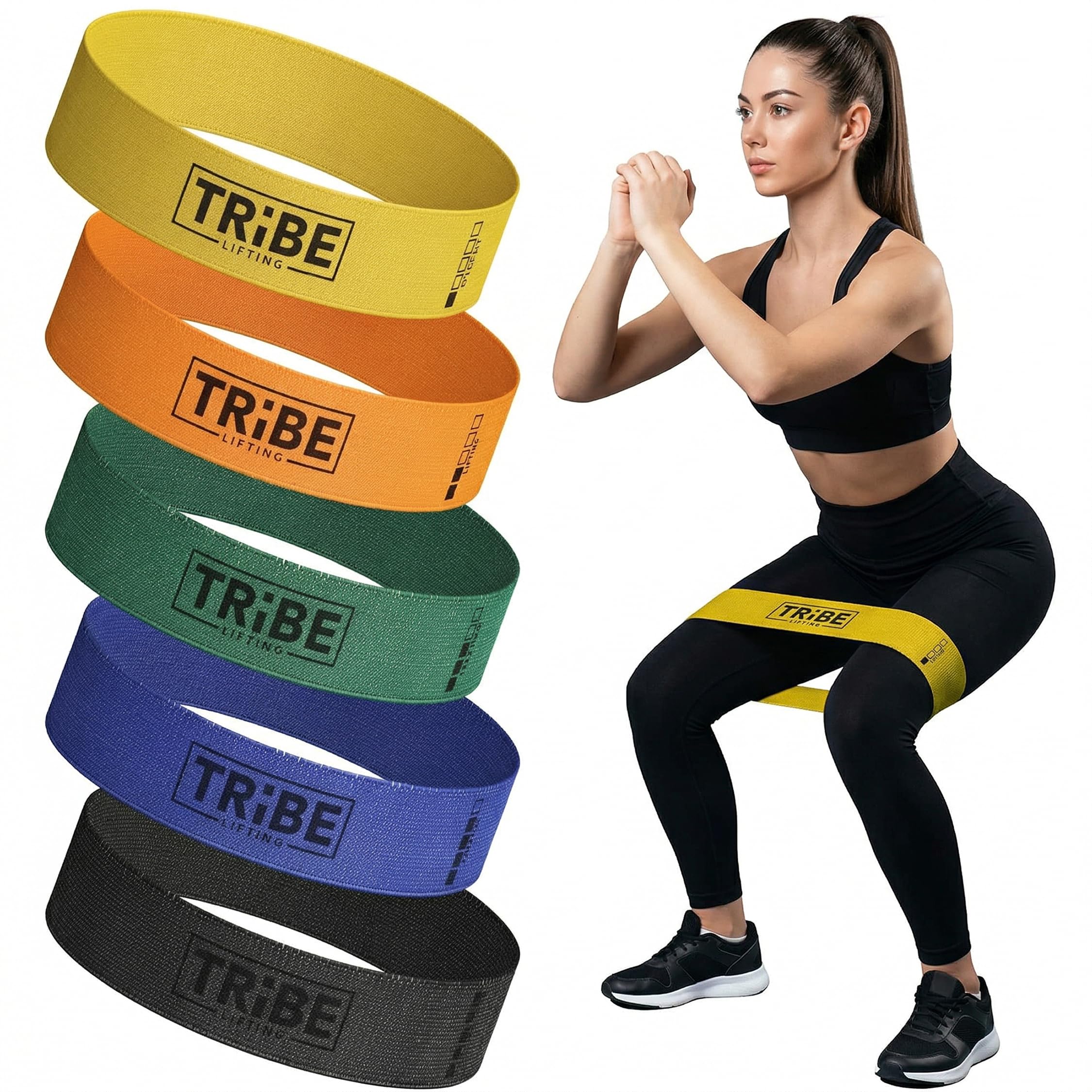
Tribe Lifting Fabric Bands

Tribe Lifting

Tribe Lifting Fabric Bands

  • Levels 5
  • Material Cotton-latex blend
  • Band Size 12 x 2 in
  • Resistance 40-180 lb
Check Price on Amazon

Five fabric loops from 40 to 180 pounds for lifters who need serious tension.

The top band in this five-piece set is rated to 180 pounds, and the lightest is 40. That is a different category of resistance from the booty bands most people start with. It is for the lifter who has outgrown a 60-pound loop and wants fabric that still stays flat during heavy hip thrusts, monster walks, and sumo squats.

The range is the useful part. Five levels from 40 to 180 pounds give you room to progress without switching to a different style of band, and the 12-by-2-inch fabric loops are wide enough to stay put. The cotton-latex blend has a sturdy, slightly stiff feel that suits loaded lower-body work. The width is the detail that matters most: a narrow loop digs in under load, while this one distributes pressure across the thigh. The set is compact enough to throw in a gym bag.

The trade-off is obvious: it is overkill if you mostly do lateral walks and glute activation. For strong lifters who want a fabric loop that can take serious tension, this is the one we recommend. If you need a lighter band for warm-ups, keep a budget fabric set alongside it rather than trying to make this one do everything.

Bottom Line

We like this set for stronger lifters who need fabric loops beyond the usual booty-band range; five levels run up to 180 pounds.

Check Latest Price

Best Budget Fabric

Our Score 9.4/10
Renoj Fabric Loop Bands

Renoj

Renoj Fabric Loop Bands

  • Included 3 bands and carry bag
  • Material Cotton and polyester
  • Band Size 28.35 x 3.15 in
  • Resistance 3 levels; 35 lb
Check Price on Amazon

Three wide fabric loops that stay flat for beginner leg and glute work.

At the budget end, the Renoj set is the one we hand to someone who wants a simple fabric loop set without spending much. You get three wide bands, a mesh carry bag, and a choice of light, medium, and heavy tension. The top tension is listed at 35 pounds, so this is firmly a beginner and intermediate tool.

We like the width. The bands are 3.15 inches wide, which is wider than many cheap loops, and the cotton-polyester fabric stays flat on the legs instead of rolling into a rope. The three levels are easy to tell apart by color, and the carry bag makes the set easy to keep in a gym bag or desk drawer. For squats, lateral walks, and glute bridges, it does the job without fuss.

The limitation is progression. Three levels and 35 pounds of top tension will not challenge a stronger lifter for long. If you are brand new and want a low-cost way to start leg work, this is an easy yes. If you already train with bands, spend a little more for four or five levels.

Bottom Line

If you want a simple, low-cost fabric loop set for beginner leg work, we think the three wide bands here are an easy yes.

Check Latest Price

Best Overall

Our Score 9.2/10
WHATAFIT Resistance Bands with Handles

WHATAFIT

WHATAFIT Resistance Bands with Handles

  • Included Handles, ankle straps, door anchor
  • Material Natural latex
  • Band Type Tube with handles
  • Resistance 10-50 lb per tube; 150 lb stacked
Check Price on Amazon

Five stackable tubes, handles, ankle straps, and a door anchor cover full-body workouts.

A full-body kit is the right way to think about the WHATAFIT set. Five color-coded tubes are rated at 10, 20, 30, 40, and 50 pounds, and you can clip them together for up to 150 pounds. Add two cushioned handles, two ankle straps, and a door anchor, and you have the movements a loop band cannot give you: rows, presses, curls, kickbacks, and anchored core work. For most people building a home gym in a spare room, this is the set we recommend first.

We like the stackable design because it grows with you. A beginner can start with the 10- or 20-pound tube and add bands as the reps get easier; a stronger lifter can stack the 40 and 50 together for a hard set of rows. The handles are the difference between a band workout that feels like a toy and one that feels like training. The door anchor is equally useful: it turns a bedroom door into a pulling station without drilling anything.

The tubes are the wear point, especially where the clips and collars meet the latex, so inspect them before heavy stacking and retire any tube that looks nicked. The set is compact, and the carry case keeps it together. If your training is mostly legs and glutes, a fabric loop set is simpler; if you want one kit that covers rows, presses, and curls, this is the one.

Bottom Line

This is the set we recommend first for a home gym: five stackable tubes, handles, ankle straps, and a door anchor cover full-body work.

Check Latest Price

Best for Pull-Up Assistance

Our Score 9.2/10
WSAKOUE Pull-Up Bands

WSAKOUE

WSAKOUE Pull-Up Bands

  • Levels 5
  • Material Natural latex
  • Band Size 82 x 2 in
  • Resistance 5-125 lb
Check Price on Amazon

Five long latex loops from 5 to 125 pounds for assisted pull-ups and stretching.

A pull-up assist band has one job: take enough weight off your body that you can complete clean reps, then get out of the way as you get stronger. The WSAKOUE set does that with five long loop bands from 5 to 125 pounds. The 82-inch length gives you room to loop one over a bar and step a knee or foot into the bottom, and the 2-inch width sits comfortably without digging in.

We recommend it for anyone working toward a first pull-up or adding band-assisted volume to their training. The five levels are the point: the 5-pound band is useful for stretching and warm-ups, while the heavier bands can support dips, push-ups, and squats. The natural latex has a smooth, even stretch, and the set comes with a carry bag and an instruction manual.

The top 125-pound band is stiff enough that a beginner should start lower and progress. The loops are also long, which is an advantage on a pull-up bar but can feel awkward for floor work. For pull-up assistance specifically, this is the set we reach for first.

Bottom Line

We recommend this five-band set for anyone working toward a first pull-up or adding band-assisted volume to their training.

Check Latest Price

Best Latex-Free

Our Score 9.2/10
LEEKEY Latex-Free Pull-Up Bands

LEEKEY

LEEKEY Latex-Free Pull-Up Bands

  • Levels 4
  • Material Synthetic rubber, latex-free
  • Thickness 3.5 mm
  • Resistance 15-125 lb
Check Price on Amazon

Four synthetic-rubber loops from 15 to 125 pounds for latex-sensitive lifters.

If latex makes you itch or you simply do not want it in the house, the LEEKEY set is the pull-up band kit to look at first. The four loops are made from layered synthetic rubber instead of natural latex, and they range from a 15-35 pound red band to a 50-125 pound green band. That is a wider spread than many four-band sets, and the 3.5-millimeter thickness gives them a substantial feel.

The range is the useful part. You can use the red band for warm-ups and assisted pull-ups, then move to black, purple, and green as you get stronger. The loops are long enough to anchor over a bar or around a sturdy post, and the set includes a carry bag and an exercise guide. For a home gym or a garage setup, it covers the pull-up progression without adding a machine.

We like the latex-free material for anyone who has had a reaction to natural rubber, and we appreciate that the bands are thick enough to feel secure under load. For a very light rehab band, the flat therapy set is the better choice. If you need a latex-free pull-up set with a broad range, this is the one we recommend.

Bottom Line

We point latex-sensitive lifters to this set because it covers pull-up assistance and strength work without natural rubber.

Check Latest Price

Best for Physical Therapy

Our Score 9.2/10
lianjindun Flat Therapy Bands

lianjindun

lianjindun Flat Therapy Bands

  • Levels 5
  • Material TPE, latex-free
  • Band Size 60 x 6 in
  • Resistance 3-20 lb
Check Price on Amazon

Five light, latex-free flat bands from 3 to 20 pounds for rehab and stretching.

Five flat bands, color-coded from extra-light to heavy, with a listed range of 3 to 20 pounds. That is the pitch for the lianjindun set, and it is aimed squarely at physical therapy, Pilates, and gentle stretching rather than heavy strength work. The bands are 60 inches long and 6 inches wide, made from latex-free TPE, and they come in five levels rather than the usual three.

The five levels are what make this set useful for rehab. You can start with the yellow band for shoulder rotations or ankle work, then move up as the movement gets easier. The TPE material is smooth and does not have the powdery feel of some latex bands, and the 6-inch width gives you something substantial to grip. The bands are also latex-free, which matters for anyone with a sensitivity.

The set is compact enough to roll into a drawer, and the five colors make it easy to follow a PT sheet. The TPE wipes clean, and the flat profile sits against the skin without bunching. Inspect the bands for nicks and replace any that look worn.

We recommend this set for anyone following a physical therapy program or adding light resistance to Pilates and yoga. It is designed for controlled movement, and that is exactly where it earns its place.

Bottom Line

For physical therapy and gentle stretching, we value this five-band set for its light, latex-free flat bands.

Check Latest Price

Best For Cheap starter loops

Our Score 9.0/10
Fit Simplify Loop Bands

Fit

Fit Simplify Loop Bands

  • Included Carry bag and guide
  • Material Latex
  • Band Size 12 x 3 in
  • Resistance 5 levels
Check Price on Amazon

Five thin latex loops, a carry bag, and a roll-up problem: that is the Fit Simplify set in a sentence. The loops are 12 inches long, color-coded across five resistance levels, and light enough to toss in a bag. This is the set most people picture when they think of resistance bands, and the low price is a big part of the appeal.

The five levels are useful for a cheap starter kit. You can use the lighter loops for shoulder work, lateral walks, and stretching, and the heavier ones for anchored rows or adding resistance to bodyweight moves. The carry bag and instruction guide make it easy to keep the set together, and the loops take up almost no space.

The issue is stability. The flat latex loops roll and slide on bare legs, especially during glute work, so they are a poor choice for the main lower-body circuit. They work better for anchored upper-body work, where the band has something to pull against and does not need to stay on a thigh.

We keep this set for travel and quick upper-body sessions, but we do not recommend it as your only lower-body band. If you want a cheap backup for rows and shoulder work, it earns a place; if leg day is the point, spend up for fabric.

Bottom Line

We keep this cheap five-loop set for travel and anchored upper-body work, where the thin latex loops are easy to pack and quick to set up.

Check Latest Price

What We Put Every Band Through

We started by gathering every set and single band we could find that listed an actual resistance range rather than one vague word like heavy, then filtered by material, length, and price until 16 sets remained — flat latex, fabric loops, and a few tube styles with handles. Every set went into the same rotation for four months, in living rooms and on gym floors, on carpet and on hardwood.

Banded squats and glute bridges were the daily test: 30 reps on carpet and 30 on hardwood, watching for the roll at the top of the thigh that makes you quit a set early. We anchored bands in doorways for rows and assisted pull-ups to see whether the anchor held and whether the band crept up the frame. A few sets spent the whole period in a carry-on and a gym bag to find out whether they came out tangled, nicked, or smelling like the inside of a duffel.

We measured every band flat on day one and again at the end, noted where the first nicks appeared (almost always the edges of the lightest band), and pulled each to roughly twice its resting length to hear how it creaked. Length mattered more than we expected — our tallest tester ran out of band on rows that felt fine to everyone else. To check honesty, we hooked bands to a luggage scale at a marked stretch and compared the reading to the printed resistance, then priced each set per usable band, since the light ones tend to die first.

How to Choose

Match the Band to the Job

Loop bands are the simplest tool for legs, glutes, and pull-up assistance; tube bands with handles add rows, presses, and curls; flat bands are for physical therapy, stretching, and low-load activation. The mistake is buying a set because it has five bands and then discovering it cannot anchor to a door or fit around your thighs. If you want one set for a full-body home workout, start with a tube set that includes handles and a door anchor. If leg day is the priority, choose wide fabric loops. If you are rehabbing a shoulder or knee, start with flat bands.

Read the Resistance Range

Five levels sounds better than three, but the range matters more than the count. A set that runs from 5 to 125 pounds can assist a pull-up and load a squat; a set that runs from 40 to 180 pounds is for someone who already has strength. Look for a lightest band you can use for 10 to 12 clean reps and a heaviest band that makes the last two reps of a set feel hard. If you are between sets, stackable tubes give you more room to grow than fixed loops.

Grip and Material Matter

Fabric loops stay flat on bare legs, which is why they are the better choice for squats, hip thrusts, and lateral walks. Latex loops are thinner and more portable, but they can roll on sweaty skin and snap if nicked. Latex-free TPE and synthetic rubber are the options for anyone with a sensitivity. The trade-off is feel: fabric can be warmer and less stretchy, while latex has a smoother pull. Match the material to the skin contact you will actually have, not to the label on the package.

Check Wear Points and Accessories

Every band has a wear point. Tubes fail at the clips and collars; latex loops fail at nicks and thin spots; fabric loops fail at stitching. Inspect before every heavy session and replace damaged bands instead of taping them. Accessories change what the set can do: a door anchor adds pulling angles, ankle straps add kickbacks, and handles make rows and presses more comfortable. If you plan to anchor to a door, test the setup with the lightest band first and make sure the door latches securely.

Frequently Asked Questions

Final Verdict

For most people, the WHATAFIT set is the one we point to first: five stackable tubes, handles, ankle straps, and a door anchor turn a doorway into a usable gym. If your training is mostly lower-body, the Vergali fabric loops are the better buy; if you need serious tension, step up to the Tribe Lifting set.

The deciding question is whether you need handles and a door anchor or just a band around your thighs.