Tech & Wearables

Best Pedometers of 2026

A pedometer that overcounts is worse than no pedometer at all — you get the little thrill of 12,000 steps on a day you mostly sat at a desk, and after that the number means nothing. What a good one buys you is boring and valuable in equal measure: an honest count, a battery that outlasts your phone's, and a display you can read without squinting. Most people don't want graphs or a subscription; they want to clip it on in the morning and trust the number at night.

I've worn these on and off since a step challenge at a former job, and the pattern hasn't changed: simple wins. Over the past three months we've put 14 through everyday life, and the keepers got the basics right — an honest step count, a clip that stays put on a waistband, a display you can read at a glance, a reset that works when it should, all for very little money. One thing worth knowing: where you wear it matters as much as what you buy, and the picks below are the ones we'd still clip on.

Best for Detailed Tracking

Our Score 8.4/10
Omron HJ-113

Omron

Omron HJ-113

  • Reset Automatic at midnight
  • Memory 7 days
  • Battery 1 AAA
  • Tracking Steps, aerobic steps, distance, calories
Check Price on Amazon

For walkers who want aerobic steps, distance, calories, and seven-day history.

The Omron is the outlier: it does more than count steps. It separates aerobic steps from ordinary steps, estimates distance and calories, and keeps seven days of history, so you can look back at a week rather than a single number. It also resets itself at midnight, which is the feature we missed most when switching back to the simpler counters.

That makes it the pick for a walker who treats a pedometer as a logbook, not just a scoreboard. The dual-axis sensor is designed to work in a pocket or bag, and the leash-style clip makes it easy to pull out and read without losing it. We think the automatic midnight reset alone is worth the upgrade for anyone who has ever forgotten to zero a pedometer and lost a day's count.

The display shows more than the budget models, but it is not as large as the Neskla's; you trade a big number for a fuller picture. The seven-day memory is the part that makes the extra data useful, because you can compare today with the rest of the week instead of guessing. It is a dedicated pedometer that happens to keep a small training log.

Bottom Line

The HJ-113 is for the walker who wants aerobic steps, distance, calories, and a week of history in a dedicated pocket pedometer.

Check Latest Price

Best for Easy Daily Use

Our Score 8.2/10
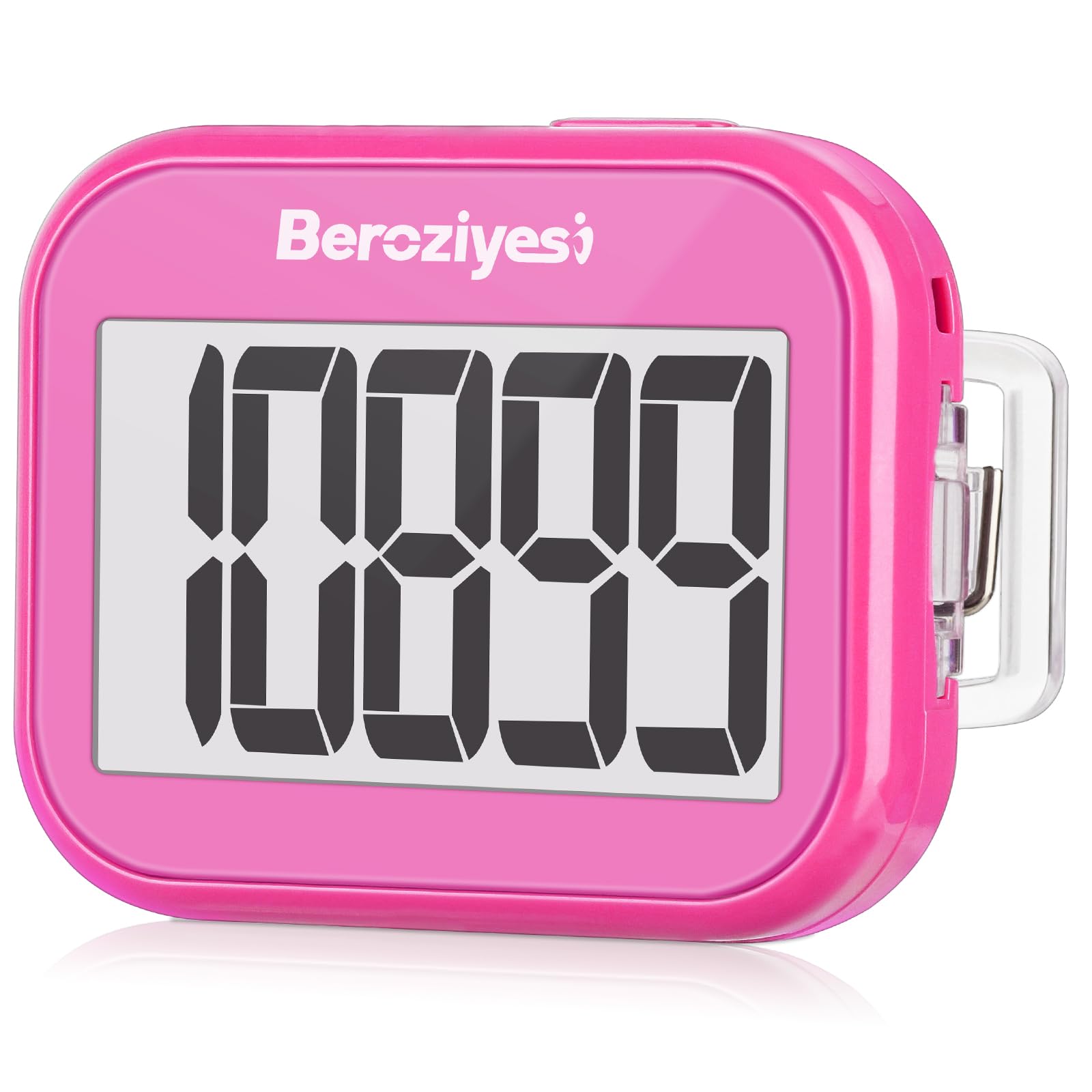
Beroziyesi 3D Pedometer

Beroziyesi

Beroziyesi 3D Pedometer

  • Display 1.73 inches
  • Tracking Steps only
  • Battery Life 6 to 12 months
  • Wear Options Clip and lanyard
Check Price on Amazon

A near-foolproof daily pedometer with a big readout and a secure clip.

The Beroziyesi is the one we hand to someone who does not want to learn a device. Hold the reset button, clip it on, walk; there is no app, no pairing, and no setup sequence to survive. That simplicity is not a stripped-down compromise here—it is the whole recommendation.

The 1.73-inch display is readable from the waist, which sounds like a small thing until you are wearing reading glasses and trying to check a count mid-walk. The clip has a strong grip, and the lanyard covers the days when a waistband is not practical. It counts up to 99,999 steps, far more than a daily walker needs, and the CR2032 battery is rated for 6 to 12 months.

It is steps-only, so it will not tell you distance or calories. That is the right trade if you want a single daily number, and the wrong one if you like reviewing a week of activity. The Realalt is the step up for that.

Bottom Line

The Beroziyesi is our pick for the least fiddly daily pedometer: easy to read, easy to wear, and easy to start using.

Check Latest Price

Best for Night Walks

Our Score 8.2/10
AVTREK 3D Step Counter

AVTREK

AVTREK 3D Step Counter

  • Display 1.57 inches, LED backlight
  • Tracking Steps and time
  • Battery Life Up to 12 months
  • Wear Options Clip
Check Price on Amazon

A backlit step counter that makes evening walks easier to check.

The AVTREK earns its place after dark. Between 6 p.m. and 6 a.m., pressing the side button lights the display, so you can read your step count on an evening walk without angling for a streetlight or pulling out a phone.

The rest is deliberately simple: steps and time, no app, no phone, no extra metrics. The 1.57-inch screen uses oversized numbers, and the step-only design makes it easy to hand to someone who does not want a fitness app. We also appreciate that the backlight only comes on with a button press, so it is not glowing in a pocket every time you move.

We think the backlight is more than a novelty: it is the difference between checking your total on a late walk and skipping it. The rest of the device stays out of the way, with no menus to learn and no phone to wake. That is a narrow job, but it is done well.

Bottom Line

The AVTREK is the one we choose for evening walks, when a backlit display makes the day's total readable without a phone flashlight.

Check Latest Price

Best Overall

Our Score 8.0/10
Realalt 3DTriSport

Realalt

Realalt 3DTriSport

  • Tracking Steps, distance, calories
  • Warranty 18 months
  • Battery Life 12 months
  • Wear Options Waist clip and lanyard
Check Price on Amazon

A well-rounded daily pedometer with steps, distance, calories, and no phone required.

The 3DTriSport is the one we reach for when a basic step total starts to feel thin. It counts steps, distance, and calories, and it does that without an app, a pairing routine, or a phone in your hand at the end of a walk. We clipped it to a waistband and wore it on the lanyard on other days; the 1.7-inch display is easy to read at arm's length, and the 3D sensor is designed to work in any orientation, so you are not hunting for one perfect spot.

What makes it our default is the balance of features and simplicity. The battery is rated for 12 months, the warranty runs 18 months, and you get both a waist clip and a lanyard in the box. Against the cheaper steps-only picks, the extra context is worth paying for; against the Omron, it is simpler and less expensive, though it does not separate aerobic steps or keep a week of history.

The display is arranged around the number you came for, so checking your total does not turn into a menu exercise. The included mini screwdriver for battery changes is the kind of detail we notice because it means the pedometer does not end up in a drawer waiting for a tool. It is a small thing, but it keeps a simple device in service.

Bottom Line

We recommend the 3DTriSport to walkers who want a straightforward daily step count with distance and calories, without carrying a phone.

Check Latest Price

Best Budget

Our Score 8.0/10
Neskla 3D Pedometer

Neskla

Neskla 3D Pedometer

  • Display 1.73 inches
  • Tracking Steps only
  • Battery Life Up to 12 months
  • Wear Options Clip and lanyard
Check Price on Amazon

The best-value simple counter, with a large display and two ways to carry it.

The Neskla sits at the low end of this group, and it does not feel like a punishment. It counts steps only, which is the point: no app, no pairing, and one reset button. We carried it in a pocket and clipped it to a waistband; at about 27 grams it disappears, and the lanyard means you do not have to trust the clip alone.

The display is the reason to choose it over the other budget counters. At 1.73 inches, the LCD is large enough to read at a glance, and the auto-sleep and auto-wake behavior means it is not burning battery between walks. We think that combination is exactly what a no-frills walker wants: a number you can see without stopping and a device you can forget about until tomorrow.

It is not the pedometer for someone who wants distance, calories, or a history; the Neskla is deliberately a single-number device. The CR2032 battery is rated for up to a year, and the one-year warranty is a useful cushion at this end of the market. For a daily walk, a paper log, and nothing else, it is a sensible place to start.

Bottom Line

The Neskla is the value pick for anyone who wants a simple step total and a display they can read without reaching for glasses.

Check Latest Price

Best For Bag carry

Our Score 8.0/10
Jaxrium 3D Pedometer

Jaxrium

Jaxrium 3D Pedometer

  • Display 0.75 inches
  • Tracking Steps only
  • Battery Life Up to 12 months
  • Wear Options Clip and carabiner
Check Price on Amazon

The Jaxrium solves a specific annoyance: the waist clip that lets go. Its built-in carabiner hooks over a belt loop or bag strap, and the detachable clip gives you a second option. We like that kind of redundancy on a device this small.

The 10-step error prevention is the other feature worth knowing about. The pedometer waits for 10 continuous steps before it starts counting, then adds those first steps to the total, which is meant to cut out the little jostles that inflate a count. We paid attention to that on a walk with frequent stops, because that is where a cheap pedometer usually gets noisy. The long-press reset is also a sensible guard against wiping the day's total with a stray bump.

For a tiny counter you clip to a bag and check when you stop, the Jaxrium is the one we reach for. The carabiner is the difference: it stays attached in a way a smooth waist clip often does not. The long-press reset is a small detail that makes daily use feel more deliberate than fiddly.

Bottom Line

The Jaxrium is the pick for anyone who prefers a carabiner to a waist clip and wants a tiny, simple counter for pocket or bag.

Check Latest Price

How We Tested 14 Pedometers in Everyday Life

We started by gathering every pedometer we could find that didn't demand a phone, an app, or a subscription, then filtered by display type, clip design, and whether the instructions made sense on a first read. That left 14 units, all cheap enough that a bad one isn't a disaster. Each was worn in rotation, two or three at a time on the same route, so we could compare their counts directly against each other and against a hand-tallied walk of 200 steps around a measured loop.

Testing ran three months. They went on morning dog walks, treadmill sessions, grocery runs, stairwell climbs, and long desk days where the only movement was leaning back in a chair. We tallied steps by hand on a known route and logged how far each unit drifted, and we drove with them clipped on to see which ones counted every pothole as a stride.

Setup was timed out of the box, including whether we had to enter a stride length or a weight before the thing would count anything at all. We noted how many button presses it took to clear the count on demand, and whether the midnight rollover actually happened or the numbers piled up into the next day. Displays got read in a dim hallway, in direct sun, and without glasses on, and we judged size by how the unit felt under a shirt and whether it crept along the waistband mid-jog.

For clip strength, we fastened each one to thin athletic shorts, thick denim, and a waistband with a phone already in the pocket, then tugged and jogged. Durability came from clumsier stuff: drops onto pavement, a week rattling loose in a tote bag, and three months of daily clipping and unclipping. Anything that skipped counts, reset itself, or lost its grip never made the list.

How to Choose

Accuracy Starts With Placement

A pedometer counts motion, not distance, so the same device can read differently on a waistband, in a pocket, or swinging from a lanyard. The fix is consistency: choose one carry position and use it for every walk. A 3D sensor is designed to work in any orientation, but it still needs a stable spot. Before you trust a new pedometer, count 100 steps on a familiar route and compare; if the total is far off, move it closer to your hip and try again.

Choose the Carry Method You Will Actually Use

Waist clips are the default for a reason: they put the sensor close to your center of motion and keep the display easy to reach. But a clip is only as good as the waistband it grabs, and smooth athletic fabric is a poor host. If you often wear dresses, leggings without a belt, or a pack, choose a lanyard or carabiner instead. The Jaxrium's built-in carabiner gives you a bag-and-belt-loop option that does not depend on a clip; the Neskla and Realalt include lanyards for neck carry.

Readability and Reset Are Daily Friction

You will check the display far more often than you think, so a big number matters more than a long feature list. Look for digits you can read at arm's length without stopping; a 1.7-inch screen is a useful benchmark. Reset behavior is the other daily friction. A single button is fine if you remember to press it, while the Omron HJ-113 resets itself at midnight and keeps a week of history. If you have ever lost a day's count to a forgotten reset, automatic is worth paying for.

Decide Whether You Need More Than Steps

Distance, calories, and aerobic steps are useful only if you actually review them. A steps-only model keeps the screen clean and the routine short, which is why the Neskla and Beroziyesi are enough for many walkers. The Realalt adds distance and calories without an app, while the Omron separates aerobic steps and stores a week of data. Choose the simplest display that answers the question you ask after a walk; extra numbers you never open are just battery drain and menu clutter.

Battery, Warranty, and Durability

Most pedometers here run on a CR2032 coin cell and claim six to twelve months of use; the Omron takes a single AAA. Treat those figures as estimates, and keep a spare cell at home so a dead battery does not end your streak. Warranty length varies from six months to 18 months, which is a fair proxy for how much backup the maker offers. Coin cells are an ingestion hazard, so keep spares and spent batteries away from children.

Frequently Asked Questions

Final Verdict

Across this group, the Realalt 3DTriSport is the best default for most walkers. It gives you steps, distance, and calories without a phone, backed by a 12-month battery and an 18-month warranty, and it is simple enough to wear every day.

If you want to spend less, the Neskla is the value pick; if you want aerobic steps and a week of history, the Omron earns its premium. For evening walks, the AVTREK's backlight is the detail that makes it the better choice.