Strength & Weights

Best Neck Harnesses of 2026

A neck harness looks simple across the room: a padded head strap, a chain, and a plate. Put one on, though, and the details start talking. The right one holds your head securely without clamping your skull, lets you move through a full range of motion, and keeps the load where you can control it. The wrong one slips mid-set, digs into your forehead or behind your ears, or makes you fight the straps. Neck training already asks for patience; the gear shouldn't add another problem.

Over four months, my team and I put 14 neck harnesses through regular sessions, and the gap between comfortable and miserable was rarely about price. Fit and comfort show up first, but adjustability keeps a harness useful as you switch movements. A good design lets you get in and out on your own, stay put through extensions and lateral work, and survive sweaty hands and repeated loading. Value matters too: flimsy stitching or a short strap is no bargain if it limits your range. The picks below made neck day feel controlled rather than clumsy.

Best Full Kit

Our Score 9.2/10
G GABANTT Neck Harness Kit

G GABANTT

G GABANTT Neck Harness Kit

  • Padding High-density neoprene
  • Top Strap Adjustable
  • Item Weight 3.5 lb
  • Kit Includes Chain, 2 bands, loading pin, 3 hooks
Check Price on Amazon

A loading pin, two bands, and an adjustable top strap for home gyms.

The loading pin is the reason to look at this one. Instead of threading plates onto a chain that swings while you hunt for the hole, you slide them onto a rod that holds them flat, and the weight change happens in seconds without touching the harness. For a movement where you are already thinking about your neck, that convenience is worth more than it sounds.

There is more in the bag than a harness: a chain, two resistance bands, three larger hooks, and the pin, which is most of why the kit weighs 3.5 pounds. Four adjustment points, including a top strap that actually moves, mean it covers heads the fixed-crown harnesses do not, large ones in particular. Run the top strap near its limit on a small head and the crown can still creep toward your brow, so take the extra minute to set the four straps before you load it.

Our take: this is the harness for a home gym where it hangs on a hook and the weight changes often. You are paying for the pin and the bands together, and if you already own a cable stack the bands will sit in the bag. The lifter who gets the most out of it is the one adding a plate a week and tired of fiddling with a swinging chain.

Bottom Line

We reach for this kit when progressive loading matters: the pin makes plate changes quick and stable, and the adjustable top strap takes up slack on bigger heads.

Check Latest Price

Best Budget

Our Score 9.2/10
POZTEV Neck Harness

POZTEV

POZTEV Neck Harness

  • Chain Heavy-duty steel chain
  • Straps Adjustable head and chin
  • Closure Hook and loop
  • Padding Neoprene
Check Price on Amazon

The least expensive way to find out whether neck training sticks.

The POZTEV is the least expensive harness we cover, and that is the point of it. Neoprene padding, adjustable head and chin straps, a heavy-duty chain, and quick-release clips give you the whole basic recipe without paying for bands, a pin, or a bag that ends up at the bottom of a gym locker. If you want to find out whether you will actually train your neck before spending real money on it, this is where we start.

What you give up is angles. There is one place to hang the weight, so you are training flexion and extension and not much else, and rotational work later means adding a band harness to the bag. Fit is the other question mark: the straps take up plenty of slack, but the crown sits where it sits, so measure your head and buy somewhere with an easy return.

Bottom Line

If you are not sure neck training will stick, this is the harness we suggest starting with — it covers the basics for the least money in this group.

Check Latest Price

Best Overall

Our Score 9.0/10
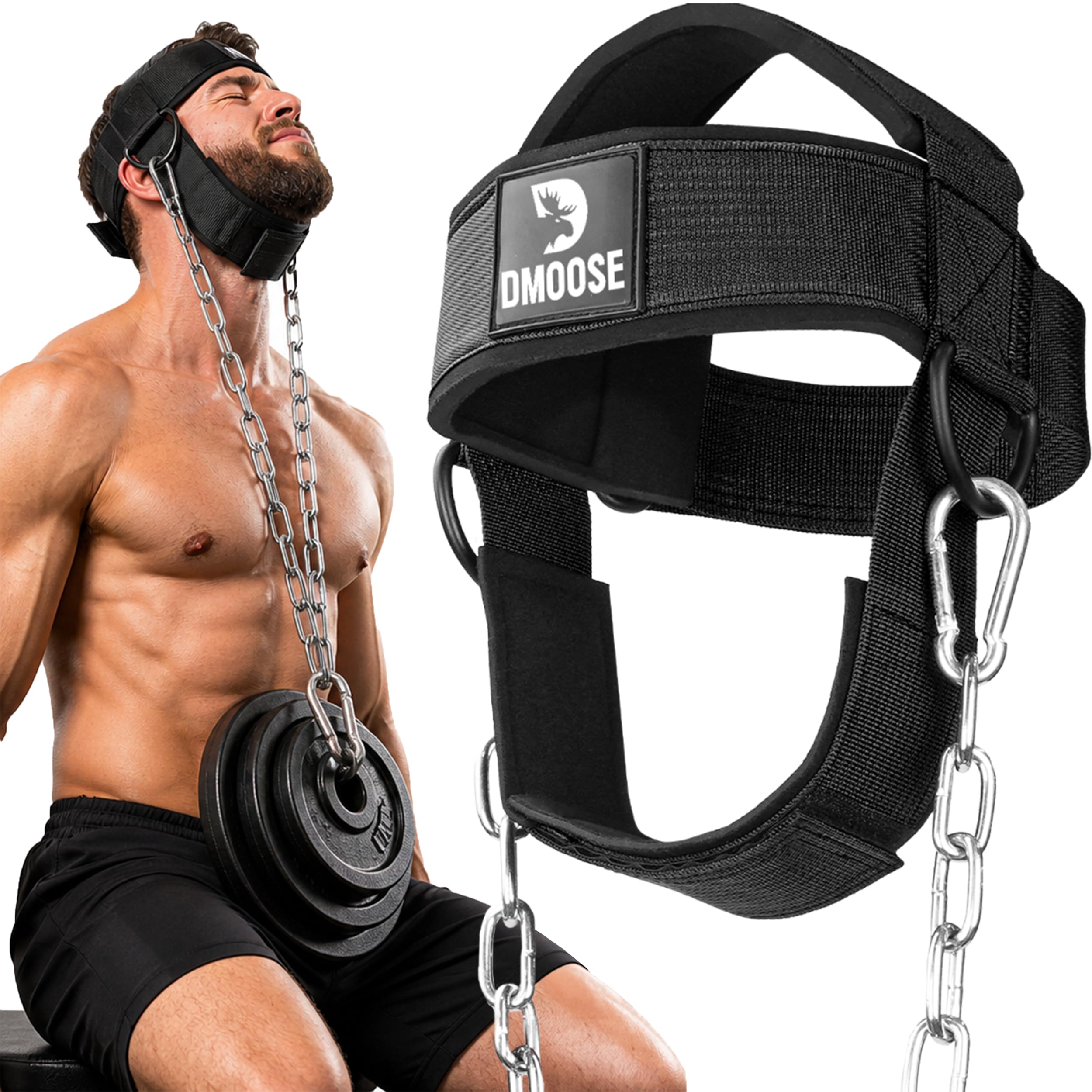
DMoose Neck Harness

DMoose

DMoose Neck Harness

  • Straps Chin plus crown support strap
  • Closure Hook and loop
  • Padding 5 mm neoprene
  • Chain Length 30 inches
Check Price on Amazon

Thick padding, a crown strap that holds, and a 30-inch chain in the box.

Five millimeters of neoprene over the crown and under the chin is where our recommendation starts, because a neck harness hangs a plate off your skull and the padding decides whether you finish the set. The DMoose pairs that foam with a second strap across the top of the head, so the rig tracks with you instead of creeping forward once the chain takes weight. A 30-inch steel chain and its rings come in the box, which means you can load it the day it arrives.

Training with it is uneventful in exactly the way you want. The chin strap does most of the stabilizing, so flexion and extension stay locked in: drop your chin against the chain and the harness follows rather than sliding up your forehead. Lateral flexion is the movement it does not serve. With essentially one plane of pull, the whole rig rotates with your head instead of resisting it, so side-to-side work belongs with a band or a harness that has rings on the sides.

Wear it for a long set and you notice where the pads land, right where a hat band sits, and the hook-and-loop will catch loose hair if you pull the harness off carelessly. Neither has stopped us putting it on three times a week. That is the trade for foam thick enough to make heavier loading tolerable, and it is why this one stays at the top of the list.

Bottom Line

This is the harness we tell most people to buy: generous padding, a crown strap that keeps the load steady, and a chain long enough to load properly.

Check Latest Price

Best For Comfortable light sessions

Our Score 9.0/10
Vikingstrength Neck Harness

Vikingstrength

Vikingstrength Neck Harness

  • Size One size fits all
  • Extras V-Strength app access
  • Padding 2 cm
  • Attachment D-rings
Check Price on Amazon

Buying this harness also gets you a training app, which sounds like filler until you remember that most people have no idea how to program neck work. The padding is thick, the straps adjust with hook-and-loop, and there are D-rings for clipping a band, which is a fuller feature set than the price suggests.

We rate the padding as the best part. It is the harness we reach for when someone wants to train neck without feeling every edge of the strap, and the chin strap keeps the whole thing from shifting once it is set. Where it asks for care is the ears: cinch it down hard and the padding presses right where a glasses temple sits, so take a minute on the chin strap before you add weight.

Set up properly it is the easiest of these to hand to someone who has never worn a harness, and the app gives that person something to follow for the first month. It is a beginner's harness in the best sense: forgiving, comfortable, and simple to get on alone.

Bottom Line

The most comfortable harness at this end of the range, with a training app thrown in — just keep the plates moderate, because the stitching is the weak point.

Check Latest Price

Best for Multi-Angle Work

Our Score 8.8/10
RDX Neck Harness

RDX

RDX Neck Harness

  • D-Rings Four, at two heights
  • Padding 4 mm neoprene
  • Chain Length 90 cm
  • Adjustability Three-way straps
Check Price on Amazon

Four D-rings at two heights change your pull angle without re-rigging.

Four D-rings, set at two different heights, plus two carabiners: the RDX gives you more places to hang a load than anything else here. The straps adjust in three places, at the top, the back, and the bottom, so fit is a matter of dialing the harness in rather than hoping it lands right.

What that buys you is a session you do not have to interrupt. Clip the chain to the lower ring for flexion, move to the upper ring for extension, and thread a band through a side ring for lateral work without taking the harness off and starting over. The adjustable top strap is the part we appreciate most, since a moving crown strap is exactly what we miss on the DMoose.

The hardware is the other reason it stays in the rotation: a 90 cm steel chain, the longest chain in this group, and two carabiners so one can live permanently on the chain and the other on the harness. Rigging a band takes seconds, which is the whole point of paying for extra rings in the first place.

Bottom Line

We point lifters here when they want to change pull angles mid-session — four rings and an adjustable crown strap make it the most flexible harness in this group.

Check Latest Price

Best For Simple daily work

Our Score 8.8/10
Gymreapers Neck Harness

Gymreapers

Gymreapers Neck Harness

  • Size One size fits all
  • Chain 29-inch stainless steel
  • Closure Hook and loop
  • Padding Neoprene
Check Price on Amazon

Same money as our top pick, same idea: a neoprene-padded band, hook-and-loop straps, and a stainless steel chain hanging from a D-ring. Gymreapers has been making straps long enough that the construction is not the question, and the 29-inch chain is honest about what the harness is for, a plate or two rather than a stack.

The crown strap is the detail that decides it either way. It sits further forward than the DMoose's, which puts the hooks closer to your temples and crosses more forehead than crown. On some head shapes that is just where the strap needs to be; on others it means the harness wants to slide back.

Our problem is positioning rather than quality. At this price the DMoose gives you more padding and an extra half-inch of chain, and the Gymreapers does not open up an angle or a loading method the others lack. Buy it if the fit lands and the brand is one you already trust; otherwise it is a solid harness without a reason to choose it.

Bottom Line

A well-built plain harness with nothing wrong with it — we just cannot name a job it does better than our top pick, unless its forward-set crown strap happens to suit your head.

Check Latest Price

Best For Rotational band work

Our Score 8.6/10
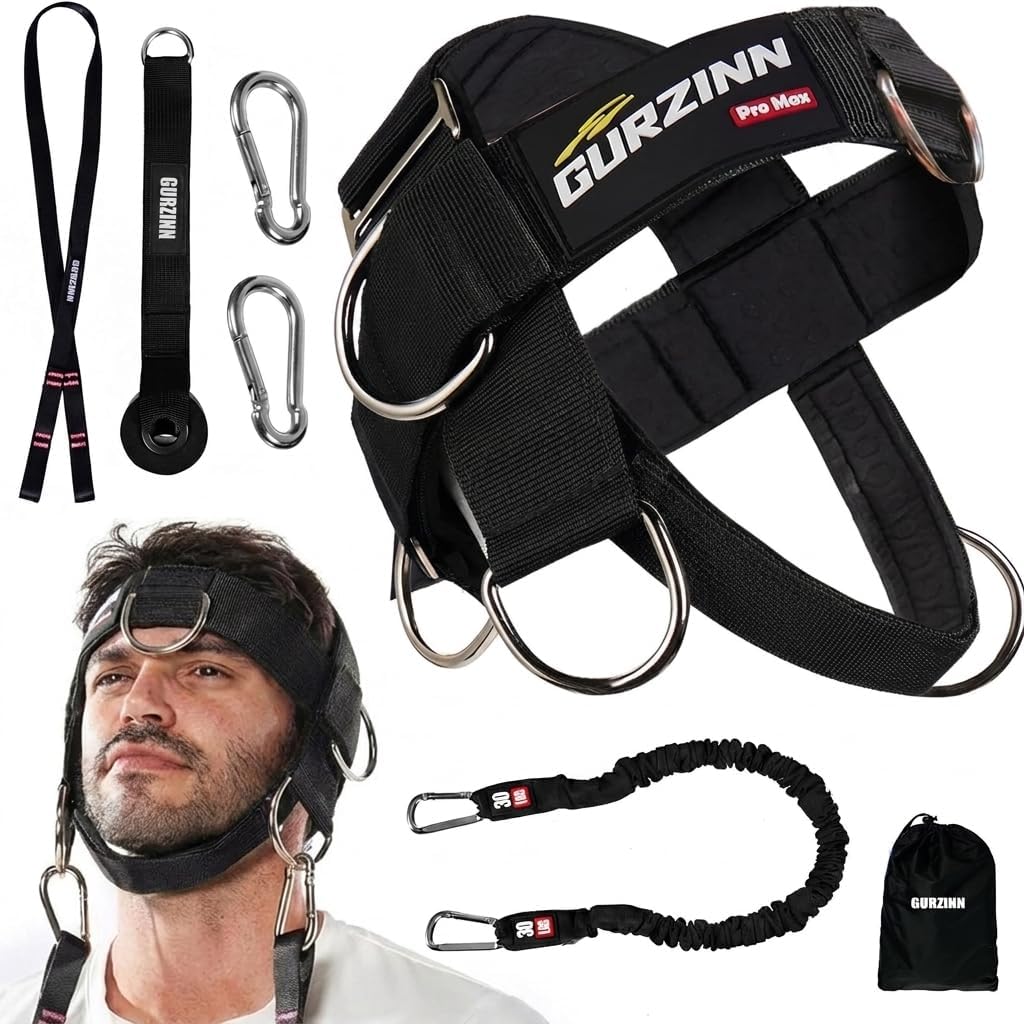
GurZinn Neck Trainer

GurZinn

GurZinn Neck Trainer

  • Rope 40-inch climbing rope
  • Padding 6 mm neoprene
  • Includes 30 lb band, door anchor, carabiners, bag
  • Adjustment Four-point straps
Check Price on Amazon

A rope instead of a chain is the first thing you notice, but the front ring is what makes this harness different. Thread a band through it and you can load rotation, which is the movement a single-ring chain harness simply cannot train. Add the side rings and you have four directions of pull from one piece of kit.

The rest of the bag is a small gym: a 40-inch climbing rope, a 30-pound resistance band, a door anchor, two carabiners, and a carry pouch. That combination makes it the harness we take when we are training somewhere without plates, and the door anchor is what turns a hotel room into a place you can work.

Six millimeters of neoprene is generous padding, and the chin closure is a buckle rather than hook-and-loop, which holds its setting once you have it right. Four straps take up the slack around the head, so it sits securely once dialed in.

Where it earns its place is versatility, not simplicity. If you train neck twice a week with a plate on a chain, the DMoose is easier and cheaper to live with. If you want rotation, band resistance, and a setup that travels, this is the one we pack.

Bottom Line

We keep this one for rotational and band work: the front ring and door anchor reach angles a chain harness cannot, and the padded band is comfortable enough to forget.

Check Latest Price

How We Tested the Best Neck Harnesses

We started by gathering the neck harnesses that turn up most often in gym bags and lifting forums, then narrowed the list to designs with padded head straps, adjustable webbing, and hardware that looked capable of repeated loading. We filtered out anything with obviously short straps or thin stitching, and we chose a mix of simple and more structured headpieces. That left 14 harnesses, which we used over four months in regular neck sessions at a gym and at home.

Each harness went through slow neck extensions, lateral flexion, and rotation with light plates, plus higher-rep sets with no load to see how the straps behaved. We put them on without help, checked whether the pad sat centered on the forehead and base of the skull, and noted pressure behind the ears or across the brow. During sets, we watched the chain and whether the headpiece felt supportive without clamping: did the load hang straight, did the plate swing into the back or shoulder, and could we reach full range without the harness shifting?

We adjusted each harness for different head sizes and recorded how much strap tail remained, whether buckles stayed tight mid-set, and how easy it was to get in and out between sets. After every session we inspected stitching, webbing, D-rings, and padding for fraying, stretching, or compressed foam; by month four, some looked barely used and others had clearly given up. We judged value by whether the harness delivered a stable pull, usable range, and no distractions during a workout, not by price alone.

How to Choose

Fit Comes Before Features

Every harness here has a chin strap and a chain; what separates them is whether the thing stays on your head through the last rep. The crown strap is the part to check. A fixed one caps the head sizes that work, which is why our top pick runs tight above about a 7½ hat size, while an adjustable top strap such as the ones on the G GABANTT and the RDX covers more ground.

Measure around your head above the ears and compare that to what the harness actually adjusts to, because one size fits all is a label rather than a measurement. Adult heads run from roughly 21 to 24 inches, which is a wide enough spread to make the top strap the deciding feature.

Padding and Pressure Points

The weight hangs from a band across your skull, so padding is load-bearing rather than decorative. Thickness in this group runs from 4 mm to 6 mm of neoprene, and it matters most if you are hanging plates instead of bands: more foam spreads pressure over the crown and keeps the chin strap from digging in. For band-only rotational work, a thinner strap is cooler and less bulky.

What padding cannot fix is placement. Pads that land on your ears hurt no matter how thick they are, so look at where the band crosses before you commit to a design.

Chain, Loading Pin, or Bands

There are three ways to load a harness and they do not overlap as much as the listings suggest. A chain and carabiner is the simplest: thread a plate on, clip it, train. It is also the least tidy, since the chain swings and can brush your face on curls. A loading pin holds the plates flat against a rod, so changing weight takes seconds and nothing swings, which is worth paying for if you add a plate most weeks.

Bands and door anchors suit rotational work and travel, but resistance climbs through the range, so the movement feels different from a plate at every point. Check that your plates fit the chain or pin before you buy, and that your door latches if you plan to anchor to one.

How Many Attachment Points You Need

One ring under the chin gives you flexion and extension, the two movements most neck programs are built on, and it is enough for a first harness. Four rings at two heights let you move from front to back to side without taking the harness off, which is what you want for contact sports or rotational work.

Extra rings cost more and add strap routing to learn. If your program is head nods with a plate twice a week, one ring is a real answer rather than a compromise.

Frequently Asked Questions

Final Verdict

Buy the DMoose. Five millimeters of padding, a crown strap that keeps the load where you put it, and a 30-inch chain in the box make it the harness we recommend to almost everyone, at a price that sits in the middle of this group.

If your head runs large, or you want to change plates without unclipping anything, the G GABANTT's adjustable top strap and loading pin are worth the step up. For pure angle changes, the RDX's four rings do more than either.