Strength & Weights

Best Focus Mitts of 2026

Nobody warns you that holding pads hurts more than hitting them. Your partner throws a decent cross, your wrist folds back a half inch, and suddenly you're the one reaching for ice. Good focus mitts are protective gear disguised as a target: dense enough foam that a hook doesn't sting your palms, stitching that doesn't split by week three, and a grip bar you can actually hang onto for a full round.

I've held for awkward beginners who apologize after every punch and for a former amateur who still throws like he means it, and the mitts that survive both tend to share the same traits. Over the past six months, my team and I worked through 12 pairs, and the ones worth buying earned it on construction rather than branding. One thing nobody tells a first-timer: mitt size should track hand size, because a wide pad on a small hand slips on every hook. The picks below are the ones that stayed in the gym bag.

Best Budget

Our Score 9.6/10
KUANG QUAN Curved Punching Mitts

KUANG QUAN

KUANG QUAN Curved Punching Mitts

  • Material Synthetic leather
  • Stitching Industrial-grade
  • Ventilation Breathable mesh back
  • Striking Face Curved
Check Price on Amazon

Industrial stitching and a mesh back for less than any other pair we recommend.

This is the least expensive pair in the guide that we are happy to recommend, and it does not feel like a compromise once it is on your hand. Synthetic leather, industrial-grade stitching along the edges, a curved striking face, and a breathable mesh back — the features you would expect a tier up, at the bottom of the price range. The olive green is a nice change from the usual black-on-black, too.

What the money buys down here is synthetic leather instead of hide, and that trade shows up over years rather than in the first month. For a beginner, a home setup, or a class where the mitts get handed around, they do everything asked of them: absorb a straight right, hold their shape, and stay put on the hand. Keep them out of the bottom of a sealed bag between sessions, because the lining will hold whatever it is left to sit in.

Bottom Line

If the budget is the decision, buy these: industrial stitching, a mesh back, and a curved face for less than any other pair we are recommending.

Check Latest Price

Best Premium

Our Score 9.6/10
Fairtex FMV9 Contoured Focus Mitts

Fairtex

Fairtex FMV9 Contoured Focus Mitts

  • Palm Contoured pocket
  • Closure Hook-and-loop strap
  • Padding Multi-layer foam
  • Material Syntek leather
Check Price on Amazon

Syntek leather and a contoured pocket built for coaches holding pads every night.

The FMV9 is the pair a coach buys once. Syntek leather over multi-layer foam, a contoured palm pocket that puts your hand in the same place every time, and stitching that looks like someone cared how it ended. The difference we noticed first is the sound: a flat, solid crack off these instead of the dull thud a PU mitt gives you.

The shape is doing the real work. Your fingers sit in a pocket rather than wrapping around a bar, and the striking surface is contoured so a punch that lands slightly off-centre gets caught instead of sliding off the edge. For teaching combinations that is worth the premium, because the puncher gets consistent feedback and the holder is not quietly absorbing every miss through the wrist.

If you are holding for one person twice a week in a garage, these are more mitt than you need, and the leather will spend most of its life in a cupboard. If coaching is the job — three fighters a night, most nights — the arithmetic changes, and this stops being an expense and becomes equipment.

Bottom Line

Worth the money if coaching is your job: Syntek leather, a contoured pocket, and a build that outlasts everything else in this guide.

Check Latest Price

Best Overall

Our Score 9.4/10
RDX Boxing Pads Curved Focus Mitts

RDX

RDX Boxing Pads Curved Focus Mitts

  • Sizes 10", 11"
  • Closure Quick-EZ hook-and-loop strap
  • Material Maya Hide leather
  • Ventilation Perforated, sweat-wicking hand compartment
Check Price on Amazon

Leather, a ventilated hand compartment, and a strap that keeps the mitt locked on.

The part of a focus mitt nobody photographs is the inside of the hand compartment, and it is where the F6 earns the top spot here. The palm side is lined with sweat-wicking fabric and punched through with ventilation holes, so the hand doing the catching stays dry through rounds that leave a cheaper mitt slick. We noticed it in back-to-back sessions, when the mitt came off clean instead of peeling.

The Palm Dome does the structural work: a raised ball inside the grip that holds your hand open, so the striking face keeps its shape instead of folding when a hard right lands slightly high. The curved surface then does what a curved surface should — catches the punch rather than letting it slide off the edge — and the Quick-EZ strap cinches far enough that the mitt stays exactly where you put it.

The padding is firm, and that is the trade you are making. A heavy puncher gets a solid surface and a clean, flat crack; someone still learning to land on a curved mitt will find it less forgiving than a soft foam pad. Sizing runs snug as well — it comes in 10 and 11 inches, and the 11 is the one to take if your hands are broad.

Bottom Line

The pair we recommend for anyone holding pads regularly: leather that takes daily rounds, a ventilated hand compartment, and a strap that locks the mitt down.

Check Latest Price

Best for Family Training

Our Score 9.4/10
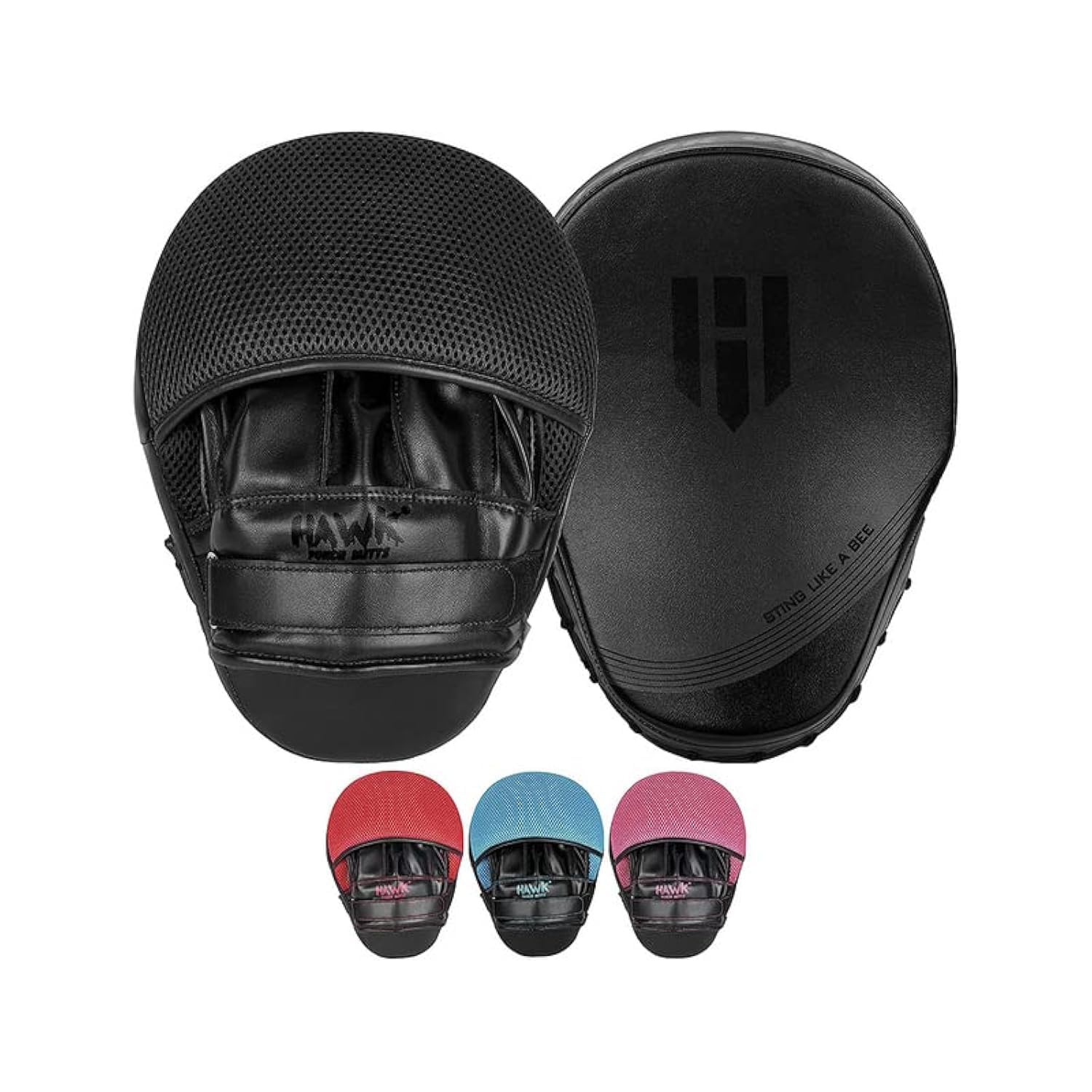
Hawk Sports Curved Punching Mitts

Hawk

Hawk Sports Curved Punching Mitts

  • Grip Built-in grip balls
  • Padding Multi-layer curved EVA foam
  • Material Faux leather
  • Ventilation Large mesh panels
Check Price on Amazon

Grip balls and double stitching in an ambidextrous pair adults and kids can share.

The grip balls are what you notice first. Hawk puts a raised ball inside each palm, and it does two jobs at once: it keeps your hand open around the mitt rather than clenched into a fist, and it stops the pad collapsing when a punch lands off-centre. If you have ever held a floppy mitt for a kid who hits harder than expected, you know exactly why that matters.

The rest is built for people who share. Large mesh panels across the back of the hand keep things cooler between rounds, double stitching runs the seams, and the fit is ambidextrous, so nobody has to work out which mitt belongs on which hand. It is listed for adults and kids both, which matches how a pair like this gets used — a parent holding for a five-year-old, then taking a turn themselves.

Firm is the right word for the padding. A real cross lands on a solid surface, which is what you want when you are catching for someone bigger; a small hitter will feel that firmness as hardness rather than cushioning. The mitts are light and packable enough to live by the door or in the car, which is where a family pair actually belongs.

Bottom Line

Built for a household that trains together — grip balls that hold the shape, mesh panels, and an ambidextrous fit adults and kids can share.

Check Latest Price

Best for Beginners

Our Score 9.2/10
Valleycomfy Curved Focus Punching Mitts

Valleycomfy

Valleycomfy Curved Focus Punching Mitts

  • Size 7.9 x 9.8 in
  • Closure Hook-and-loop wrist strap
  • Padding 1.5 in one-piece molded foam
  • Material PU leather
Check Price on Amazon

Thick molded foam and a curved face that forgive a beginner's mis-timed hook.

The first time someone lands a hook on the wrong knuckle, you can watch their whole arm react. The Valleycomfy pair is what we hand people at that stage: a 1.5-inch one-piece molded foam core takes the sting out of a mis-timed shot, and the curved face gives a beginner something obvious to aim at. It is a beginner's mitt in the best sense, forgiving of the mistakes beginners actually make.

The details hold up to shared use. A full hook-and-loop band across the back of the hand adjusts to most people without a size chart, the surface wipes clean with a damp cloth, and the edge is sewn with strong nylon string so the foam stays where it belongs instead of bulging out the sides.

What makes them so easy to recommend for a class or a garage is how little they ask of you. There is no break-in and no leather to condition, and the strap is a single pull. A group can pass the same pair around all evening and nobody ends up fighting with their equipment instead of training.

Sizing is the one thing that can go wrong. At 7.9 inches across they are generous in length and stingy through the palm, so if you normally wear an XL glove or have broad hands, look at a mitt that comes in sizes. Everyone else gets a pair that can be handed around, wiped down, and forgotten in a gym bag without anyone minding.

Bottom Line

Our pick for a first pair: 1.5 inches of molded foam, a curved face, and a shell you can wipe down — forgiving enough for someone still learning to hold.

Check Latest Price

Best for Coaches

Our Score 9.2/10
Ringside Gel Shock Micro Boxing Mitts

Ringside

Ringside Gel Shock Micro Boxing Mitts

  • Length 8 in
  • Weight 1.2 lb
  • Material Genuine leather
  • Gel Layer 1/4 in
Check Price on Amazon

A quarter inch of gel and an 8-inch target that sharpens a fighter's accuracy.

A quarter inch of gel does not sound like much until you are the one catching. Ringside puts a layer of it under the foam, and it is aimed squarely at the coach's side of the exchange — shoulders, elbows, wrists — rather than at the puncher's knuckles. Across a session of holding for a heavy hitter, that is the difference between finishing the round and shortening it.

The rest of the design follows the same logic. At 8 inches long these are a genuinely small target, which sharpens accuracy because a puncher has to put the shot where it belongs instead of swinging at a barn door. The concave face catches what arrives slightly off-line, and the whole mitt is light enough to move from a slip to a counter without dragging.

This is a coaching tool more than a training partner's mitt. A beginner will find the small target frustrating long before it becomes useful, and if you are holding for a teenager throwing haymakers, a bigger curved mitt is the kinder choice. For a coach who wants fighters tightening their accuracy, and who wants to still be able to lift their arms the next morning, it is the pick here.

Bottom Line

A coach's mitt: a quarter inch of gel to save your joints, an 8-inch target to sharpen accuracy, and almost nothing to it in the hand.

Check Latest Price

Best For Light technique work

Our Score 9.2/10
Xnature Curved Boxing Focus Mitts

Xnature

Xnature Curved Boxing Focus Mitts

  • Weight 3.2 oz
  • Padding Shock-absorbing foam
  • Material Faux leather
  • Warranty 6-month limited
Check Price on Amazon

At 3.2 ounces these carry the lightest listed weight in the group, and that changes how they behave: your hands stay quick, your arms do not load up by the third round, and you can hold them out for a fast fighter without feeling it. The curved striking face and the ventilation holes through the shell are the same idea executed cheaply — light foam, light shell, light everything.

Light has a cost, and here it is less material between your hand and the punch. For technique work, a home routine of combinations, or a spare pair that lives in the car, they are perfectly good and the six-month limited warranty covers the early failures. For a coach holding for a heavyweight every night, they are not the pair, and the seams are where that shows up first.

Bottom Line

A light, inexpensive second pair for technique work and home drills — just do not expect the shell to survive a coach's schedule.

Check Latest Price

Best For Precision drills

Our Score 8.6/10
MaxxMMA Micro Focus Punch Mitts

MaxxMMA

MaxxMMA Micro Focus Punch Mitts

  • Size 6.25 x 6 x 1.25 in
  • Material PU leather
  • Warranty 120-day manufacturer
  • Finger Cover Additional padding over fingers
Check Price on Amazon

At 6.25 by 6 inches, the MaxxMMA Micro is roughly the size of a paperback. That is the whole idea: a target small enough that a fighter has to be precise, and a mitt light enough that the holder can shift it a fraction of an inch to turn a near-miss into a clean miss.

The details are thoughtful for the money. There is an extra cover over the fingers, so a stray knuckle meets padding rather than a gap, and the wrist cover at the back is soft and thick, which keeps the mitt on without a strap digging into your forearm mid-round.

Build is simple and, from what we have seen, sturdy: foam that holds its shape between sessions, a curved palm side that sits naturally against the hand, and a surface that does not punish a puncher who grazes it. Nothing here will win a leather comparison, and nothing is falling apart either.

Where it earns its keep is repetition — dozens of short, sharp combinations where the puncher has to reset their feet and land on a small moving target. For that specific job we keep reaching for it ahead of the bigger mitts in the bag, and we leave it there when someone is learning the basics.

Bottom Line

Precision work for a fighter who already hits straight: a 6.25-inch target, light enough to move, and kinder to your knuckles than it looks.

Check Latest Price

How We Tested a Dozen Pairs of Focus Mitts

We built the shortlist from pairs coaches and gym regulars actually keep in their bags, then read the spec sheets for shell material, foam thickness, strap style, and mitt diameter. Anything with no stated foam density or a wrist closure that looked likely to stretch out got cut before testing. That left 12 pairs, which we rotated through over six months.

Testing happened where mitts live: midweek pad rounds at the gym, a garage session with a partner, a beginner's first lesson, and a lot of short combination drills. Two testers — one with small hands, one with considerably larger ones — strapped on every pair with and without hand wraps and held three-minute rounds of straights, hooks, and uppercuts, 50 of each per session.

We noted whether the grip bar sat in the palm or slid toward the fingers mid-round, whether the wrist strap cinched down without cutting in, and whether the punching surface stayed flat or the foam packed down along the knuckle line. After each session we checked the thumb and wrist seams for loose thread and weighed each mitt to see how much sweat the lining was holding. Beginners in the group were handed pairs cold, with no coaching, to see whether the target angle made sense on its own.

By month three the field had sorted itself out. Some shells had gone soft enough that a hard right hand traveled through to the palm, while others felt like they did on day one. For us, value came down to how many rounds a pair took before the foam gave, not the number on the tag.

How to Choose

Start With the Hand Holding the Mitt

Most listings are read from the puncher's point of view, which is how people end up with a mitt that punishes the holder. The palm should sit against foam rather than a hard shell, the fingers need a place to go, and the strap has to be reachable with one hand while the other is holding a target.

Measure across your knuckles before ordering. A mitt listed at 7.9 inches wide will not cinch down on a broad hand however hard you pull, and a pad that rotates when a hook lands is worse than no pad at all. If you are between sizes, take the larger one — a snug compartment is the single most common complaint about focus mitts.

Padding: Thickness Is Only Half the Story

Thick foam is not automatically protective. What matters is whether the padding is dense enough to absorb a hard shot without collapsing, and whether it is layered so the force spreads instead of concentrating under your thumb. A 1.5-inch molded core, a multi-layer stack, and a quarter-inch gel layer all solve that problem in different ways.

Think about who is throwing. A heavy hitter will drive soft foam to the bottom, and a light hitter will find firm foam harsh on the knuckles. Firm also gives a cleaner, flatter crack and a more consistent target, which is why coaching mitts tend to be denser than beginner ones.

Target Size: Standard, Curved, and Micro

Most focus mitts run 8 to 10 inches with a curved striking face that catches a punch landing slightly off-line. That is the right choice for teaching: the puncher gets a consistent surface and the holder gets forgiveness on the misses.

Micro mitts, closer to 6 inches, do the opposite job. They force precision, which is useful for an experienced fighter tightening combinations and frustrating for anyone still learning where their hands are. The curve matters too — a contoured palm pocket holds your hand in one position, while a flat mitt lets the pad roll when a hook lands.

Leather, Synthetic, and Where Mitts Fail

The shell decides how long a pair lasts, and the seam is usually what goes first — specifically where the striking face meets the side panel. Leather resists abrasion and stays supple through sweat; synthetic leather is lighter and cheaper, and tends to crack at the fold lines once it has dried out enough times.

Stitching quality tells you more than the material label. Look for tight, even seams and reinforcement where the strap meets the body of the mitt. A pair with clean stitching and an honest synthetic shell will outlast a sloppy leather one, and the price difference is often the sewing rather than the hide.

Frequently Asked Questions

Final Verdict

Buy the RDX F6. It solves the two problems a mitt actually has — keeping the holder's hand dry and keeping the pad's shape under a real punch — and the leather shell means one purchase instead of two. The firm padding asks a little of a beginner, and that is the only reason to hesitate.

If you are buying a first pair purely to learn on, the Valleycomfy is the one we point beginners toward: thicker molded foam, the same curved face, and no drama if it gets left in a car. If coaching is the job rather than the hobby, pay for the Fairtex FMV9 and stop thinking about it.