Strength & Weights

Best Medicine Balls of 2026

A medicine ball is about as low-tech as fitness gear gets: a weighted sphere you throw, slam, catch, and carry. That simplicity is exactly why the bad ones are so irritating. A ball that rebounds off the floor, smells like a tire for a month, or shifts its sand mid-swing turns a five-minute workout into a wrestling match. The right one stays where it lands, keeps its balance through a wall ball, and stays secure in sweaty hands.

I've had a sand-filled ball in my garage for years that now serves mainly as a doorstop, and testing 12 medicine balls over the past six months sorted the rest fast. The number stamped on the side tells you almost nothing: a 14-pounder you can actually slam beats a 20-pounder that throws your back out. What matters is whether the fill stays put, whether the shell survives concrete, and whether the ball is built to bounce or to sit. Both kinds are below, along with the smooth-textured ones that won't shred your hands.

Best Overall

Our Score 9.6/10
Amazon Basics Weighted Medicine Ball

Amazon Basics

Amazon Basics Weighted Medicine Ball

  • Weight 4 lb
  • Surface Lightly textured rubber
  • Diameter 7.6 in
  • Ball Type Rubber bounce ball
Check Price on Amazon

A bouncy, grippy, low-cost ball for twists, throws, and everyday core work.

The first thing you notice picking this up is that it feels like a basketball that swallowed a dumbbell: same pebbled skin, same 7.6-inch span in two hands, just denser than it looks. That familiarity is why it's the ball we point most people to first. Rubber with a little give rebounds off a wall or a floor predictably, so one ball covers chest passes, wall throws, twists, squats, and the floor-based core circuits that fill most home workouts.

The surface is lightly textured rather than slick, which matters more than it sounds: a damp hand still gets traction on a two-handed throw. And it's firm rather than squishy, so it feels like equipment instead of a toy when it lands.

The 4-pound size is the part worth thinking about before you order. Four pounds is real resistance for a Russian twist, a figure-eight, or a light toss-and-catch, and it's a sensible starting point for rehab or a teenager. It is not a strength load. If you want a ball that makes squats and presses harder, the 8-pound ProsourceFit below is the better buy.

What's left is the price, which is among the lowest of the balls here, and that changes how you use it: it's the ball you can leave in the living room for a five-minute twist set without treating it as gym equipment that lives in a bag.

Bottom Line

We tell most people to start here: it bounces true, grips when your hands are wet, and covers twists, tosses, and core work — as long as four pounds is enough load for you.

Check Latest Price

Best Bounce Ball for Strength

Our Score 9.6/10
ProsourceFit Weighted Medicine Ball

ProsourceFit

ProsourceFit Weighted Medicine Ball

  • Weight 8 lb
  • Diameter 8.5 in
  • Warranty Limited lifetime
  • Ball Type Rubber bounce ball
Check Price on Amazon

A heavier rubber ball that adds real resistance to throws and core circuits.

If the 4-pound Amazon Basics ball is the entry point, this 8-pounder is the one you graduate to. Same idea — textured rubber, a true bounce, a ball you can throw at a wall and catch on the way back — with twice the load behind it.

At 8.5 inches across it sits comfortably in two hands, so a chest pass or an overhead throw feels secure rather than clumsy. The textured rubber holds when you're sweating, and the bounce is consistent enough that solo wall work doesn't turn into a chase.

Our view is that this is the best ball here for someone whose core work has outgrown a light ball but who isn't training for slams. Eight pounds makes a Russian twist, a woodchop, or a squat-to-press feel like resistance, and the rebound means you can work alone against a wall.

One thing to know before you buy: a rubber shell with an air valve is built to be thrown, not driven into concrete. Keep this one for tosses, twists, and wall work, and leave slamming to the sand-filled balls; that's how the seam at the valve lasts.

Bottom Line

Once four pounds stops being enough, this is the bounce ball we point to: eight pounds of load, a grip that holds, and a rebound you can work against on your own.

Check Latest Price

Best with Handles

Our Score 9.6/10
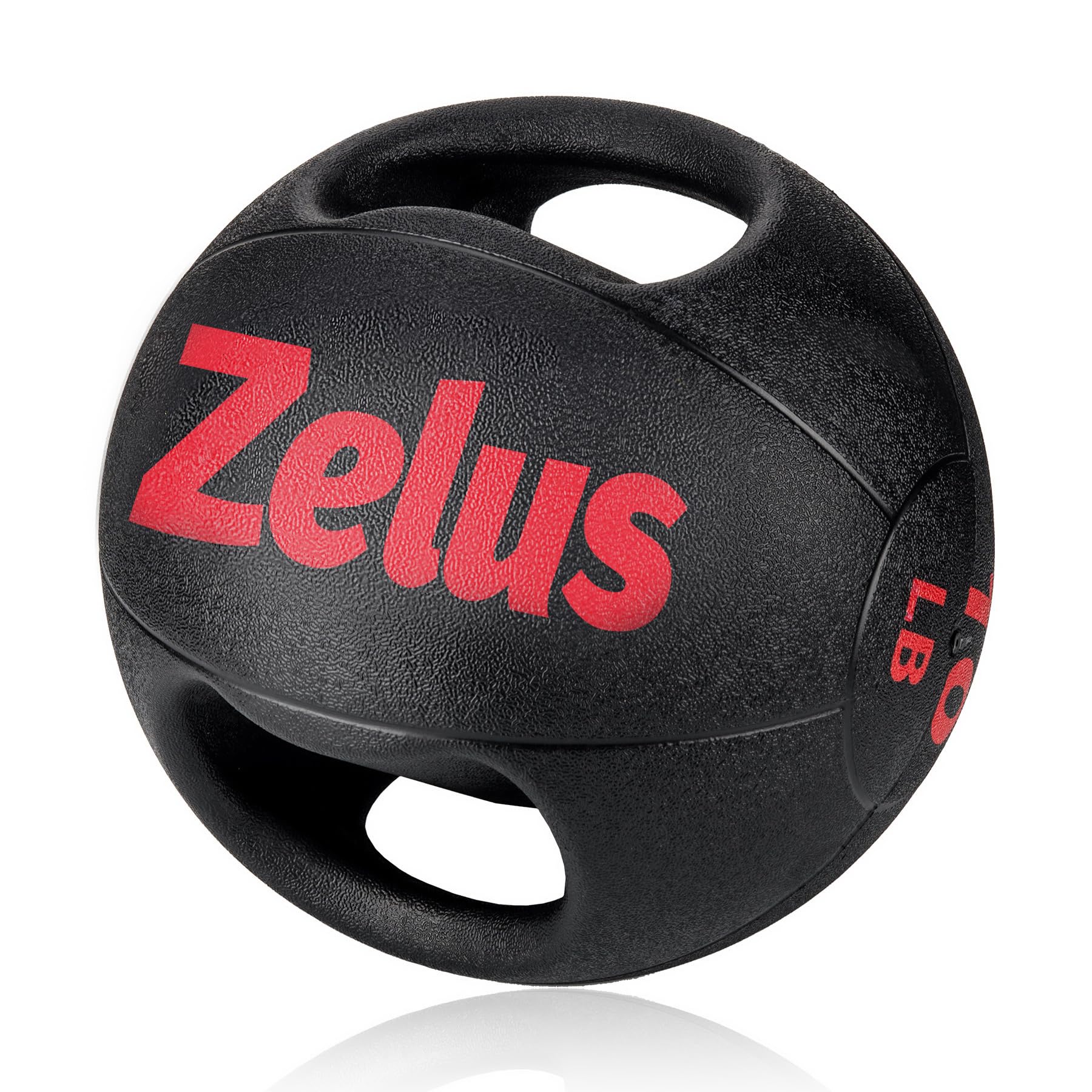
ZELUS Dual Grip Medicine Ball

ZELUS

ZELUS Dual Grip Medicine Ball

  • Grip Dual molded handles
  • Weight 10 lb
  • Diameter 14 in
  • Ball Type Rubber ball with handles
Check Price on Amazon

Two molded grips turn the medicine ball into a kettlebell alternative.

Two molded handles are the reason to look at this ball. They turn it into something between a medicine ball and a kettlebell: you can carry it like a briefcase for squats and lunges, or grip both sides for a swing, instead of waiting for a smooth sphere to settle into your palms.

The handles are rounded and slightly flexible, so they don't dig into your fingers during a set of presses, and the rubber between them is textured enough to hold when your hands are damp.

Fourteen inches across is a lot of ball, though. Two-handed work is comfortable; one-handed twists, and anything that asks you to trap the ball against a forearm, get awkward. If your hands are small, the handles are effectively how you'll hold it.

Our verdict on this one is narrow but real: it's the best option in this group for a home setup that wants one weighted object to press, swing, squat, and pass with, and the extra cost over the plain rubber balls is what those handles buy you.

Bottom Line

We like this one for anyone who wants a single weighted tool for presses, squats, and swings — the handles make it far easier to hold than a smooth sphere.

Check Latest Price

Best Slam Ball

Our Score 9.4/10
ProsourceFit Slam Medicine Ball

ProsourceFit

ProsourceFit Slam Medicine Ball

  • Weight 15 lb
  • Diameter 9 in
  • Warranty Limited lifetime
  • Ball Type Sand-filled slam ball
Check Price on Amazon

Dead sand fill and a molded tread that hold up to repeated slams.

Drop this on a gym floor and it lands with a dull thud and stays put — no rebound, no chasing it across the room. That dead weight is the entire point of a slam ball, and it's why a bouncy rubber ball is a poor stand-in if your workout includes slams.

The 15-pound version we used is the weight most adults will want for conditioning sets: heavy enough that ten slams get your heart rate up, light enough that you can still move fast. The molded tread gives sweaty hands something to bite on, though the shell arrives a little slick and takes a few sessions of use to scuff into its real grip.

Molded PVC over a sand core is the same recipe most slam balls use; what separates this one is the limited lifetime warranty, the longest coverage in this group, and a weight range that runs from 5 to 50 pounds so you can add a heavier ball later without changing the feel.

Bottom Line

This is the slam ball we recommend: a sand core that lands dead, a tread that holds through a sweaty set, and the longest warranty in this group.

Check Latest Price

Best Leather Medicine Ball

Our Score 9.4/10
Champion Sports Leather Medicine Ball

Champion

Champion Sports Leather Medicine Ball

  • Weight 9 lb
  • Diameter 7.79 in
  • Ball Type Stitched synthetic leather
  • Stitching Reinforced
Check Price on Amazon

Quiet stitched leather that soaks up impact and skips the rubber smell.

It doesn't smell like a tire and it doesn't clatter when you set it down. Synthetic leather over a stitched shell makes this the quietest ball in the group, and that quiet is exactly why we keep coming back to it for indoor core work.

The 7.79-inch shell is small enough to hold at your side in one hand, and the supple synthetic leather is easy to grip even when your palms are damp. It's not a bouncy ball — stitched leather over a packed fill deadens the rebound — so a toss-and-catch drill stays controlled rather than springy, and the 9- to 10-pound size suits sit-ups, standing twists, and wall-ball-style squats.

Because the fill is packed rather than molded, give it a roll across the floor when it arrives; a ball that wobbles is one to exchange before you build a routine around it. That done, it's the ball for apartments, shared spaces, and anyone who wants a classic leather feel without the smell of a new tire.

Bottom Line

Apartment-friendly core work is what this stitched leather ball is for: quiet, grippy, and free of the rubber smell that hangs around the others.

Check Latest Price

Best Adjustable Slam Ball

Our Score 9.2/10
Rage Fitness Slam Ball

Rage Fitness

Rage Fitness Slam Ball

  • Weight 10 lb
  • Diameter 10 in
  • Firmness Adjustable air valve
  • Ball Type Sand-filled slam ball
Check Price on Amazon

An air valve lets you firm up the fill for cleaner, less sloshy slams.

An air valve on a sand-filled ball looks like a mistake until you use it. Pump it up and the shell tightens around the fill, so the sand has less room to slide; let some air out and the whole ball goes softer in your hands.

The 10-inch shell is the widest of the slam balls here, which is comfortable for two-handed overhead throws and a little broad for one-arm work. The tread pattern grabs well when your hands are dry.

A thick rubber shell over sand is a durable combination, and nothing about the way this one lands suggests it's about to split.

What we like most is the adjustability. Firm it up for flat, dead slams, soften it for high-rep sets when your hands are already tired, and accept that the fill will still shift when you catch it off-center. That's the trade for a ball you can tune.

Bottom Line

The valve is the reason to pick this slam ball: firm it up for flat, dead slams or soften it for high-rep days, and it stays where it lands.

Check Latest Price

Best For Budget slams

Our Score 9.2/10
Amazon Basics Slam Medicine Ball

Amazon Basics

Amazon Basics Slam Medicine Ball

  • Weight 10 lb
  • Surface Textured PVC
  • Diameter 7.87 in
  • Ball Type Sand-filled slam ball
Check Price on Amazon

At 7.87 inches across, this is the smallest ball in the slam group, and the size is what we noticed first: one hand wraps around it for single-arm slams and rotations in a way the 10-inch Rage ball doesn't allow.

It behaves the way a slam ball should. PVC over a sand core lands where it hits and stays there, so you're not chasing it between reps, and the textured surface gives you something to hold when your hands are wet. That's the whole job, done.

It's the least expensive of the three slam balls here, and nothing about it feels like a shortcut. If you want a dead ball you can also tuck under one arm for a split squat, the compact size is the reason to choose it over the bigger options.

Bottom Line

For garage-gym slams on a tight budget, this is the one: a compact, dead-landing ball that's easy to control with one hand.

Check Latest Price

Best For Wall ball drills

Our Score 9.2/10
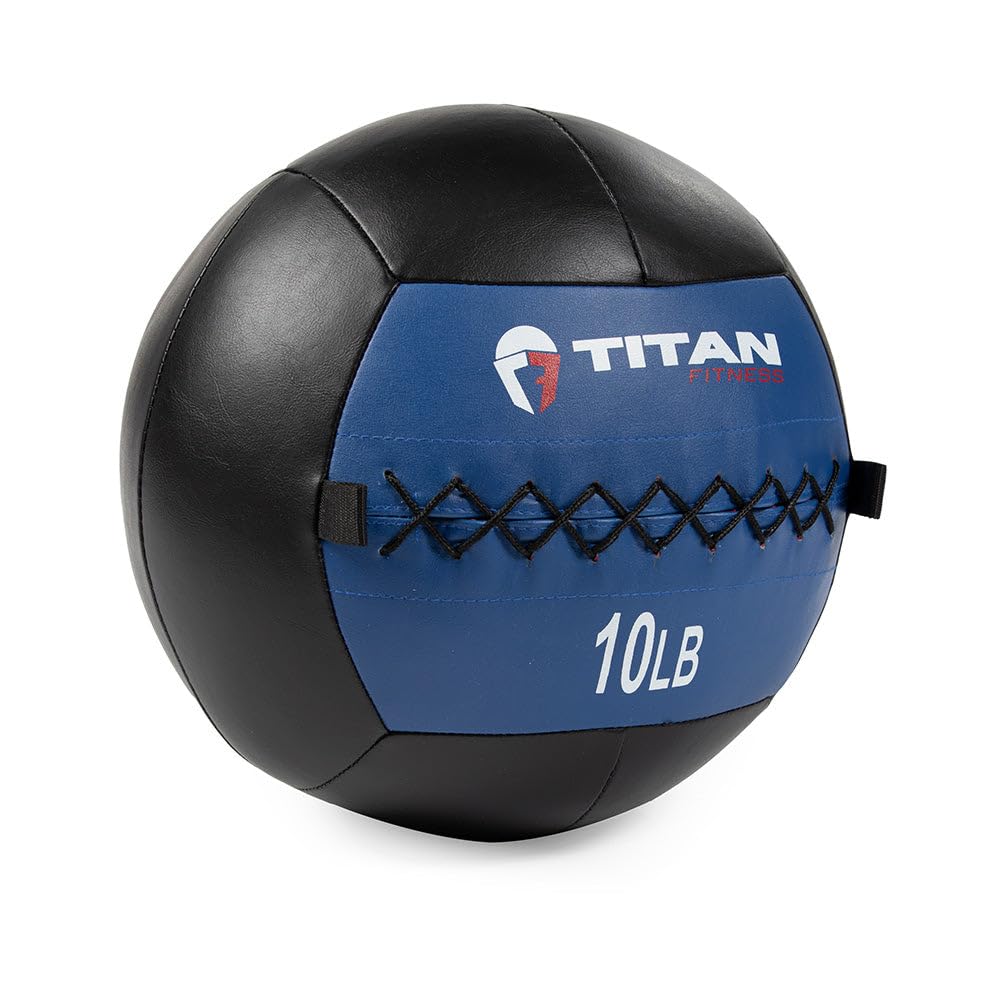
Titan Fitness Soft Wall Ball

Titan Fitness

Titan Fitness Soft Wall Ball

  • Shell PU leather
  • Weight 10 lb
  • Diameter 14 in
  • Ball Type Soft wall ball
Check Price on Amazon

Catch this one bare-handed and you understand why gyms use soft wall balls: the padded shell gives on impact, so a squat throw against the wall doesn't sting on the way back.

Fourteen inches of PU leather over cotton fill makes this the biggest and softest ball here, and the double-stitched seams are what hold it together through repeated wall shots. It also behaves the least like the rest of this group: it absorbs a throw rather than returning it.

For wall balls, thrusters, and partner drills, the soft shell is worth choosing over rubber — you can throw it hard without wincing. What we flag is shape: these can lose their round and settle lopsided, so set yours on a flat floor and watch whether it rolls off on its own before the return window closes.

Bottom Line

Wall balls and partner drills are where a soft shell earns its keep, and this one soaks up impact without complaint through a long set.

Check Latest Price

How We Chose and Tested 12 Medicine Balls

We started with a list of roughly 40 medicine balls sold at major retailers, then cut anything with an unlisted fill material, weights outside the 6-to-30-pound range most people actually use, or a pattern of reviews reporting split seams within weeks. That left 12 balls, which we lived with for six months in a garage gym with a concrete floor and rubber mats, and in a commercial gym with a padded wall. Every ball got thrown against that wall, slammed into concrete, rolled, caught, and carried, so we could see which ones suited wall balls, which handled overhead slams, and which were only good for rotational throws.

Grip and surface texture got tested the honest way: we did sets of wall balls until our hands were slick, then repeated them with chalk, noting which surfaces turned greasy and which held on. Because a medicine ball spends most of its life on the floor, we also dropped each one from waist height onto concrete and recorded whether it stayed put or took off toward the nearest shin. Odor got a sniff on arrival and again a week later, with each ball left in a warm garage, and the rubber ones separated quickly from the rest.

Shape and balance were the slow checks. We weighed every ball on a kitchen scale and compared it to the label, then held each at eye level and rocked it side to side to feel whether the fill had settled after weeks of storage and slamming. Seams, dents, and flat spots were noted after each session, and we kept using whichever ones survived past the six-month mark. Quality, in the end, showed up in boring places: a shell that didn't crack at the seam, a texture that stayed grippy after a hundred throws, and a ball that still felt like the weight printed on it.

How to Choose

Start With How the Ball Leaves Your Hands

There are three families, and they don't substitute for each other. Hollow rubber balls rebound, so they return energy on a chest pass or a wall throw and suit twists, tosses, and partner drills. Sand-filled balls go dead on impact, which is exactly what a slam needs and exactly what makes them useless for a rebound drill. Soft stitched balls absorb a throw rather than returning it, which is why gyms use them for wall balls.

The trap is buying a bouncy ball for slams. It comes back at you off the floor, and the valve seam takes a beating it wasn't designed for. If slams are the point of the purchase, buy a sand-filled ball; if you want one ball for everything else, buy the bouncy one.

Pick a Weight You Can Move Fast

Medicine ball work is power work, and power falls off the moment the ball is too heavy to accelerate. We put more stock in a ball you can move quickly than in a heavy one that turns every set into a grind. A 4- to 6-pound ball is plenty for twists, warm-ups, and rehab; 8 to 12 pounds covers most throws, chops, and squat-to-press work; heavier balls belong in conditioning circuits and partner drills.

If you're buying one ball, choose the weight you can move at speed for the drill you actually do. If you're buying two, put one at each end of that range — which is also why it's worth checking how far a product line goes before you commit to it.

Let the Diameter Decide the Exercise

Balls in the 7- to 9-inch range handle like a basketball: two hands wrap around them, and they suit throws, twists, and partner work. Soft wall balls run out to 14 inches so you can catch one against your chest, and that size is strictly a two-handed tool — nobody is doing one-arm rotations with it.

Handles change the equation again, giving you a briefcase grip for squats and lunges at the cost of a clean sphere. Match the diameter to the drill you have in mind before you fall for a color, because a 14-inch ball and a 7.6-inch ball are different exercises even at the same weight.

Check the Shell, the Seam, and the Warranty

Balls tend to fail in predictable places: the valve seam on an air-filled rubber ball, the stitching on a soft one, the shell on a sand-filled one. Warranties tell you something about how confident a maker is — the ProsourceFit balls carry a limited lifetime warranty, while the Rage slam ball covers 30 days.

Think about what you're throwing at, too. A hollow rubber ball driven into concrete will split long before a sand-filled one does, and that's a use decision, not a defect. If a ball arrives smelling like a tire, that fades with air; if it arrives lopsided, it doesn't.

Frequently Asked Questions

Final Verdict

For most home setups, the Amazon Basics weighted ball is the one to buy first: it bounces true, grips in sweaty hands, and covers twists, tosses, and core circuits without asking much of your budget or your floor space.

If slams are part of your training, add the ProsourceFit 15-pounder — the sand core lands dead and the warranty is the longest here, and between the two balls you can handle nearly every drill. Chasing strength rather than movement? Skip the 4-pounder entirely and start at 8.