Strength & Weights

Best Loadable Dumbbells for Home Gyms of 2026

A rack of fixed dumbbells is a wonderful thing until you need to store it, afford it, or move it. Loadable dumbbells trade that convenience for a single pair of handles and a stack of plates—enough to cover presses, rows, squats, and curls without turning a spare room into a commercial gym. The catch is that you become the adjustment mechanism: every set change means sliding plates on, tightening collars, and checking that nothing rattles loose mid-rep. Done well, that ritual fades into the workout; done poorly, it becomes the reason you skip training.

I've used loadable handles off and on for years, and the sets that stick around are the ones that fit together cleanly, feel secure in sweaty hands, and don't make plate changes a project. Over the past six months, my team and I tested 12 sets through real home workouts—loading, pressing, rowing, carrying, and re-racking them. The best made the switch feel like part of the set, not a fight with the hardware. Here's what earned a spot.

Best for Olympic Plates

Our Score 9.4/10
AboveGenius 16-Inch Olympic Handles

AboveGenius

AboveGenius 16-Inch Olympic Handles

  • Max Load 100 lb
  • Plate Fit 2-inch Olympic
  • Bar Length 16 inches
  • Grip Diameter 25 millimeters
Check Price on Amazon

Turns the Olympic plates you already own into 100-pound dumbbells.

If you already own Olympic plates, the arithmetic changes completely: this pair of 16-inch bars turns a plate tree into a dumbbell rack. Each bar weighs 8.3 pounds empty, so your lightest set is already about 17 pounds before a plate goes on, and the stated ceiling is 100 pounds a bar — more than most people will ever press in each hand. Two spring collars come in the box.

We rate it the best route into heavy dumbbell work in this group for anyone with 2-inch plates. The bars are solid alloy steel with a chrome finish and a textured grip section, the sleeves are sized for standard Olympic plates, and there's nothing proprietary about them — the plates you already own are the whole system.

The trade is length. Sixteen inches gives you room for four or five plates a side, and it also puts the load well away from your hand, which you'll notice on curls and which can crowd your thighs at the bottom of a press. If your work is mostly pressing, rowing and shrugging, that's a non-issue; if it's mostly curls and lateral raises, a shorter handle is easier to live with. Plates aren't included, and that's the point.

Bottom Line

For anyone who already owns Olympic plates, this pair is the most direct way here to turn them into heavy dumbbells, with capacity to spare.

Check Latest Price

Best Overall

Our Score 9.2/10
Amazon Basics 38 lb Set

Amazon Basics

Amazon Basics 38 lb Set

  • Storage Carry case included
  • Plate Fit 1-inch standard
  • Set Weight 38 pounds total
  • Per-Dumbbell Max 19 lb
Check Price on Amazon

A complete starter set — plates, collars and case — that builds to 19 pounds a hand.

The number that matters here isn't 38, it's 19. Spread the plates across both handles, add the collars, and each dumbbell tops out at roughly 19 pounds — light by gym standards, and the right amount for a first set, a rehab program, or an apartment where a rack isn't happening. We think that's a fair trade for a kit that arrives complete and lives in a case when you're done.

What we appreciated in use is the plate mix: two 5s, two 2.5s and two half-pound collars on each handle, which lets you move up in small steps instead of jumping ten pounds at a time. The collars count toward the 38-pound total, so the usable iron is a little under what the box claims — worth knowing if you count every pound. Everything drops into the included case, which is what keeps plates off the closet floor.

The knurling is the detail that decides whether you enjoy using it. It's sharp — sharp enough that we reach for gloves on longer sets, and sharp enough that a beginner will feel it on day one. That's not a flaw exactly, but it's the difference between a set you leave out and a set you avoid.

Bottom Line

For a first plate-loaded pair in a small space, this is the set we hand people: complete out of the box, light enough to grow into, and easy to put away.

Check Latest Price

Best Cast-Iron Set

Our Score 9.2/10
Yes4All 40 lb Cast-Iron Set

Yes4All

Yes4All 40 lb Cast-Iron Set

  • Plate Fit 1-inch standard
  • Set Weight 40 pounds total
  • Handle Length 14 inches
  • Plate Material Cast iron
Check Price on Amazon

Dense cast-iron plates and chrome handles that take standard one-inch plates later.

The difference between this set and our top pick is mostly material. Yes4All uses cast iron plates with a protective coating and 14-inch chrome handles with a diamond knurl, and it arrives triple-boxed with foam — packaging built for a 40-pound box rather than a showroom shelf.

Cast iron is dense, so the plates stay narrow for their weight and the loaded dumbbell doesn't balloon the way a cement set does. The knurl sits in the middle of the range: grippy enough for sweaty hands, not so sharp that a set of curls demands gloves. Getting a full 20 pounds a hand out of the included plates takes about a minute of threading, which is the honest cost of the design.

We point people to this one when the set is going to be the start of a plate collection rather than a single purchase. The one-inch handles take standard plates, so a pair of tens from a secondhand listing extends the set, and the build is heavy enough to take that seriously. Test the plate fit when the box arrives — a plate that binds on the bar is a return, not a workaround.

Bottom Line

For a set you'll keep and add to, this is our pick: cast-iron plates, chrome handles and a full year of warranty behind it.

Check Latest Price

Best All-In-One Kit

Our Score 9.2/10
KISS GOLD 44 lb Set

KISS GOLD

KISS GOLD 44 lb Set

  • Connector Barbell rod included
  • Per Dumbbell 22 lb
  • Total Weight 44 lb
  • Plate Material Solid steel
Check Price on Amazon

One kit that becomes a dumbbell pair or a barbell in about a minute.

The connector bar is the reason to pick this kit over a plain pair of handles: screw the two dumbbell bars together and you have a barbell for curls, rows and floor press, then break it back down into a dumbbell pair. We keep coming back to it as a one-box answer for a small apartment gym, where a single kit doing two jobs beats two kits doing one each.

The plates are solid steel rather than cement, which makes them thinner for the same weight and keeps the loaded dumbbell short enough to clear your legs at the top of a curl. The plate weights are the odd part: 2.2, 2.8 and 4.4 pounds, so your jumps land on numbers that never quite match a program. Fine for general training, mildly irritating if you log every set.

Twenty-two pounds a hand is the honest ceiling. That covers high reps, rehab and a first year of training, and it won't cover a serious press. Within that range it's the tidiest kit here, and the barbell mode buys you a second set of exercise choices out of the same box.

Bottom Line

For a small space and a light-to-moderate load, this is the kit we reach for: dumbbells one minute, a barbell the next, everything back in one box.

Check Latest Price

Best Budget Handles

Our Score 9.2/10
JFIT Threaded Handles

JFIT

JFIT Threaded Handles

  • Grip Knurled chrome
  • Collars Four star lock
  • Max Load 300 lb
  • Plate Fit 1-inch standard
Check Price on Amazon

Two solid one-inch handles for anyone who already owns plates.

Buying a bare pair of handles is the leanest way into loadable dumbbells: no plates to store, nothing proprietary, and nothing to throw away when your needs change. The JFIT pair is threaded for standard one-inch plates, carries a stated 300-pound capacity, and ships with four star-lock collars, two per handle.

We rate it the pick for anyone with one-inch plates already in the garage. The chrome is clean, the five inches of diamond knurling covers the whole gripping area rather than just the middle, and each handle runs just under four pounds empty — heavy enough to feel like equipment, light enough that it isn't eating into your working weight.

Bottom Line

If your plates are one-inch, this pair is the sensible spend: solid chrome handles, a 300-pound rating and no gimmicks.

Check Latest Price

Best For First home set

Our Score 8.8/10
UNNMIIY 45 lb Set

UNNMIIY

UNNMIIY 45 lb Set

  • Plate Fill Cement and iron sand
  • Per Dumbbell 22.5 lb
  • Configurations 5-in-1
  • Handle Diameter 24 millimeters
Check Price on Amazon

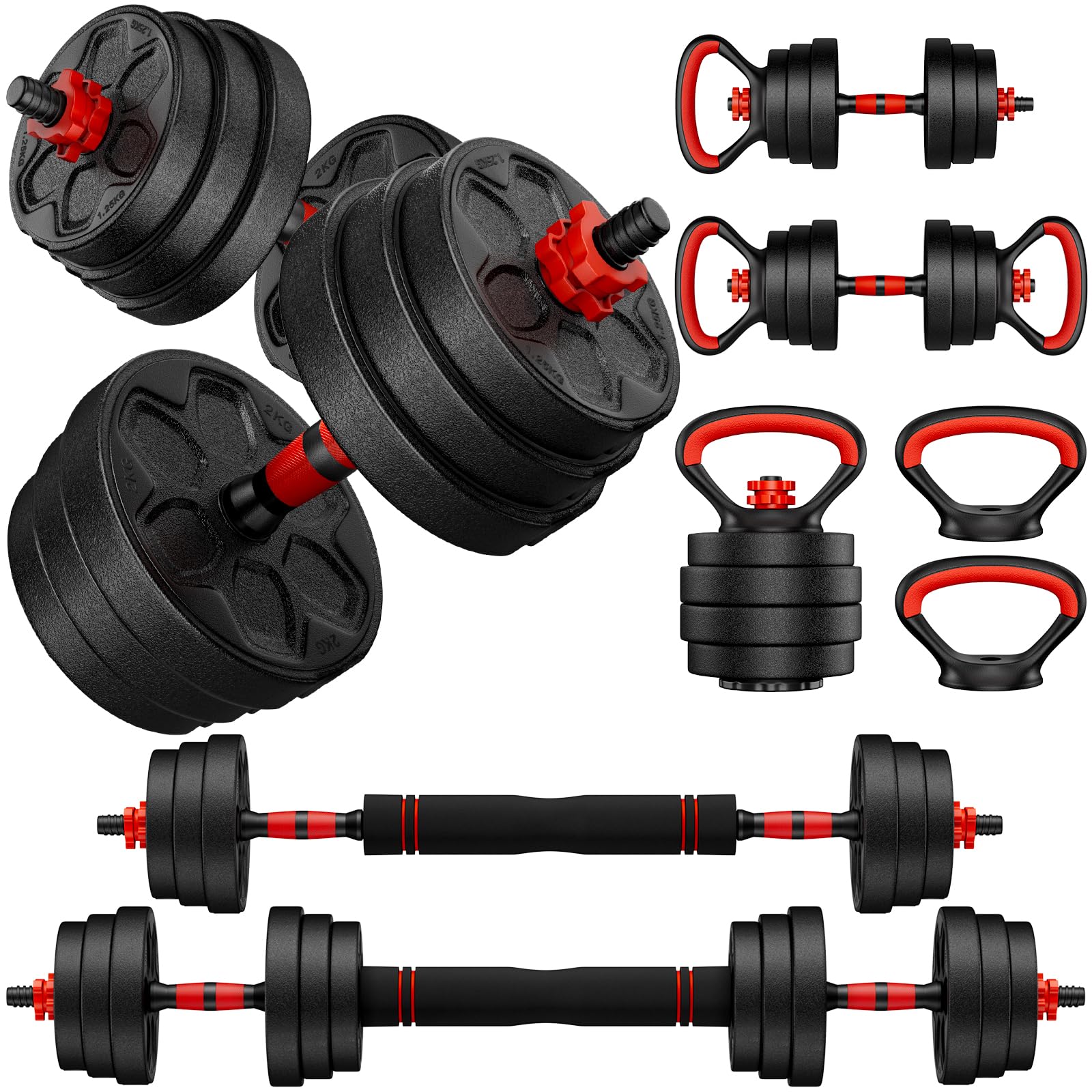
One assembly detail decides whether this kit feels solid or rattly: the stoppers seat only one way round, and a backwards one leaves the plates loose no matter how hard you tighten the nut. Get them right and the stack is quiet — the plates are cement and iron sand sealed in PE, so there's no dust and nothing shaking loose inside.

The numbers are sensible for a first set: 6 to 22.5 pounds a hand in small steps, a 24 mm alloy steel handle with a non-slip texture, and a connector that turns the pair into a barbell. That connector carries 20 mm of foam, which matters more than it sounds — the bar rests on your neck during squats, and a thin pad is the difference between finishing a set and cutting it short.

Five configurations get advertised and two earn their keep. Dumbbells and the barbell are what you'll actually use; the kettlebell handle and push-up stand make the listing longer rather than the training better. That's not a knock on the kit so much as a note on how to read the box.

We recommend it to anyone starting from nothing in a small space. It's one purchase that covers a surprising amount of a home program, it breaks down into a corner, and the range is honest about what it is: a beginner's kit that a beginner can genuinely progress on for a year.

Bottom Line

For someone starting from nothing in a small space, this is the kit we recommend: one purchase, a year of progress and a corner's worth of storage.

Check Latest Price

Best For Tight storage

Our Score 8.8/10
BDSHE 45 lb Set

BDSHE

BDSHE 45 lb Set

  • Collars Four double-lock nuts
  • Plate Fill Cement and iron sand
  • Total Weight 45 lb
  • Configurations 5-in-1
Check Price on Amazon

When the workout is over, this kit disappears. The bars break down, the plates stack flat, and the whole 45 pounds fits in a cabinet or under a chair — the part of home gym ownership that gets ignored until the living room is full of iron.

It goes together quickly, and the double nuts are why it stays together: two per end, a primary nut backed by a locking ring, which is more security than the single spinlock collars on most kits here. The grip is textured rather than knurled, which is gentler on the hands and less sure once your palms are wet.

We put it just behind the KISS GOLD kit, and the gap is material rather than design — steel plates versus cement fill. If storage is your binding constraint, a studio apartment or a shared living room where the closet has to close, this is the one we point to, because it's the tidiest 45-pound kit in the group.

Bottom Line

If your gym has to pack away into a cabinet, this is the kit to buy — tidy, quick to assemble and secure once it's together.

Check Latest Price

How We Tested Loadable Dumbbells

We started by pulling together every loadable set we could find that was actually in stock, then narrowed the field by plate compatibility, handle diameter, collar design, storage options, and cost per pound. Customer reviews helped us flag the usual trouble spots—plates that wobble, collars that back off, cases that split at the seams—but we didn't take those complaints at face value. We ended up testing 12 sets for six months, rotating them through the same workouts so the comparison stayed fair.

Most of our testing happened in a garage gym and a spare-room corner, which is where loadable dumbbells usually live. We did presses, rows, split squats, curls, and farmer carries, changing plates between sets with sweaty hands and timing how long a jump from a heavy press to a lighter warm-up actually took. We checked grip by seeing whether the handles bit into our palms with chalk and without it, and whether the texture let the dumbbells twist during rows. Fit and tightness got checked every time we slid a plate on or ran collars through a 20-rep set: did the plate drop cleanly, did it wobble, and did the collars back off or rattle?

We measured plate diameter and the footprint each set left between sessions, then packed the sets that came with cases and carried them up and down a flight of stairs. After six months, we inspected threads, welds, powder coat, and case stitching; we also set loaded dumbbells down from waist height onto rubber mats to see what loosened or chipped. Versatility meant moving from a heavy press to lateral raises and split squats without wishing for a second pair. Value was cost per pound plus what came in the box—plates, collars, case—not just the sticker price.

How to Choose

Match the handle to the plates you own

Standard dumbbell plates have a one-inch center hole; Olympic plates have a two-inch hole, and the two never mix. If you already own plates, that single measurement settles the purchase: one-inch handles like the JFIT pair, or Olympic bars like the AboveGenius pair. Starting from nothing, a set with plates in the box is usually the faster route in.

The trap is the 5-in-1 kits. Their plates and bars are a matched proprietary system, which works fine on its own terms and stops working the moment you want to add a pair of twenties. Nothing is wrong with buying one — just buy it knowing the included plates are the ceiling.

Decide your ceiling before you buy

A 40- or 45-pound set splits into roughly 20 to 22 pounds a hand once every plate is loaded, which is a beginner's range rather than a permanent one. Check two numbers before you commit: what the included plates build to, and what the handle itself is rated for. Handles rated at 100 or 300 pounds leave room to add plates; a kit's own bars usually don't.

Plate material matters more than the spec sheet suggests. Cast iron is dense, so a five-pound plate stays narrow. Cement-filled plates wrapped in vinyl or PE need more bulk for the same weight, which makes the loaded dumbbell longer and clunkier against your legs at the top of a curl.

How the plates stay on

Every design here relies on something threaded or clipped, and all of them can work loose: spinlock collars, star locks, double nuts, spring clips. Threaded collars are the most secure and the slowest, and four of them between exercises adds real time to a session. Spring clips are the fastest to move and the least trustworthy on a smooth sleeve.

Whichever you choose, check the collars before your first rep rather than after it, and treat a clip that slides as a part to replace rather than a habit to work around.

Length, grip and where it lives

Handle length is a range-of-motion decision. A 14-inch handle keeps the load close and suits curls and lateral raises; a 16-inch bar holds more plates and pushes the weight away from your hand, which you feel on presses and on anything where your thighs get in the way. Grip diameter across these picks runs from 24 to 25 millimeters, close to a standard one-inch bar — thinner suits smaller hands, thicker suits big ones.

Then there's storage. A case, a cabinet shelf or a corner of the garage all work, but decide which one before you buy. A 40-pound set with nowhere to live becomes a set you stop picking up.

Frequently Asked Questions

Final Verdict

Most people should buy the Amazon Basics 38-pound set: it arrives complete, stores in a case, and builds to about 19 pounds a hand — enough for a first year of training and affordable enough that outgrowing it isn't a loss.

Two exceptions are worth naming. If you already own Olympic plates, the AboveGenius bars are the better buy by a wide margin, with 100 pounds a bar and nothing proprietary to lock you in. If your plates are one-inch, the JFIT handles are the sensible spend.