Strength & Weights

Best Lat Pulldown Machines of 2026

A lat pulldown is the one gym staple that's genuinely hard to fake at home: bands give out before your lats do, and a pull-up bar assumes you already have the strength you're trying to build. A machine lets you set the weight, pull the bar to your chest, and fight it on the way up — real, measurable progress without a membership. The wrong one announces itself on the first rep, with a frame that rocks, a cable that jerks, and a pulley that squeals.

I've now spent nine months with seven machines — built them, loaded them, and pulled through hundreds of sets — and the differences show up in places the spec sheet never mentions. Cables fray at the crimp, not in the middle, and footprint matters more than stack height because you need room to lean back into the pull. Value, meanwhile, has almost nothing to do with the lowest price tag; it's the machine you won't be replacing in two years. The picks below earned their place.

Best Overall

Our Score 9.2/10
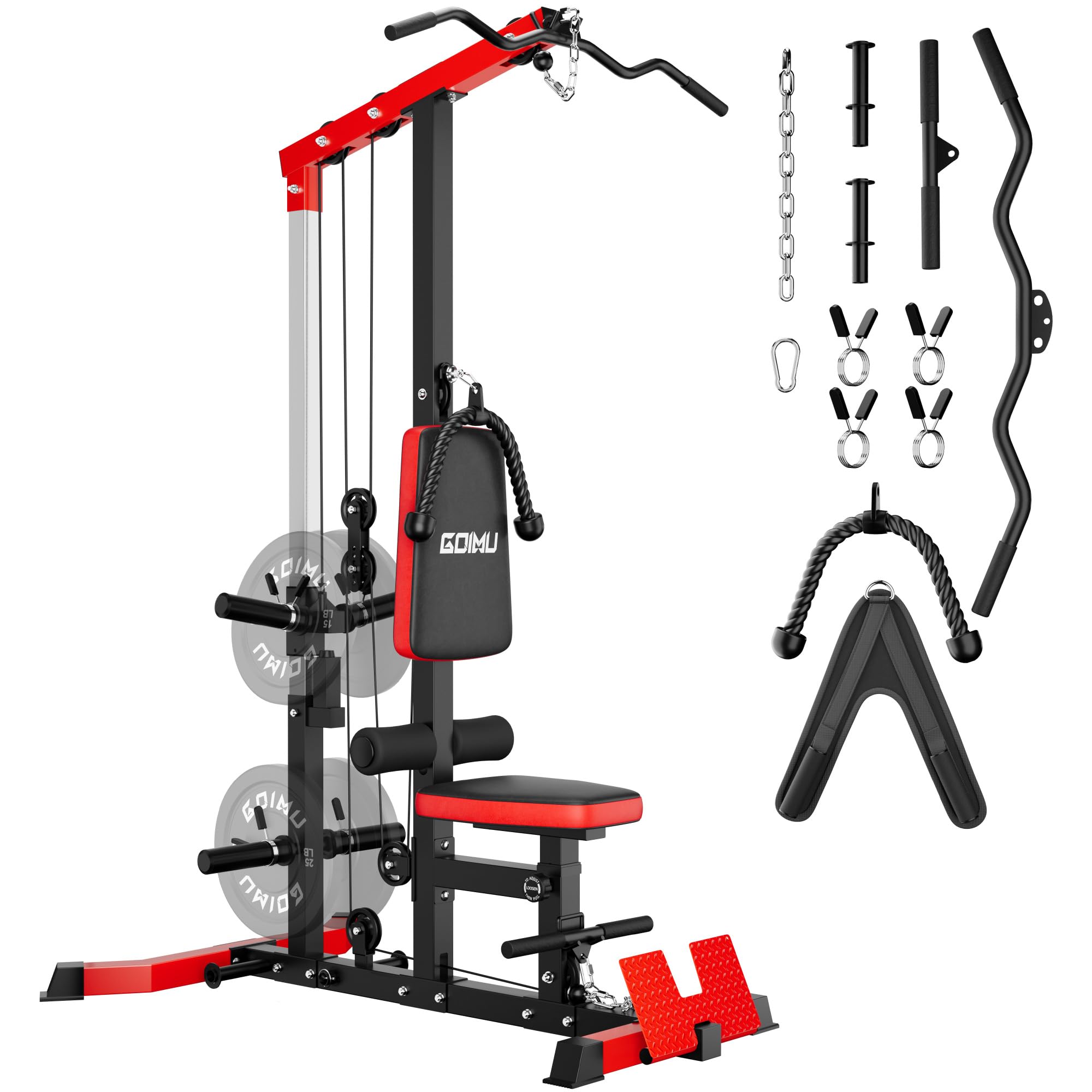
Goimu LS01 3-in-1 Lat Pulldown

Goimu

Goimu LS01 3-in-1 Lat Pulldown

  • Pulley Stations High, low, ab crunch
  • Included Attachments Lat bar, cable bar, tricep rope
  • Footprint (D X W X H) 59"D x 23.43"W x 83.46"H
  • Maximum Weight Rating 800 lb
Check Price on Amazon

Three pulley stations and an 800-pound rating in a narrow, small-gym frame.

Just over 23 inches of width is the first thing we check on a tower now, because it decides whether the machine lives where you train or gets shoved into a corner. The LS01 measures 23.43 inches across and 59 inches deep, so it slides into the strip beside a rack or along a garage wall that a 48-inch plate-loaded tower would fill completely. It stands 83.46 inches tall and weighs 80 pounds before you add a single plate.

Three pulley stations inside that footprint are what earned it the top spot. The high pulley covers pulldowns and overhead work, the low pulley turns the same frame into a row and curl station, and the ab-crunch station adds a third exercise the two-pulley towers here simply cannot do. The lat bar, cable bar and tricep rope all come in the box, so you can train the day it is assembled instead of shopping for a bar.

Assembly is where machines in this class usually lose people. This one arrives with the hardware bagged and labelled by build step, and the frame goes up with a socket set and a second pair of hands for the upright. We appreciated that more than any single number on the spec sheet, because it is the difference between one afternoon and two weeks of boxes in the hallway.

One detail worth flagging: the frame includes band pegs. None of the other towers here has them, and they turn the high pulley into a band station for resisted pulldowns and face pulls — the kind of addition you notice a month in, when the same weight stops feeling heavy.

Bottom Line

For most home gyms, this is the tower we point people to: three pulley stations, an 800-pound rating, and a frame narrow enough to fit the space you have.

Check Latest Price

Best For Moving around

Our Score 9.2/10
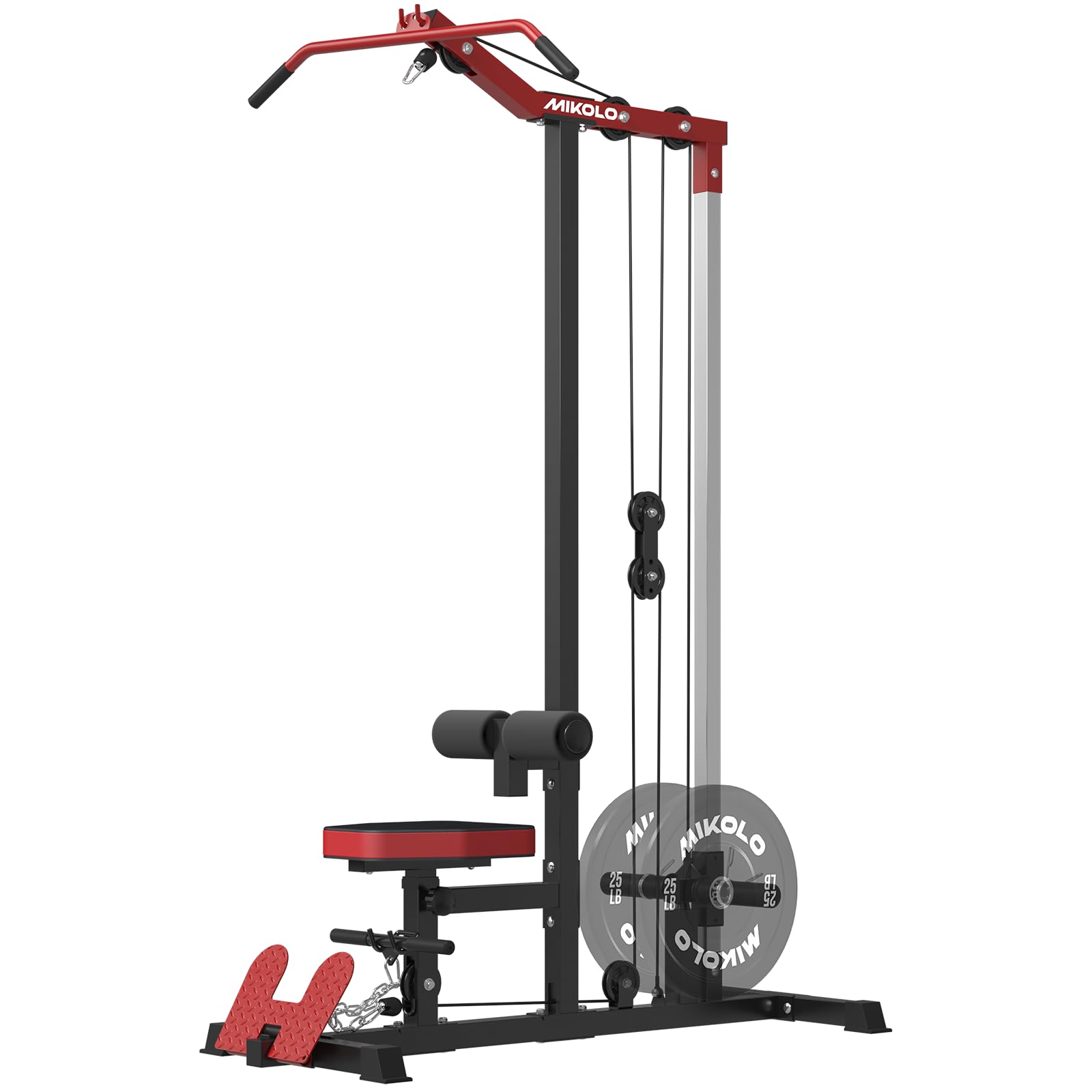
Mikolo Lat Pulldown Machine

Mikolo

Mikolo Lat Pulldown Machine

  • Seat 13" x 18", 3 heights
  • Machine Weight 71 lb
  • Pulley Stations High and low
  • Maximum Weight Rating 450 lb
Check Price on Amazon

The Mikolo chases the same buyer as our top pick, and the honest answer is that it is a good two-station tower that loses on the details. You get high and low pulleys, a 450-pound rating, a 71-pound frame and a 13-by-18-inch padded seat with three height settings, plus a lat bar and cable bar in the box — but not the third station, and not the same generous shape-to-floor ratio.

One behaviour to plan around: on high-angle pulls such as face pulls, the frame has no counterbalance and can tip forward, so it wants a plate on the base or a wall behind it. On pulldowns and rows, where the pull comes down and in toward the frame, that never comes up.

What is left is a quiet, solid machine with a wider seat than most of this group and an assembly process you can finish in an afternoon. At 71 pounds it is light enough to shift on your own, which is more than the plate-loaded towers here can claim.

Bottom Line

A solid two-pulley tower that loses on the details; worth it if the machine has to move and you're under six feet.

Check Latest Price

Best Heavy-Duty

Our Score 9.0/10
Titan Plate-Loaded Lat Tower

Titan

Titan Plate-Loaded Lat Tower

  • Machine Weight 120 lb
  • Footprint (D X W X H) 57"D x 47"W x 85"H
  • Maximum Weight Rating 400 lb
  • Loadable Sleeve Length 13 inches
Check Price on Amazon

Plate-loaded with 13-inch sleeves and a 120-pound frame that stays planted.

There comes a point where a light lat tower stops being enough, and the Titan is built for the lifters past it. The frame weighs 120 pounds before a single plate goes on and carries Olympic plates on a 13-inch loading sleeve, long enough that you can stack real weight without the bottom plate fouling the pin. Of the machines here, this is the one that feels least like home equipment and most like the pulldown station at a gym.

Plate loading is the right call at this level. There is no selector pin and no stack to shimmy, so the resistance is only as smooth as the pulleys allow, and the powder-coated steel is reinforced at the joints that take the pull. The thigh pads adjust through four positions, which matters more than the seat on a heavy set: your legs hold you down while you pull, not your back. The lat bar and the low row handle both come with it.

What we did not expect was how much difference the frame weight makes at the end of a set. A light tower rocks back when you finish a heavy pull; this one stays where you put it, and that is the whole argument for spending more on a plate-loaded machine. The one thing we minded is the handles, which are fixed rather than swivelling, so your wrists follow the bar's arc on a wide pulldown.

Bottom Line

We recommend it to anyone who has outgrown a light tower and can bolt one down — the 120-pound frame is the most planted machine here.

Check Latest Price

Best For Backup cable on hand

Our Score 9.0/10
Yes4All Lat Pulldown Machine

Yes4All

Yes4All Lat Pulldown Machine

  • Height 76.5 inches
  • Included Cables Two pulley cables plus a spare
  • Maximum Weight Rating 500 lb
  • Seat And Knee Support 4 levels each
Check Price on Amazon

Three cables for two pulleys: the Yes4All ships with two pulley cables and an extra one, plus a lat bar and a pair of barbell clamps. It looks like an odd thing to lead with until you have owned a cable machine, and then it reads as the most practical line on the spec sheet.

The rest of the package is competitive. The frame is rated to 500 pounds and stands 76.5 inches, and the thick cushion seat and knee support each adjust through four levels — more positions than most of this group. The knee support is the part that matters: it is what stops you sliding up out of the seat when you pull heavy.

At moderate weight the pull is smooth and the frame stays put. Geometry is the compromise. The bar comes down close over your head at full stretch and the seat runs small, so a long-torsoed lifter spends the first set hunting for a position that lets them finish the rep cleanly.

For about the same money as the two-pulley towers here, we think that is a fair trade. You get the highest rating in this group, four-position adjustment at both ends, and a second cable on the shelf — which makes it the sensible buy for someone who pulls hard and does not want to think about the machine between sessions.

Bottom Line

The highest rating in this group and a spare cable in the box — a good buy for someone who pulls hard and doesn't want fuss.

Check Latest Price

Best for Low Ceilings

Our Score 8.4/10
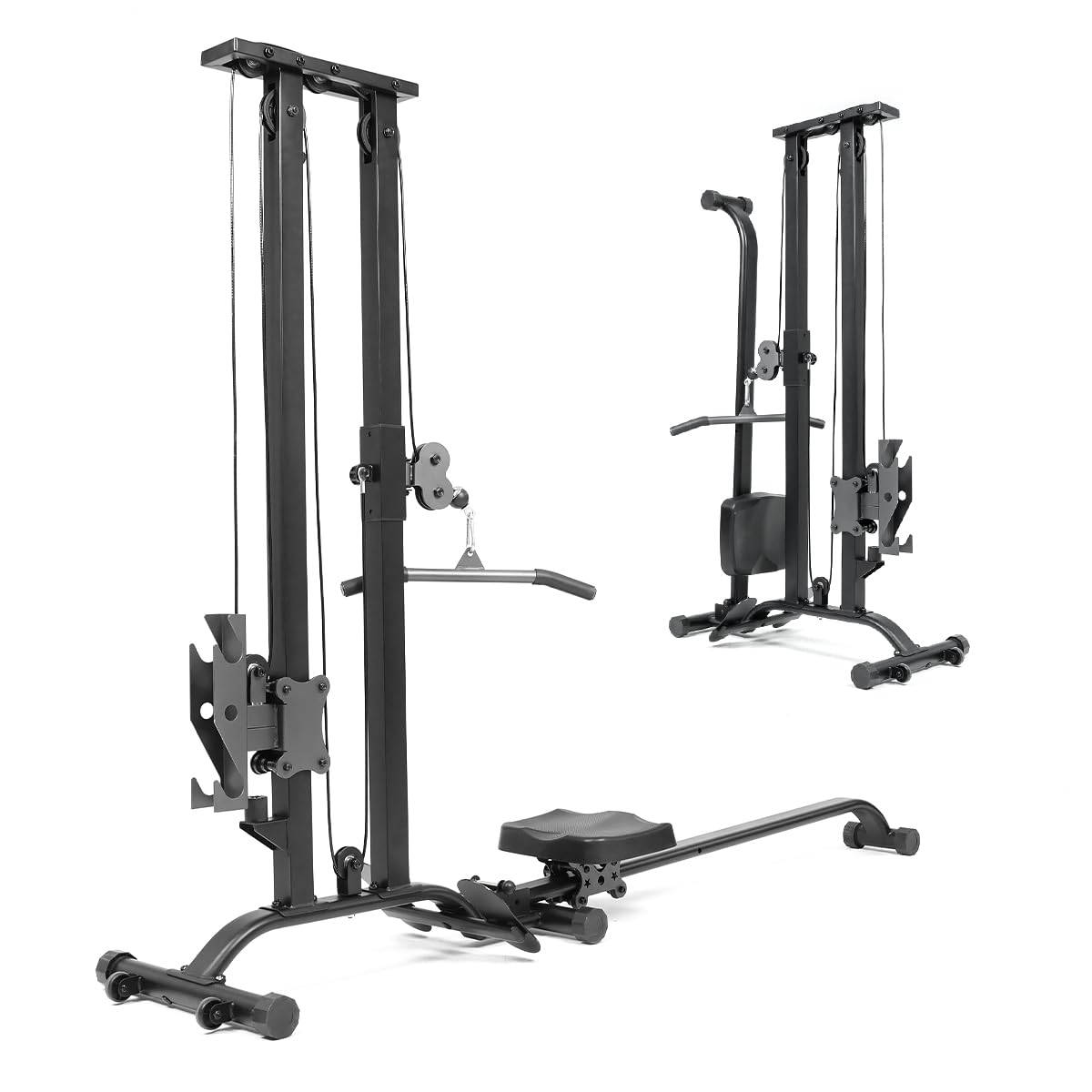
Tousains CR63 Folding Cable Machine

Tousains

Tousains CR63 Folding Cable Machine

  • Height 62.99 inches
  • Machine Weight 50.7 lb
  • Folded Footprint 2.92 sq ft
  • Maximum Weight Rating 400 lb
Check Price on Amazon

Stands under 63 inches tall and folds flat, so it fits a 7-foot room.

A 7-foot ceiling rules out almost everything else here. The CR63 tops out at 62.99 inches, which leaves roughly 21 inches of headroom for a pulldown under a standard 84-inch ceiling, and it folds to about 2.92 square feet — suitcase-sized against a wall. In a rental, a spare bedroom or a basement with ductwork in the way, that difference is the entire purchase.

Folding gets it into the room; the loading is what makes it usable once it is there. Two stacked slots take dumbbells, and the loading pins accept both 1-inch and 2-inch plates, so you can add resistance in small steps with whatever you already own rather than buying a second set of plates for one machine. Fifteen height positions on the column and an adjustable seat let you set up for pulldowns, face pulls or rows without moving the frame.

What surprised us is how much of a real cable station it feels like once it is loaded. The cable runs on sealed pulleys, and the 400-pound figure is a whole-machine rating rather than a plate limit — that distinction matters. It is plenty for moderate-rep back work and it is not a licence to hang your heaviest plates on the pin and drop them.

Two small things we noted and moved past: the folded machine still needs a metre of wall to lean against, and the welds are cosmetic-grade rather than showroom-clean. Neither changes what it does, and nothing else on this page fits a low room at all.

Bottom Line

Our pick for a spare room or basement with a 7-foot ceiling: it stands under 63 inches and folds into a corner.

Check Latest Price

Best for Standard Plates

Our Score 8.4/10
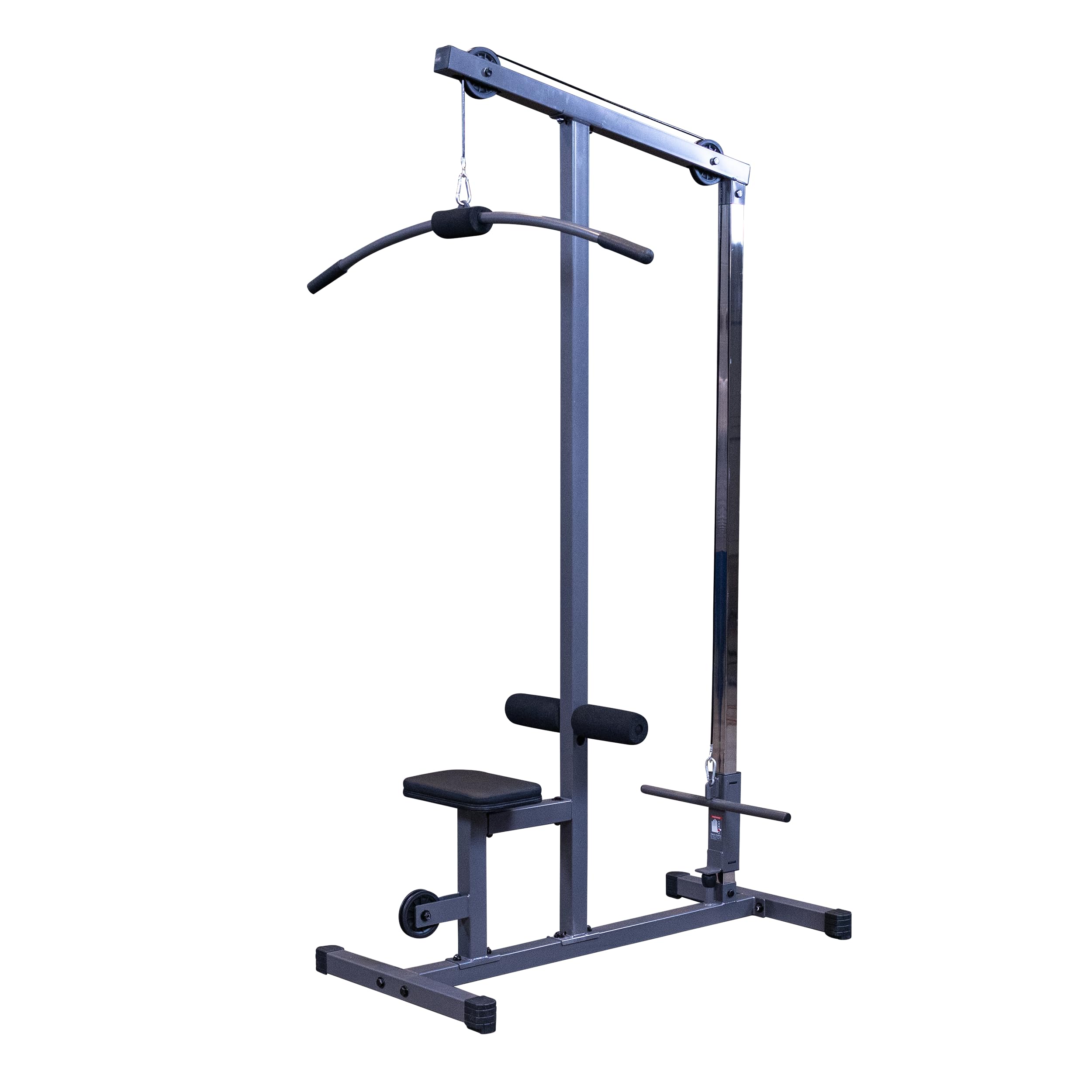
Powerline PLM180X Lat Machine

Powerline

Powerline PLM180X Lat Machine

  • Frame Warranty 10 years
  • Plate Compatibility Standard 1-inch; 2-inch with adapter
  • Footprint (D X W X H) 48"D x 48"W x 81"H
  • Maximum Weight Rating 250 lb
Check Price on Amazon

Takes standard 1-inch plates and measures 48 inches square, with a 10-year frame warranty.

Standard 1-inch plates are the cheapest iron you can buy, and they do not fit most of the towers here. The PLM180X takes them as standard and accepts Olympic 2-inch plates with an adapter, which makes it the sensible landing spot for a garage gym built around the plate set you already own. The footprint is a tidy 48 inches square and the frame carries a 10-year warranty, the longest coverage in this group.

The reason it is a runner-up rather than filler is the pull. Heavy gauge steel and nylon bushings sound like catalogue copy until you feel the difference at the top of a slow, heavy rep, where any stutter in the pulley gets magnified. This one runs clean and quiet, and the dual-position 8-inch foam rollers hold your legs down for pulldowns and swing clear for rows.

One habit worth building from the first session: low-pulley curls lift the back of the frame off the floor unless you put a foot on the lower brace. That is a two-second fix once you know it and a puzzle the first time, and it is the only quirk that shows up in normal use.

Bottom Line

If your plates are standard 1-inch rather than Olympic, this is the tower we name, with a 10-year frame warranty.

Check Latest Price

Best For First home tower

Our Score 8.4/10
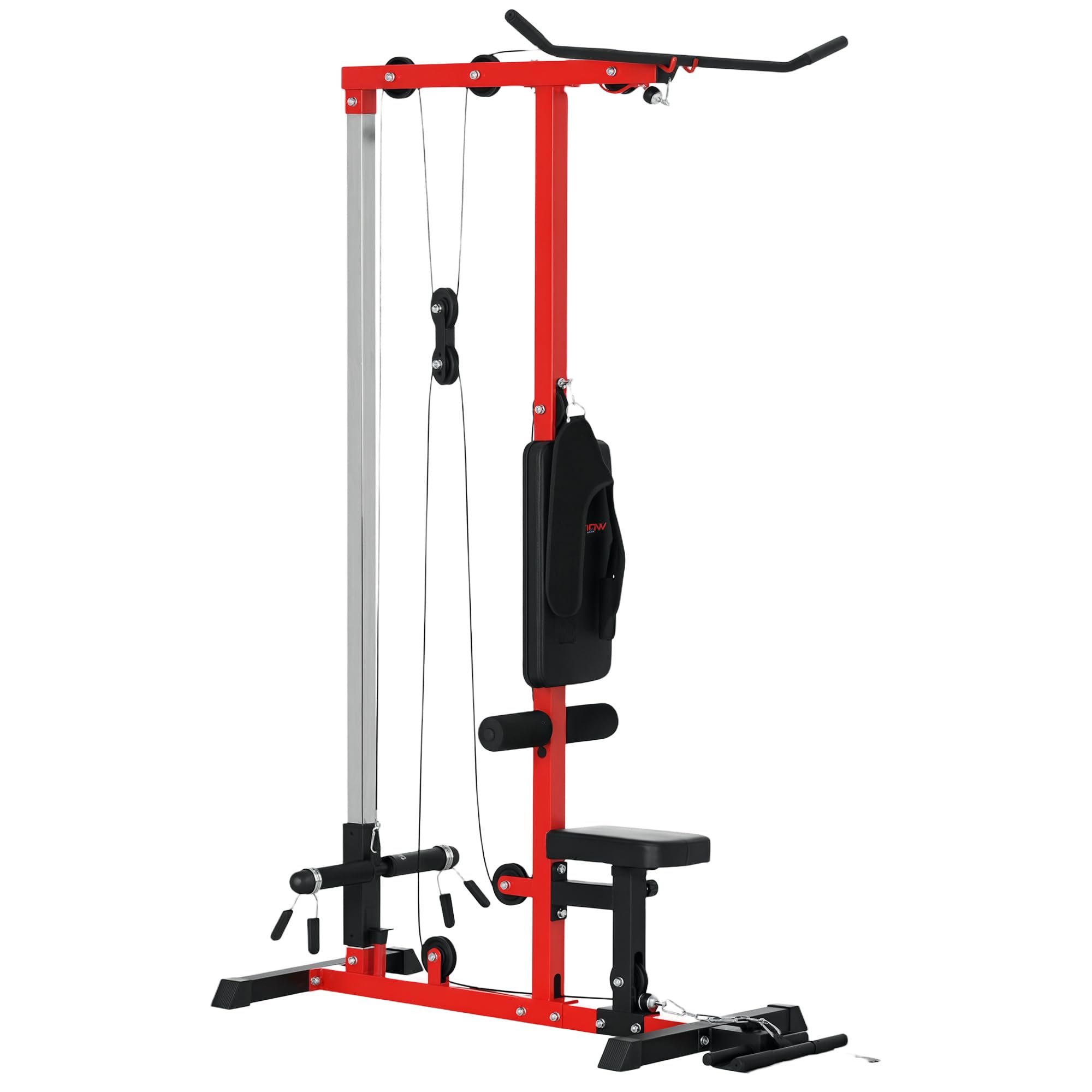
Soozier Cable Machine

Soozier

Soozier Cable Machine

  • Footplate Non-slip, flip-up 90 degrees
  • Machine Weight 67.1 lb
  • Footprint (L X W X H) 55"L x 42.5"W x 77.5"H
  • Maximum Weight Rating 242 lb
Check Price on Amazon

The Soozier is the cheapest route into a two-pulley tower here, and it does the two jobs the category exists for: pulldowns from the high pulley and rows from the low one. The frame stands 77.5 inches, weighs 67.1 pounds, and adds a flip-up footplate and a seat with four height settings.

The footplate is the design decision we appreciated most. It flips up 90 degrees out of the way for rows and back down with a non-slip surface for pulldowns, so you are not fighting a fixed plate mid-set or sliding forward when you pull. The four seat heights cover most users, and the whole thing is light enough to shove back against the wall when the floor needs to be a floor again.

What you are buying is a light-duty machine, and it is happiest set up once and left in place. For high-rep back work, a first tower, or a small apartment where the machine lives in a corner, it delivers the movement pattern for less than anything else on this page — and it leaves budget for the plates, which is where the real cost of a plate-loaded tower hides.

Bottom Line

The least expensive way into a two-pulley tower, and enough machine for high-rep back work in a small apartment.

Check Latest Price

How We Tested the Best Lat Pulldown Machines

We started with every lat pulldown machine we could find that a normal person could get delivered and assembled at home — plate-loaded and selectorized, standalone and lat/low-row combos — then cut the list by footprint, weight capacity, and whether the maker published an actual cable rating. That left seven machines across a wide price range. We bought them at retail, built them ourselves, and kept them in rotation for nine months in a garage gym, a spare bedroom, and a low-ceilinged basement.

Every machine was assembled solo with only the tools in the box, and we timed it. We wrote down each step where the instructions skipped a bracket or the diagram pointed the wrong way, and noted whether hardware arrived bagged by assembly stage or dumped together in one sack — often the difference between a two-hour build and a lost afternoon.

Once built, we loaded each one to its top plate and pulled hard, watching whether the frame rocked, whether the feet lifted off the floor, and whether it needed bolting down to feel safe. For smoothness, we tracked where the cable caught, at what point in the pull the pulley started to rasp, and whether the seat and thigh pads adjusted far enough for both a 5-foot-4 and a 6-foot-2 lifter.

The slow test was the cable. Every few weeks we ran a hand along the crimp and checked the pulley bushings for flattening, fraying, and slack, and we noted which machines developed a wobble or a sticky rep after a few months of steady use. At the end, we asked one question of each: is this worth its price next to the smoothest machine in the group?

How to Choose

Start With Ceiling Height, Not Floor Space

The number that eliminates machines fastest is ceiling height. The towers here run from 62.99 inches to 85 inches tall, and a pulldown needs clearance above the bar for your head and hands at full stretch. A 7-foot ceiling really only works with something built low, like the Tousains CR63; under a standard 8-foot ceiling you have room for the tall frames as long as you leave an inch or two above them.

Floor space matters less than the listings imply. Most of these are narrow, deep frames that want a strip of wall rather than a whole bay, and a machine with a 23-inch width will tuck beside a rack where a 48-inch plate-loaded tower will not. Watch the word compact in a product title — it usually describes the folded footprint, not the working one.

Match the Rating to the Weight You Actually Pull

Ratings in this group run from 242 pounds to 800, and it is easy to pay for capacity you will never approach. The figure is a structural limit for the frame and cable, not a target: a genuinely heavy pulldown for a strong lifter is well under half of a 400-pound machine's rating, so 400 to 500 pounds already gives you room to grow.

Where the rating matters is the low end. A 242-pound machine is fine for high-rep back work, rehab and light rows, and it becomes limiting the moment you start pulling seriously. Buy headroom if you plan to keep training; skip it if the tower is there for maintenance work and mobility.

Stability Is the Part You Can't See in a Photo

Frame weight is the best proxy you have before you touch one. The towers here run from about 50 pounds to 120, and the heavy one is the one that sits still when you finish a heavy set rather than rocking back. Two things go wrong on lighter frames: tipping forward on high-angle pulls such as face pulls, and the back of the base lifting during low-pulley curls.

Both have cheap fixes — put a plate on the base, stand on the lower brace, or anchor the frame to the floor where the maker recommends it. Renters and anyone training over a finished floor should rule out the machines that want bolting before they fall for the rest of the spec sheet.

Set the Seat and Thigh Pads for Your Height

Seat adjustment is what lets one tower fit more than one person, and most of these offer three or four positions. The thigh or knee pad matters just as much: on a heavy pulldown it is what holds you down, and a pad with four positions is worth more than a thicker cushion.

If you are tall, check the bar's resting position against your reach before you buy. Several machines here put the bar close over your head at full stretch, which costs you the stretch at the top of every rep — the part of a pulldown that does the most for a back.

Pulleys, Cables and What Comes in the Box

Pulley quality is felt rather than measured. Bushings and sealed pulleys run smooth and quiet, and a rough pulley is most obvious at the slow, heavy end of a set where any stutter gets magnified. Cables are the wear item on all of these machines, particularly where the sheath runs over a pulley, which is why a spare in the box is worth more than a cosmetic upgrade.

Check the attachments too. A lat bar, a row bar and a tricep rope add real money when bought separately, and most of the picks here include at least a lat bar, with the Goimu throwing in the rope and cable bar as well.

Frequently Asked Questions

Final Verdict

The Goimu LS01 is the machine we tell most people to buy. Three pulley stations, an 800-pound rating and a frame narrow enough for the space you actually have is the best balance of capability and floor space in this group, and the price sits in the middle of it.

Two situations change the answer. If your ceiling is 7 feet, the Tousains CR63 is the only tower here that works, and it folds away between sessions. If you pull heavy, have a full-height room and can drill into the floor, the Titan's 120-pound frame is worth the step up.