Strength & Weights

Best Calf Raise Machines of 2026

Calf raises are the easiest exercise in any program to skip, and the setup is usually why: a loaded barbell across your back, a step that's a little too narrow, one hand on the wall for balance. A dedicated calf raise machine takes that away — it holds you in position, keeps the load over your feet, and lets you sit in the stretch at the bottom instead of bouncing out of it. What it can't fix is floor space, which is the honest question with these: one muscle group's worth of footprint in a gym that's already crowded.

Seven machines have lived in my garage and my team's spare bedrooms for the past eight months, and the spread is wider than you'd think — some rock an inch at the top of every rep, a couple feel like commercial-gym iron, and assembly runs from twenty minutes alone to an afternoon with a helper. Buy for construction and adjustability and the value tends to follow. The picks below are the ones worth the square footage.

Best Overall

Our Score 8.8/10
HVO Seated Calf Raise Machine

HVO

HVO Seated Calf Raise Machine

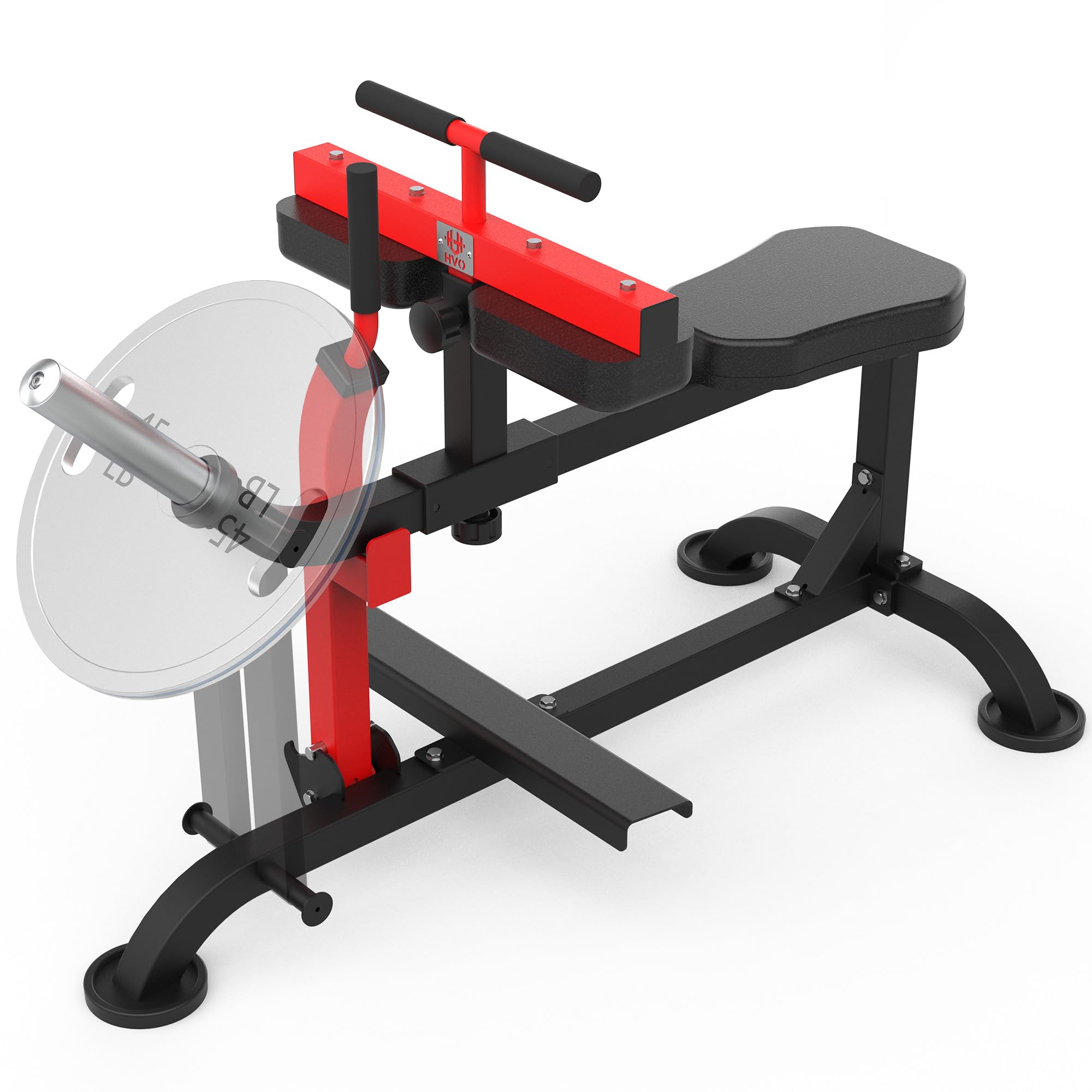
  • Footprint 26.57"D x 50.2"W x 33.9"H
  • Resistance Plates and 4 band hooks
  • Weight Capacity 660 lb
  • Leg Pad Settings 6 height levels
Check Price on Amazon

Highest weight rating here, six pad heights, and bands for warm-up sets.

A 660-pound rating is the highest in this group, and it's the reason the HVO is the machine we recommend first to anyone planning to keep adding plates. The parts you actually touch are sized for that job: a wide, thickly padded seat, a textured footplate that grips through a sweaty set, and a leg pad with six height levels plus a support rod that moves through four front-to-back positions. That last adjustment is the one we care about most. Seated calf machines live or die on whether the pad lands on your lower thigh instead of jamming into your knee, and the HVO gives you enough travel to fix that rather than padding the problem with a towel.

The dual resistance setup is more useful than it sounds. Four band hooks take the resistance bands that come with the machine, so you can warm up, chase a pump, or finish a set without dragging plates on and off the sleeves — then go back to plates when you want real load. We also expected a fight at assembly and didn't get one: the frame is a straightforward bolt-together job, and the hardware matches the instructions.

If your calf work is mostly bodyweight and high reps, you can spend less — the GMWD below does that job in a much narrower strip of floor. The HVO is for the lifter who intends to load the thing: more capacity than most home gyms will ever need, band work for the days you don't want to move plates, and enough pad travel to fit a household of different leg lengths rather than one person's setup.

Bottom Line

Our pick if you plan to load plates for years: the highest capacity here, the most pad travel, and bands for warm-ups. Give it a wall.

Check Latest Price

Best Build Quality

Our Score 8.8/10
Valor Fitness CC-5 Seated Calf Raise

Valor Fitness

Valor Fitness CC-5 Seated Calf Raise

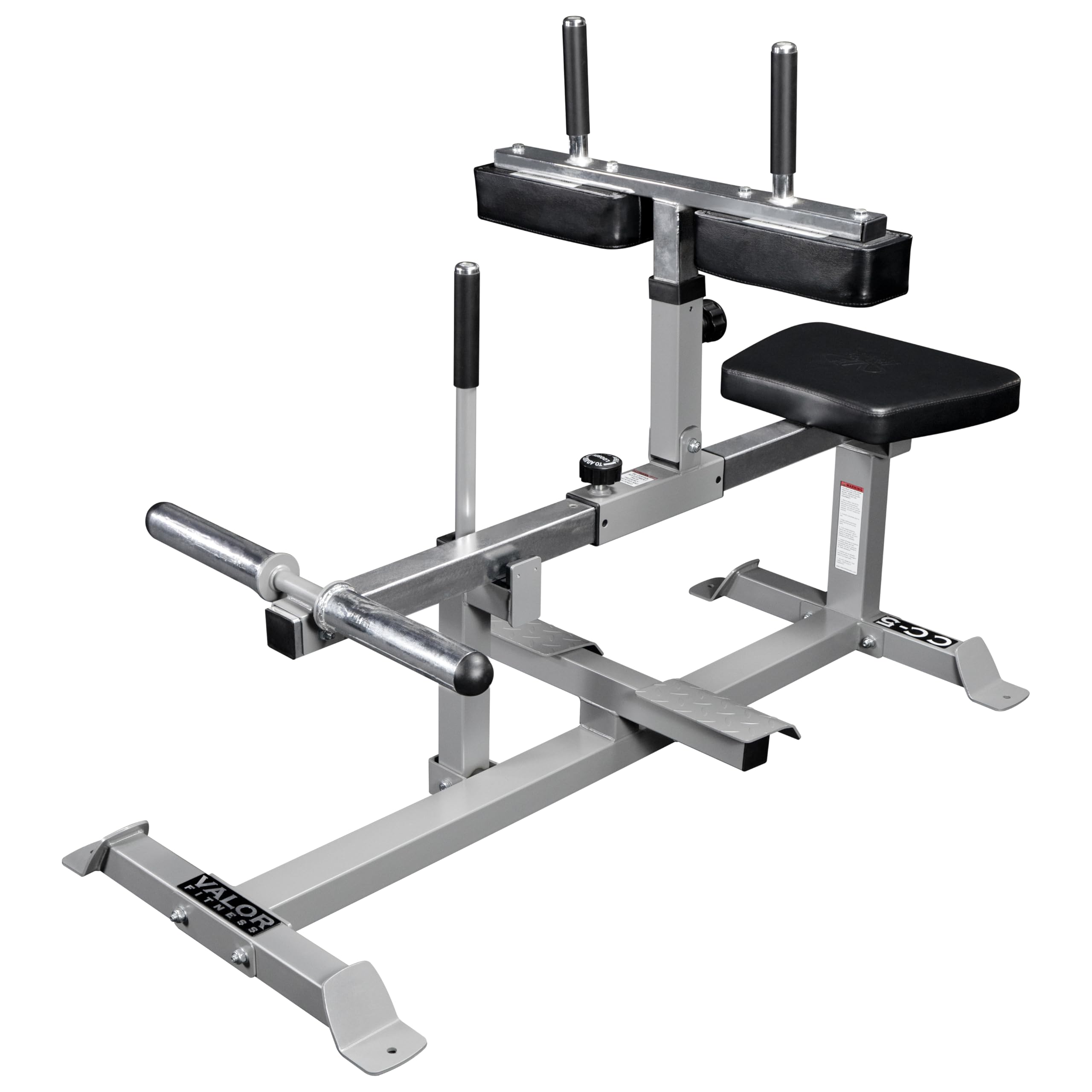
  • Frame 12-gauge steel
  • Dimensions 51.25"D x 25"W x 41"H
  • Machine Weight 80 lb
  • Weight Capacity 350 lb
Check Price on Amazon

Eighty pounds of 12-gauge steel, built like the seated calf raise at your gym.

Eighty pounds of 12-gauge steel is the first thing you notice about the Valor, and it is the machine in this group that comes closest to the seated calf raise at a commercial gym: diamond-plate foot platforms, thick padding, and welds that look tidy rather than rushed. We prefer spending money on a frame than on a badge, and if you feel the same, this is the pick that rewards it.

The adjustability is the quiet advantage. The knee pad moves vertically and horizontally, so you can put it where your thigh actually is rather than where the manufacturer guessed, and the low-leverage angle gives you a long stretch at the bottom of the rep. We appreciated that more the heavier we loaded — a pad in the wrong place is a distraction on a warm-up set and a real problem once there's weight on the machine. The padding holds up as well: bracing against it doesn't turn into a bruise.

Assembly is a one-person job with hand tools, and the frame goes together neatly enough that you're not squinting at the instructions. What takes the time is the weight of the thing when you tip it upright, so build it where it's going to live and save yourself the walk.

Bottom Line

If you want the machine that feels like the one at your gym, this is it — the best build quality in this group by a clear margin, with the frame to justify the price.

Check Latest Price

Best Budget

Our Score 8.4/10
GMWD Seated Calf Raise Machine

GMWD

GMWD Seated Calf Raise Machine

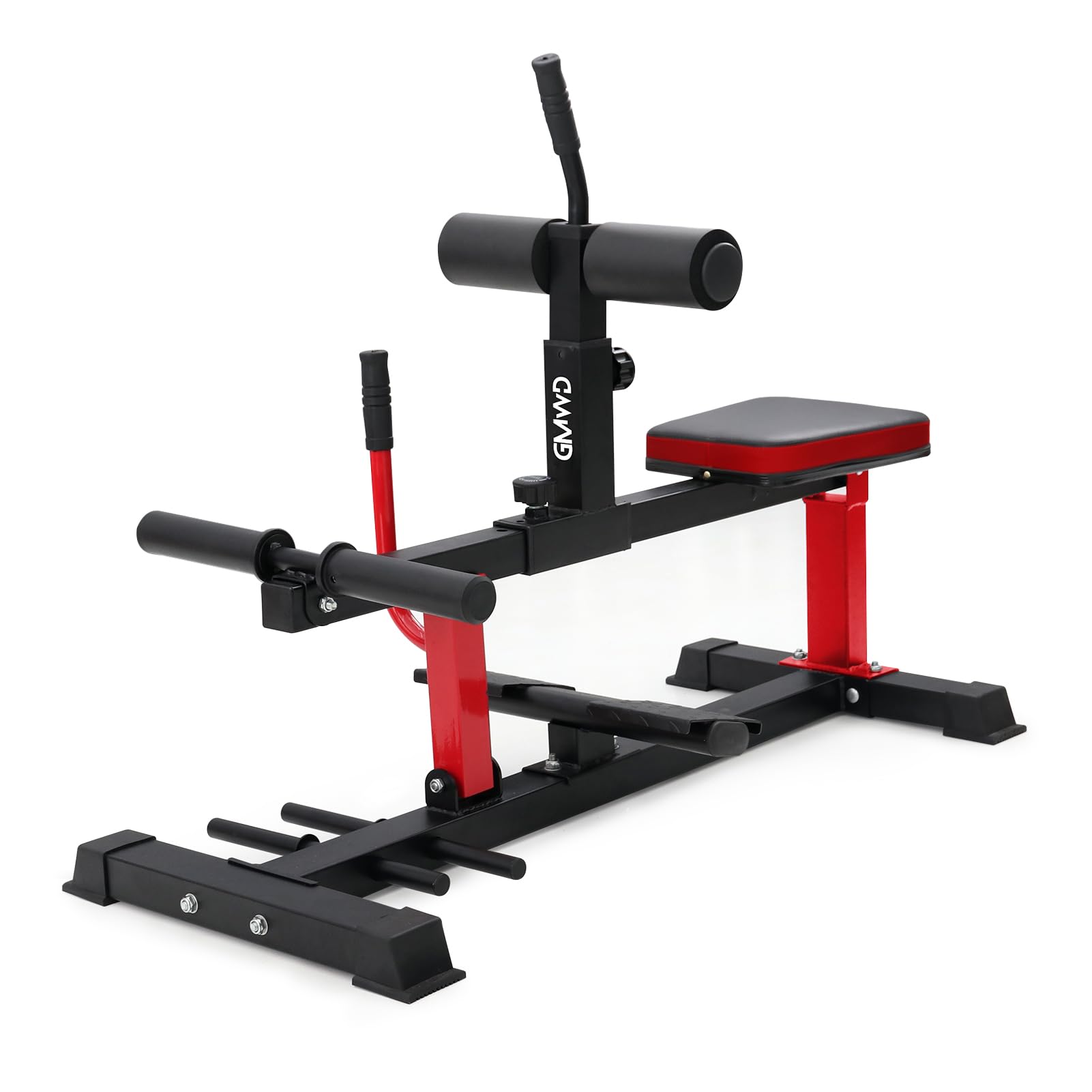
  • Dimensions 38.6"D x 22"W x 38.6"H
  • Adjustability 6 height and length settings
  • Machine Weight 56.2 lb
  • Weight Capacity 550 lb
Check Price on Amazon

The least expensive machine here and the narrowest, with room for real plates.

The GMWD is the least expensive machine here, and it is also the narrowest thing in this group: 22 inches across, 38.6 inches deep, and 56 pounds of frame. That combination is the whole pitch. It fits the strip of floor beside a rack, under a window, or in the corner of a garage where a 50-inch machine simply won't go, and it still gives you a 550-pound rating, band pegs, and six height and length settings on the leg pad.

We recommend it for the home lifter who trains calves a couple of times a week with a pair of plates a side and doesn't want to spend commercial-gym money to do it. What you give up shows up as the load climbs, and it shows up as sway: the frame moves side to side under heavy sets. Tightening every bolt at the end of assembly and re-checking them after the first few weeks takes most of that out, and what's left is a 56-pound frame doing a job bigger machines do.

The band pegs are the detail we didn't expect to use and did. They clip onto the side straps without tools, so a burnout set takes seconds instead of a plate change — the small convenience that decides whether you bother with the last set. Between this and the top pick, the HVO buys you capacity and pad travel; this one buys you floor space and a smaller bill.

Bottom Line

For a tight corner and a modest budget, this is the machine we point to: the least expensive here, the narrowest by a wide margin, and rated for more than most home lifters load.

Check Latest Price

Best For Olympic plate loading

Our Score 8.2/10
Titan Fitness Seated Calf Raise

Titan Fitness

Titan Fitness Seated Calf Raise

  • Dimensions 48"D x 23.5"W x 39.5"H
  • Weight Sleeves Dual 9.5" Olympic
  • Weight Capacity 550 lb
  • Thigh Pad Settings 4 positions
Check Price on Amazon

The Titan costs more than our top pick and, on paper, doesn't return much for the difference. What it does have is a pair of 9.5-inch Olympic sleeves — long enough to stack several plates a side without the last one hanging off the end — a 550-pound rating, four thigh pad positions, and a 39.5-inch frame that sits taller than the compact machines here.

We found it a competent, unremarkable machine. The soleus work is there, the diamond-plate foot bars grip, and assembly is straightforward with the directions in the box. But it doesn't do anything the HVO doesn't do for less money, and it doesn't feel as planted under load as the Valor. That leaves it as a reasonable third choice for someone who specifically wants the longer sleeves or a taller frame to sit at.

The knee pad is the one place to plan ahead. Heavy sets drive it into your quads rather than spreading the load, and a folded towel or an aftermarket pad fixes that for very little. Single-leg work is harder to solve: the support bar doesn't swing far enough clear, so both legs together is the practical way to use it.

Bottom Line

Buy the Titan if long Olympic sleeves and a taller frame are what you're after — it does the job, even if our top pick does it for less money.

Check Latest Price

How We Tested Calf Raise Machines at Home

Every machine here started from the same filter: a standalone calf raise station, not a leg-press attachment or a stack of blocks, that one person could get into a home gym without hiring help. We read spec sheets for footprint, load rating, and adjustment range, then cut anything with a footplate too short for a size 12 shoe or a frame rated under 300 pounds.

That left seven machines, which we ran for eight months — twice a week in a garage gym and a spare bedroom, three sets of 12 to 20 reps, alternating barefoot and in lifting shoes. Setup was timed solo with whatever tools shipped in the box, and we noted how long it took to get from opening the carton to the first working set. Then we watched: whether the frame walked across the rubber mat on heavy reps, whether the shoulder pads slid, whether the creak that appeared in week one was still there in week six.

Range of motion got measured with a tape against the platform lip, and both a 5'4" and a 6'2" tester ran the same settings to see how much of the adjustment was usable rather than nominal. Comfort was judged on the second set, not the first — pads that dig into the shoulders, plates too short to catch the ball of the foot, handles set so far forward you can't pull against them. A machine that shifted or wobbled under load got marked down no matter how clean the welds looked.

Value came last: we compared weld quality, steel gauge, and whether the pads were stitched or stapled against what each machine asked, and dropped one otherwise-solid unit that was built and priced like commercial equipment.

How to Choose

Capacity Is a Starting Point, Not a Promise

Ratings in this group run from 350 to 660 pounds, and the listings don't all say whether the figure covers the plates alone or the lifter as well, so buy with headroom. Count the plates you load on your heaviest day rather than the number you hope to reach in five years; a 660-pound frame that never sees more than two plates is steel you paid for and don't use.

The rating also won't tell you how the frame behaves at that load. Sway comes from the joints of a bolt-together machine, not from the thickness of its tubing.

Measure the Floor Before Anything Else

A seated calf raise takes more room than its footprint suggests. You need space in front for your feet on the plate, clearance behind for the knee-pad arm to travel, and room on both sides to slide plates on and off. The machines here run from a 22-inch-wide frame to a 50-inch one, and that difference decides whether it lives beside your rack or in the middle of the room.

"Compact" in a listing often means it stows under a bed, not that it fits the corner you had in mind. Tape the footprint out on the floor, sit inside it, and check you can load a plate without stepping around the frame.

Check What Actually Adjusts

Four to six height positions on the leg pad are standard here, and one machine also slides the knee pad forward and back. Seat height is the adjustment that gets left out, so where you sit is often fixed even when the pad moves freely. What matters is whether the pad lands on your lower thigh with your knee at roughly a right angle: too high and it jams into the knee, too low and you lose the stretch at the bottom.

If you're tall, short, or sharing the machine with someone whose legs are a different length, check the pad's lowest setting against your own thigh before you commit. That's the one fit problem a wrench won't solve.

Pads and Footplates: Where Budget Shows

Thin knee padding is the first thing to give out as the plates go on. Past a plate a side it turns into a pressure point rather than a cushion, and you'll feel it in your quads before your calves. A folded towel or an aftermarket pad solves it. Footplates matter just as much: diamond-plate or textured bars keep your feet from sliding when they're sweating, which is exactly when you're pushing close to failure.

Our advice is to treat added padding as part of the cost of a budget frame rather than a reason to walk away from one.

Frequently Asked Questions

Final Verdict

The HVO is the machine we recommend to most people. It has the highest weight rating here, six pad heights plus front-to-back travel, and band hooks that make warm-up and burnout sets easy — the combination that keeps up as you get stronger.

If floor space or budget is the constraint, the GMWD does the same job in a much narrower strip of floor. If you want the frame that feels like the one at your gym, the Valor is worth the step up, provided its capacity covers your heavy days.