Recovery

Best Knee Braces for Working Out, Tested of 2026

Knees have a way of announcing themselves mid-set. If you've ever felt a twinge at the bottom of a squat or had your kneecap wander on a downhill mile, you already know what a brace is for: it holds the joint in a track you can trust, adds compression to keep swelling down, and gives you enough feedback to push through the last few reps instead of bailing. The catch is that the wrong brace makes things worse — sliding down your thigh, bunching behind the knee, or cutting off circulation by the second set.

I've worn 14 different braces over six months of training — leg days, treadmill intervals, two long trail runs, and a lot of stairs — and the differences come down to a few unglamorous details. A sleeve helps with kneecap tracking and general compression; a hinged brace with side supports is the better call if the joint has actually given way before. And sizing, not brand loyalty, is what keeps one in place: measure your thigh, don't guess from your pant size. The picks below are the ones that stayed put.

Best for Heavy Lifting

Our Score 9.2/10
Gymreapers 7MM Knee Sleeves

Gymreapers

Gymreapers 7MM Knee Sleeves

  • Pack 1 pair with gym bag
  • Thickness 7 millimeters
  • Support Type Neoprene lifting sleeve
  • Certification IPF approved
Check Price on Amazon

7mm neoprene built for squats and maximal loads, with IPF approval for competition.

Seven millimeters of neoprene feels less like a sleeve and more like a piece of equipment, and we like it for exactly that. Pull one on and the compression is immediate and even. It holds heat in a way a thin nylon knit never will, which is the whole point when there's a loaded bar on your back and the joint needs to feel bulletproof before you descend.

Support is where these separate from the rest of the set. The rubber doesn't just squeeze — it gives a little rebound out of the bottom of a squat, and the fit stays put without straps or silicone. IPF approval matters if you compete; the fact that they arrive as a pair with a gym bag matters if you don't.

Two things to know before ordering. Sizing runs small, so use a tape measure against their chart rather than your usual size — the gap between a large and an extra-large is the gap between support and a tourniquet. And these are for the barbell, not the treadmill: an hour of conditioning in 7mm neoprene is an unpleasant experiment. Wear them for the work sets and peel them off for the cardio.

Bottom Line

We keep these for heavy leg days: 7mm of neoprene adds warmth and rebound under a loaded bar, and the IPF approval makes them competition-legal.

Check Latest Price

Best Budget Two-Pack

Our Score 9.0/10
Bodyprox Knee Compression Sleeves (2 Pack)

Bodyprox

Bodyprox Knee Compression Sleeves (2 Pack)

  • Pack 2 sleeves
  • Closure Pull on
  • Material Nylon, spandex, and latex
  • Support Type Compression sleeve
Check Price on Amazon

Two light, comfortable sleeves so you can test compression on both knees.

Two sleeves in one order is the entire argument here. If you're new to compression, a pair lets you wear one, wash one, and work out over a couple of weeks whether your knees actually feel better under load — without committing serious money to the experiment. That's a sensible way to shop a category where fit varies so much between bodies.

We were surprised by how much support the knit gives for something this light. It's snug without cutting in, thin enough to sit under shorts or loose pants, and it doesn't bunch behind the knee the way cheap sleeves usually do. The nylon, spandex, and latex blend has enough stretch to pull on easily and enough recovery to keep its shape.

The trade-off is structure: no stays, no hinges, and moderate rather than aggressive compression, so it's the wrong pick if you want something to lean on under a heavy bar. Think of it as the everyday sleeve — gym sessions, walks, yard work, a long shift on your feet — and keep a pair in the gym bag for exactly that.

Bottom Line

We hand this pair to first-timers: two comfortable sleeves, so you can test compression on both knees before spending real money.

Check Latest Price

Best Overall

Our Score 8.8/10
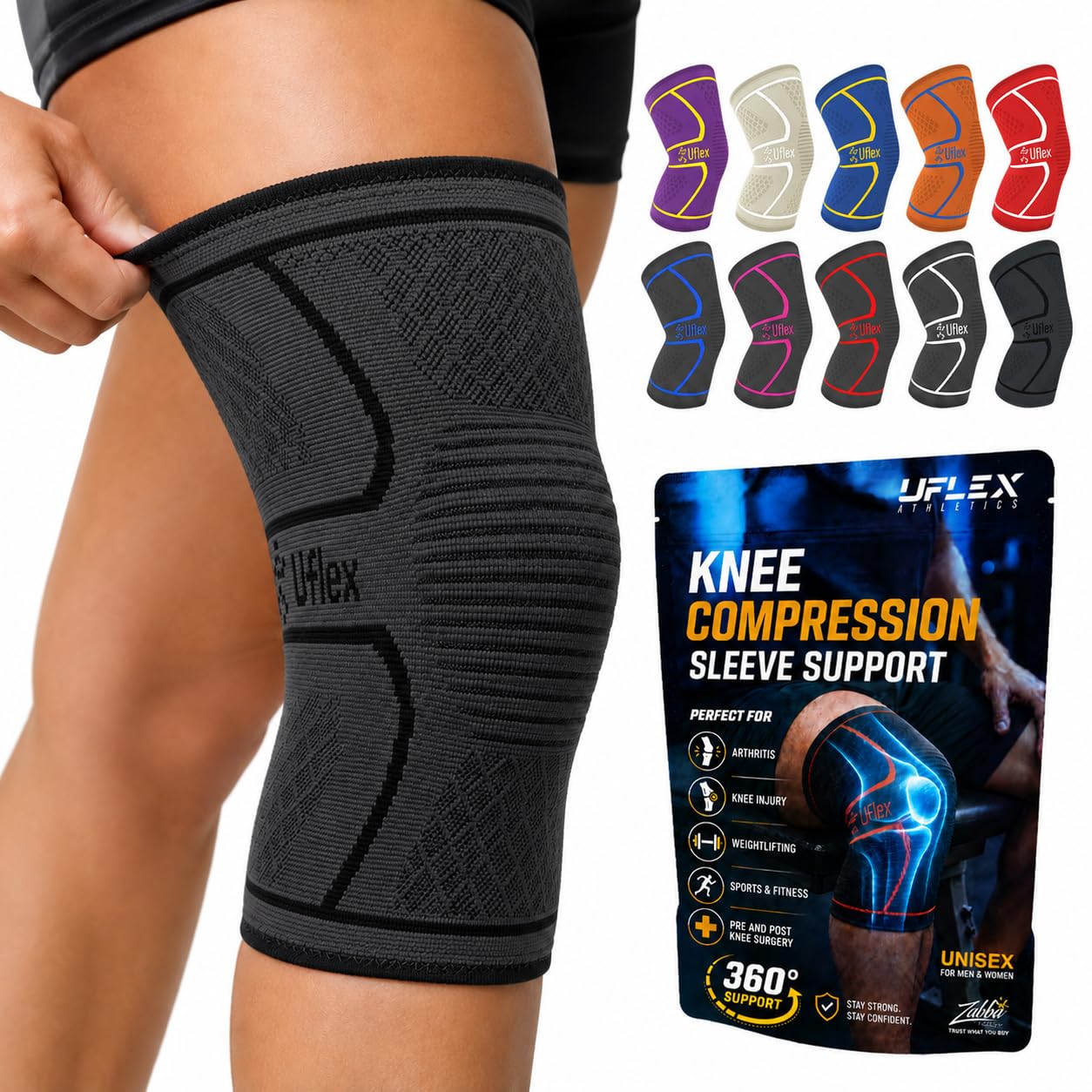
UFlex Athletics Compression Knee Sleeve

UFlex

UFlex Athletics Compression Knee Sleeve

  • Closure Pull on
  • Material 52% nylon, 26% polyester, 20% rubber, 2% spandex
  • Anti-Slip Double silicone grip
  • Support Type Compression sleeve
Check Price on Amazon

A silicone-gripped compression sleeve that stays on through sweat, squats, and runs.

The detail that earns this sleeve its place is a double silicone band along the inside of the top edge. Sleeves fail at exactly one job — staying over the kneecap once you start sweating — and the band gives the knit something to grip instead of relying on tightness alone. It's the kind of small design decision that determines whether you finish a session tugging at your thigh or forget you're wearing anything.

This is the one we reach for on the days that punish a brace hardest: squats, lunges, a treadmill warm-up. The four-way stretch lets it sit tight without fighting the bend, and the nylon, polyester, and rubber blend breathes well enough that an hour in it doesn't turn into a sauna. There's no strap, no hinge, nothing to adjust between sets, which is most of why it stays on for whole workouts rather than coming off after the first block.

What it doesn't do is stabilize. If your knee translates sideways under load, or your patella has a mind of its own, the braced picks further down are the better answer. For running, lifting, classes, and long days on your feet, though, a well-fitting sleeve is the lighter and cooler option — and this is the best fit of the sleeves in this guide.

Bottom Line

We recommend this as the default workout sleeve: the double silicone grip holds through sweat, and the four-way stretch doesn't fight your knee.

Check Latest Price

Best for Recovery

Our Score 8.8/10
Incrediwear Knee Sleeve

Incrediwear

Incrediwear Knee Sleeve

  • Care Machine wash, tumble dry low
  • Weight 2.4 oz
  • Material Polyester, nylon, cotton, spandex
  • Support Type Recovery sleeve
Check Price on Amazon

Wear it after training for stiffness and swelling, not as your lifting brace.

This is not the sleeve you put on to squat. Incrediwear positions it as recovery wear, and it's most useful in the hours after training, or on a day when the knee is puffy and stiff rather than unstable. The fabric is the draw: soft, low-profile, and the most pleasant thing in this guide against bare skin.

The infrared and circulation pitch is the brand's claim, and it isn't why this sleeve earns a place on the list. What's easy to confirm is how it wears — the polyester, nylon, cotton, and spandex blend is comfortable enough to leave on through an evening, it doesn't itch, and at 2.4 ounces it disappears under clothes. Machine wash and tumble dry low makes it the easiest pick here to look after.

Where it's harder to justify is as a training brace. There's no structure here — no stays, no patella ring — and the sleeve migrates down the leg over a long wear, so you're buying it for the fabric and the recovery idea rather than for support under a bar. If you want one sleeve for the gym, this isn't it. If you want something to live in after the session, it's lovely.

Bottom Line

We treat it as recovery wear, not a training brace: it goes on after the session for stiffness and swelling, and it's comfortable enough to forget.

Check Latest Price

Best For Wide size range

Our Score 8.8/10
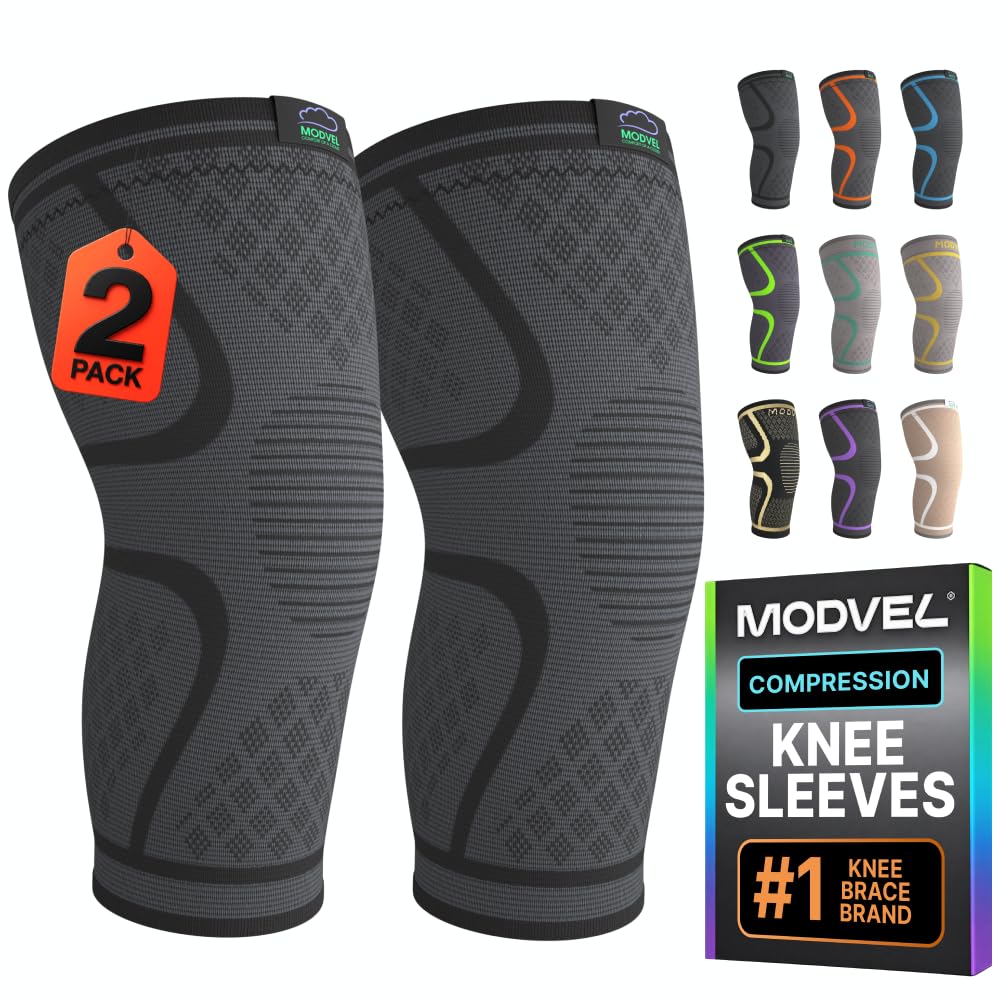
Modvel Compression Knee Brace (2 Pack)

Modvel

Modvel Compression Knee Brace (2 Pack)

  • Pack 2 sleeves
  • Sizes S to 3XL
  • Material Nylon and latex blend
  • Support Type Compression sleeve
Check Price on Amazon

Six sizes, up to 3XL, is why this pair made the cut. Plenty of sleeves are listed in the middle of the size range and quietly stop there, and a medium that fits everywhere except the top edge is worse than useless. We like having an option that goes up to a genuinely large size, and it arrives as two sleeves rather than one.

The knit is a nylon and latex blend, lightweight and moisture-wicking, with compression that's even rather than aggressive. Two sleeves means you can rotate them through the wash, which extends the life of a garment that spends an hour soaked in sweat several times a week. The fabric doesn't chafe, and it doesn't turn clammy under a session.

The catch is sizing accuracy: the chart runs small, and the difference between a good fit and a rolling top edge can be a single size. Measure your thigh, and if you land on a boundary, take the larger measurement rather than the smaller one. Get that right and it's a lot of sleeve for the outlay.

Bottom Line

We point shoppers with bigger legs here: the run goes to 3XL and you get two sleeves, which is more range than most picks in this set.

Check Latest Price

Best For Kneecap support

Our Score 8.8/10
NEENCA Professional Knee Brace

NEENCA

NEENCA Professional Knee Brace

  • Weight 5.6 oz
  • Patella Gel pad
  • Stabilizers Dual spring
  • Support Type Stabilized brace
Check Price on Amazon

Inside this brace is a gel ring that surrounds the kneecap and two spring stabilizers running down either side — the same broad idea as the other braced pick, in a lighter package. The knit is high-elastic and breathable, and at 5.6 ounces it sits under pants more discreetly.

The gel ring is the part we noticed most. It gives the kneecap a place to settle and keeps the fabric from riding up over it, while the springs add lateral guidance without locking the joint. For a knee that feels like it wanders during lunges, that's meaningful support a plain sleeve can't offer.

Positioning takes a try or two, and the fit around the upper thigh is the fussy part. It runs warm compared with a thin sleeve, though nowhere near a 7mm neoprene pair, and it's easy enough to take on and off between sets.

Sizing is the sticking point. The chart has been unreliable, and the smallest size has come up big on smaller legs, so measure your thigh and size down if you're on the line. Do that, and what you get is genuine kneecap support from a braced design that doesn't feel like a piece of hardware strapped to your leg.

Bottom Line

We rate the gel ring for a kneecap that needs guiding, and it weighs less than the other braced pick here — just measure before you order.

Check Latest Price

Best for Extra Stability

Our Score 8.6/10
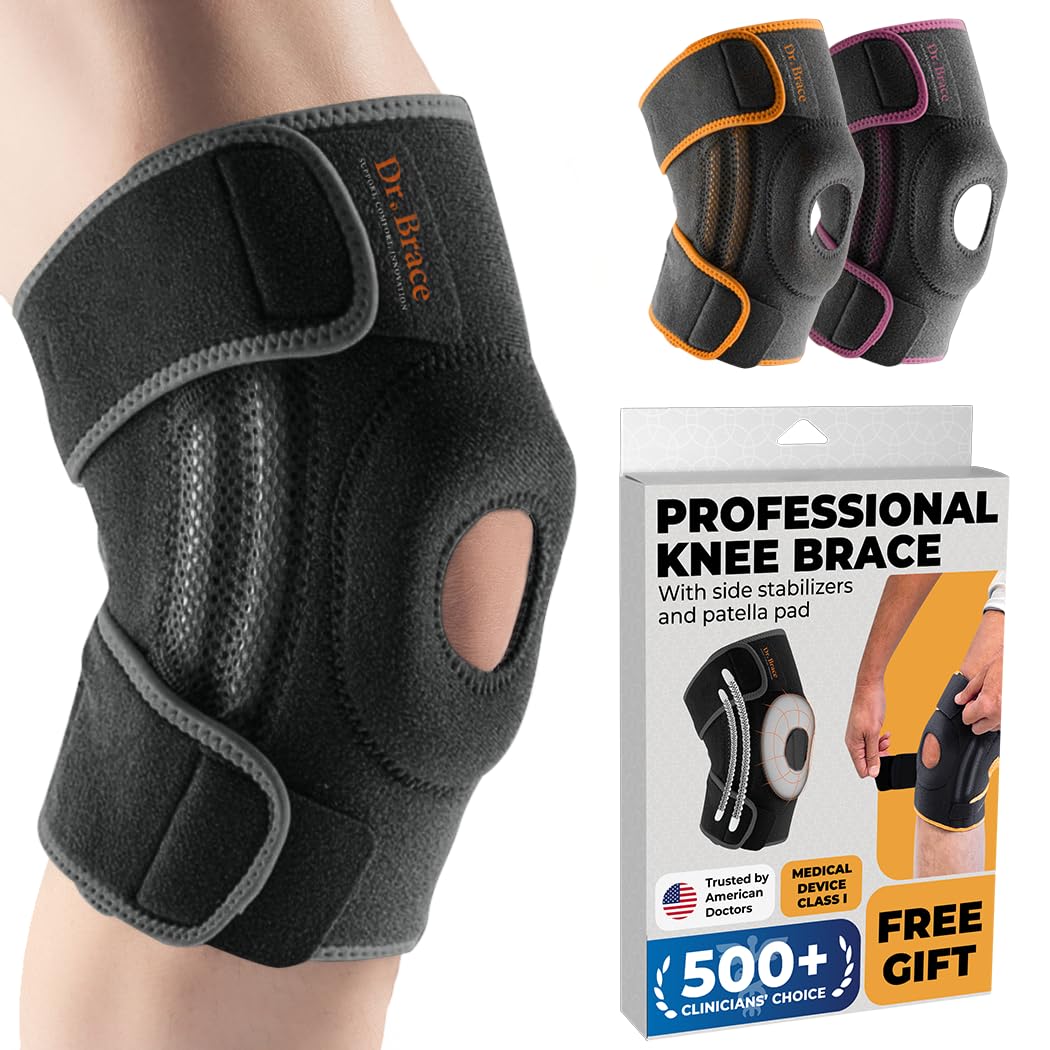
DR. BRACE ELITE Knee Brace

DR. BRACE ELITE

DR. BRACE ELITE Knee Brace

  • Weight 8.47 oz
  • Patella Gel pad
  • Stabilizers Double side stabilizers
  • Support Type Stabilized brace
Check Price on Amazon

Side stays and a gel patella pad for knees that need more than compression.

Some knees don't want a hug, they want a hand on either side. This brace is built for that knee: two side stabilizers run down the medial and lateral lines, and a gel ring sits around the patella so it tracks rather than floats. The non-slip silicone keeps the whole thing from migrating while you're positioning it.

It's the heaviest brace here at just over eight ounces, and you notice it going on. What you get for that is structure you can feel when you lunge, step down off a box, or change direction — a sleeve compresses, this one resists. The fabric stays breathable through a session, and it's easy to position correctly, which matters more than it sounds: a brace sitting half an inch off your kneecap is doing nothing at all.

Where it beats the sleeves is confidence on uneven ground and under a wobbly knee. Where it loses is discretion. Under slim joggers it reads as a medical device, and it's more work to launder than a plain knit. We reach for it on grumpy-knee leg days and on hikes rather than treadmill intervals, and that's the right division of labor.

Bottom Line

For a knee that feels loose rather than sore, this is our pick: the side stabilizers resist the wobble while the gel pad keeps the kneecap centered.

Check Latest Price

Best For Low-cost backup

Our Score 8.6/10
Physix Gear Knee Compression Sleeve

Physix

Physix Gear Knee Compression Sleeve

  • Pack 1 sleeve
  • Material Nylon and rubber
  • Compression Graduated
  • Support Type Compression sleeve
Check Price on Amazon

This is the budget end of the set, and it's here because not everyone needs to spend much to find out whether compression helps at all. It's a plain pull-on knit, available in a single, and it does the basic job without asking you to learn anything.

The design is simple: graduated compression, a moisture-wicking nylon and rubber blend, and a ribbed knit that doesn't bunch behind the knee. There are no straps to fiddle with and no silicone band to peel away from your skin. Hand wash it and let it air dry and it holds its shape well enough.

What you're not buying is structure. It's a thin sleeve, so the support is compression and a little warmth rather than stability — if your knee feels loose instead of sore, a braced design is the answer. Sizing runs small too, so measure your thigh rather than ordering your usual medium and hoping.

For all that, it does what a spare should. Ours lives rolled up in a gym bag, and it's the one we lend out, pack for a weekend, and don't worry about losing. If you're testing whether a sleeve is worth wearing, start here and upgrade once you know.

Bottom Line

Ours lives in the gym bag as a spare: graduated compression, no straps, and a low-risk way to find out whether a sleeve helps your knees.

Check Latest Price

How We Tested the Best Knee Braces for Working Out

We started with roughly 50 braces on the market and cut anything with a vague sizing chart, no stated compression level, or a return policy that made trying a second size a gamble. That left 14, which we bought ourselves. Each one got at least a week of wear over six months: leg days with back squats, split squats, and walking lunges; treadmill intervals and jump rope; two outdoor runs; plus the unglamorous stuff like stairs and the walk to the car.

Sizing came first. We measured every tester's thigh at the widest point and just above the kneecap, matched the numbers to each chart, and noted where the chart's recommendation actually landed. To check whether a brace stays in place, we marked the top edge's starting position with a fabric pen and measured how far it crept during a 30-minute session — some migrated two inches before the first set was over, while others never budged.

Support and comfort got judged from the back of the knee outward: could we drop into a full squat without fabric bunching or a hinge digging in, and did we want the thing off the second the set ended? Testers logged ache during and after sessions, so we could tell which braces changed how the knee felt versus which just felt tight. Every brace went through repeated machine washes, and we checked stitching, elastic recovery, and whether the straps still gripped after a month.

How to Choose

Decide What Kind of Support You Need

Three designs cover almost every gym situation. A compression sleeve is a knit tube that squeezes the knee and adds warmth, with nothing in it to stop sideways movement — right for running, classes, and general leg day. A stabilized brace adds side pieces and often a gel ring around the kneecap; it's the answer when the knee feels loose or untrustworthy under load, and it's bulkier. A thick 7mm neoprene sleeve is a lifting tool: it stores heat and adds rebound out of the bottom of a squat, and it's miserable for anything aerobic.

Start with the workout you do most, not the one you do occasionally. A sleeve that's perfect for a five-mile run won't give you the bracing you want under a heavy bar, and a pair of competition sleeves will feel like a sauna in a spin class.

Measure Before You Order Anything

Every sleeve here is sized by circumference, not by your usual clothing size, and the charts don't agree with each other. Run a tape around your thigh about four to six inches above the kneecap and match that number to the chart, ignoring the size on your jeans. If you land between two sizes, the top edge decides: a sleeve that's too big rolls down the thigh within minutes of sweating, and one that's too small leaves a deep mark and restricts circulation.

Sizing runs small on several of these picks, so the larger measurement is usually the safer bet. Measure both legs, too — a dominant thigh can be a half size bigger, and that side is the one that will roll.

Weigh Thickness Against Heat

Neoprene thickness is a heat decision as much as a support decision. Seven millimeters holds warmth and gives noticeable rebound under a bar, but it also turns a conditioning session into a sauna and takes longer to dry. A thin four-way stretch knit breathes and moves, which is what you want for running and high-rep work, but it won't do much for a knee that needs bracing.

If you train both ways, that's an argument for owning a light sleeve and a heavy pair rather than trying to split the difference with one compromise garment.

Check the Parts That Fail

Two components give out first: the silicone grip band along the top edge and the stitching at seams and closures. On a sleeve, run a thumb along the grip and check it's bonded flat rather than spot-glued; on a braced design, flex the side pieces and see whether they spring back cleanly.

None of that guarantees longevity, but it's what separates a brace that survives a training block from one that doesn't. Braced designs carry a third wear point in the side stabilizers, so look at how they're anchored before you commit.

One Sleeve or a Pair?

A pair costs little more than a single in several cases here, and it buys rotation: one on, one drying. It also makes sense if both knees take the same beating, since the unsupported side often starts complaining once the first one is looked after.

A single is the better buy if you're testing a material or a fit before committing, which is exactly why the budget picks in this guide come as singles.

Frequently Asked Questions

Final Verdict

If your week is a mix of lifting, running, and classes, the UFlex Athletics sleeve is the one to buy. The double silicone grip is what keeps it over the kneecap once everything else starts sliding, and it's thin enough to wear for a full session rather than three sets.

Two requirements change that answer. If the bar is the main event, the Gymreapers pair gives you heat and rebound a knit can't. If the knee feels loose rather than sore, step up to the DR. BRACE and its side stabilizers. Everyone else should start with a sleeve and a tape measure.