Strength & Weights

Best Bumper Plates of 2026

Drop a loaded barbell from overhead and a good bumper plate answers with a dull thud. A bad one clangs, skitters sideways across the floor, and makes you squat down to check whether the collar has started separating from the rubber. I've lifted on both kinds, and the gap shows up in the details: a plate that lands at the weight it claims, survives a few hundred drops without cracking, and doesn't turn your garage into a tire store. That's the job these plates do — letting you miss a lift or finish one without wrecking your floor, your bar, or your neighbors' goodwill.

We've spent the past eight months loading and dropping 12 bumper plates, singles and pairs, from budget imports to competition-style discs, and the pattern held across all of them. One thing new buyers miss: a 10-pound plate is almost always the same diameter as a 45, so width at the collar is where cheap manufacturing shows, and it's also what quietly eats your bar space during a heavy pull. The picks below are the ones that got the boring things right.

Best Overall

Our Score 9.4/10
Zoomster Bumper Plate Set

Zoomster

Zoomster Bumper Plate Set

  • Bounce High
  • Set Weight 190 lb
  • Center Hole 2 inches
  • Plates In Set 8
Check Price on Amazon

A 190-pound set with the steadiest durability and accuracy feedback here.

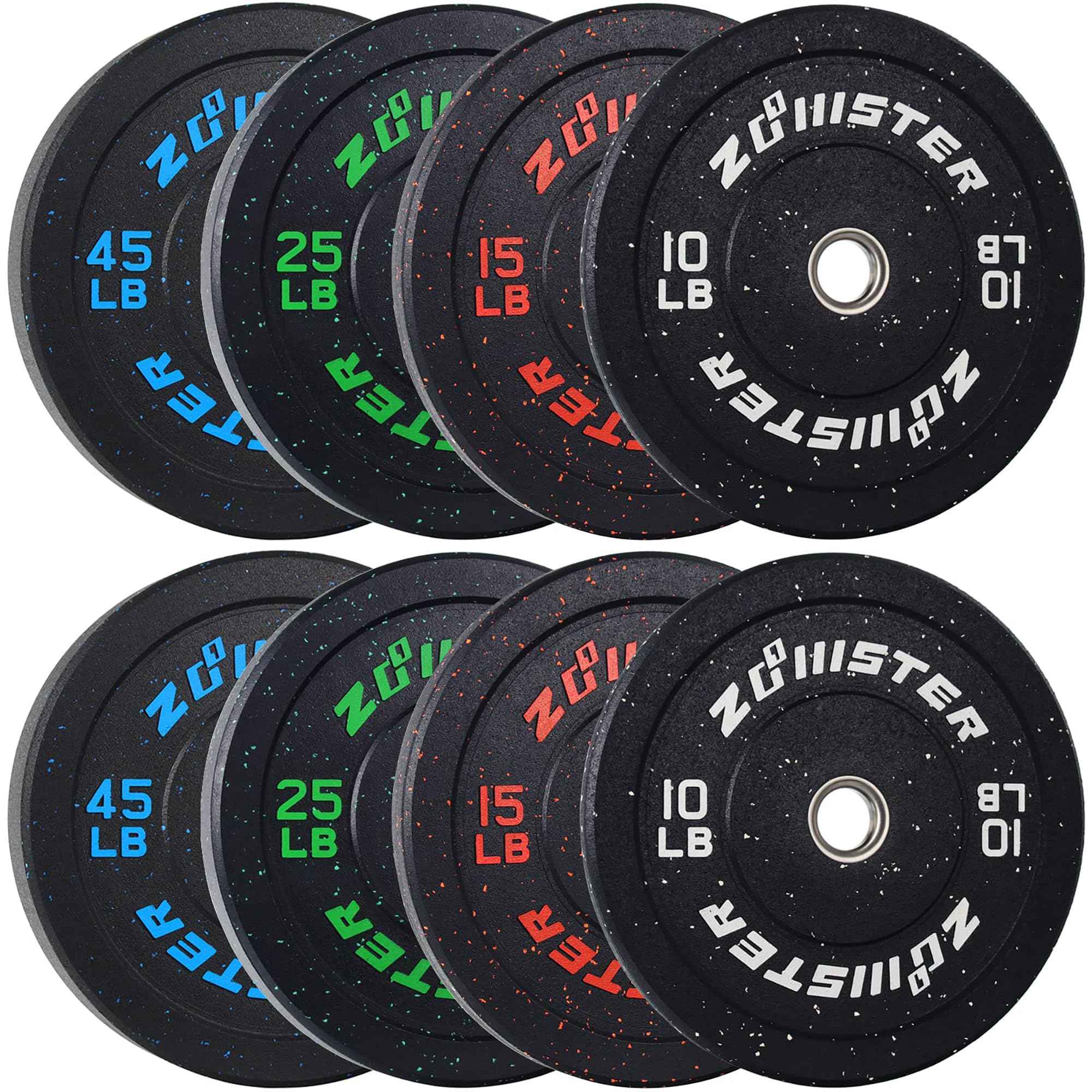
A bumper plate's whole job happens in the second after you let go of the bar, and this is the set we hand to most people building a garage gym. Eight plates, 190 pounds in total, which is enough bar weight for cleans, front squats and the deadlifts most home lifters pull.

What settled it for us is consistency. Durability and weight-accuracy hold up better on this set than on any other set here, and the plates keep their shape through repeated drops onto a hard floor. The rubber is dense, the markings are big enough to read from across the rack, and the rebound is predictable rather than wild.

The bounce is on the lively side. High-rebound rubber sends the bar back up with some energy instead of swallowing the drop, which is what you want over a slab with a mat on it and less welcome when you're drilling snatches and want the bar to stay put. For the strength work that fills most home sessions, the liveliness is a fair trade for the protection.

One practical note before you load anything: plates like these often arrive with a film of molding release on the rubber. A wipe-down with dish soap and hot water before the first session keeps your hands and your bar from picking it up, and after that there's nothing fussy about them.

Bottom Line

Our pick for most home gyms: a 190-pound set whose durability and accuracy hold up better than any other set here, with a bounce that forgives concrete.

Check Latest Price

Best Low Bounce

Our Score 9.4/10
Iron Crush Olympic Bumper Plates

Iron

Iron Crush Olympic Bumper Plates

  • Bounce Low, dead
  • Sold As Pairs
  • Diameter 450 mm (IWF)
  • Available Weights 10 to 45 pounds
Check Price on Amazon

Dead-bounce rubber and a full 450 mm diameter keep the bar where it lands.

Low bounce is the whole reason to buy these, and the reason we keep reaching for them on Olympic work. The virgin rubber gives very little back when it hits. The bar lands and stays landed, which is what you want when you're catching a clean and not what you get from the springier sets on this page.

The numbers behind the feel are good ones. Each plate is 450 mm across, the IWF diameter, so the bar sits at competition height and your pull starts where it would at a meet. The stainless inserts are snug enough that nothing rattles on the sleeve and loose enough that the plates still slide on without a fight, and the 10-pound plate is molded thicker than most, which is the detail that shows someone thought about the weakest plate in the set.

Drops are quiet enough to train late in a garage, the finish has stayed intact through repeated overhead drops, and the plates have held their marked weight. They're sold two at a time from 10 to 45 pounds, so a full set arrives as several orders and costs more per pound than the big sets here. What you buy with that is control.

Bottom Line

Low-bounce rubber in a full 450 mm plate: if your training is built on cleans and snatches, this is the pair that keeps the bar where it lands.

Check Latest Price

Best Starter Set

Our Score 9.4/10
HANDBODE 100 lb Bumper Plate Set

HANDBODE

HANDBODE 100 lb Bumper Plate Set

  • Material Recycled vulcanized rubber
  • Set Weight 100 lb
  • Center Hole 2 inches
  • Plates In Set 6
Check Price on Amazon

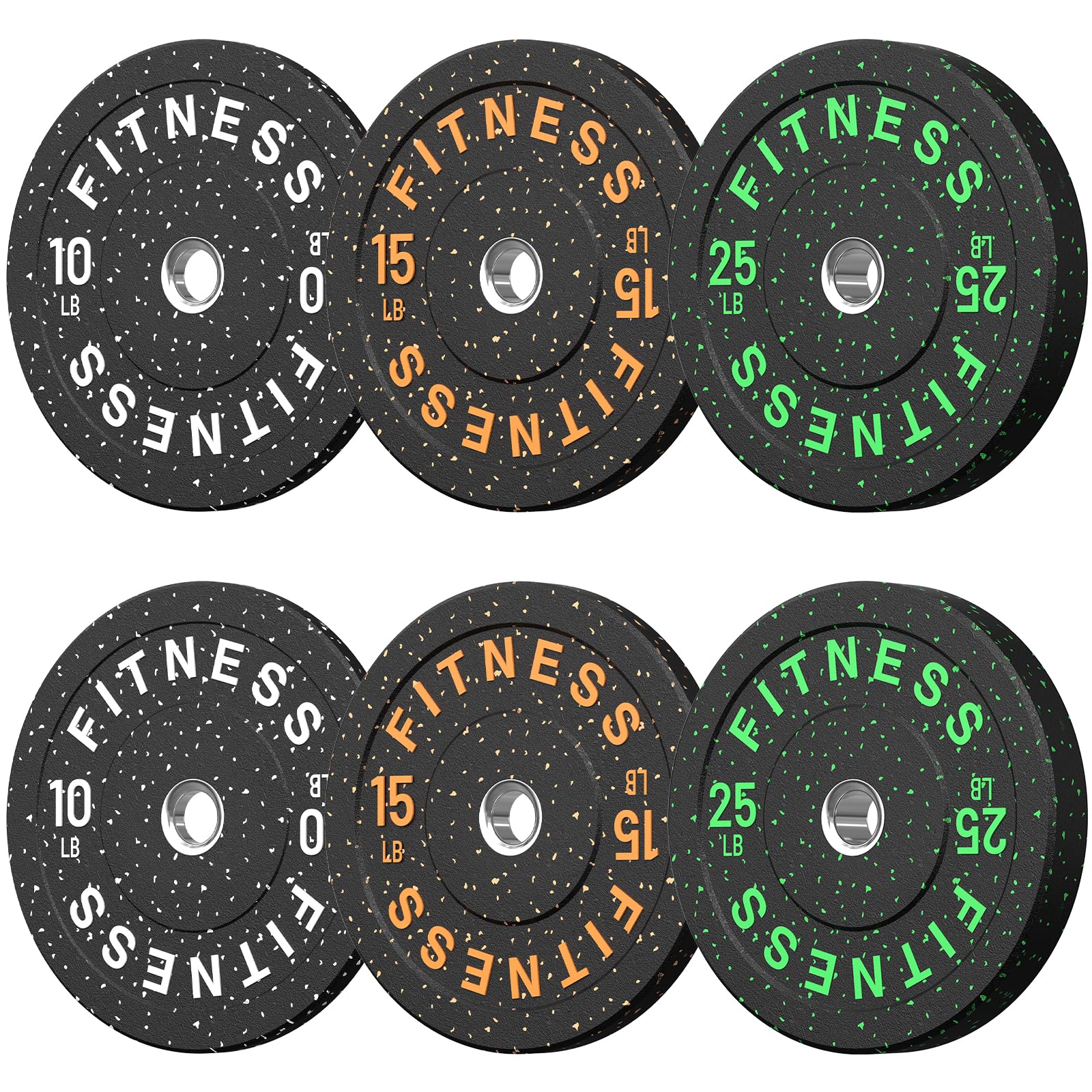
100 pounds in three color-coded pairs for learning cleans and snatches.

If you're still learning to catch a clean, a 190-pound set is mostly weight you won't load for months. This one is sized for that stage: pairs at 10, 15 and 25 pounds, 100 pounds in total, which is enough to drill technique and leaves room to add a pair of 45s when the lifts start clicking.

The plates are vulcanized recycled rubber with a reinforced steel ring at the center, flecked with color so you can grab the right weight without reading the number. All six share one diameter and change only in thickness, which is how bumper plates work and what keeps the bar at a consistent height when you pull from the floor. Expect the 10s to look surprisingly large the first time you see them.

What we like most is that the set doesn't become dead weight. The 10s and 15s stay in service as warm-up and technique plates long after heavy pairs arrive, so this grows with a lifter instead of being replaced by the next purchase. For a first year in a garage, that's the right shape of spending.

The light end is where the compromises sit. Thin rubber can only do so much, and a set this size is where a plate running slightly off its marked number is most likely to turn up. Neither stops you training; both are worth knowing before the boxes arrive.

Bottom Line

Start here if you're learning the lifts: 100 pounds in three pairs that stay useful as warm-up plates after you outgrow them.

Check Latest Price

Best Full Set With Every Increment

Our Score 9.4/10
AMGYM 190 lb Bumper Plate Set

AMGYM

AMGYM 190 lb Bumper Plate Set

  • Insert Rust-resistant steel
  • Diameter 17.5 inches
  • Set Weight 190 lb
  • Plates In Set 8
Check Price on Amazon

Pairs at 10, 15, 25, and 45 pounds, all at one diameter.

A 190-pound set is really a pair of 45s plus the change you need to load them, and this is the set here that spells out exactly what you get: pairs at 10, 15, 25 and 45 pounds, all 17.5 inches across, with a rust-resistant steel insert in every plate. Knowing your plate list before you order rather than after the boxes arrive is worth something, and it's the main reason this earns a place beside our top pick at the same money.

The rubber is recycled stock with a textured, non-slip surface that holds onto a sweaty hand, and the color-coded markings are easy to read mid-circuit. The listed 10,000-drop testing is the manufacturer's own figure rather than something we can check; the more useful signal is that construction feedback here is strong and the inserts have stayed put through repeated deadlift sessions.

Bounce is high, like our top pick's, so the same floor advice applies. The rubber is on the strong side when the boxes first open, and a week in the garage takes care of most of that. Weight accuracy is the real soft spot, since it draws the most divided feedback of any set here.

Bottom Line

Every weight you need in one order, from 10-pound pairs to 45s — as long as you're willing to check a few plates on a scale.

Check Latest Price

Best For Kilo lifters

Our Score 9.4/10
PROIRON Olympic Bumper Plates

PROIRON

PROIRON Olympic Bumper Plates

  • Bounce Low
  • Warranty 5 years
  • Center Hole 2 inches
  • Available Sizes 5 to 20 kg (11 to 44 pounds)
Check Price on Amazon

Kilos first: these come as 5, 10, 15 and 20 kg plates, which is 11, 22, 33 and 44 pounds. If you follow a program written in kilos and the numbers on the plate are supposed to match the numbers on the sheet, that alone puts these ahead of a set marked in pounds.

The rubber is solid through the full thickness rather than a crumb fill, and the formulation is low bounce, so drops stay quiet and the bar stays close. The 2-inch steel sleeves are built to fit Olympic bars, dumbbell bars and sleds, a wider range than most plates here claim.

Five years of warranty is the longest on this page, though whether it's easy to use is another matter and we treat it as a tiebreaker rather than a reason on its own.

Our reservation is the size ceiling. Twenty kilos is the heaviest plate offered, so a genuinely heavy pull is going to need several of them, and there's less feedback on these than on the bigger brands here. What tipped it for us is the combination, a dead-ish bounce and solid rubber backed by a long warranty, rather than any single figure.

Bottom Line

Worth buying if your program is written in kilos: solid rubber, a low bounce, 5 to 20 kg sizes, and the longest warranty here.

Check Latest Price

Best For Single heavy plate

Our Score 9.4/10
Yes4All 2-Inch Bumper Plate

Yes4All

Yes4All 2-Inch Bumper Plate

  • Bounce Moderate
  • Weight 45 lb
  • Warranty 1 year
  • Center Hole 2 inches
Check Price on Amazon

A single 45 in crumb rubber with a moderate bounce: less springy than the high-bounce sets here, livelier than the dead-bounce pairs. For most garage lifting that middle ground is easy to live with, and the grainy crumb surface gives you something to hold when you're sliding it onto a sleeve.

We like it as an add-on plate rather than the foundation of a set. The 2-inch hole fits standard Olympic sleeves, the moderate bounce protects a floor without launching the bar, and a year of warranty backs it. The first thing we check is the hub, because the hole has come up loose on some bars and let the plate slide along the sleeve; slide one on and shake it before you load it.

Cost is the other consideration. For the same 45 pounds of rubber you'll pay noticeably more here than for the CAP plate, so this makes the most sense when a moderate bounce and a warranty on one plate are exactly what you're after, and least sense when you're chasing the lowest cost per pound.

Bottom Line

A solid single 45 with a moderate bounce and a year of warranty — check the hub fit on your bar first.

Check Latest Price

Best for Easy Loading

Our Score 9.2/10
REP Fitness Rubber Bumper Plates

REP Fitness

REP Fitness Rubber Bumper Plates

  • Loading Molded grip holes
  • Sold As Pairs
  • Center Hole 2 inches
  • Available Weights 5 to 45 pounds
Check Price on Amazon

Molded grip holes turn loading a 45 into a one-hand job.

Every plate in this guide has to be picked up off the floor, and only these give your fingers somewhere to go. REP molds grip holes into each plate, so a 45 comes off the stack with one hand instead of a two-handed pinch on a slick rubber edge.

The rest of the build supports the convenience. The steel core is machined so the plates sit tight on a 2-inch sleeve without rattling, and sturdiness gets the cleanest feedback of any plate here: no flex in the disc, no wobble on the bar. Sizes run from 5 to 45 pounds in pairs, which lets you build around the weights you actually load rather than a package someone else chose.

Where the record is thinner is long-term durability. These are holding up and nothing we saw points to a problem, but that feedback is good rather than settled the way the sturdiness is. Treat the grip holes as the reason to buy and everything else as solid rather than proven.

For a home gym where you change plates five times a session, that one-hand lift earns its keep in a way that a few saved pounds per plate never will. We're happy to have a pair of these on the rack next to any of the sets here.

Bottom Line

Buy these for the grip holes: loading a 45 with one hand changes a session, and the steel core and sturdiness hold up behind it.

Check Latest Price

Best Budget Plate

Our Score 9.0/10
CAP Barbell Rubber Bumper Plate

CAP Barbell

CAP Barbell Rubber Bumper Plate

  • Hub Steel floating hub
  • Bounce Medium
  • Weight 45 lb
  • Center Hole 2 inches
Check Price on Amazon

The cheapest 45 here, with a steel hub and honest weight.

If you already own plates and just need more 45s on the bar, this is where the money goes furthest. It's a single plate rather than a set, which is exactly what most garage gyms want once the initial kit is bought: one more 45 at a time, as the lifts ask for it.

The build is more thoughtful than the price suggests. A steel floating hub keeps the plate from binding on the sleeve, the rubber blend is a medium bounce so drops don't send the bar into orbit, and the weight markers are color coded for a quick grab. Accuracy has never been the complaint with these.

They arrive oily. A film of molding release coats the rubber and transfers to hands, bar and floor until it's washed off, so plan on dish soap, hot water and a couple of days of air before the first session. It's a one-time chore, not a permanent condition.

That's also the honest answer about where these belong: a garage or a well-ventilated room rather than a spare bedroom. Set up that way, this is the cheapest way to add 45 pounds to a bar, and the color coding means you can spot the plate you want from across the room.

Bottom Line

Spend the least per plate here and get a steel hub and honest weight — just plan on letting it air out in a garage.

Check Latest Price

How We Tested the Best Bumper Plates

We started by pulling together every bumper plate we could find that published an actual weight tolerance and used a steel or stainless insert, then cut anything with a warranty under a year or a price per pound that didn't line up with what the plate delivered. That left 12 plates, singles and pairs, which we loaded, dropped, and lived with for eight months.

The first hour with each one was unglamorous. We unwrapped it and smelled the rubber immediately and again a week later, since a plate that still stinks after seven days in a garage rarely settles down. A white rag wiped across the face showed how much mold-release grease came off onto our hands during a normal loading session. We measured diameter and width with calipers, because a plate can be perfectly round and still be too wide to fit four on a sleeve, and we looked over the seams, lettering, and hub finish that decide whether a set reads as matched or as leftovers. Value was checked the same way: price per pound, weighed against stated tolerance and warranty.

In use, each plate went onto a calibrated shipping scale twice, once out of the box and once after months of drops, so we could see whether the weight had drifted. We dropped 45s from overhead onto stall mats and onto bare concrete, then inspected the collars for hairline cracks and rolled each plate across the floor to catch a warp. Mixed pairs went on the bar so we could feel for slop at the sleeve, and we noted how much bounce came back and in which direction. The plates that came through all of that without cracking, wandering off weight, or leaving grease on our hands are the ones below.

How to Choose

Match the bounce to your lifting and your floor

Rubber formulation decides what happens after impact. High-bounce plates return energy, so the bar comes back up and sideways; that's forgiving of a concrete slab and easy on the bar, but it makes a missed lift more eventful. Dead-bounce plates absorb the drop and leave the bar where it landed, which is why weightlifting gyms favor them.

If your training is built on snatches and cleans, lean toward a dead bounce, as on the Iron Crush pairs. If you deadlift, press and front squat in a garage, the springier sets here are the friendlier choice, and one of our picks sits in the middle as a medium bounce.

Buy the weight you'll actually load

A set usually costs less per pound than pairs bought one at a time, but only if you'll load the light plates. A garage gym built around deadlifts gets more use from two pairs of 45s and a pair of 25s than from a spread that includes one pair of 45s and a lot of rubber you never touch.

Beginners are the exception: 100 pounds is plenty for drilling technique, and heavy pairs can follow. Before comparing prices, read what a set actually contains, because two sets of the same total weight can hold very different plate lists.

Why every plate is the same size, and why the 10s bend

Bumper plates share a diameter, 450 mm under IWF rules and about 17.5 inches on most sets, so the bar always starts from the same height and the biggest plates take the impact. The consequence is that a 10-pound plate is a thin disc with very little rubber to spread a load, which is why it bows when dropped alone.

Keep a 25 or a 45 on the bar beside the 10s and the problem disappears. If you mix brands, check the diameters match; otherwise the larger plates carry the bar and the smaller ones hang in the air.

Hubs, inserts, and weight accuracy

The center hole is 2 inches on every plate here, which fits standard Olympic sleeves. What varies is the insert: a steel ring molded into the rubber holds its shape and slides cleanly, while a plate with a loose hub shifts on the sleeve under load. Slide a plate on and shake it before you trust it.

Accuracy is the other check. Most plates land close to their marked weight, but a set running light by a few percent quietly changes what your working weights mean. Weigh a plate or two when they arrive; a bathroom scale and a steady hand is enough.

Smell, oil, and where the plates will live

New rubber arrives with mold-release oil on the surface and a smell that ranges from faint to room-clearing. Wipe the plates with dish soap and hot water before the first session and give them air; a week in a garage does more than any home remedy.

This is the strongest argument for putting a home gym in a ventilated space rather than a spare bedroom, and it applies across the price range here. Buy the plate you want, then plan for where it will sit for the first month.

Frequently Asked Questions

Final Verdict

The Zoomster 190-pound set is the one we point most home gyms to. Its durability and accuracy record is the steadiest of the sets here, the plates cover the lifts most people actually do at home, and the lively bounce is a fair trade for a floor you'd rather not resurface.

If your training is built on cleans and snatches, buy Iron Crush pairs instead and let the bar stay where it lands. And if you're still learning the lifts, a 100-pound HANDBODE set will carry you through a first year and keep working as warm-up plates long after.