Strength & Weights

Best Agility Hurdles of 2026

A good set of agility hurdles is the backbone of any training session. Whether you're working with a puppy learning to jump or a seasoned competitor fine-tuning timing, the right hurdle makes reps smooth. The wrong one—flimsy, wobbly, with heights that slip mid-run—turns training into a wrestling match. That's why I care about stability, adjustability, and material quality as much as the jump itself. A hurdle that stays put and adjusts easily means less fiddling and more training.

Over the past six months, my team and I have put 12 different agility hurdle sets through their paces on grass, turf, and a basement floor. We've adjusted heights up and down, watched dogs of all sizes clear them (and knock them), and left a few out in the rain. What we found: you don't need to spend a fortune to get a reliable hurdle, but you do need to know what separates a good one from a frustrating one. The picks below earned their place in our training bag.

Best for Beginners

Our Score 9.4/10
SKLZ 6X Agility Hurdles

SKLZ

SKLZ 6X Agility Hurdles

  • Height 6 inches
  • Material Composite, one-piece twist frame
  • Set Size 6 hurdles
  • Carry Bag Included
Check Price on Amazon

Springy composite hurdles that forgive a clipped foot, ideal for young athletes learning footwork.

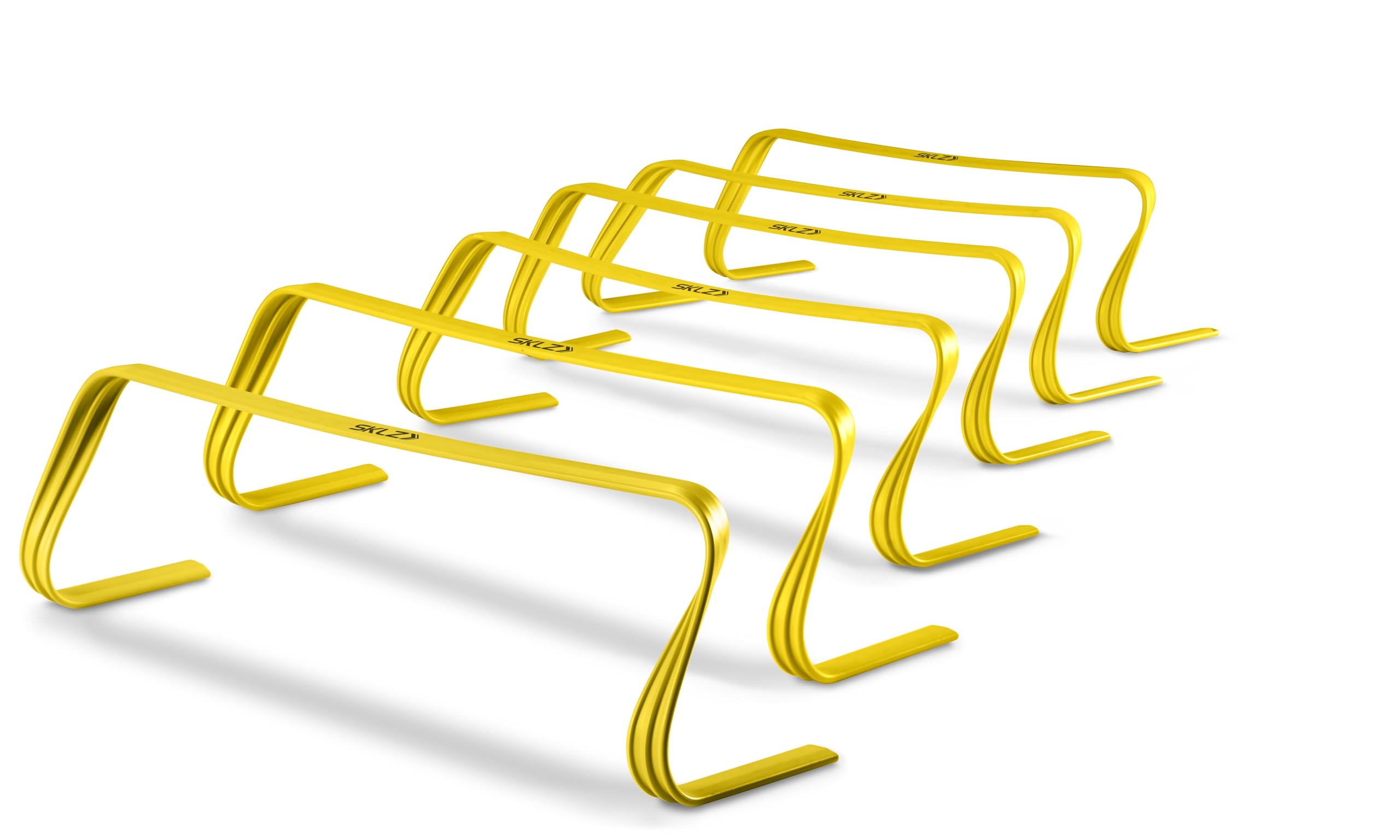
SKLZ builds the 6X from a composite that's meant to be stepped on, and the one-piece twist frame flattens under a foot and springs back into shape. Nothing clicks apart to set them up, nothing small goes missing, and there's no assembly before a session — you pull them out of the bag and put them down.

That forgiveness is why these are our pick for beginners. At six inches they're low enough that a hesitant athlete can walk the line first, jog it, then sprint it, and when someone catches a foot the hurdle gives instead of planting them. The yellow isn't a small thing either; these are the easiest set here to pick out from the far side of a field, which matters when you're counting hurdles at the end of a session.

The bag swallows all six with room over, and the set is light enough for a parent to carry in one hand alongside a water bottle. It's the priciest set we recommend, and for a first set for a young athlete it's still the one we hand over first.

Bottom Line

The first set we hand a young athlete: the composite springs back under a clipped foot, and six yellow hurdles plus a bag cover most drills.

Check Latest Price

Best for Teams

Our Score 9.4/10
ASENVER 12-Hurdle Training Set

ASENVER

ASENVER 12-Hurdle Training Set

  • Color Orange
  • Material ABS plastic
  • Set Contents 12 hurdles, 10 cones, 2 hand straps
Check Price on Amazon

Twelve hurdles and ten cones in one bundle, enough for a full squad circuit.

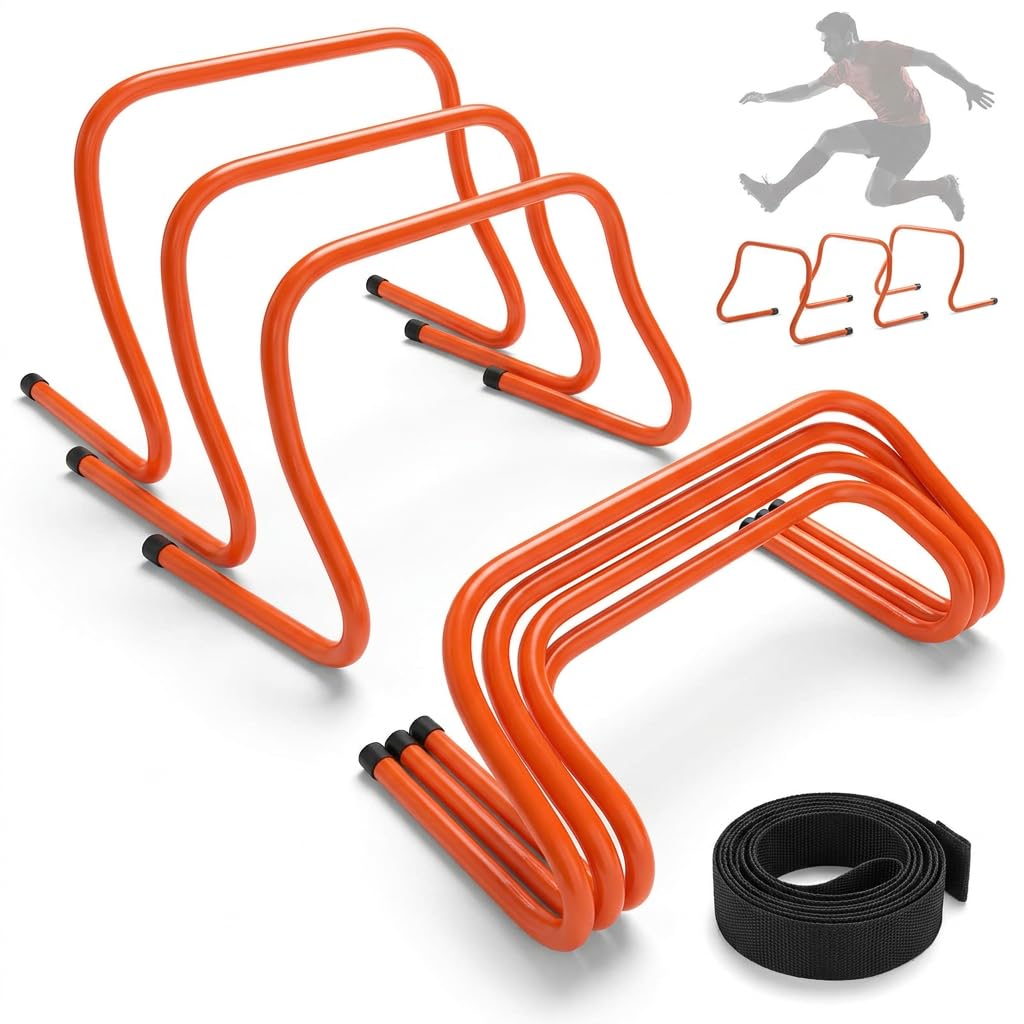
Twelve hurdles, ten disc cones, and two hand straps in one box — this is the set you buy when you're building a circuit for a squad rather than a line for one athlete. The straps are the detail we appreciate most: they bundle the whole stack into one carry, so setting up a station doesn't mean three trips to the car.

The hurdles are ABS in a bright orange that stands out against grass, and the cones let you mark gates, turning points, and start lines without buying anything else. Setup is quick, and the straps keep the whole set together in the trunk between sessions.

Where it earns its place is team training. Twelve hurdles lets you build two lines and keep a queue moving, which is the difference between a session where everyone is working and one where they're standing around — and per hurdle it's the best value in this group. If you train alone, it's simply more hurdles than you need.

Bottom Line

We keep this one for teams: 12 hurdles, 10 cones, and straps that bundle the whole lot into a single carry.

Check Latest Price

Best For One-athlete setups

Our Score 9.4/10
Body Sport Adjustable Hurdles

Body

Body Sport Adjustable Hurdles

  • Folding Collapses flat
  • Set Size 5 hurdles
  • Carry Bag Included, extra large
  • Height Settings 6, 9, and 12 inches
Check Price on Amazon

The bag is the giveaway: Body Sport ships this five-pack in a carry bag generous enough for the hurdles plus cones, a stopwatch, and whatever else is coming to the field. It's a small thing that makes the set easier to live with than a strap and a stack.

The hurdles adjust to 6, 9, or 12 inches and collapse flat, which puts them in the same useful category as our top pick: one set covering warm-up footwork and reactive work without buying twice. Changing height takes a moment of working the legs into place, but nothing comes apart in your hands.

They're steady on a flat surface and quick to break down, and the oversized bag means the whole kit goes back in one piece at the end of a session. For a physical-therapy setup or a single athlete, that's a tidy package.

The one hesitation is the long haul. If you're outfitting a club that trains four nights a week, the QUICKPLAY or the SKLZ is the safer call; for an individual or a small group, the price, the adjustment, and that bag make this the sensible buy.

Bottom Line

If you want adjustable heights and a bag that swallows everything, this is the set we recommend after our top pick.

Check Latest Price

Best Overall

Our Score 9.2/10
QUICKPLAY Adjustable Speed Hurdles

QUICKPLAY

QUICKPLAY Adjustable Speed Hurdles

  • Frame High-impact polypropylene, flexes on impact
  • Set Size 6 hurdles
  • Carry Bag Included
  • Height Settings 6, 9, and 12 inches
Check Price on Amazon

Three heights on one hurdle means a single set covers beginners through advanced athletes.

Three heights on the same hurdle is why this set leads our list. Rotate the legs and these six hurdles sit at 6, 9, or 12 inches, so a coach working with a mixed group can drop everyone to six for a warm-up and raise the same line for a reactive drill. It's the difference between buying one set and buying two.

Nothing unclips to make the change, which is the part we appreciate most. The legs fold rather than detach, so there's no bag of loose parts to keep track of in the grass, and the whole line goes up in the time it takes to walk down it. Between sessions the six stack into the included bag and fit in a small trunk.

Lightness cuts both ways. On a gym floor or short turf they sit where you put them; on an open field with a breeze they tip, and a hurdle lying on its side mid-drill is the thing that will annoy you. Set the line across the wind rather than into it and you'll spend far less time resetting.

The frame is high-impact polypropylene with a breakaway construction that flexes under a clipped foot instead of stopping the athlete dead, which is what makes these usable with athletes still learning to pick their feet up. The bag is thin nylon — fine for the job, not the part you'll be admiring.

Bottom Line

The one we point most people to: three heights on one hurdle means a single set covers a whole squad, and it folds flat into a bag.

Check Latest Price

Best for Coaches on the Go

Our Score 9.2/10
NWS Forza Speed Hurdles

NWS

NWS Forza Speed Hurdles

  • Height 6 inches
  • Material Shatterproof plastic
  • Set Size 6 hurdles
  • Warranty 6 months
Check Price on Amazon

Light, bright six-inch hurdles that one coach can carry and set up alone.

Six hurdles, one arm, one walk to the far touchline. The Forza set is built around being carried: six-inch shatterproof hurdles that weigh very little, stack flat, and don't need a trolley or a second trip from the car.

What we value is the lack of drama. They stand at six inches, they're bright enough to spot at dusk, and ours have been thrown in and out of a trunk all season without a crack. For a coach setting up alone, that reliability matters more than a clever folding mechanism.

One practical note before you order: the pack is hurdles only, so add a tote or a strap if you want them bundled for the walk in. Everything else about the set is fit-and-forget, which is the whole point of a training tool you carry yourself.

Bottom Line

We hand these to coaches who carry their own gear: six light, bright hurdles that go under one arm and shrug off a trunk ride.

Check Latest Price

Best Budget

Our Score 9.2/10
Yes4All Agility Hurdles, 5-Pack

Yes4All

Yes4All Agility Hurdles, 5-Pack

  • Material ABS plastic
  • Set Size 5 hurdles
  • Warranty 1 year
  • Carry Strap Included
Check Price on Amazon

Solid, flat-sitting hurdles at the lowest price here, best for gym-floor footwork.

Cheapest set here, and it doesn't feel like a compromise in the hand. Five neon-orange hurdles, a carry strap, and PP caps on the tips so they don't scuff a gym floor — for one adult running footwork drills, that's the whole job done.

The trade is rigidity. The ABS frame doesn't flex, so catching a foot on one stops you rather than letting you through, and on a gym floor that stiffness is exactly what keeps them planted: ours sit flat and stay where they're put.

Where they don't suit is a group of kids learning to jump. Without give, a misstep is a stubbed toe and a hurdle on the floor, and the fun goes out of it quickly. Hand them to an adult with a drill to run and they'll last.

Bottom Line

Our budget pick, and the one we suggest for an adult on a gym floor: solid, flat-sitting hurdles that don't move.

Check Latest Price

Best For Driveway sessions

Our Score 9.2/10
Trademark Innovations Speed Hurdles

Trademark

Trademark Innovations Speed Hurdles

  • Height 6 inches
  • Material Plastic
  • Set Size 5 hurdles
  • Warranty 1 year
Check Price on Amazon

The first thing to do with this five-pack is stand all of them on a flat floor and look along the line. The frames don't always arrive straight — a bent leg leaves one corner off the ground, and a hurdle that rocks is one an athlete learns to step around rather than jump. Send back any that won't sit flat; the set is cheap enough to make that worth the trouble.

What you get is five six-inch hurdles in orange, light enough to carry in one hand and simple enough that there's nothing to assemble. On a flat driveway or a gym floor they do their job: high knees, lateral steps, quick feet through a line. A one-year warranty backs them, which is more cover than some pricier sets here list.

For a parent running footwork in the driveway with one or two kids, this is enough set at a price that doesn't sting when someone stands on one. For a coach who needs ten matched hurdles in a straight line, the inconsistency will drive you mad — the adjustable set at the top of this list is the better buy.

Bottom Line

We rate it for a driveway and a couple of kids, less so for a coach who needs five hurdles that match — check them the day they land.

Check Latest Price

Best For Big group drills

Our Score 8.8/10
GHB 8-Inch Agility Hurdles

GHB

GHB 8-Inch Agility Hurdles

  • Height 8 inches
  • Weight 250 grams per hurdle
  • Storage Carry bag and strap
  • Set Size 10 hurdles
Check Price on Amazon

Eight inches is the height that makes this set interesting. Most cheap hurdles are six inches; most adjustable sets top out at twelve. Ten fixed hurdles at eight sit in the gap where a lot of intermediate footwork and lateral work actually happens.

The count is the other argument. Ten hurdles at 250 grams each is a stack one person can carry, and the kit gives you two ways to do it — a storage bag and a separate strap — so you can bundle them tight for the trunk or sling the lot over a shoulder.

They go together from sections rather than folding out in one piece, so the first session starts with ten small assemblies. After that, leave them made up and carry them on the strap; there's no reason to break them down between sessions.

For a coach who wants a lot of hurdles at a middle height without paying premium money, this is the practical buy — ten per box means two lines running at once without sharing. Just don't expect the fit and finish of a set that costs more.

Bottom Line

Ten eight-inch hurdles for the price of a decent six-pack is the trade we take when a coach needs stations for a big group.

Check Latest Price

How We Tested Agility Hurdles

We began by researching the market and filtering out any hurdle with a narrow height range or a base that looked easy to tip. From there, we narrowed to 12 sets that represented the most common designs—fixed vs. adjustable, plastic vs. metal, collapsible vs. one-piece. Over six months, we used each set in real training sessions: backyard drills on grass, indoor work on turf and concrete, and quick setup at a local park. We ran dogs of different sizes and experience levels through the same sequences, then repeated the drills to see which hurdles held their settings.

Adjustability was a big focus. We changed heights up and down at least a dozen times per set, timing how long it took and checking whether the locking mechanisms stayed tight or slipped during use. We also paid attention to stability—whether a base stayed put when a dog brushed a bar, and how much the legs slid on smooth floors. For durability, we left several sets outside through rain and sun, then looked for rust, cracks, or fading. We also tested flexibility by watching how the hurdles responded to a clumsy jump—did they flex and return, or tip over?

Finally, we evaluated training utility and value. We watched how easily dogs understood each hurdle—whether the bar height was consistent, whether the base was visible, and whether a knocked bar was easy to reset. We compared what each set offered in terms of material quality, height range, and portability against its cost. The 12 sets that made our list are the ones that required the least fiddling and the most actual training time.

How to Choose

Height First, Then Adjustability

Six inches is the workhorse: low enough to sprint over and low enough that a nervous beginner can walk through the line before jogging it. Nine and twelve inches change the drill — more knee lift, more timing — and they're where an athlete who has mastered six inches goes next. If you coach a group with a spread of ages, an adjustable set like the QUICKPLAY replaces two fixed sets and saves the second purchase. If it's one athlete at one level, a fixed six-pack is simpler and cheaper.

The common mistake is buying twelve-inch hurdles for a young team because they look more serious. They don't work harder; they just get knocked over more.

What a Clipped Foot Meets

Breakaway and flex frames bend under a foot and spring back, so a mistimed jump costs you a reset rather than an ankle. Rigid ABS doesn't move, which is stable on a flat floor and unforgiving when a child catches a toe. Match the design to the least experienced person who will use the set, not to the best athlete in the group.

Expect the flex to be the part that ages. The leg joints on folding designs are where a season of full-weight landings eventually shows up, on every set here. Buy for the replacement cost you can live with.

Surface, Wind, and Where You'll Set Up

These hurdles are hollow and light because you have to carry them, and that's the same reason a breeze takes them. On a gym floor or short turf they sit and stay. On an open field, lay the line across the wind rather than into it and expect to reset one or two mid-session. Check all four feet before you start — a hurdle with one leg in a divot is a trip hazard, not a training aid.

Grass also changes the effective height: feet sink, and an eight-inch hurdle ends up sitting at six. Walk the line once after setup and look at it from the athlete's side.

Count and Packing

Six hurdles is the standard drill line and enough for most individual sessions. Ten or twelve lets you build two stations and keep a queue of athletes moving, which is exactly why a team should look at the ASENVER rather than two six-packs.

Then think about the walk from the car. A strap is fine for a stack you carry fifty yards; a bag is better if the hurdles live in a trunk between sessions and share space with cones, a ball, and whatever else comes along.

Frequently Asked Questions

Final Verdict

The QUICKPLAY Adjustable Speed Hurdles are the set we recommend first: three heights, six hurdles, and a fold-flat design that goes from warm-up to reactive work without a second kit. It's the one purchase that keeps working as the athletes in front of you get better.

If your group is young and still learning to pick their feet up, fixed and bouncy beats adjustable, and the SKLZ 6X is the one to get. Outfitting a squad instead? The ASENVER twelve-pack fills two stations for less per hurdle than anything else here.