Strength & Weights

Best Adjustable Kettlebells of 2026

An adjustable kettlebell is a set of plates locked into a shell by a dial, a pin, or a lever, so one bell replaces five or six fixed ones. The appeal isn't only the money — it's not surrendering a corner of the room to a rack you'll outgrow in a season. What the marketing leaves out is that the mechanism is everything: a good one swings like a solid lump of cast iron, and a bad one clicks against your forearm and wobbles overhead.

Over nine months, my team and I have worked 11 of them into our own training — swings in the garage, cleans in a low-ceilinged spare room, presses wherever there was headroom — and the gap between good and bad shows up in the first set. New buyers fixate on weight range; the handle matters more, since a thick, glossy grip shreds your hands long before the load does. Somewhere below is the bell that fits your training and your floor space.

Best Overall

Our Score 9.6/10
BowFlex SelectTech 840

BowFlex

BowFlex SelectTech 840

  • Adjustment Dial
  • Dimensions 8.82"L x 7.01"W
  • Handle Diameter 28 mm
  • Weight Settings 8, 12, 20, 25, 35, 40 lb
Check Price on Amazon

Six weights from 8 to 40 pounds in one footprint, changed with a dial.

Six kettlebells in the footprint of one — 8.82 by 7.01 inches of floor — is the claim, and it's the one that kept mattering. The dial moves through 8, 12, 20, 25, 35, and 40 pounds, and you work it with the bell sitting on the floor between sets. In a one-bedroom apartment, that's the difference between a habit and a bell that ends up under the bed.

The change itself is quick, a couple of seconds, and the shell holds its balance at every setting, so a 25-pound swing and a 40-pound swing feel like the same object. Where the design costs you is shape. The body is taller and squarer than cast iron, which is invisible in swings, goblet squats, and rows and obvious in cleans, snatches, and anything that passes the bell under a leg. Build your training on those movements and this isn't your bell.

The handle is 28 millimeters of textured plastic, comfortable for two hands and easy to hold once your palms are going. Two years of warranty covers the mechanism, and the bell arrives with a two-month trial of the brand's app-based coaching membership — a genuine bonus if you like guided sessions, easy to ignore if you don't.

What we didn't expect was how little thought it takes. There's no decision about which bell to pick up and no walk to a rack, so a ten-minute session actually happens. That's most of the case for going adjustable at all.

Bottom Line

Our default pick: six weights from 8 to 40 pounds, changed with one dial, in a footprint small enough to leave out. The shell is bulky, but nothing here matches the range.

Check Latest Price

Best for Beginners

Our Score 9.6/10
Polyfit Adjustable Kettlebell

Polyfit

Polyfit Adjustable Kettlebell

  • Material Polyethylene
  • Handle Diameter About 30–38 mm
  • Weight Settings 5, 8, 12 lb
Check Price on Amazon

Light, soft-handled, and easy to start with at five to twelve pounds.

Twelve pounds is the ceiling, and that is the whole decision. The three settings — 5, 8, and 12 — make this a first bell, a warm-up bell, or the only bell that fits in a small apartment where 40 pounds of iron isn't welcome.

Within that brief, what we appreciated is the finish. The shell is coated in a soft, grippy polyethylene that's kind on forearms during cleans and doesn't need chalk, and the handle is roomy enough for two hands at a swing. It's also the only one here we didn't mind leaving out in a living room — the green is genuinely good-looking and doesn't read as gym equipment.

The weight change is a rotating top section, and the habit worth building is checking that the segment has seated with its markings lined up before you swing, since a partly seated segment can click into place mid-movement. Twisted home properly, the setting stays put through swings and squats. For a beginner working on hip hinge and tempo, it's the least intimidating bell we used; twelve pounds just isn't a long runway.

Bottom Line

We recommend it as a first bell or a warm-up bell, not for a lifter who will outgrow twelve pounds inside a month.

Check Latest Price

Best Cast-Iron Feel

Our Score 9.2/10
Yes4All Adjustable Kettlebell

Yes4All

Yes4All Adjustable Kettlebell

  • Material Cast iron
  • Dimensions 10.62"L x 9.06"W x 13.39"H
  • Weight Settings 7.8, 12.4, 17.9, 23.9, 29.9, 35.4, 40 lb
Check Price on Amazon

A real iron bell in seven steps, with a flat base for floor work.

Cast iron changes the character of an adjustable bell, and this is the one for anyone who wants theirs to feel like a kettlebell rather than a small appliance. Seven settings run from 7.8 to 40 pounds, and the odd decimals give away how it works: the steps come from the plates, not a dial, so the ladder climbs in roughly five- to six-pound rungs. That's a finer ramp than the dial-controlled bells here manage, and it matters most when you're pressing, where a big single jump is a lot to absorb.

The wide handle takes both hands, and the flat bottom does two jobs: the bell stands upright on a shelf, and you can plant your hands on it for renegade rows without it rocking. The plates are stamped with their weights, so you can see what's loaded without counting discs, and the lock seats with a click we trusted more than we expected to.

Against the composite bells, you're trading speed for feel. Keep one by the desk and switch weights between circuits and the dial wins; set the weight, run your sets, and change it when the program says so, and cast iron at this kind of money is the better bargain. It's also the pick we'd hand someone who dislikes the look of an adjustable shell — a stack of plates reads as a weight, not a gadget.

Bottom Line

Buy this one if you want cast iron under your hands and a flat base for floor work; the changes are slower, but it swings like a bell rather than a machine.

Check Latest Price

Best Premium Build

Our Score 9.2/10
REP Fitness Adjustable Kettlebell

REP Fitness

REP Fitness Adjustable Kettlebell

  • Weight 40 lb
  • Material Iron
  • Adjustment Push-and-turn dial
  • Handle Diameter 1.3 in
Check Price on Amazon

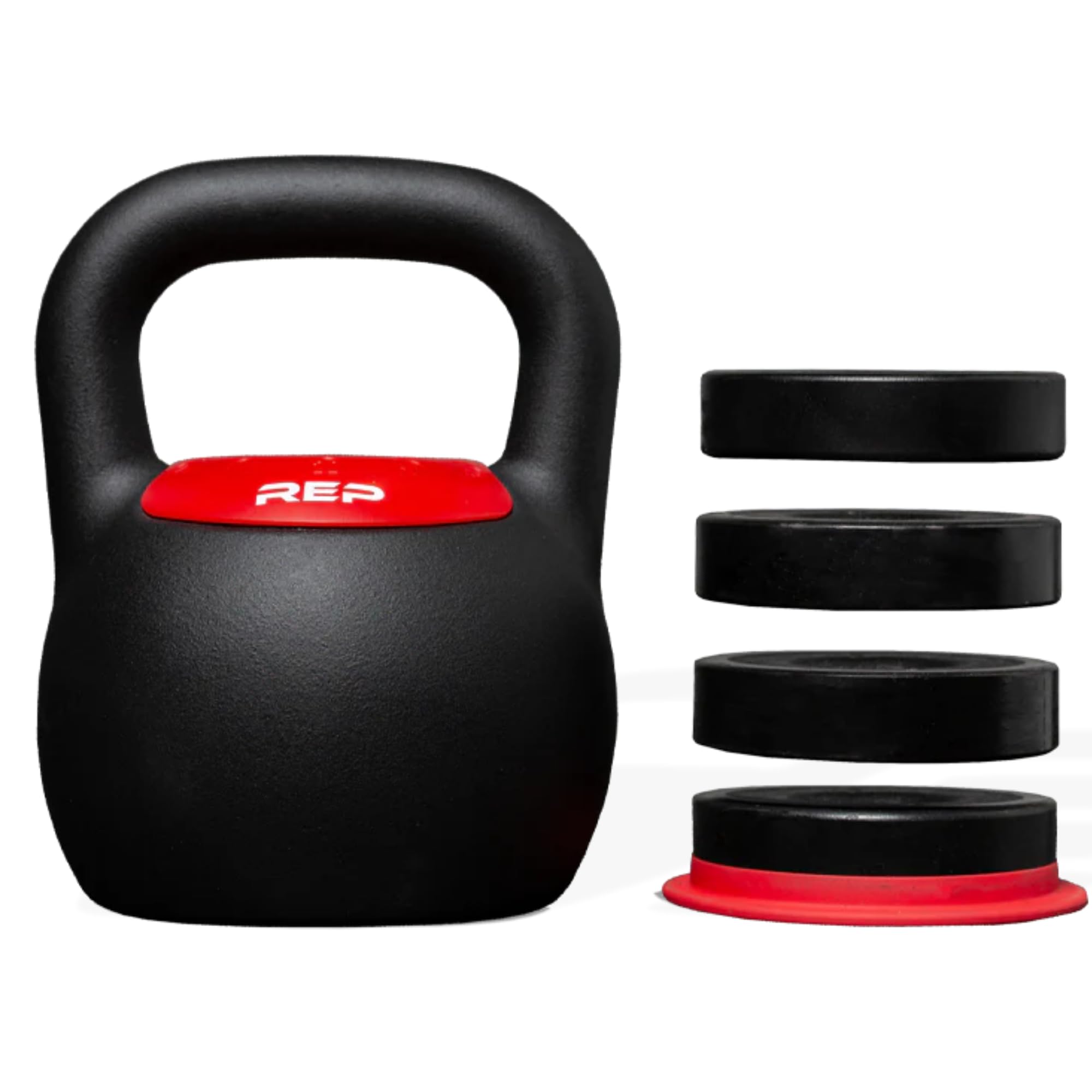
Matte iron and a wide handle, with a dial you can work one-handed.

The first thing we noticed is the finish: matte powdercoat rather than the glossy shell the dial bells wear, which makes the REP feel like gym equipment instead of a gadget. The handle measures 1.3 inches across — wider than the 28-millimeter handle on our top pick — so two-handed swings and high pulls have room to spare, though that same width is a lot to wrap if your hands are small.

The mechanism is a push-and-twist dial that works one-handed, which is the point: you can change the load without setting the bell down and re-gripping. Inside, nylon thermoplastic retainers hold the plates; the stack swings flat, but shake the bell and you can hear the weights settle, which is the one part we'd keep an ear on over a year of use.

It's the priciest bell here, and the iron and the finish are most of what you're paying for. One thing to settle before ordering: the listing doesn't spell out the weight ladder for the 40-pound model, so confirm the steps line up with your working weights. Do that, and it's the best-feeling bell of the group to pick up.

Bottom Line

The one to choose when a matte iron finish, a wide handle, and a one-handed dial are worth paying the most in this group for.

Check Latest Price

Best For Plate owners

Our Score 9.0/10
Apex Kettlebell Handle Set

Apex

Apex Kettlebell Handle Set

  • Material Cast iron
  • Starting Weight 20 lb
  • Plate Compatibility 1-inch standard plates
  • Capacity With Plates Up to 50 lb
Check Price on Amazon

This is a handle, a base, and four spacer discs; the kettlebell is the stack of standard one-inch plates you already own. If there's a box of them in the garage, this turns that pile into a 20-to-50-pound bell for a fraction of what a loaded one costs, which is a very different proposition from buying another complete kettlebell.

In use it's more conventional than it looks. The cast-iron handle is wide enough for two hands, the powder coat grips, and the base unscrews so you can stack plates on the center pin and lock them back down. Budget a minute or two for a change and do it between exercises rather than inside a circuit — this is not a bell you'll be resetting mid-set.

The other catch is arithmetic. Reaching the advertised 50 pounds takes a full 30 pounds of plates under the handle, so the top end is really a statement about your plate collection rather than about the handle. In a garage gym with a mixed pile that's fine; if you were counting on a specific number, weigh what you've got first. Loaded and locked, it swings like a solid bell because, in effect, it is one.

Bottom Line

Worth it only if a stack of standard one-inch plates is already sitting in your garage; then it's the least expensive road to a heavy bell.

Check Latest Price

How We Tested 11 Adjustable Kettlebells Over Nine Months

We started by assembling every adjustable kettlebell we could find with a genuine weight range, then filtered by mechanism type, jump increments, footprint, and price per pound of range covered. That narrowed things to 11 bells, each of which went home with a tester for nine months. They got used the way people actually use them: swings in a garage, cleans and presses in a spare room with a low ceiling, a quick set before work, doubles work on the weekend.

Weight accuracy came first. Every setting on every bell went onto a calibrated scale, and we logged the gap between the number on the dial and the number on the display, then checked whether that gap grew at the top of the range. For ergonomics, we measured handle diameter with calipers, noted where the plate seams sit against the forearm in the rack position, and watched for shells that rotated against the wrist mid-clean. For adjustability and ease of use, we timed each change with a stopwatch from a standing start and recorded whether the bell had to be set down, flipped over, or could be switched one-handed between sets.

We loaded each bell to its stated capacity and ran ten two-handed swings, listening for rattle and checking that the lock held. Then we kept going: hundreds of weight changes over nine months, re-checking for loosened plates, chipped shells, and handles that had gone slick with chalk and sweat. Value came last — what a given range costs against buying the equivalent fixed bells one at a time, and whether the jumps in between are small enough to actually be useful.

How to Choose

Start with the bottom of the range, not the top

Everyone checks the top number. The number that decides whether a bell earns its corner is the bottom one: something that starts at 20 pounds can't warm you up, teach a press, or hand a lighter bell to a beginner in the house. Look for a ladder that brackets your working weights for swings, presses, and goblet squats, then check the size of the steps.

Step size is where adjustable designs diverge most. Our top pick jumps from 12 to 20 pounds, which is a big leap for pressing; the plate-loaded Yes4All moves in roughly five-pound rungs. Write down the weight you swing and the weight you press before you order — those two numbers eliminate most of the field.

Dials, plates, and screws: how the weight changes

Speed of change is the difference between a bell you use and a bell you skip. A dial resets in a couple of seconds and can be worked between sides of a set. A plate-loaded bell with a locking collar takes a minute and belongs between exercises. A screw-base handle takes longer still, which is fine for a garage program and miserable for a circuit.

So match the mechanism to the training. If your program drops from 40 pounds to 25 between rounds, buy the dial. If you set the weight for the session and leave it, plate-loaded designs give you iron feel for less money. Either way, seat the lock fully and check it before the first swing.

Handle, shape, and the movements you actually do

A wide handle makes two-hand swings comfortable and can crowd a small hand on one-arm presses; diameters across these picks run from 28 millimeters to 1.3 inches. If your hands are on the smaller side, that difference is worth more attention than the weight range.

Shape matters more than most shoppers expect. Composite dial bells are taller and squarer than iron, which is invisible in swings and rows and obvious in cleans, snatches, and anything that passes the bell under a leg. If your training is built on those movements, weight the cast-iron designs higher, or keep one fixed bell for them.

Footprint, base, and what it replaces

An adjustable earns its keep by replacing a rack. One bell covering six or seven weights is the difference between a home gym and a pile in the corner, and it's why these designs win in apartments. Check the base as well as the body: a flat bottom stands upright on a shelf and lets you plant your hands on it for renegade rows and push-up rows.

If you already own a stack of standard plates, price the handle-and-base route before you buy a loaded bell — the Apex turns plates you have into a 20-to-50-pound bell for less than a complete one costs.

Frequently Asked Questions

Final Verdict

If you want one bell that covers a whole session, from warm-up swings to heavy goblet squats, the BowFlex SelectTech 840 is the one we point people to: the fastest change here, the widest range, and the smallest footprint of the group.

Take the Yes4All instead if cast iron under your hands and a flat base for floor work matter more than speed, and the Polyfit if twelve pounds is genuinely all the weight you need.