Strength & Weights

Best Adjustable Ankle Weights of 2026

An ankle weight looks like the least complicated thing you could strap to your body: a cuff, a few pockets, a strip of hook-and-loop. Then you wear one through a full set of leg lifts and the truth shows up — the filling bunches at one end, the strap gives, and by minute ten you're re-fastening instead of finishing your reps. A good pair fixes that quietly. It stays where you put it, spreads the load instead of digging in above the ankle bone, and takes you from two pounds to ten without your buying four separate cuffs.

I've used ankle weights since rehabbing a knee injury, and my team has now spent four months with 14 pairs — in living rooms during PT exercises, on gym floors, and on evening walks. The surprise: total weight matters far less than how that weight is packaged. A flat, slim profile hugs the ankle and stays put; a bulky cuff swings and drags no matter how hard you cinch it. The picks below earned their place, sorted by what each one is actually best at.

Best Overall

Our Score 9.2/10
Healthymodellife Adjustable Ankle Weights

Healthymodellife

Healthymodellife Adjustable Ankle Weights

  • Shell Neoprene
  • Adjustment Removable weight bags
  • Set Weight 10 lb
  • Weight Per Ankle 1 to 5 lb
Check Price on Amazon

Our pick for walks and mat work: it stays put from 1 to 5 pounds.

Most ankle weights fail the same way. They slide down the calf within the first few minutes, and the rest of the walk becomes a negotiation with a strap that will not stay where you put it. This is the pair in our group that held its position: five removable bags per side take each ankle from 1 to 5 pounds, the neoprene shell is soft against bare skin, and the closure cinches far enough down to sit tight on a genuinely small ankle.

The range covers what most people want from ankle weights. At 1 or 2 pounds per side they are unobtrusive for mat Pilates, rehab sets, and ordinary walks; load all five bags and you have a 10-pound pair for leg extensions, hip work, and slow strength circuits. Changing the load is straightforward — the bags slide into their pockets and the strap comes off and on without a fight, which matters more than it sounds when you are switching between exercises mid-session.

One thing to settle before you order: unlike the Sportneer and Zelus pairs, which publish a 7.5-to-12.5-inch fit range, this one gives you no circumference figure to check against. If your ankles run wide, measure them first. Everything else about it is unfussy, including the grip strip that keeps the strap end from curling up as you move.

What we kept coming back to is how little there is to think about once they are on. No hitching mid-set, no welts behind the ankle, no strap end flapping against the shin. For a piece of kit whose whole job is to be forgotten about until the last rep, that is the strongest thing we can say.

Bottom Line

Our default pick: it stays where you strap it and stays comfortable, and the 1-to-5-pound range handles walking, mat work, and physical therapy.

Check Latest Price

Best For Wider ankles

Our Score 9.2/10
Zelus Adjustable Ankle Weights

Zelus

Zelus Adjustable Ankle Weights

  • Shell Polyester and Oxford fabric
  • Sandbags Five 1 lb per side
  • Stated Ankle Fit 7.5 to 12.5 in
  • Weight Per Ankle 1 to 5 lb
Check Price on Amazon

Two details separate the Zelus pair from the other 1-to-5-pound sets here: metal rings underneath the hook-and-loop, and a published fit range of 7.5 to 12.5 inches. The rings let you pull the strap past where Velcro alone gives up and lock it there, which is exactly what you want at the heavier end of the range.

Five removable 1-pound sandbags per side take it to 5 pounds per ankle, and the strap, rings, and closure are sewn to a reinforced polyester and Oxford-fabric body rather than neoprene. Loading follows the same ritual as the rest of these: open the sleeve, slide in the bags you want, close it up, strap on.

Where we landed is that this is the pair for a wider ankle or a strap that keeps slipping. The published range gives you something to measure against before ordering, the rings give you a second pull at tightness, and 1 to 5 pounds per side is the range that suits most training. At a mid-range price it is a sensible alternative to our top pick, particularly if fit matters more to you than padding.

Bottom Line

If your ankle runs wide or the strap keeps letting go, this is the pair we point you to, thanks to the rings and the published range.

Check Latest Price

Best for a Wide Fit Range

Our Score 9.0/10
Sportneer Adjustable Ankle Weights

Sportneer

Sportneer Adjustable Ankle Weights

  • Bags Five 1 lb per side
  • Pair Weight 2 to 10 lb
  • Stated Ankle Fit 7.5 to 12.5 in
  • Weight Per Ankle 1 to 5 lb
Check Price on Amazon

A published 7.5- to 12.5-inch fit, soft neoprene, and 1-pound bags per ankle.

Neoprene on the outside, a moisture-absorbing lining on the inside, and a soft outer trim: the Sportneer pair is built like a brace rather than a sandbag with a strap attached. That is the right instinct for something worn against bare skin for half an hour at a time, and it is why this is the pair we reach for on a warm day.

It is also the pair we point to when fit is the worry. The stated window of 7.5 to 12.5 inches is the widest in this group, and the wicking lining makes the pair easy to wear over a thin sock for a whole session. Five 1-pound iron sand bags per side give you a 2- to 10-pound pair, and because every bag is the same size, two bags is two pounds and three is three — the load is easy to reason about instead of guess at.

The friction is in the sleeves. Pull a bag out and getting it back in takes patience, which is a small thing until you are doing it between sets. The practical fix is to decide your load before you strap them on and leave it alone for the session; treat these as a set-and-go pair rather than something to fine-tune mid-workout.

For walking, Pilates, and physical therapy at moderate loads it does everything asked of it at a mid-range price, and the lining means you are not peeling it off a damp ankle at the end.

Bottom Line

Choose this pair when fit is the worry: it publishes a 7.5-to-12.5-inch range, wears softly against the skin, and climbs from 2 to 10 pounds.

Check Latest Price

Best for Rehab Progressions

Our Score 9.0/10
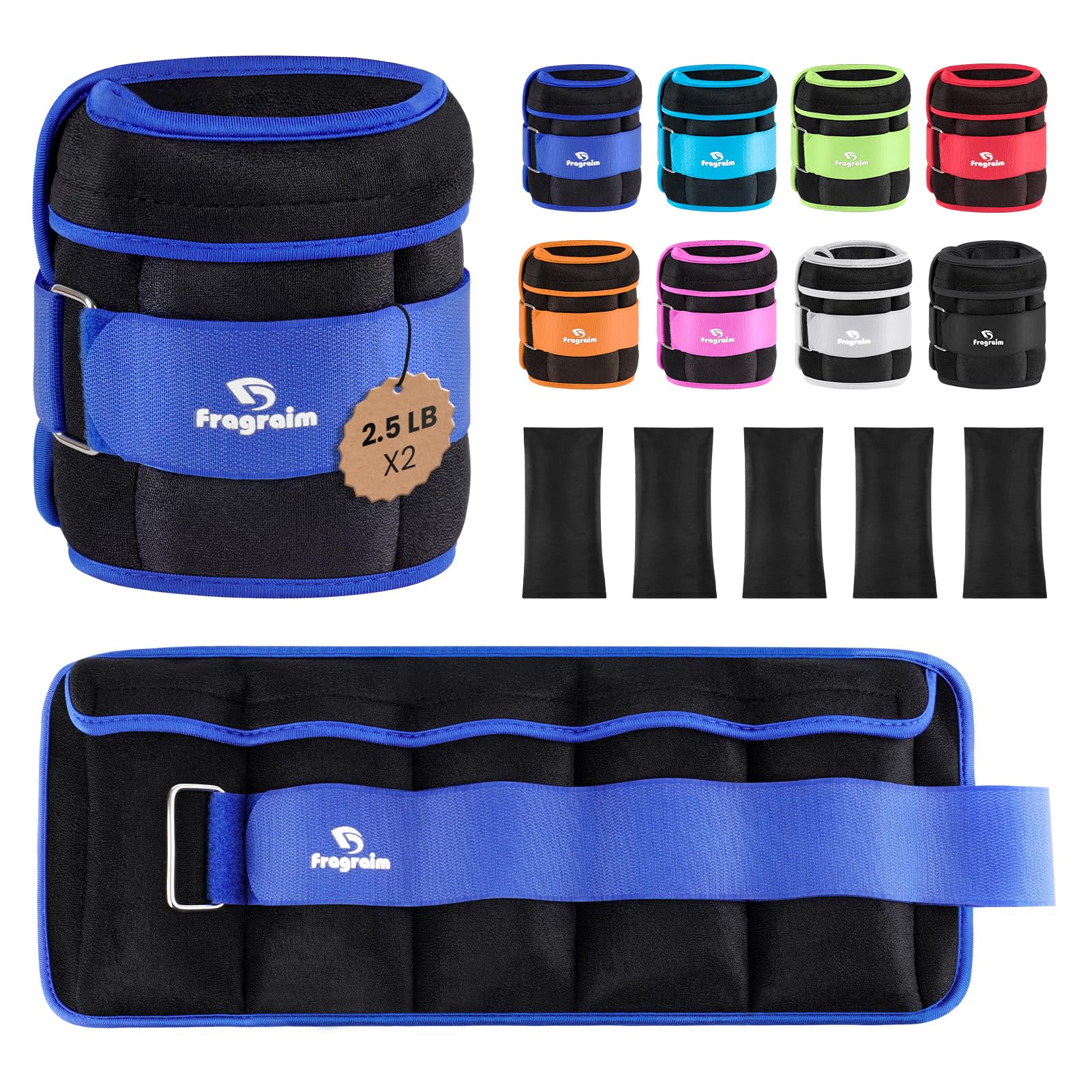
Fragraim Adjustable Ankle Weights

Fragraim

Fragraim Adjustable Ankle Weights

  • Shell Mercerized cotton
  • Bag Size 0.5 lb
  • Pair Weight 5 lb
  • Weight Per Ankle 0.5 to 2.5 lb
Check Price on Amazon

Half-pound bags let you start at 0.5 pound on each ankle and build slowly.

Half a pound is the number that matters here. Each of the five sandbags per side weighs 0.5 pound, so you can start at half a pound on each ankle and climb in half-pound steps to 2.5 pounds a side — the finest ladder in this group. If you are adding load week by week after an injury, or working through a physical therapy progression, that fine a step is the whole point.

Mercerized cotton with a moisture-absorbing lining makes it the most pleasant of these against bare skin: softer and less clammy than the neoprene pairs, and far less likely to have you peeling it off after a sweaty session. The hook-and-loop is strong, genuinely strong, which cuts both ways.

The catch is the strap. It runs long, and on a slim ankle there is a tail left over while the fit sits loose rather than snug; this is the loosest fit of the pairs we tried on smaller ankles. If your ankle is on the small side, start with a pair that publishes its range — the Sportneer and Zelus sets both state a 7.5-inch minimum, and this one does not.

Below that ceiling it is a well-made, comfortable pair for mat work, gentle walking, and the slow build-back that rehab asks for, and it is the one we hand people starting from nothing.

Bottom Line

This is the pair we hand someone rebuilding from a light load, because nothing else here climbs in half-pound steps.

Check Latest Price

Best For Light mat work

Our Score 9.0/10
Apexup Adjustable Ankle Weights

Apexup

Apexup Adjustable Ankle Weights

  • Shell Neoprene
  • Modules Five 1 lb per side
  • Pair Weight 10 lb
  • Weight Per Ankle 1 to 5 lb
Check Price on Amazon

Three pounds per side is where this pair changes character. Load one or two of the five 1-pound modules into each strap and it behaves; fill the sleeves and the pack can work its way down the calf, because the closure can only do so much against that much weight swinging.

Below that, the design is neat. The iron-sand modules are compact and sit flat in their sleeves, so the profile stays lower than the bag-and-pocket pairs here, and there is a little stretch in the strap that makes it comfortable over a sock. Adjusting is a matter of sliding modules in or out — no zips, no folding, no wrestling with a flap.

We recommend it for mat work, pool sessions, and short walks at a pound or two per side, where the low profile is a real advantage and the load never gets heavy enough to shift. At a mid-range price that is a fair trade — just do not buy the 10-pound version planning to train at five pounds a side.

Bottom Line

We recommend it for mat work and pool sessions at a pound or two per side, not for loaded strength work.

Check Latest Price

Best Budget

Our Score 8.8/10
Amazon Basics Adjustable Ankle Weights

Amazon Basics

Amazon Basics Adjustable Ankle Weights

  • Shell Polyester
  • Closure Dual hook and loop
  • Set Weight 5 lb
  • Weight Per Ankle 0.5 to 2.5 lb
Check Price on Amazon

The least expensive way in, with half-pound inserts and a 2.5-pound ceiling.

This is the least expensive set in the group by a wide margin, and it does the core job: removable inserts take each ankle from 0.5 pound to 2.5 pounds, and a dual hook-and-loop closure holds the pack flat instead of bunching it under the strap.

We think of it as a starter pair rather than a training pair. At 2.5 pounds per side there is enough load for a walk, standing leg work, and the exercises a physical therapist hands you, and the half-pound increments mean you can creep up on a weight rather than jump. Anyone with a heavier setting already in mind is better served by one of the 10-pound sets here.

Fit is the catch. The polyester shell is cut generously, and on a smaller ankle it sits wide with the strap doing all the work — over a thick sock it is fine, against bare skin it is the least snug of the pairs here. The fabric is functional rather than inviting, without the softness of the neoprene and cotton options.

None of that matters much if the question is whether you will actually wear ankle weights. This pair answers it for the smallest outlay in the group: if the habit sticks, you will know exactly what to look for next; if it does not, you have risked the least.

Bottom Line

Buy it to find out whether you will wear ankle weights at all: it is the least expensive way in and it does the core job.

Check Latest Price

How We Tested 14 Pairs of Adjustable Ankle Weights

We started with roughly 60 listings and cut anything that couldn't be adjusted in increments of a pound or two, anything with a single wide strap and no real fit range, and anything where the weight was sealed in and couldn't be pulled out for washing. That left 14 pairs, from budget sand-filled cuffs to steel-bar designs, and we wore them for four months.

Testing happened where ankle weights actually live: living room floors during physical-therapy-style leg lifts and clamshells, the mat at the gym for accessory work, evening walks around the block, and one editor's standing desk. We wore each pair over bare skin and over socks, logged every time a strap had to be re-secured mid-set, and timed how long it took to strip a pair from 8 pounds down to 2 between exercises. We also strapped each one onto wrists for arm raises, to see whether a single pair could cover both jobs.

Hook-and-loop got the harshest treatment: 50 open-and-close cycles per pair, then a check for fuzzing and whether it still held at full tension with 8 pounds swinging from it. We watched for sand leaking through seams and stitching pulling loose after repeated adjustments, and noted whether the weight came out easily enough to hand-wash the shell. Fit was checked on ankles from about 7 to 11 inches around, and bulkiness got judged by whether a cuff clipped the opposite leg during walking lunges. Finally, we compared cost per pound, since a pair that tops out at 5 pounds is poor value no matter how cheap it looks in the cart.

How to Choose

Look at the Increment Before the Maximum

The number to check first is the size of one bag, not the heaviest setting. A 1-pound bag gives you a coarse ladder — one, two, three, four, five pounds per ankle — and that is plenty if the goal is making a walk or a mat class harder.

Half-pound bags double the number of stops, which matters when you are adding load week by week after an injury or working through a physical therapy progression. The Fragraim and Amazon Basics sets both use 0.5-pound bags, though each stops at 2.5 pounds per ankle. Decide the increment your progression needs, then confirm the ceiling is high enough.

Fit Is the Purchase

Ankle weights stay on through strap tension, so the circumference a strap covers matters more than the load in the sleeve. Two pairs here publish a range, 7.5 to 12.5 inches; the rest say one size fits most, which describes other people's ankles rather than yours.

Measure around the narrowest part of your ankle, over the sock you plan to wear, before ordering. A long strap tail on a slim ankle is the other half of fit: it flaps, catches on trouser cuffs, and usually means the pack is not sitting flat against the leg.

How You Actually Change the Weight

Almost every adjustable pair here works the same way: sleeves or pouches sewn to the inside of the strap, filled with sand or iron-shot bags. Sliding a bag into a sleeve holds the load flatter against the ankle but takes longer than dropping it into an open pocket.

Think about when you will swap. If you change load between sets, look for a closure you can open without looking; if you set the load once a month, a tight sleeve costs you nothing. What defeats the whole idea is leaving every bag in permanently — the range is the reason to buy these rather than a fixed pair.

Ceilings, Materials, and Where Wear Shows Up

Two and a half pounds per ankle is enough to make a walk or a mat class harder; 5 pounds per ankle is where a pair starts to feel like a training tool, and also where straps loosen and packs swing. Loading up and then running or jumping is asking for trouble, because the weight sits at the end of the limb and the ankle takes the leverage.

On materials, neoprene wipes clean and sits soft against skin, cotton breathes better, and polyester is the plainest of the three. Match the shell to how much you sweat, not to how the pair looks in a photo.

Frequently Asked Questions

Final Verdict

Buy the Healthymodellife pair if you want one set for walks, mat work, and physical therapy: it is the pair that stayed put and stayed comfortable, and 1 to 5 pounds per side covers the range most people actually use.

If you are rebuilding from almost nothing, the Fragraim set's half-pound bags let you climb more slowly. And if you are not yet sure ankle weights will become a habit, the Amazon Basics pair is the least expensive way to find out.