How Should a Sports Bra Fit? A Five-Point Movement Check
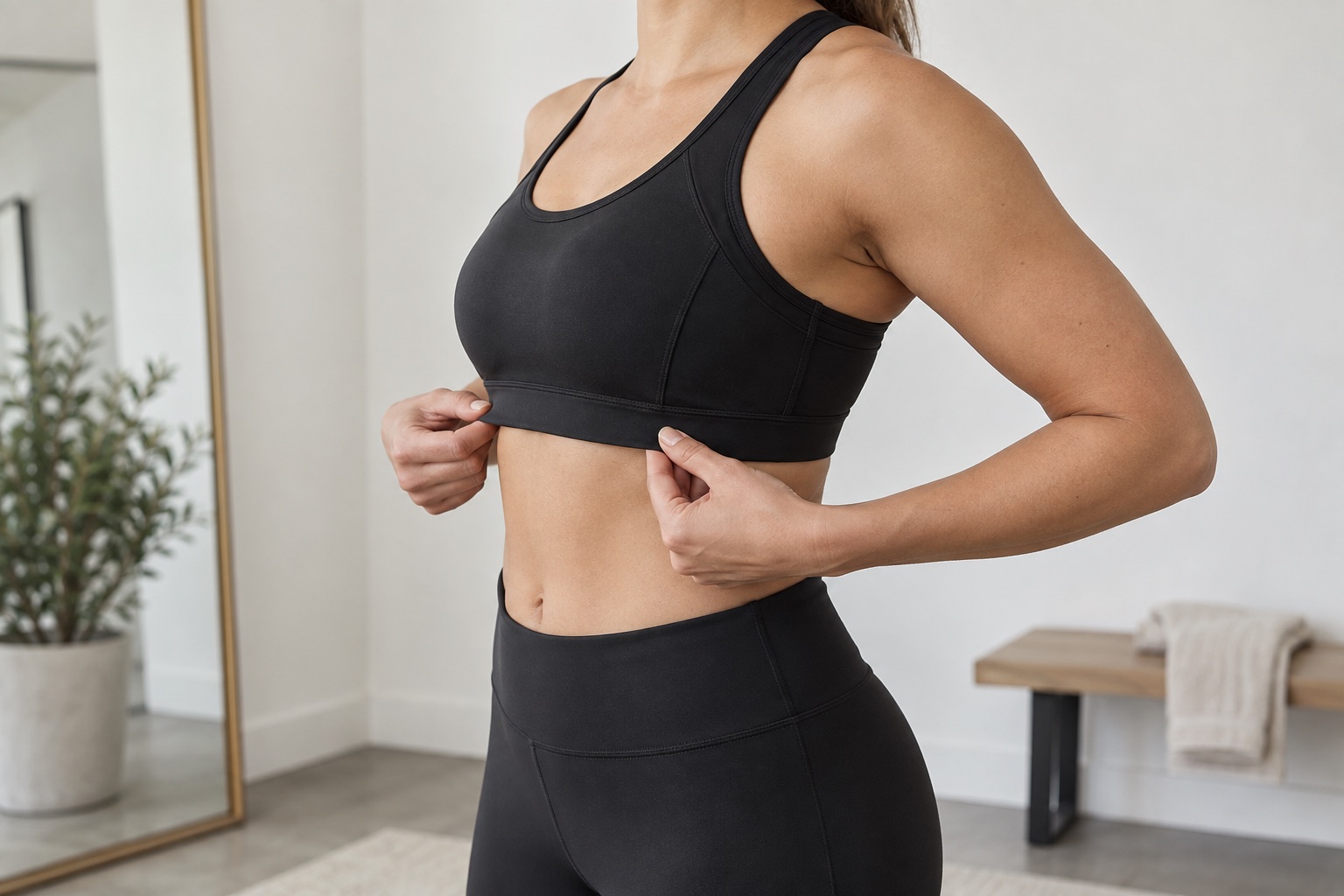
A sports bra should feel firm and secure, not painful. The underband stays level as you move, breast tissue is fully contained without bulging or empty space, straps remain comfortable, and the bra controls movement enough for the intended activity without restricting a full breath.
Fit the bra you are wearing, not the number on its tag. Band and cup sizing varies across brands and styles, and support needs change with activity, breast size and shape, hormonal changes, pregnancy, weight change, and the age of the garment.
Check Five Fit Points in Order
- Underband: it should be level around the torso, firm enough not to ride up, and comfortable through a full breath.
- Cups: all breast tissue should be contained. Reject spilling, side bulges, wrinkles, or empty gaps that persist after adjustment.
- Wire or cup edge: if the bra has an underwire, it follows the breast crease and does not sit on tissue. Wireless cup edges should not cut in or fold.
- Center front: on an encapsulation bra designed with a center panel, it should sit as intended rather than floating far away. Compression styles may not have the same separation.
- Straps: they stay in place without digging, carrying all the load, or requiring maximum tightening.
Then Test the Bra at the Movement You Will Do
- Raise both arms and rotate the torso. The band should stay level and breast tissue should remain contained.
- Take several deep breaths. Stop if the band causes pain, dizziness, numbness, or a sense that breathing is restricted.
- Jog in place, jump gently, or mimic the highest-impact movement in your workout in a private fitting area.
- Notice movement in more than one direction, strap slip, chafing, cup shift, and pressure under the arms.
- Keep the bra only if support and comfort remain acceptable together. Maximum compression is not the same as best fit.
Match the Design to the Support Problem
| Design | How it manages movement | Fit focus |
|---|---|---|
| Compression | Holds breast tissue closer to the chest as one unit | Even pressure, full coverage, no tissue escaping at neckline or armholes |
| Encapsulation | Supports each breast in a separate shaped cup | Correct cup volume, center/front position, and wire or cup edge placement |
| Combination | Uses separate cups plus compression or an outer support layer | All five fit points; extra panels should not fold or create pressure ridges |
| Adjustable high-support | Lets band and straps be tuned for higher-impact movement | Fasteners remain secure; straps assist but do not compensate for a loose band |
What Common Fit Problems Usually Mean
| Problem | First change to compare | Do not rely on |
|---|---|---|
| Band rides up | Smaller or firmer band with compensating cup change if needed | Shortening straps until they dig |
| Breast tissue spills at top or sides | Larger cup, greater coverage, or a different cup shape | A looser band that removes support |
| Cups wrinkle or gape | Smaller cup or shape with less depth/height in the empty area | Assuming every style in the same size will fit |
| Straps dig | Improve band and cup support; compare wider or adjustable straps | Padding straps while the band remains too loose |
| Chafing under arms or band | Different edge height, seam placement, size, or fabric | Waiting for broken skin to toughen |
| Bounce remains painful | Higher-support design that still passes all comfort checks | Simply sizing down into painful compression |
Recheck Fit as the Bra Ages
Repeat the movement test when the band stretches, straps slip sooner, fasteners distort, cups crease permanently, elastic cracks, or support feels different. Wash and dry according to the care label; high heat and incompatible products can shorten elastic life.
Persistent breast pain, a new lump, skin injury, nipple discharge, or pain unrelated to bra pressure needs medical assessment rather than a tighter garment.
Sources and Manufacturer Guidance
Requirements can vary by product, model, and situation. These primary sources informed this guide; official instructions for your exact product and current authoritative guidance take priority.
- University of Portsmouth Research Group in Breast Health: Five-point best-fit criteria
- Breast Research Australia: Evidence-based breast support resources
- Australian Institute of Sport: Breast health and bra-fit resources
- World Rugby and England Rugby: Sports Bra Fitting Guide based on University of Portsmouth research
Frequently Asked Questions
-
Firm enough that the band stays level during movement, but not painful and not restrictive during a full breath. Support should not require numbness, deep marks, or skin injury.
-
Temporary light impressions can occur with close-fitting clothing. Deep, painful, itchy, broken, or long-lasting marks suggest excessive pressure, friction, or an unsuitable edge.
-
No as a general rule. Choose the correct band, cup, coverage, and support design. Sizing down can create spillage, painful compression, and restricted movement without solving the underlying fit problem.
-
The band may be too loose, the elastic may be worn, or the style may not match your torso. Do not try to solve a loose band only by shortening the straps.
-
Neither is universally better. Choose the design that delivers enough movement control while passing the band, cup, edge, center, strap, breathing, and activity tests.