Does Protein Powder Expire? A Practical Keep-Or-Discard Check
Protein powder does not become unsafe at the stroke of midnight on a best-by date, but it also does not last forever. Flavor, aroma, mixability, and some nutrients can deteriorate with time. Moisture, heat, damaged packaging, a dirty wet scoop, pests, or microbial contamination can turn a quality question into a safety question.
In the United States, FDA does not require an expiration date on dietary supplements. If a firm uses one, FDA says it should be supported by valid data and not be false or misleading. That makes the printed date useful product-specific evidence—but not permission to ignore storage history or visible damage.
The Keep-or-Discard Decision
| What you find | Action | Why |
|---|---|---|
| Unopened, within date, intact seal, stored as directed | Usually reasonable to keep | Packaging and date remain within the maker's intended conditions |
| Past best-by date but sealed, dry, intact, and normally stored | Ask the manufacturer using the lot number; decide conservatively | Quality and nutrient stability are product-specific |
| Opened but dry, normal odor/color, within date, clean scoop | Use only if the label's storage directions were followed | Opening introduces handling and humidity exposure |
| Wet scoop, water exposure, condensation, flood, or very humid storage | Discard | Moisture removes the protection that makes dry powder relatively shelf-stable |
| Mold, insects, webbing, off or rancid odor, unusual discoloration, or persistent hard damp clumps | Discard without tasting | These are contamination or deterioration warning signs |
| Broken inner seal before first opening, cracked tub, torn pouch, or unknown decanted powder | Do not use | Identity and contamination history cannot be verified |
| Product or lot is recalled | Follow the recall instructions | Recall scope and remedy are lot-specific |
What the Date Does—and Does Not—Mean
First identify the wording: “best by,” “best if used by,” “use by,” or an actual expiration statement. Date language for foods is often about peak quality rather than an automatic safety cutoff, while a supplement maker that chooses to print an expiration date is responsible for supporting it. Protein powders can be sold as conventional foods with a Nutrition Facts panel or as dietary supplements with a Supplement Facts panel, so do not assume every tub follows the same labeling framework.
The date applies to the product in its original packaging under labeled storage conditions. It does not account for a lid left open in a steamy kitchen, powder stored in a hot car, or contamination from a wet shaker scoop.
Inspect It Without Tasting It
- Check identity. Confirm the product name, lot code, date, and original container.
- Check the package. Look for swelling, cracks, punctures, a broken first-use seal, lid damage, or moisture around the closure.
- Check the storage story. Ask whether it was exposed to heat, humidity, a wet scoop, pests, floodwater, or an unknown transfer container.
- Open and observe. In good light, look for mold, insects, webbing, unusual spots, damp hard masses, or a color change inconsistent with the product.
- Smell from a safe distance. A sour, rancid, musty, or otherwise abnormal odor is a discard sign. Do not taste a questionable powder to “test” it.
- Check recalls and contact the maker. Give customer service the lot code and explain the storage conditions and change you observed.
Are Clumps Always Spoilage?
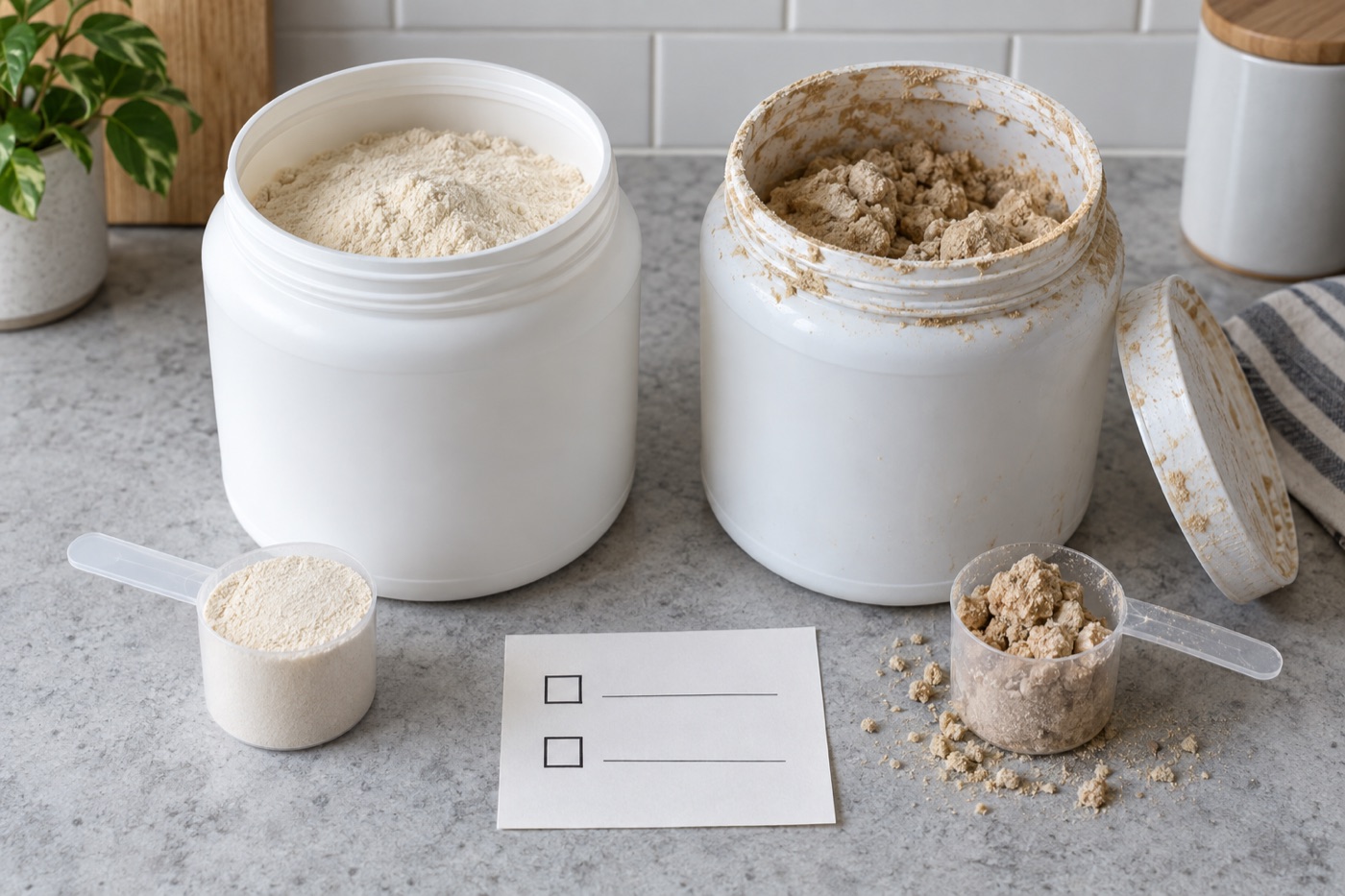
No. Fine powders can compact during shipping, and some ingredients naturally form small dry clumps. The important distinction is the whole pattern: dry clumps that break apart easily are different from damp, hard masses accompanied by condensation, discoloration, abnormal odor, package damage, or a known wet scoop.
When you cannot explain the change, do not use smell or a small taste as a safety test. Contact the manufacturer with photos and the lot number or discard the product.
Store Protein Powder to Protect the Date
- Follow the exact temperature and storage statement on the label.
- Keep the original lot-coded container tightly closed in a cool, dry indoor cabinet.
- Keep the scoop clean and completely dry; never return a scoop from a used shaker.
- Do not store the tub above a stove, beside a dishwasher, in direct sun, or in a hot vehicle.
- Do not top up an old container with new powder. You lose lot traceability and can carry contamination forward.
- Write the opening date on the container if the manufacturer does not provide an after-opening period.
Use a More Conservative Rule When Consequences Are Higher
If the powder is used for a child, during pregnancy, by a person with a weakened immune system, or as part of medically directed nutrition, follow the clinician's and manufacturer's instructions rather than a general internet shelf-life estimate. Dispose of any product with uncertain identity, recall status, seal integrity, or storage history.
Sources and Manufacturer Guidance
Requirements can vary by product, model, and situation. These primary sources informed this guide; official instructions for your exact product and current authoritative guidance take priority.
Frequently Asked Questions
-
The date often concerns product-specific quality, but the answer depends on the label wording, whether the package is open, storage history, and manufacturer stability information. Ask the maker with the lot number; discard if the package or powder shows damage or contamination.
-
Quality and some nutrients can change during storage, but you cannot measure retained protein or nutrient potency at home. The printed date and manufacturer data are more useful than guessing from taste.
-
Small dry clumps can come from settling, but damp hard clumps—especially with condensation, discoloration, package damage, or abnormal odor—are a discard sign.
-
Keep it in its tightly closed original container in a cool, dry place, following the label. Avoid steam, direct sun, hot vehicles, and wet scoops.