Creatine Gummies vs Powder: Dose, Cost, and Evidence Compared
Powder is usually the simpler value choice; gummies may be the easier adherence choice. The evidence supports creatine monohydrate as an ingredient, but you still need to verify how much creatine the finished product delivers, how many pieces make a serving, and whether the product has credible third-party certification.
A gummy is not automatically ineffective, and a powder is not automatically high quality. Compare the finished products on the same dose and cost basis.
Quick Verdict
| Question | Powder usually wins when | Gummies may win when |
|---|---|---|
| Cost | You want the lowest cost per gram of creatine | You accept a premium for convenience |
| Dose control | You want to weigh or adjust the amount | The labeled number of pieces reliably gives your intended amount |
| Ingredients | You prefer minimal added sugar, flavor, or gelling agents | Taste and texture improve consistent use |
| Travel | You can carry a dry, sealed portion | Pre-portioned pieces are easier and storage conditions are suitable |
| Evidence | You want the format closest to most research protocols | The exact gummy has credible finished-product testing |
| Mixing | You do not mind a drink or food mixture | You dislike grit or do not have water available |
Compare the Label in Six Steps
- Find the grams of creatine monohydrate per full serving—not per gummy or per scoop unless that equals a serving.
- Count how many gummies or scoops deliver that amount.
- Calculate total creatine in the package: grams per serving × servings.
- Divide the actual purchase price by total creatine grams.
- Compare added sugars, calories, allergens, sweeteners, and serving burden.
- Verify the exact product and flavor in a credible third-party directory.
If a proprietary blend hides the creatine amount, you cannot make a fair dose or cost comparison.
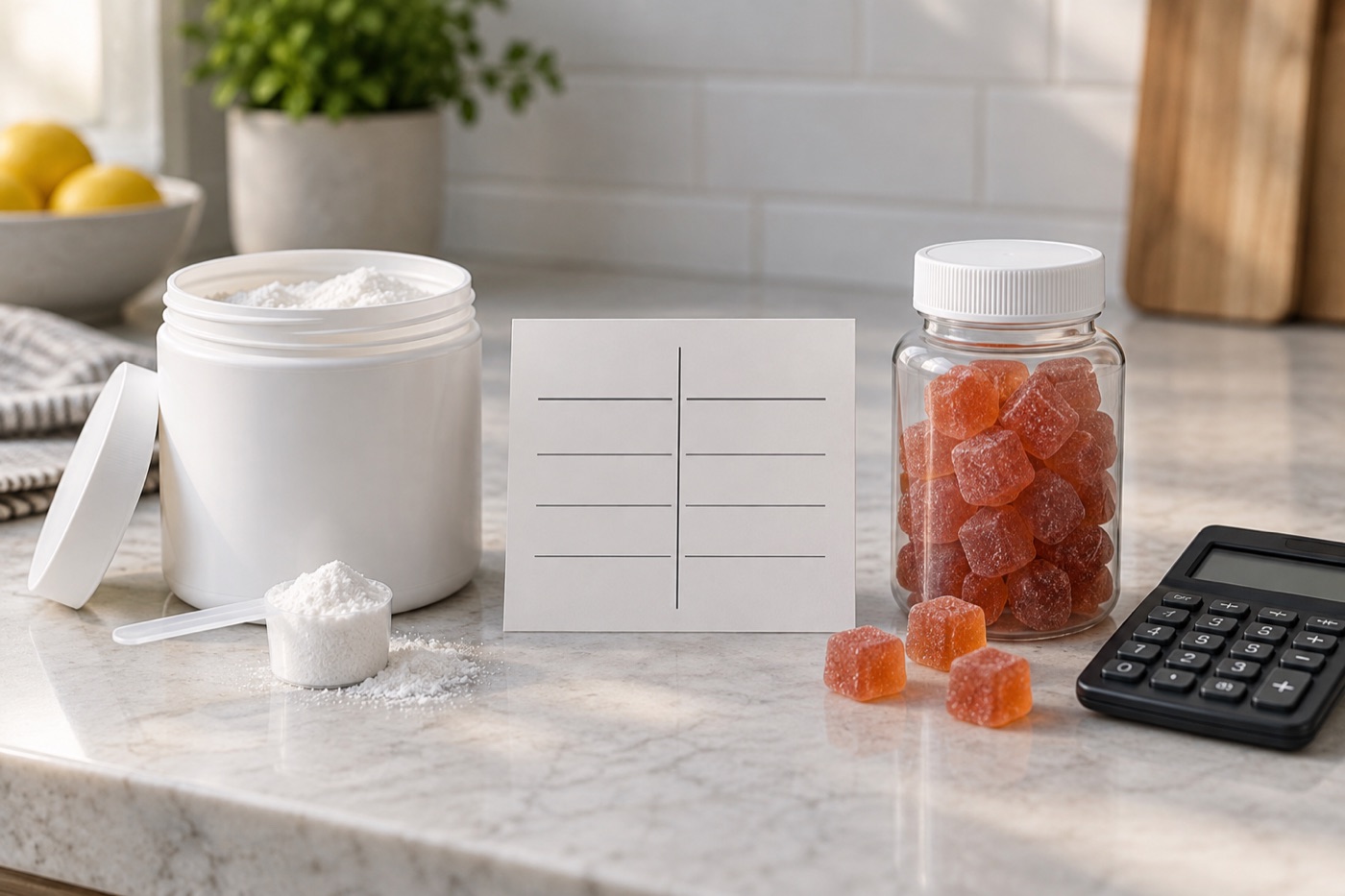
Use Cost per Gram, Not Cost per Serving
Suppose a $25 powder contains 100 servings at 5 g each: 500 g total, or $0.05 per gram. A $30 gummy product with 30 servings at 5 g each contains 150 g total, or $0.20 per gram. The gummy costs four times as much per gram even though the package prices look similar.
Repeat the calculation with current labels and the price you actually pay. Count shipping and subscription requirements consistently. Our protein cost calculator uses a different nutrient, so do not reuse its output; the comparison method is the relevant part.
What the Evidence Can—and Cannot—Tell You
Most performance evidence is about creatine monohydrate, often supplied as powder, rather than a broad head-to-head comparison of commercial gummies and powders. NIH's Office of Dietary Supplements notes that creatine can improve repeated short bursts of high-intensity activity and that other creatine forms have not proved superior to monohydrate.
A small 2026 randomized study reported outcomes for one branded gummy providing 5 g/day versus no supplement in female beach volleyball athletes. That can support research on that specific intervention, but it does not establish that all gummies match powder for dose accuracy, absorption, storage stability, or value—and it was not a direct finished-product equivalence test.
Storage and Stability Deserve Attention
Dry creatine powder is generally stable when kept sealed and dry. Creatine in water is more sensitive to pH, temperature, and time. Gummies are semisolid formulations, so powder data alone cannot prove that every gummy remains on-label through its shelf life.
That does not mean gummies necessarily degrade. It means the finished product should carry a clear expiration or best-by date, storage instructions, lot identity, and ideally independent verification. Avoid products that arrive melted, unusually wet, unsealed, or stored outside the label conditions.
Finished-Product Checklist
For sport certification, follow our NSF Certified for Sport verification guide.
| Check | Good evidence | Red flag |
|---|---|---|
| Dose | Exact grams of creatine monohydrate per serving | Only a blend total or vague creatine complex |
| Serving burden | A realistic number of pieces | Many gummies needed without clear daily total |
| Verification | Exact product in a live independent directory | Logo visible only on marketplace images |
| Traceability | Lot and date printed clearly | Missing or altered code |
| Storage | Specific conditions and intact seal | Heat-damaged or leaking package |
| Value | Price divided by total creatine grams | Cost compared only per serving |
Sources and Manufacturer Guidance
Requirements can vary by product, model, and situation. These primary sources informed this guide; official instructions for your exact product and current authoritative guidance take priority.
Frequently Asked Questions
-
They may deliver the same ingredient, but equivalence depends on the actual creatine monohydrate dose, finished-product quality, stability, and consistent use. Broad direct comparison evidence is limited.
-
There is no universal number. Divide the creatine amount in your powder scoop by the creatine amount per gummy, using the current labels.
-
Formulation, flavoring, molding, packaging, and convenience can add cost. Compare price per gram of actual creatine rather than package or serving price.
-
Follow the exact label. Many shelf-stable gummies do not, but heat and moisture can damage texture or stability. Do not invent storage conditions beyond the maker's instructions.