Accessories

Best Weighted Jump Rope of 2026

A weighted jump rope looks like a simple upgrade, but the difference between a good one and a bad one shows up fast: one gives you a smooth, rhythmic workout, the other slaps your calves and leaves your hands cramping. I've used jump ropes in hotel gyms, on driveways, and in a garage with barely enough clearance, and the pattern is always the same—weight only helps if the rope is the right length and the handles stay comfortable. The right rope fixes that by making the weight feel intentional instead of clumsy, so you can actually finish a workout.

Over the past three months, I tested 14 weighted jump ropes, paying attention to how each one felt during actual workouts rather than just spinning it once in the living room. The biggest surprise was that a heavier rope isn't automatically better—weight distribution, rope thickness, handle comfort, and how easily the length adjusts matter more than the number on the package. Some value picks held up fine; others felt stiff and cheap after a few sessions. The picks below are the ones I'd reach for again, for a quick workout or a longer steady session.

Best Premium System

Our Score 9.6/10
Crossrope Get Lean Set

Crossrope

Crossrope Get Lean Set

  • App iOS and Android workouts
  • Sizing By height, S to XL
  • Connection Quick-clip handles
  • Rope Weights 1/4 lb and 1/2 lb
Check Price on Amazon

Clip-in quarter- and half-pound ropes sized to your height, with the smoothest swaps here.

The price is the first thing to deal with. The Get Lean set costs several times what our midrange picks do, and it arrives as a pair of slim handles and two ropes — no floor, no mat, nothing else to hold. What those handles buy is a fast clip connection plus a 1/4-pound rope and a 1/2-pound rope, and the ability to change between them in a couple of seconds.

That is the feature that turns a weighted rope into a training tool rather than a heavy thing you own. You warm up on the quarter-pound, take a hard round on the half, then drop back when your forearms start to go, all without rethreading a rope through a collar. The handles are textured and shaped so your grip lands in the same place every time, and the swivels turn without the small catch we've felt on cheaper hardware. The ropes are sized by height rather than trimmed, and ours arrived correct — which quietly solves the problem that sinks most weighted-rope purchases.

So the value question answers itself depending on how you train. If you'll swing one weight forever, buy a single rope and keep the difference. If you plan to progress — light rounds, heavy rounds, back to light — the clip system is the thing you're paying for, and the app workouts that come with it are a bonus rather than the reason. We came back to this set whenever we wanted to change intensity mid-session, which turned out to be more often than we expected.

Bottom Line

Buy this if you'll actually switch rope weights between rounds: the clip system is the slickest here, and the height sizing means it arrives at the right length.

Check Latest Price

Best for Combat Sports

Our Score 9.2/10
EliteSRS Muay Thai 2.0

EliteSRS

EliteSRS Muay Thai 2.0

  • Length 10 ft, fixed
  • Material Heavy-duty PVC
  • Rope Weight 1.3 lb
  • Intended Height 6'2" to 6'5"
Check Price on Amazon

A stiff, fixed 10-foot rope built for tall boxers and Muay Thai rounds.

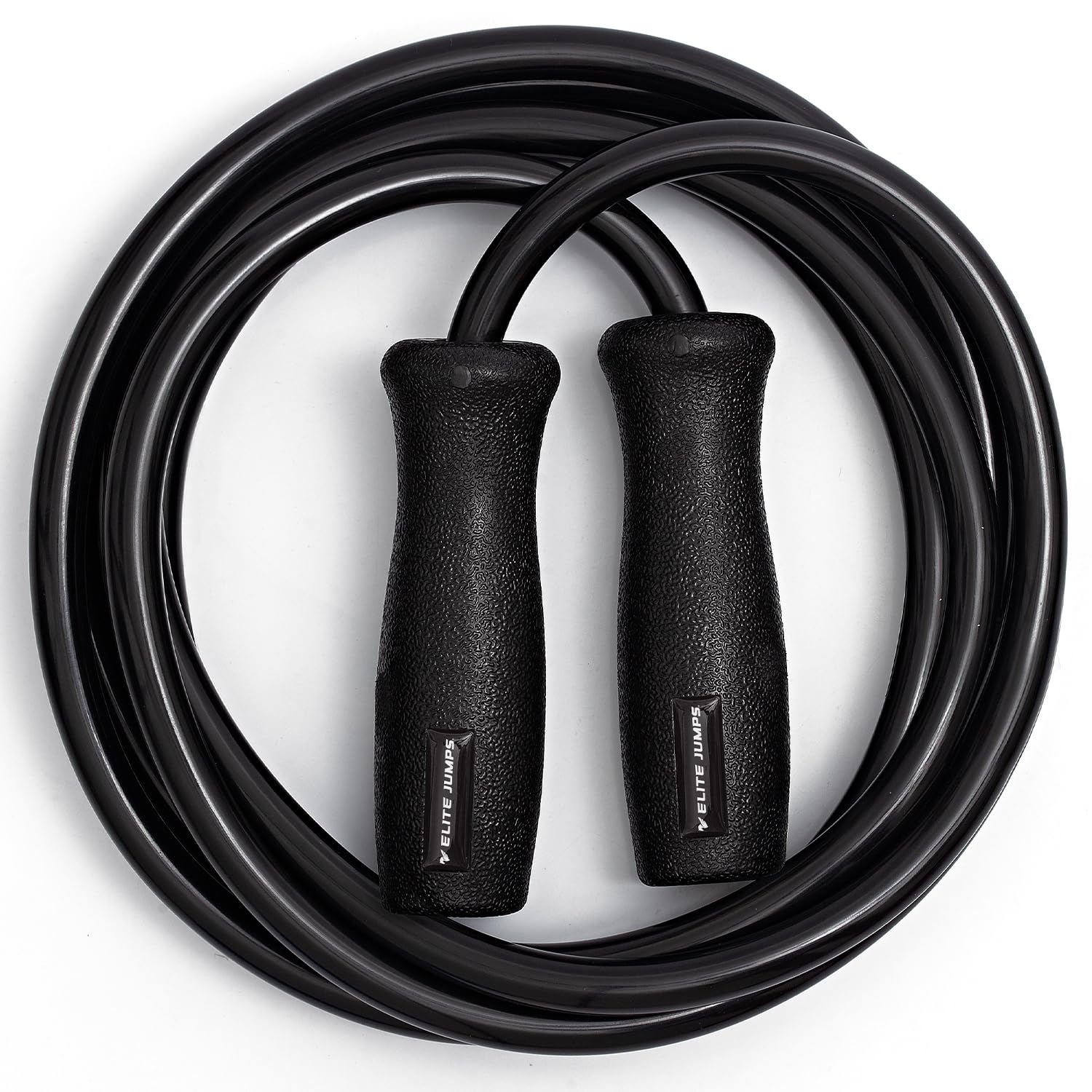
Ten feet, fixed, no collar, no screw. The Muay Thai 2.0 is cut for athletes in the 6'2" to 6'5" range and it stays that length, which is either the simplest thing about it or an immediate dealbreaker. Nothing drifts mid-round, nothing needs re-tightening, and there's no spare rope hanging past the handle to whip you in the ear.

For the right jumper, this is the most satisfying rope in the group. The 1.3-pound PVC holds a shape in the air, so it keeps a clean arc and hands you a rhythm to jump to; a limp cable asks more of your timing and gives less back. Ball bearings in the handles turn cleanly at speed, the molded grips are wide enough for taped hands, and the whole thing is built for gym floors rather than living rooms. We found the stiffness reassuring: it behaves the same on the first turn and the two-hundredth.

One practical note: the PVC arrives coiled and keeps the bend for a day or two, so hang it up before you judge it. After that it becomes a rope you stop thinking about, which is the highest compliment we can pay a piece of gym equipment.

Bottom Line

For tall combat athletes: a fixed 10-foot rope with real momentum, smooth bearings, and nothing to adjust between rounds.

Check Latest Price

Best Light Resistance

Our Score 9.2/10
FEECCO 1/4 lb Weighted Rope

FEECCO

FEECCO 1/4 lb Weighted Rope

  • Length 9 to 10 ft, adjustable
  • Handles Machined aluminum, silicone
  • Rope Weight 1/4 lb
  • Intended Height 5'8" to 6'3"
Check Price on Amazon

A quarter pound of steel cable between machined aluminum handles for fast, clean rounds.

The handles are the first thing you notice: turned aluminum under a silicone sleeve, with enough machining marks to look like they came off a lathe. They're the reason this rope feels more expensive than it is. Nothing creaks or flexes, and the mass sits where your fingers close instead of swinging around at the end of a plastic tube.

The rope itself is a 5.5mm steel cable with a quarter pound of listed weight, which is the light end of what counts as weighted. That's enough that you feel where the rope is without looking down, and not enough to slow your turnover — if you're chasing double unders, this rope won't be the thing that stops you. Between the aluminum and the thin cable, it's the quickest weighted rope we picked up.

Adjustment runs from 9 to 10 feet, which the maker maps to 5'8" through 6'3", and it held where we set it. That's a narrower window than the sliding-collar ropes give you, and it's the thing to check before ordering: 9 feet is still a lot of rope for someone well under that range, and the collar won't take it shorter.

What we didn't expect to care about was the carry bag. It's soft, it has a drawstring, and it means the rope doesn't end up wrapped around a water bottle — a small thing that made this the one we took out of the house most often. Add silicone grips that stay grippy and a cable that keeps its line, and it's a lot of rope for the money.

Bottom Line

For added feel without losing speed: a quarter pound of steel cable between machined aluminum handles, for about what plastic costs.

Check Latest Price

Best For Sized-to-height fit

Our Score 9.2/10
HEREROPE 1/4 lb Weighted Rope

HEREROPE

HEREROPE 1/4 lb Weighted Rope

  • Cable 6mm PVC-coated steel
  • Sizes S, M, L, XL by height
  • Weight 1/4 lb
  • Handles Faux leather grip
Check Price on Amazon

Four sizes picked off a height chart is the least glamorous feature in this guide and the one that decides whether everything else works. Most weighted ropes come fixed at 9 or 9.2 feet and ask you to live with the result; HEREROPE asks your height first and ships the matching length. Ours arrived right, and we never touched a collar. For anyone who has bought a rope that was an inch short, that's worth more than any bearing upgrade.

The rest of it is a light, fast rope that behaves. Six millimeters of PVC-coated steel cable, a quarter pound of listed weight, and bearings in the handles that spin without snagging; it comes out of the bag straight and stays that way through a set. The textured grips kept their hold once our hands got damp, and the whole thing is light enough to throw in a backpack with a pair of shoes.

One habit worth building: check the joint where the cable enters the handle before each session. Thin-cable ropes take a lot of load at that point, and a two-second look is cheaper than replacing the rope.

Bottom Line

Buy this if you want the length settled before the rope arrives: four sizes matched to height, a light cable, and grips that hold when damp.

Check Latest Price

Best Overall

Our Score 9.0/10
Redify Weighted Jump Rope 1LB

Redify

Redify Weighted Jump Rope 1LB

  • Length 120 inches, adjustable
  • Handles Aluminum with silicone grip
  • Rope Weight 1 lb
  • Ropes Included 9mm cotton and 9mm PVC
Check Price on Amazon

Two swappable ropes, grippy silicone handles, and tool-free length adjustment make this the easiest pick.

Two ropes in the box is what sold us on this one. Redify ships a 9mm braided cotton rope, listed at about 0.46 pounds, alongside a 9mm solid PVC rope of the same thickness, and swapping them takes a few seconds at the handle collar. The cotton is the quiet one: it lands soft on a wood floor and won't have the downstairs neighbors knocking. The PVC feels denser through the air and wipes clean after a session on a garage floor.

What we like most is that the swap doesn't cost you the handles. These are aluminum barrels with a raised silicone oval pattern, and they kept their grip once our hands got sweaty — more than we can say for the smooth plastic handles on the cheapest ropes here. Double ball bearings keep the turn loose at a moderate pace, and the built-in lock slides the rope to length without tools, which matters in a house where more than one person jumps. Set it long before your first session; a weighted rope that's an inch short hits your head, not just your feet.

A pound is the middle of the weighted range, and that's exactly why this is our default: enough mass that you feel the rope come over the top of the arc, and not so much that you can't string together a full minute of jumps. It's a cardio rope more than a strength one, and that distinction matters if you're buying to build shoulders rather than to move for longer. For warm-ups, steady skipping and learning double unders, this is the one we reach for.

Bottom Line

Our pick for most jumpers: two swappable ropes, silicone grips that stay put when hands sweat, and tool-free length adjustment, without a premium price.

Check Latest Price

Best for Strength Training

Our Score 9.0/10
Proud Panda Heavy Rope 2.8LB

Proud

Proud Panda Heavy Rope 2.8LB

  • Length 9.2 ft, fixed
  • Handles Soft plastic grip
  • Material Three-strand polymer fiber
  • Rope Weight 2.8 lb
Check Price on Amazon

Nearly three pounds of rope that turns skipping into shoulder and forearm work.

Two or three turns in, the difference is obvious: this rope doesn't flick, it pulls. At 2.8 pounds the mass sits in a three-strand polymer braid closer in feel to a power cord than to anything you'd take to a speed session, and we think that's the point — skipping stops being footwork and becomes a shoulder-and-forearm job. Our first round was humbling. The pace drops, the jump count you manage with a light rope stops mattering, and you feel the rope coming all the way around.

Use it like a strength tool rather than a cardio rope. Short sets with honest rest between them, driven from the shoulder instead of flicked from the wrist, is where this thing makes sense; long steady sessions will just grind you down. The braid has held its shape through our sessions, the soft plastic handles are comfortable for a few minutes at a time, and there's a bag for carrying it to a gym, which is where a rope this heavy tends to live.

Where it fits is as a second rope. Jumping 2.8 pounds before you can time a light rope teaches you to muscle the rope around rather than wait for it, and that habit is hard to unlearn. Pair it with something quick for your speed days and pull this one out when you want to finish a session feeling like you worked.

Bottom Line

For strength days rather than cardio: nearly three pounds of braided rope that makes you drive from the shoulder and ends the set on your forearms.

Check Latest Price

Best Budget

Our Score 9.0/10
KUZARO Weighted Jump Rope

KUZARO

KUZARO Weighted Jump Rope

  • Length 110 inches
  • Handles TPE anti-slip
  • Material Polymer fiber
  • Rope Weight 1.5 lb
Check Price on Amazon

Cheapest way into a genuinely weighted rope, in a finish you won't hide away.

It comes in pink, which sounds trivial until you've owned four black ropes that live in a drawer. This one stayed out on a hook, and it got used more because of it. The 1.5-pound polymer-fiber rope is thicker than most of the ropes here, and the TPE handles have a soft, slightly tacky feel that's kind to bare hands.

A pound and a half is a sensible place to land if you're stepping up from a basic rope. There's weight through the whole arc, so the swing feels deliberate rather than whippy, and it's light enough that a couple of minutes of jumping doesn't end with your shoulders on fire. The thickness is a trade-off: the rope is easy to see and easy to time, but it's a lot of rope to clear, and if you jump narrow and fast it will feel clumsy under your feet.

For the least money here, you get the most rope. The braid has no rough patches, the handles haven't loosened on us, and the swing stays straight, which is more than we expected for the price. It's the rope we hand to someone who wants to try weighted skipping before committing to a system.

Bottom Line

The value pick: a real 1.5-pound rope with soft grips, for jumpers who want to try weighted skipping without buying a system.

Check Latest Price

How We Tested the Best Weighted Jump Ropes

We built the shortlist by reading through customer reviews and spec sheets, then filtering out ropes with vague weight claims, handles that looked too slick, or adjustment systems that required tools. From there, I ordered 14 weighted jump ropes across a range of price tiers, rope lengths, and handle shapes, and we used them for three months.

Testing happened where people actually jump: my driveway, a rubber gym floor, and a backyard patio. I warmed up with three-minute steady sets, then ran 30-second intervals to see whether each rope kept a predictable swing when I got tired. I adjusted every rope to my height and had a taller tester try the same length changes, timing how long it took and checking whether the rope slipped after a few sets. I also left each rope coiled in a bag between sessions and noted whether it kept a stubborn curl, since a stiff rope is a trip hazard in a small space.

I paid attention to the small stuff that decides whether a rope gets used: how the handles felt during sweaty sets, whether the weight pulled at my shoulders, and whether the rope's thickness made it catch the air or skim the floor. To judge durability, I dragged each rope across concrete, checked the handles for wobble, and compared the wear against what each one cost. The ropes that made the list were the ones that stayed comfortable, adjusted without fuss, and still felt worth picking up after three months.

How to Choose

Decide what the weight is for

A weighted rope is a range of resistances rather than one product. A quarter pound of added weight — the FEECCO and HEREROPE end of things — barely slows your turnover, so it suits speed work, double unders, and anyone stepping up from a basic PVC rope. Around a pound, where our top pick sits, is the everyday middle: enough mass to feel the arc, not so much that you can't string jumps together. Past two pounds the rope stops being a cardio tool and becomes a strength one, and the set ends when your forearms decide it does.

Be honest about which of those you'll actually do, because most people buy too heavy and drift back to a light rope. If you want the option of both, an interchangeable set is cheaper than buying two ropes over time; Crossrope's clip-in system is the slickest version here, and Redify's two 9mm ropes do a simpler version of the same trick.

Get the length right before anything else

Length is the specification most likely to ruin the purchase, and the one most listings bury. Stand on the middle of the rope and the ends should reach roughly your armpits. Weighted ropes make a bad length worse because they're less forgiving of a sloppy arc: too long and it drags and catches, too short and it clips your head. Two designs solve it — an adjustable collar you set once, or height-based sizing where you order a size and never touch anything again.

The trap is a fixed rope in a length that doesn't match you. Several heavy ropes here come in around 9.2 feet with no adjustment, which is fine at average height and short for anyone near six feet or taller; if you're tall, start at 10 feet. If you're shorter, an adjustable rope that stops at 9 feet still leaves you a lot of rope, and a size chart is the cleaner answer.

Handles, grip, and where the weight sits

Handles matter more on a weighted rope because there's more force pulling against your grip. Metal barrels with a silicone or rubber sleeve stay put once your hands are damp; smooth plastic goes slick right when you need it. Weight in the handles shifts the work into your forearms and wrists and makes a rope feel heavier than its number, which is good for upper-body endurance and harder on the joints than weight carried in the rope.

Check the hardware, too. Any handle with screw-in weights or a sliding length lock is a place that loosens, and a quick tighten before each session beats replacing a rope. We rate the one-piece molded handles on the EliteSRS and the machined aluminum on the FEECCO for exactly that reason.

Match the rope to the floor you jump on

Cotton and synthetic braid is the quiet option: it lands soft on wood and won't scuff a living-room floor, which is why the Redify's braided rope is the one we reach for indoors. PVC-coated steel cable is faster and wipes clean, but it stings on bare feet and wears fast on concrete. Thick three-strand polymer belongs on rubber gym flooring or a mat.

Give yourself more headroom than you think you need. A weighted rope swings a wider arc than a speed rope, so a ceiling that clears a light rope by a few inches may not clear this one. Keep coated cables off abrasive concrete, and keep any rope away from grit, which grinds a coating from the inside.

What the extra money buys

Cheap ropes aren't automatically bad value — our budget pick is a genuinely weighted pound and a half — but the savings usually come out of the handle joint, the coating, or the length options. More money buys smoother bearings, metal handles, interchangeable ropes and height-based sizing. The top end buys a system rather than a rope.

Our rule: buy the weight and the length you need now, and pay for a set only if you can name the day you'll use the second rope. A rope that fits you at a midrange price will out-train an expensive one that doesn't.

Frequently Asked Questions

Final Verdict

Buy the Redify first. At about a pound, with two ropes that swap in seconds, it covers warm-ups, steady cardio and everything in between, and it's the rope we hand to most people without a follow-up question. If you know you want resistance you can feel in your shoulders, the Proud Panda 2.8-pounder will make you earn every round. And if you'd rather have the length and the progression handled for you, save for the Crossrope set.