Cardio Machines

Best Treadmills for Low Ceilings of 2026

The number that decides your treadmill isn't belt length or price — it's floor-to-ceiling height minus your own height, minus the bounce. Most decks sit six to eight inches off the ground, and incline lifts you closer to the joists still. Under a low ceiling that math gets tight fast, which is why the right machine keeps your head clear without shrinking the belt to something you can't stride on. The fix is a treadmill that lies low: a flat deck, a compact console, a fold that goes down rather than up.

I've measured plenty of basements and sloped attic rooms, and the height on the spec sheet is rarely the number that matters. We've spent the past nine months walking and running on seven treadmills in rooms with ceilings around six and a half feet, watching for noise, steadiness at speed, how long setup took, how quickly each one folds and rolls out of the way, and whether the cord actually reaches the wall outlet. Anything that made me duck was out. What's left fits under a real ceiling and stays there.

Best For Simple daily steps

Our Score 9.4/10
Ulfario LF-X2DF

Ulfario

Ulfario LF-X2DF

  • Belt Size 90 x 38 cm
  • Item Weight 38.5 lb
  • Maximum Speed 4 mph
  • Weight Capacity 264.6 lb
Check Price on Amazon

Lower the handlebar, tip it onto the front wheels, and it rolls like a suitcase. At 38.5 pounds it is the kind of thing one person moves without thinking, which is usually the difference between a walking pad you use and one that lives folded in a corner.

The belt is 90 by 38 centimeters, around 35 by 15 inches, with a five-layer cushioned top, and a 440W motor that tops out at 4 mph. You get an LED readout, a remote, and a handrail that loosens and drops for storage or comes off entirely if you want it under a desk.

The short list of what it does not do: no incline, no app, no programs. In a low room that is less of a loss than it sounds, since an incline lifts you toward the ceiling you are trying to clear and an app you never open is another login. What you keep is a cushioned belt, a rail for balance, and a machine that is ready when you are.

This is the pad we suggest to someone rebuilding a gym habit as a twenty-minute daily walk, and the simplicity is the recommendation rather than an apology for it. The thing that surprised us is how little noise reaches the room: at a normal pace, a podcast at ordinary volume covers it completely.

Bottom Line

A quiet, uncomplicated 4 mph pad with a rail that lowers or comes off, and the one we suggest to someone who would rather walk than configure anything.

Check Latest Price

Best Adjustable Handrail

Our Score 9.2/10
WELLFIT WFTM032

WELLFIT

WELLFIT WFTM032

  • Incline Up to 10 percent, automatic
  • Maximum Speed 8.6 mph
  • Handrail Height 30.5 to 41 inches
  • Weight Capacity 400 lb
Check Price on Amazon

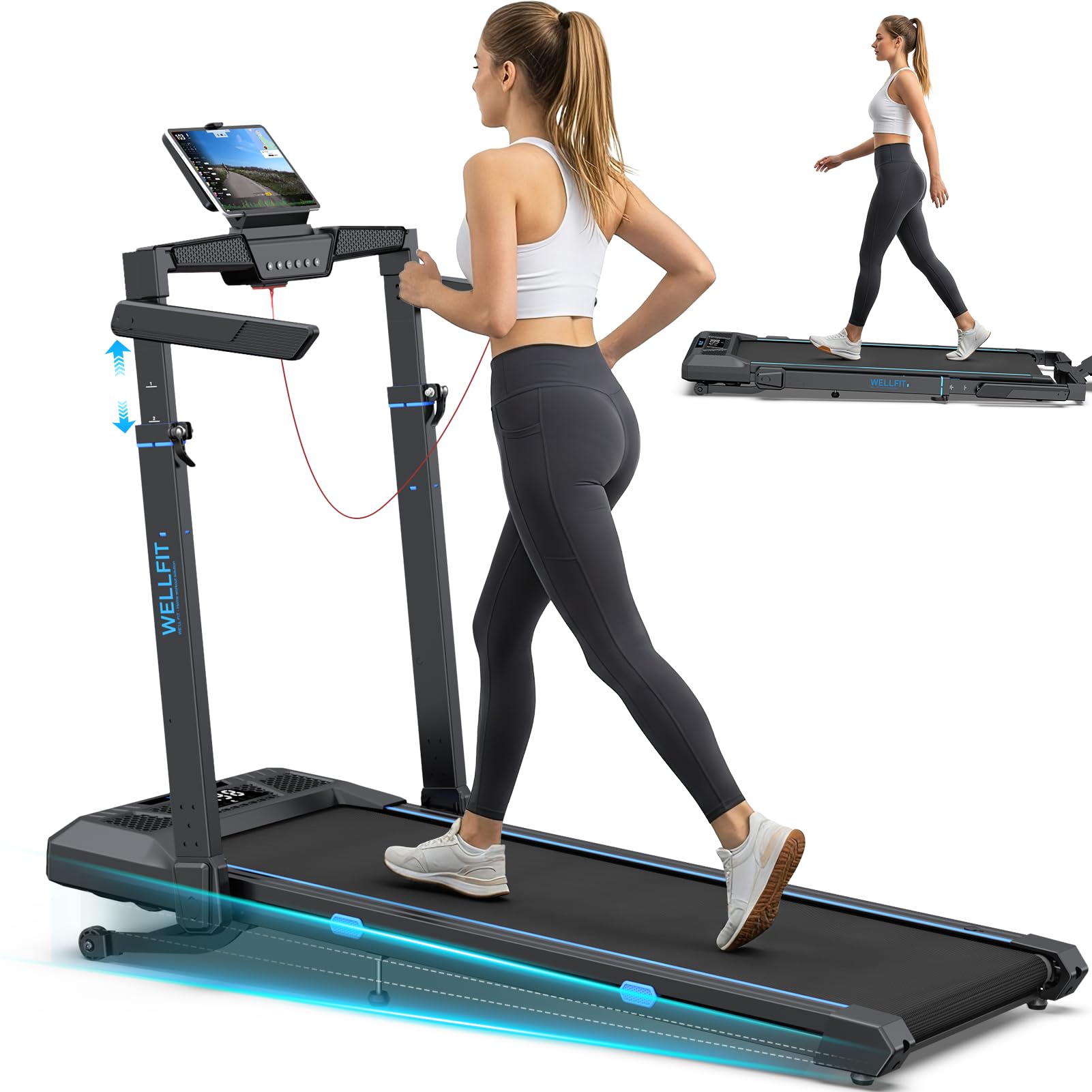
The rail drops to 30.5 inches, so tall and short walkers share one low room.

The handrail is the reason this one exists. It locks at five heights between 30.5 and 41 inches, a range wide enough that a six-footer and a five-footer can both find something like waist height on the same machine. In a low room the bottom of that range does the real work: drop the rail and the tallest thing in front of you comes down with it.

What sells it for us is the package behind that rail. A 400-pound capacity, a 44 by 17 inch belt long enough to actually run on, and a 10 percent automatic incline you change from the console mid-walk instead of stopping to move pins. The motor stays quiet enough that your feet are the loudest part of the session.

It is also the heaviest thing here at 80.5 pounds, which makes it furniture rather than a gadget. It folds to 5.7 inches and lives against a wall; the mass that makes it annoying to carry is the same mass that keeps it steady when you pick up the pace. Plan a permanent corner and the premium is easy to justify.

Bottom Line

Buy this when a low room has to serve two people: the handrail slides from 30.5 to 41 inches, so a six-footer and a five-footer can both hold it.

Check Latest Price

Best Overall

Our Score 9.0/10
Vhorilix Walking Pad

Vhorilix

Vhorilix Walking Pad

  • Item Height 4.33 inches
  • Item Weight 36.4 lb
  • Maximum Speed 4 mph
  • Weight Capacity 264 lb
Check Price on Amazon

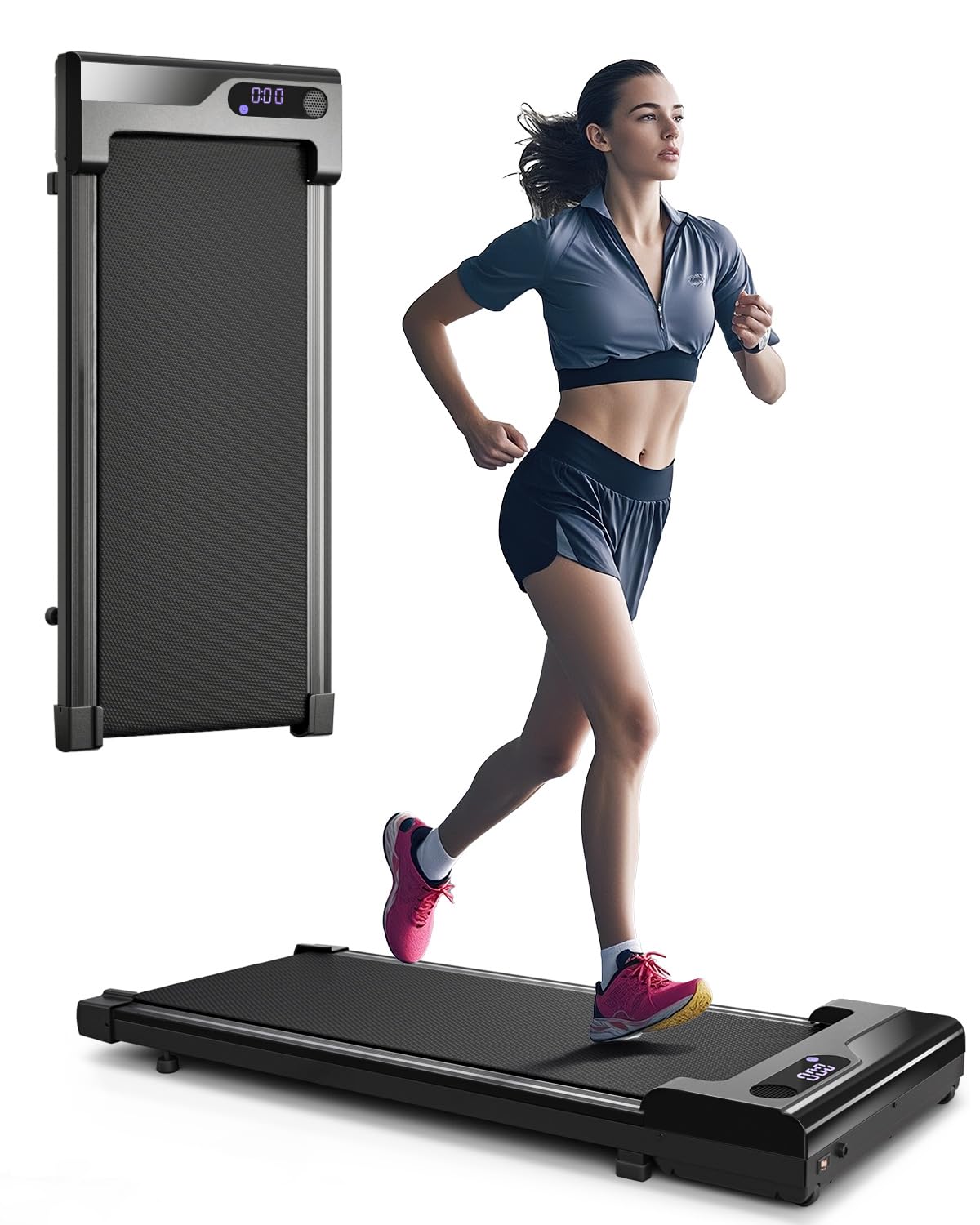
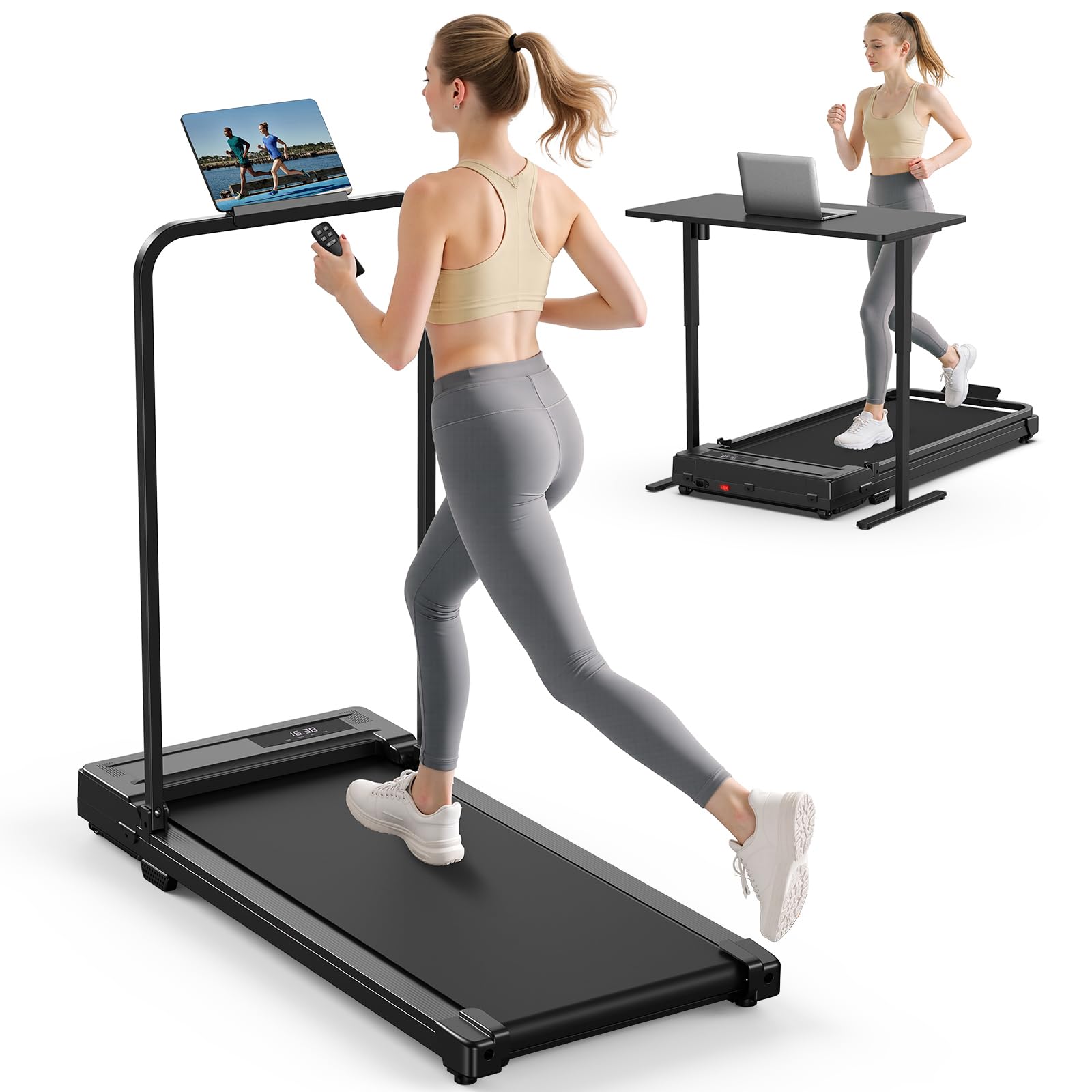
A 4.33-inch deck leaves your headroom alone, then rolls under a bed.

Four and a third inches is the whole machine. Set a pad that flat on the floor of a basement or a room under a stairwell and the ceiling stops being part of the decision: your headroom is your own height plus a deck you step over, with nothing to duck around. We put ours down under a low beam and stopped noticing the beam inside a minute, which is the highest compliment this category offers.

Everything else is deliberately plain. A 2.5HP motor, a small LED readout for speed and distance, a hand-held remote, and a five-layer belt with a diamond-textured top that keeps a sock foot from sliding. At 36.4 pounds with wheels at the front it rolls under a bed or behind a couch, and there is no assembly at all: plug it in, feed the remote two AAAs, walk.

The trade is speed and support. If you want to jog, or you want something to hold when you wobble, the WELLFIT WFTM032 further down answers both. What surprised us is how much of a walking day this still covers — a standing desk, a phone call, twenty minutes before dinner — with nothing to fold, lift, or bolt on.

Bottom Line

At 4.33 inches it barely counts as height, which is why we hand this one to anyone with a low room and a walking habit — the ceiling stops being part of the purchase.

Check Latest Price

Best Value With a Handrail

Our Score 9.0/10
WELLFIT WFTM037

WELLFIT

WELLFIT WFTM037

  • Incline Up to 10 percent
  • Folded Height 6.1 inches
  • Maximum Speed 6.2 mph
  • Weight Capacity 350 lb
Check Price on Amazon

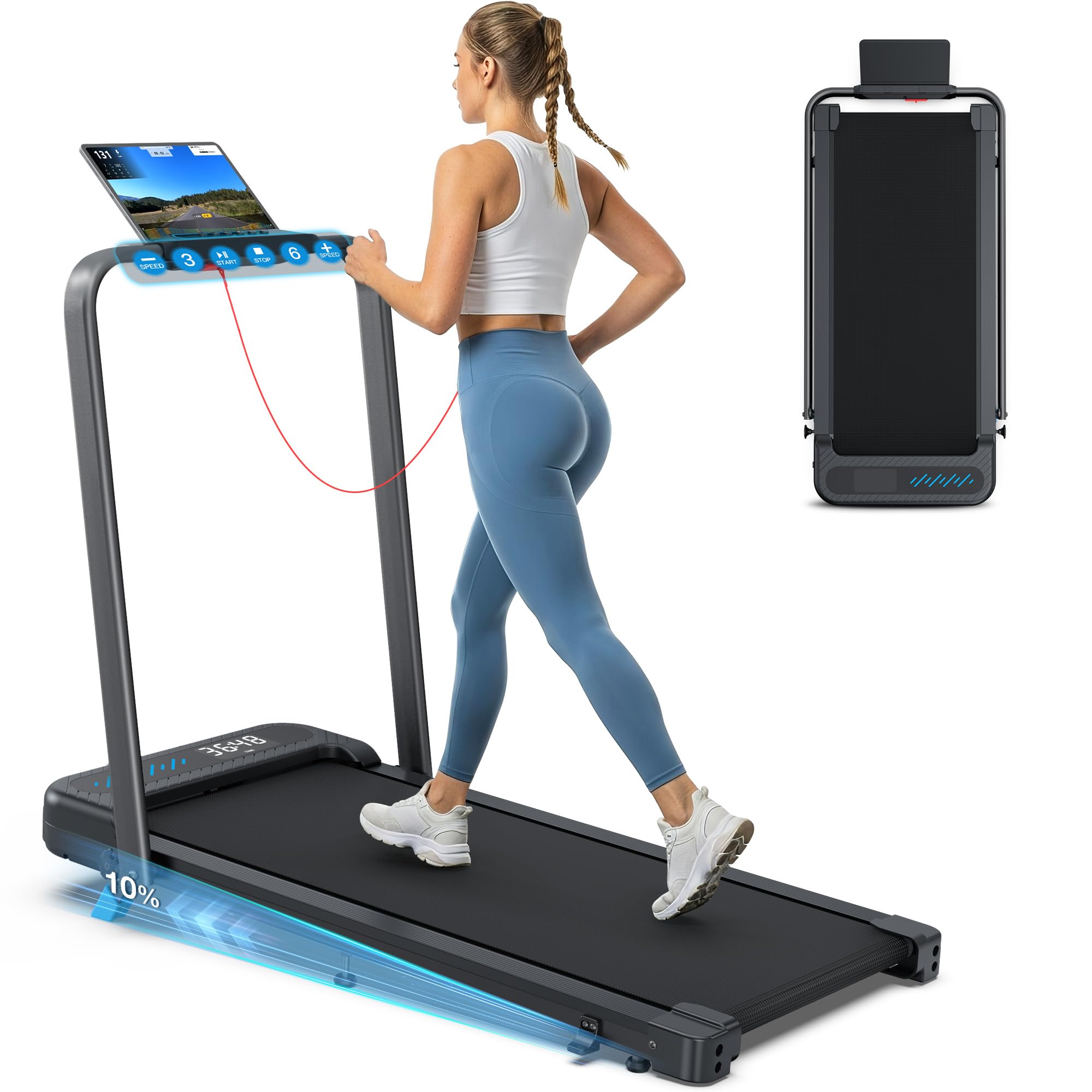
A 6.1-inch fold, handlebar controls, and 350-pound capacity without the premium.

The controls sit on top of the handlebar, which sounds minor until you have spent a walk reaching for a console down by your knees. Start, stop, a 3 mph button, a 6 mph button, and speed up or down, all where your hands already are. There is a remote too, plus app and voice control if you like that sort of thing.

It folds to 6.1 inches and rolls on built-in wheels, so storage is a slide under a bed or behind a couch rather than a project. The belt is built to keep itself centered without the hex-key ritual, and we have not had to go looking for the tool yet.

For the money, this is the handlebar machine we point people to first. You get a rail to hold, a 350-pound capacity, and a low ceiling cleared without paying for an adjustable rail you may never move. The catch is height: the rail tops out lower than the others here, so if you are tall you will be reaching down rather than resting your hands, and the remote becomes the better control.

The deck is 36 by 16 inches, enough for a walking stride and not much more. Tall walkers who like to stretch out at speed should look at the longer belts in this group; everyone else gets the value pick, and the one that stays out between sessions.

Bottom Line

A rail to hold, a 350-pound limit, and a 6.1-inch fold for the price of a basic pad — our value pick for anyone who wants support under a low ceiling.

Check Latest Price

Best for Incline

Our Score 8.6/10
LONTEK U20F-1

LONTEK

LONTEK U20F-1

  • Incline Up to 15 percent, manual
  • Belt Size 37.4 x 15 inches
  • Item Height 4.4 inches
  • Weight Capacity 350 lb
Check Price on Amazon

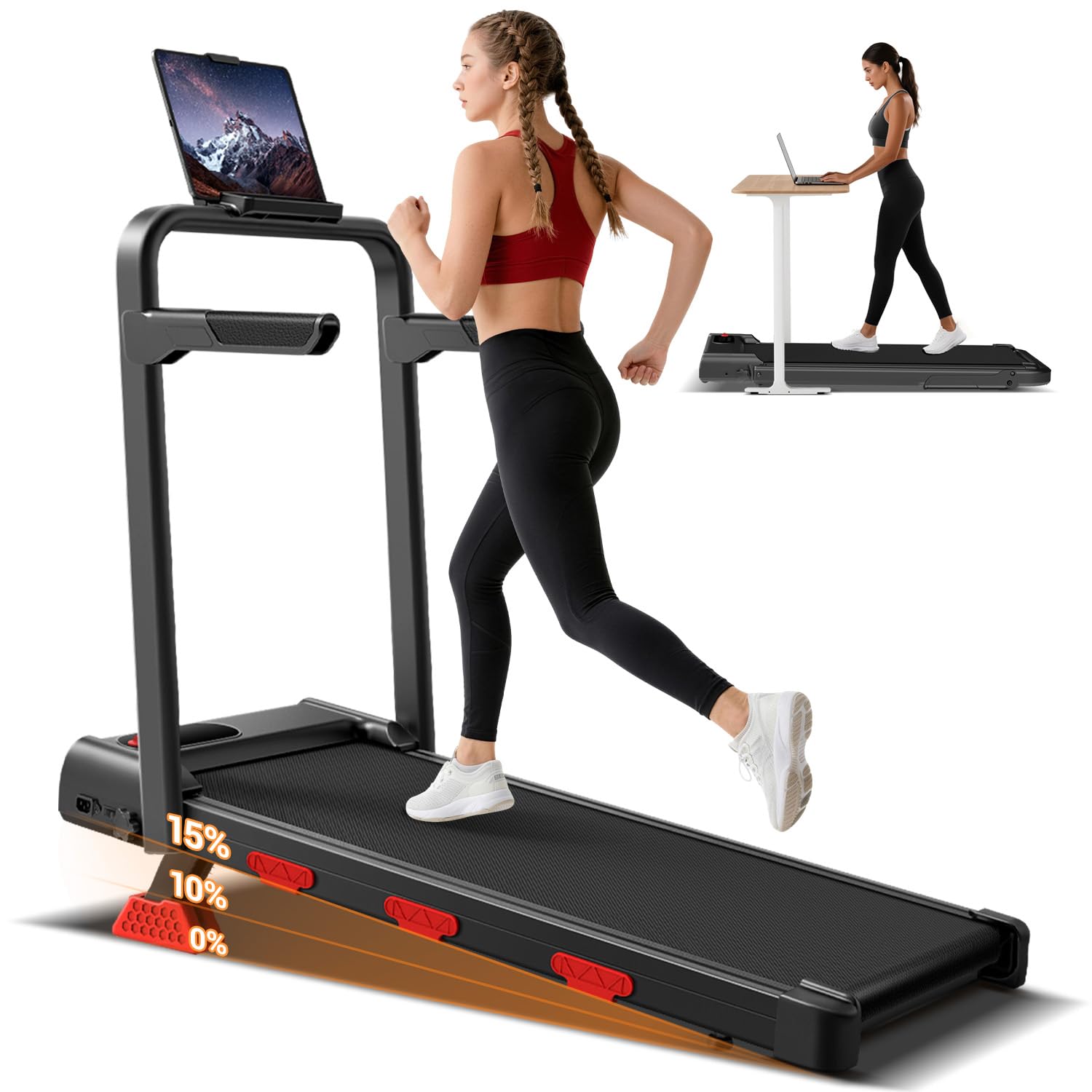
Take the rail off and flip out the legs for hills in a low room.

The handrail comes off. A couple of screws and it is a flat 4.4-inch pad you can slide under a bed or stand against a wall; bolt it back and you have something to hold at hip height. In a low room that flexibility earns its keep, because the same machine is a walking pad on Monday and a supported walker on Friday.

What we keep coming back to is the incline. Flip out the legs at the back and you get a 10 or 15 percent grade, with no motor, no console command, and no extra height when it is stowed. Set it once and walk. It is the simplest way in this guide to add hills to a room where you cannot afford a tower.

The belt is the catch. At 37.4 by 15 inches it is short, and the machine will accept 6.2 mph on a deck that really wants you walking. It is happiest between 2 and 4 mph, where the grade does the work of making a walk interesting; keep to a stride you would use on a sidewalk and the length never bothers you.

Bottom Line

Three grades, a handrail you can unbolt, and a 4.4-inch body: the low-room answer when you want hills without a tower in front of you.

Check Latest Price

Best For Desk walking

Our Score 8.6/10
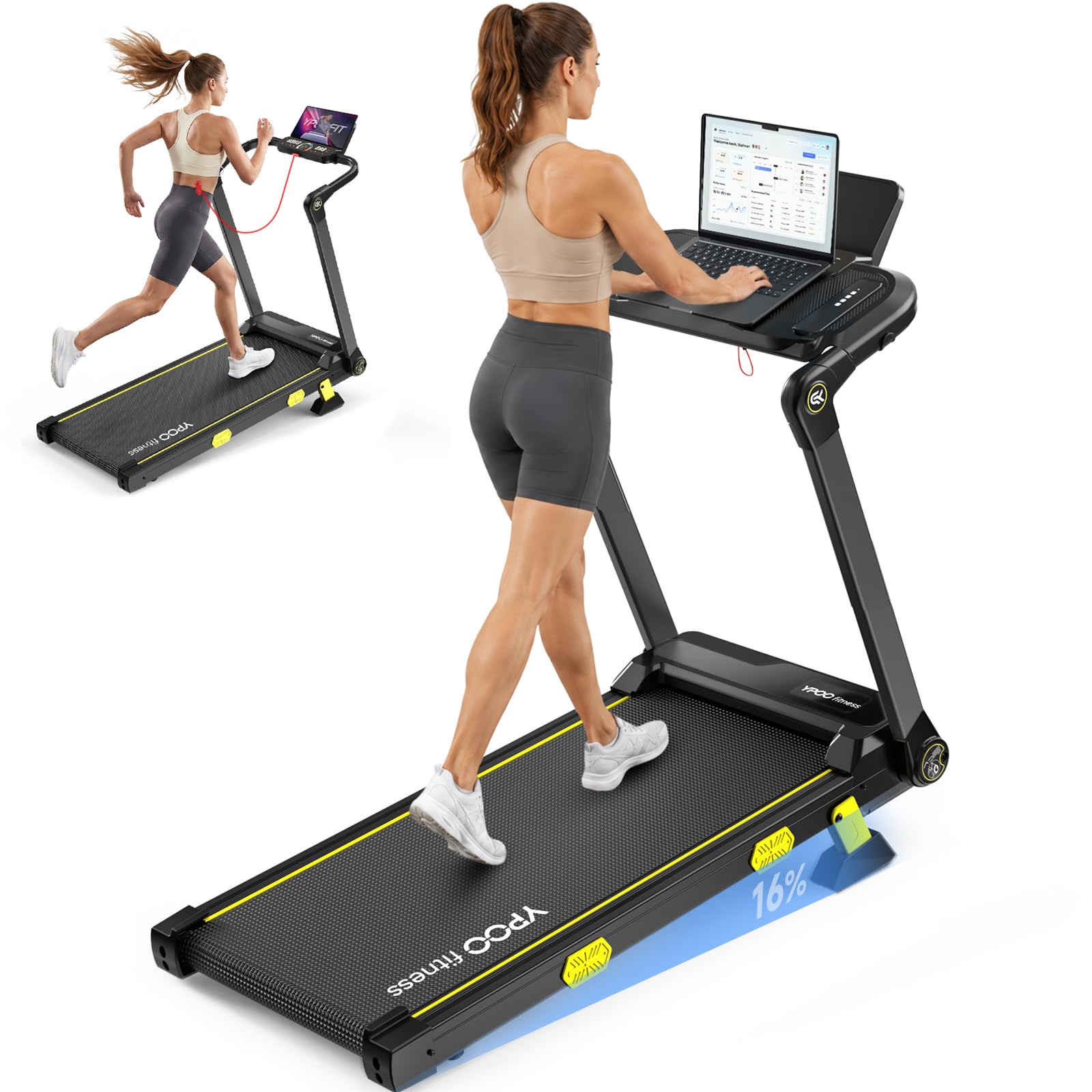
YPOO T7

YPOO

YPOO T7

  • Incline Up to 16 percent
  • Belt Size 37.5 x 15.4 inches
  • Frame Height 48 inches
  • Weight Capacity 350 lb
Check Price on Amazon

The desk comes off. With the workstation mounted you have a walk-and-work setup for a laptop or a tablet; unbolt it and the same machine is a 37.5 by 15.4 inch walking pad that folds and rolls into a corner.

The incline is the steepest here, three settings up to 16 percent against 15 on the LONTEK and 10 on the WELLFIT. A 3.5HP motor carries 350 pounds, the frame folds, and the listing puts noise around 45 dB, quiet enough that headphones are louder than the belt.

Here is the catch, and for this search it is the only one that matters: mounted, the frame stands 48 inches tall, the tallest thing in this guide. Under a genuinely low ceiling that is a machine you plan a room around rather than one that disappears. Take the desk off and the height problem goes with it, but then you have bought a walking pad with a spare part in the closet.

So the buyer is specific: someone with the ceiling for the desk who will strip it down when the room needs to be a room again. If clearance is the constraint and the desk is only a maybe, the flat pads here serve you better, and they cost less.

Bottom Line

The only pick here with a desk you can take off, and the steepest incline in the group — just measure its 48-inch frame against the ceiling first.

Check Latest Price

Best Low Handrail

Our Score 8.4/10
Aiteid 380C

Aiteid

Aiteid 380C

  • Belt Size 39 x 15 inches
  • Maximum Speed 6.2 mph
  • Handrail Height 36 inches
  • Weight Capacity 300 lb
Check Price on Amazon

The lowest fixed rail here at 36 inches, with 6.2 mph for faster walkers.

Thirty-six inches is where this one's handrail sits, the lowest fixed rail here, four inches under the WELLFIT WFTM037 and a foot under the YPOO. In a room where the ceiling comes down on you, that keeps the machine feeling like furniture instead of a tower, and it puts the controls within reach of shorter walkers. That is the whole case for it, and it is a good one.

Behind the rail is a conventional compact treadmill: 6.2 mph, a 300-pound limit, a six-layer 39 by 15 inch belt, twelve preset programs, and a fold that takes it to 5.5 inches. We got more use out of the programs than expected on days when choosing a pace was the hardest part of the workout.

Where it gives ground is reach. At 36 inches the rail lands around hip height for a tall walker, so you steer with the remote rather than lean on it, and the machine is happiest at a walk. For a shorter user, or a household that does not want a chest-high bar in the room, none of that is a compromise.

Bottom Line

The buyer here is a shorter walker in a shallow room: 36 inches is the lowest rail in this group and 6.2 mph is more speed than most pads offer.

Check Latest Price

Best For Minimal setup

Our Score 8.0/10
RJOP N4054FS

RJOP

RJOP N4054FS

  • Item Height 4.3 inches
  • Maximum Speed 5 mph
  • Weight Capacity 270 lb
Check Price on Amazon

It arrives assembled. No bolts, no handlebar to attach, no hex-key hunt: take it out, plug it in, walk. In a category where setup is often a small project, that counts for more than any specification suggests.

What you get is a 4.3-inch body, a 2.5HP motor that runs to 5 mph, a 270-pound limit, and a handlebar that folds down for storage. The incline is manual and chosen before you start, and the LED display tracks speed, time, distance, and calories while the remote sits in your hand.

The 5 mph ceiling tells you what it is for. This is a machine happiest between 1 and 3 mph — desk walking, a rainy morning, twenty minutes before dinner — and the folding rail is what makes the low profile useful when the session ends.

As a no-assembly first walking pad it earns its place, and the 270-pound capacity is the number to check against the household before you order. The detail that won us over is the handlebar: it drops down for storage, so the machine that disappears under the sofa is the same machine you walk on, not a second piece of furniture.

Bottom Line

For someone who wants to walk today and assemble nothing: it comes out of the box ready, with a rail that folds down and a 4.3-inch body.

Check Latest Price

How We Tested Treadmills for Low Ceilings

We started with specs, not samples: deck height at rest, console height, folded footprint, belt length and width, machine weight, and the stated cord length. Anything that would put a walker's head within a few inches of a six-and-a-half-foot ceiling was cut before it shipped. From there we narrowed by price, dropping machines that charge for incline and programming you can't use in a low room, and ordered seven.

Each one was unboxed and assembled solo, timed from cutting the tape to the first walk, with notes on whether it needed tools, a second person, or a doorway wider than mine. We measured the power cord from the front of the deck to the nearest outlet and logged whether it reached without an extension cord. Noise got checked twice: a meter at ear height during a 3-mph walk and a 6-mph run, and a listener in the room below.

The height test was a tape measure and a pencil mark on the wall — where the top of my head landed at a flat walk, at a jog, and with the deck raised. Stability we judged by feel: whether the rails shifted at speed, whether the front end lifted on an incline, whether the belt drifted to one side. Then we folded, rolled, lifted, and tried to stash each one in a closet. Quality showed in the small things — deck flex underfoot, a belt that tracked straight, a console that didn't rattle. Value was the last question: whether the price bought capability you could actually use under a low ceiling.

How to Choose

Measure From the Deck, Not the Console

The arithmetic is short: ceiling height, minus deck height, minus your height, leaves your clearance. The flat pads here put you 4.1 to 4.4 inches up, which under a seven-foot basement ceiling leaves a six-footer around two feet of air. Handrails matter less than they look — a rail at 36 to 48 inches sits well below your head and costs you nothing vertically, which is why the tallest machine in this guide is not automatically the wrong one for a low room.

Take the tape to the lowest obstruction rather than the middle of the ceiling. A duct, a joist, or a light fitting is often four to eight inches lower than the field of the ceiling, and that is the measurement your head actually meets.

Incline Quietly Costs You Headroom

Every degree of grade lifts the front of the belt, and you with it. A 10 percent incline across a 40-inch deck raises the front by about four inches; 16 percent raises it by more. If your clearance is already within a hand's width, buy flat or save the incline for the day you move the machine.

When you do want hills, the LONTEK's flip-out legs and the WELLFIT WFTM032's console-controlled ramp both work. Neither adds a single inch to the machine when the grade is at zero, so there is no reason to fear the feature — only a reason to use it deliberately.

Choose the Handrail by Household, Not by Habit

If one person uses the machine, a fixed rail at a comfortable height is enough. If two do, the adjustable 30.5-to-41-inch rail on the WELLFIT WFTM032 is the only one here that covers both, and it is the reason that machine sits at the top of the price range. If nobody wants to hold on, buy a flat pad and skip the rail entirely — that is most of what a walking pad is.

One trap worth naming: a rail that has to be unbolted before the machine will stow is a rail you stop stowing. If folding is the plan, check that the rail drops or folds without tools.

Storage: Weight Decides Whether You Actually Move It

Folded heights between 4.1 and 6.1 inches sound interchangeable until you are the one lifting. A 36-pound pad rolls under a bed one-handed; an 80-pound treadmill gets a corner and stays there. If the room has to go back to being a living room every evening, weight matters more than the fold.

Measure the gap under the bed or sofa before you buy, and remember that a rail on a folding treadmill usually ends up above the folded deck. The pads here clear a bed frame easily; the machines with handrails clear a wall, not a gap.

Belt Length Sets the Speed You Will Actually Use

Compact decks run 35 to 44 inches, and a 36-inch belt at 6 mph feels very different from a 44-inch belt at the same number. Walking is comfortable on the short ones; jogging wants 40 inches or more, and tall walkers should add a couple of inches to whatever they think they need.

The WELLFIT WFTM032's 44-inch deck is the longest in this group, and the short pads are honest walking machines rather than compromised runners. Match the belt to the pace you will really keep, not the one the top speed advertises.

Frequently Asked Questions

Final Verdict

A low ceiling stops being a problem the moment you stop shopping for treadmills with towers on them. Our default is the Vhorilix: 4.33 inches underfoot, under 40 pounds, and nothing above your ankles to plan a room around — the cheapest way here to keep walking indoors, and the one that leaves your headroom completely alone.

If you want a rail to hold, or two people of different heights share the machine, the WELLFIT WFTM032's adjustable handrail is worth the step up. Want hills as well? The LONTEK adds a 15 percent grade on a 4.4-inch body with a rail that unbolts.