Strength & Weights

Best Slam Balls of 2026

A slam ball has one job, and it's the opposite of every other ball in the gym: it's supposed to hit the floor and stay there. That dead thud is the point, because a ball that bounces back is a ball that can catch your face. What separates a good one from a bad one shows up later, though: whether the fill stays put after a few hundred throws or settles into a lopsided lump, whether the seams survive, and whether the shell still grips once your hands are sweaty.

My garage floor has taken a beating from these things, and the differences are real. Over the past four months, my team and I slammed a dozen of them into concrete, and the deciding factors turned out to be two things almost nobody checks before buying: the weight printed on the side versus the weight on a scale, and whether the rubber still held a sweaty hand at rep thirty. The ones worth your money are below.

Best Overall

Our Score 9.4/10
Yes4All Sand-Filled Slam Ball

Yes4All

Yes4All Sand-Filled Slam Ball

  • Weight 20 lb
  • Diameter 9.75 inches
  • Construction Sand-filled PVC
  • Weight Range 10 to 40 lb
Check Price on Amazon

Widest weight range here, with a textured shell that handles daily slams.

Twenty pounds in a 9.75-inch ball is the proportion we keep coming back to. There's enough circumference to get both hands around it for an overhead slam, and it's small enough that Russian twists and wood chops don't turn into a wrestling match with a beach ball.

What makes it the pick is the range behind it. The same line runs 10, 15, 20, 25, 30, and 40 lb, so you can move up without relearning a different shell, and the 20 sits in the middle of that ladder where most people will stay. The PVC is molded into raised panels that give your fingers somewhere to catch from any angle, and the threaded construction keeps the seam from being the obvious failure point. It's also priced in the middle of this group rather than at the top, which is not nothing when you're likely to buy a second one.

The panels are the catch. They're rough, and after a long set of slams and chest passes your palms will feel it; anyone with soft office hands should plan on gloves for the first few weeks. Twenty pounds is also a genuine load for overhead work, so it isn't the ball to learn the movement with if you've never thrown one.

Where it earns its keep is a home gym with one shelf. Start at 15, add the 20 when the timing clicks, and you have a two-ball setup that covers slams, carries, squats, and twists without ever needing a rack.

Bottom Line

Our default slam ball: a grippy, dead-bounce shell, a 10-to-40 lb ladder to grow into, and a midrange price that's easy to justify.

Check Latest Price

Best Grip

Our Score 9.4/10
ProsourceFit Slam Medicine Ball

ProsourceFit

ProsourceFit Slam Medicine Ball

  • Weight 15 lb
  • Surface Tire-tread texture
  • Diameter 9 inches
  • Weight Range 5 to 50 lb
Check Price on Amazon

Tire-tread surface bites into sweaty hands, backed by a lifetime warranty.

Molded tire tread is the reason this ball exists, and it's the grip we trust most in this group once hands get wet. The ridges stand proud of the shell, so your fingers wrap into them instead of relying on surface tack. The difference shows up around rep fifteen, when a smooth ball starts to feel like a bar of soap.

The rest is conventional and well executed. Fifteen pounds at 9 inches is middle-of-the-road in the best sense, the sand fill kills the bounce, and the line runs from 5 to 50 lb, the widest spread here. ProsourceFit backs it with a limited lifetime warranty, the longest cover in this set, and it costs about the same as our top pick.

Two things to know before you commit. The tread is abrasive, and a high-volume session will leave your hands hot, so keep chalk nearby. And the surface feels slicker when it's new than after a few weeks of slamming, which is normal for a molded shell.

Buy it for the tread and treat everything else as competent. That's not faint praise in a category where the shell is usually the part that lets you down.

Bottom Line

The best grip in this set: molded tread that keeps a sweaty ball in your hands, plus a 5-to-50 lb range and a lifetime warranty.

Check Latest Price

Best Budget

Our Score 9.4/10
Trademark Innovations Slam Ball

Trademark

Trademark Innovations Slam Ball

  • Fill Sand, no bounce
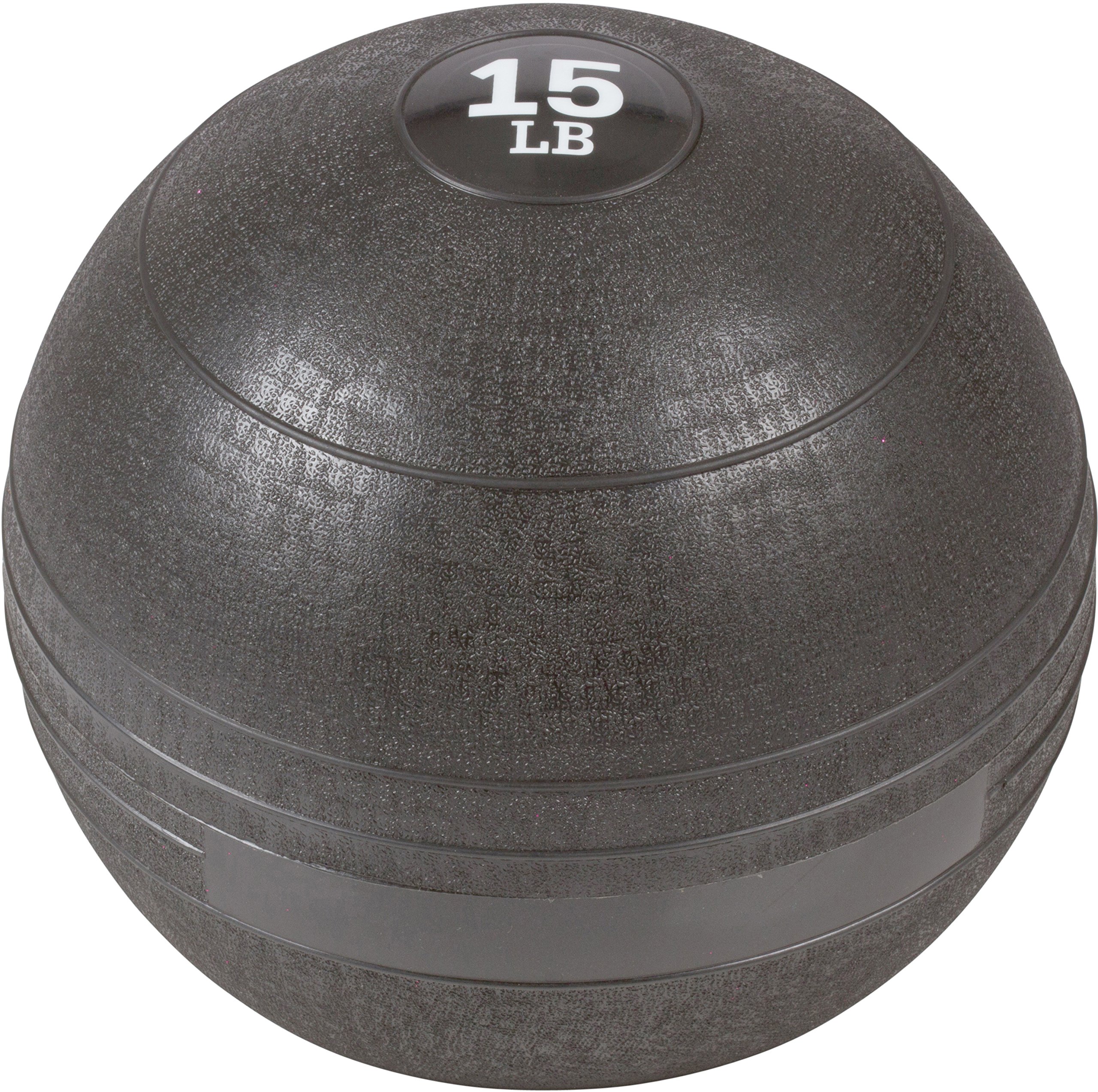
  • Weight 15 lb
  • Diameter 9 inches
  • Material PVC
Check Price on Amazon

Lowest price here for a full-size 15-pound ball that takes a beating.

No tread, no panels, no color story. The Trademark ball is a gray PVC sphere with sand in it, and at 9 inches and 15 pounds it matches the shape of balls that cost noticeably more.

That shape is the one most people should own. Fifteen pounds is heavy enough to make slams and thrusters count but light enough to keep form on overhead work, and the 9-inch diameter wraps easily in two hands. It also needs no break-in: no valve, no grip pattern to wear down, nothing to set up before your first set.

What you give up is surface. The shell is smooth and a little soft, and there's no warranty story beyond a year against defects, which is ordinary here rather than generous.

We keep coming back to it for group work. When four people are cycling through a circuit on a driveway, this is the ball you can buy four of without wincing, and the one whose scuffs nobody minds.

Bottom Line

The value pick: a full-size 15-pound ball at the lowest price here, with a plain shell that asks you to bring chalk and nothing else.

Check Latest Price

Best for Adjustable Firmness

Our Score 9.2/10
Rage Fitness Slam Ball

Rage Fitness

Rage Fitness Slam Ball

  • Shell Rubber with sand fill
  • Weight 10 lb
  • Diameter 10 inches
  • Firmness Adjustable air valve
Check Price on Amazon

An air valve lets you tune how firm the ball feels in your hands.

An air valve on a slam ball sounds like a gimmick until your hands are tired. Let a little air out of the Rage and the shell goes soft and catchable; pump it up and the ball comes off the floor with some life. None of the others here give you that adjustment, and it changes how the same ball behaves on a tired day versus a fresh one.

The shape is beginner-friendly too. Ten pounds spread across a 10-inch shell is the roomiest weight-to-size ratio in this group: plenty of ball to wrap both hands around, and hard to fumble on a catch. The rubber shell has a softer, tackier feel than the PVC balls here, which we noticed most on chest passes and shorter throws.

The limit is the ladder. It runs 10, 15, and 20 lb, and then it stops, so this is a ball you outgrow rather than one you keep for years. That's fine for a first purchase or a ball shared with a teenager, less fine once you're already slamming 20 pounds for sets, because at that point you're buying the same weight twice.

Bottom Line

The only ball here with an air valve: soften it while you learn, firm it up later, and keep it for warmups after you pass the 20 lb ceiling.

Check Latest Price

Best for Beginners

Our Score 9.2/10
Amazon Basics Slam Medicine Ball

Amazon Basics

Amazon Basics Slam Medicine Ball

  • Weight 10 lb
  • Surface Textured non-slip
  • Diameter 7.87 inches
  • Material PVC
Check Price on Amazon

A compact, forgiving 10-pounder that makes learning the movement easy.

At 7.87 inches across this is the smallest ball in the set, and that's precisely why we hand it to a beginner. You can choke down to one hand for twists, keep it under control during fast squats, and catch it without a juggling act while the timing is still new. Ten pounds in a small package is the least intimidating thing in this article.

It's the softest ball here, too. The PVC gives on impact and squishes slightly in your hands, which is kind to the palms and quieter on a garage floor than the hard-shelled options. The textured surface holds well, and the dead fill means it drops instead of chasing your shins across the room.

The catch is headroom. Once you're stringing slams together without thinking, 10 pounds stops being a challenge and the give in the shell starts to feel vague on a hard catch. Expect to add something denser within a year rather than to keep this as your only ball.

Bottom Line

Our pick for a first slam ball: small enough to control, soft enough to be kind to your hands, and one of the cheapest ways to try the movement.

Check Latest Price

Best For Compact grip

Our Score 9.2/10
GOOGIC Slam Ball

GOOGIC

GOOGIC Slam Ball

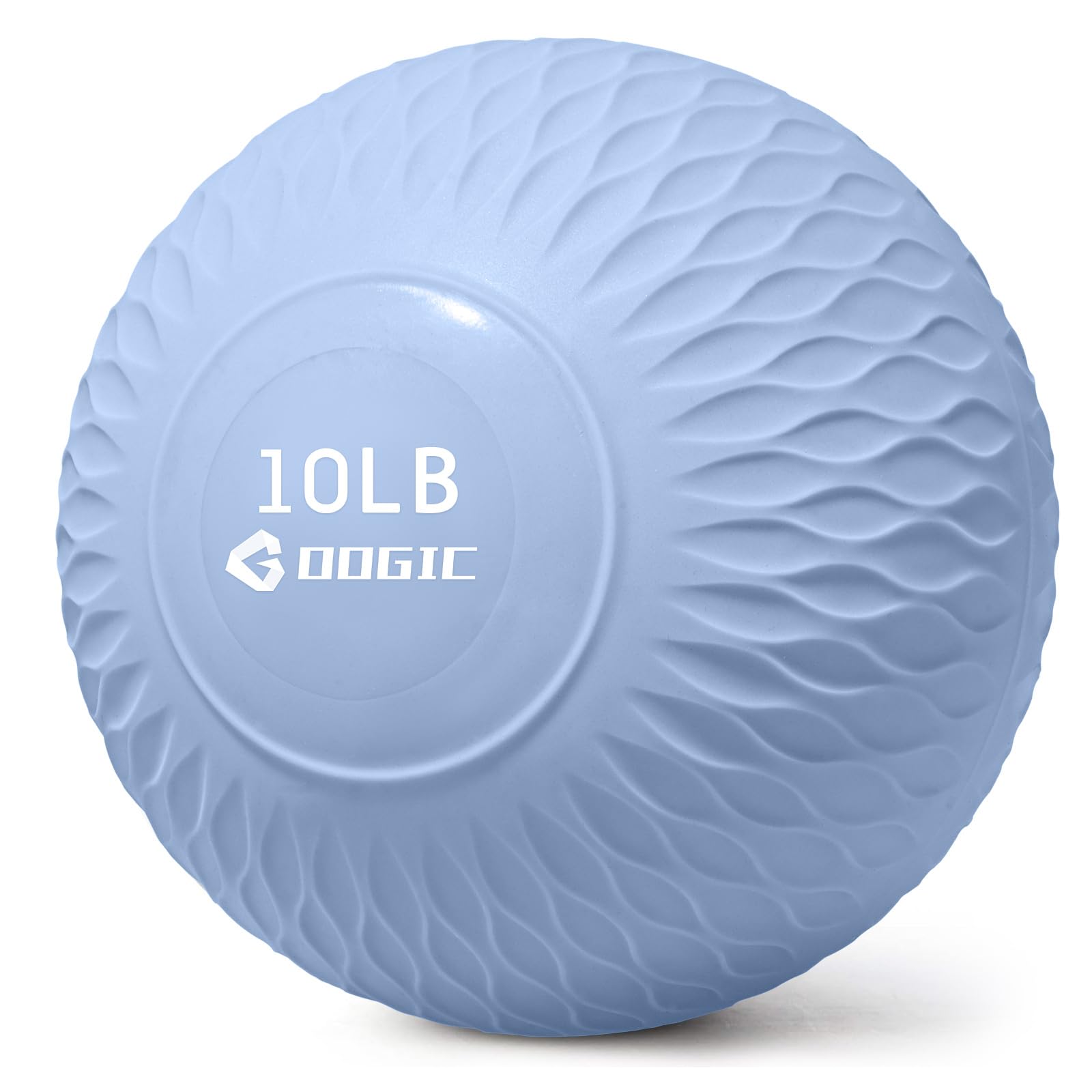
  • Weight 10 lb
  • Surface Textured tread
  • Diameter 7.8 inches
  • Material Sand-filled PVC
Check Price on Amazon

The tread on the GOOGIC is the most pronounced of the small balls here, and at 7.8 inches it's a genuinely one-handed tool for twists and single-arm slams. If you've been making do with a smooth 10-pounder that slides on the catch, this is a direct fix.

Our hesitation is positioning. The shell is thick PVC over a dead sand fill, the finish looks better than the price suggests, and the five colors are a nice touch rather than a reason to buy. But at this money it's competing with balls that give you more weight for the same spend, and 10 pounds is 10 pounds.

Buy it if 10 pounds is the weight you actually need and grip is what's been missing from your current ball. If you want to progress past 20 pounds, put the money toward a 15 and skip a step.

Bottom Line

A well-finished 10-pounder with the deepest tread of the small balls here, best for one-hand work and tight spaces, less compelling if you want to move up in weight.

Check Latest Price

Best For Warmups and technique

Our Score 8.8/10
Fitvids Slam Medicine Wall Ball

Fitvids

Fitvids Slam Medicine Wall Ball

  • Type Slam, wall, and medicine ball
  • Weight 6 lb
  • Diameter 9 inches
  • Warranty 2 years
Check Price on Amazon

Six pounds is the number that defines this ball. At 9 inches it looks like the 15- and 20-pounders in this set, so it's a surprise the first time you pick it up, and it explains everything about who it's for.

As a warmup and technique ball it does its job. The shell is grippy, the fill is dead, and it's quiet enough for an apartment floor, which makes it a sensible way to groove the slam pattern before you're strong enough to do it under load. It's also backed for two years, more cover than most of the balls here.

What it can't do is conditioning. Ten hard slams with a 6-pounder won't leave you breathing hard the way the 20 lb Yes4All does, and we found the fill moves enough that an off-center catch wobbles. Sold as a slam, wall, and medicine ball, it's really the first of those three: buy it for warmups, movement practice, or a teenager starting out, and buy something heavier for the set that counts.

Bottom Line

A well-made warmup ball rather than a conditioning tool: right for technique work and light days, too light for the slams that leave you on the floor.

Check Latest Price

How We Tested the Best Slam Balls

We started with a shortlist of roughly 40 balls sold by brands we'd used or seen holding up in commercial gyms, then filtered by weight range, shell material, seam construction, and price per pound, trimming it down to 12. Every ball got used the way a home gym actually gets used: slams and wall balls on a garage floor, over-the-shoulder throws onto a driveway, and a few rounds of partner tosses on a basement mat.

We weighed each one on a shipping scale before the first session and again at the end, because a 30-pound ball that's actually 26 pounds throws off your progression quietly. We did sets with dry hands, then with sweaty hands and with chalk, noting which textures went slick and which gripped. After each session we wiped every ball with a damp towel to see how much grit, pet hair, and driveway sand had worked into the tread, then checked the seams and shell for scuffs, splitting, and soft spots.

To assess balance and fill, we rolled each ball across a level floor and watched for wobble, then dropped them from waist height to confirm they died rather than bounced. Durability came down to hours of abuse and what the shell looked like afterward. Value we judged per pound and per session, not per sticker price, since a cheap ball that goes lopsided in a month costs more than it saves.

How to Choose

Slam ball first, medicine ball second

The difference is the fill. A slam ball is packed with sand or iron sand, so it lands and stays landed; a medicine ball with a bouncy core comes back at you, which is fine for wall throws and wrong for a full-force slam into the floor. The shell matters just as much, since PVC or rubber absorbs impact where a hard composite can split at the seam.

Decide up front whether you want one ball or a crossover. If your sessions include wall-ball sets or partner throws, dead weight means catching every rep yourself. If your training is slams, thrusters, carries, and twists, dead weight is exactly the point, and every ball in this guide is built that way.

Weight and diameter are one decision

A 20-pound ball isn't a 10-pounder scaled up; the two feel completely different in the hands. Diameters here run from 7.87 inches on the Amazon Basics 10-pounder to 10 inches on the Rage, and the small ones suit one-handed twists while the big ones are easier to catch two-handed.

For slams, choose the largest diameter you can comfortably wrap both hands around at your working weight, usually 9 to 10 inches. Fifteen to 20 pounds covers most adults for conditioning; go lighter only for technique work or a shared household, heavier only if overhead work already feels easy. One good 15- or 20-pounder beats three cheap ones.

What the surface does once you sweat

Grip is the first thing to fail in a hard session, and texture is the fix. Tire-tread patterns like the ProsourceFit's bite hardest, molded panels like the Yes4All's give you edges to catch from odd angles, and smooth shells like the Trademark's are the slickest when wet. More texture also means more wear on your palms, so chalk or gloves are standard kit rather than a sign you bought wrong.

One trap: a brand-new shell is slicker than a broken-in one, whatever the tread pattern. Judge grip after a few sessions, not on the first set, and don't write off a ball because it felt greasy out of the box.

Shells, fills, and what the warranty tells you

Sand-filled balls shift. That's the design rather than a defect: a partly filled shell moves under your hands and makes the ball wobble on an off-center catch. What you're really paying for is the shell staying together, so look at the seam and at the cover behind it. ProsourceFit offers a limited lifetime warranty, Fitvids two years, and Yes4All and Trademark a year against defects.

PVC shells feel softer and quieter indoors, while rubber shells like the Rage's feel tackier in the hand. The material matters less than a reinforced seam and a maker who will replace a ball that splits.

Frequently Asked Questions

Final Verdict

The 20 lb Yes4All is our default for a reason: the size suits two-handed slams, the raised panels hold a sweaty grip, the line runs to 40 lb so you can add weight later, and the price sits in the middle of this group rather than at the top.

If grip is what has been letting you down, the treaded ProsourceFit is the better ball for about the same money. And if you're buying for a beginner or a tight space, the 7.87-inch Amazon Basics is the one nobody feels intimidated by.