Strength & Weights

Best Plyo Boxes of 2026

A plyo box looks like the simplest thing in a home gym: a box, and you jump on it. But the decision at checkout — wood or foam, fixed height or three-in-one, shipped flat or already built — is what determines whether it stays planted at rep twelve or shifts under you. Size matters more than the listing photos suggest, too, since whatever you buy has to live somewhere between workouts. Get it right and the box becomes the most dependable piece of equipment you own; get it wrong and it's the reason you stop jumping.

I've spent the past six months with 11 of them in a garage gym, a carpeted spare room, and a driveway, assembling, hauling, and jumping on each one. A good plyo box should be boring: planted on landing, grippy with sweaty hands, and quiet about it. Price turned out to be a poor predictor of quality — more than one budget box felt sturdier than a spendy one — and the two that reeked of foam for a week or shifted on the first hard landing didn't last. What's still standing in my garage is below.

Best No-Assembly Pick

Our Score 9.6/10
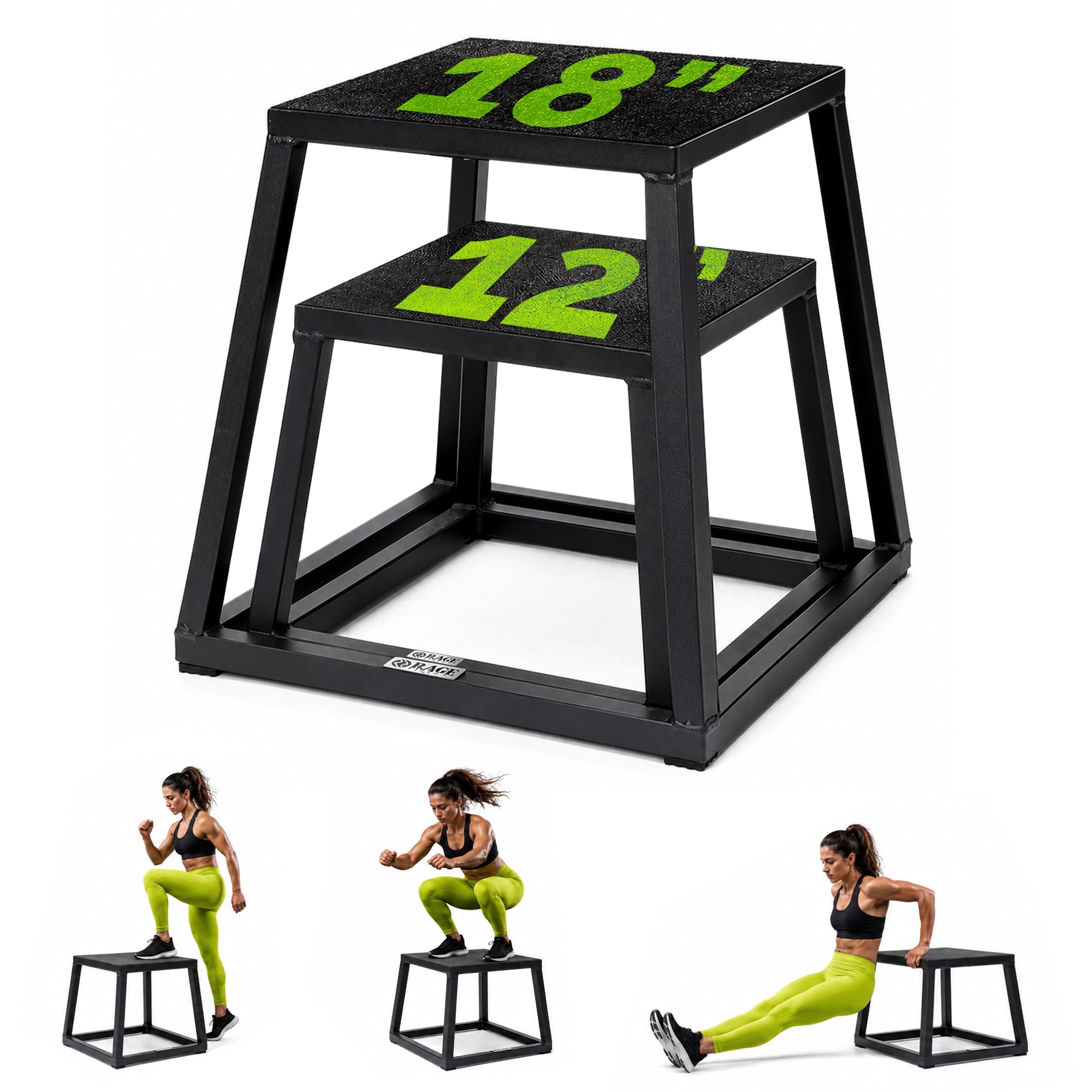
Rage Fitness Steel Plyo Box

Rage Fitness

Rage Fitness Steel Plyo Box

  • Height 12 in
  • Weight 12 lb
  • Assembly None required
  • Top Platform 12.5 x 12.5 in
Check Price on Amazon

Arrives welded and ready, and shrugs off years of step-ups and low jumps.

Nothing to put together: this arrives welded, and the only thing between the box and your first set is the cardboard. The frame is heavy-gauge steel tube with rubber on both faces, so there are no bolts to check, no wobble to chase, and no chance that an assembly mistake turns into a bad landing.

What it does well is the unglamorous work. Twelve pounds moves with one hand, the rubber bottom keeps it quiet on a garage floor and planted when you push off, and the 12.5-inch top is a comfortable target at this height. The one bit of upkeep: the top pad is glued down, so glance at the corners every few months and press back anything that is lifting, because a loose edge is the only way this box gets slippery.

Bottom Line

We keep this welded steel step for low-jump days and step-up work: it arrives ready to use and never needs tightening.

Check Latest Price

Best for Step-Ups

Our Score 9.6/10
Retrospec Leap Plyo Box

Retrospec

Retrospec Leap Plyo Box

  • Frame Welded metal
  • Height 18 in
  • Assembly None required
  • Weight Capacity 350 lb
Check Price on Amazon

One welded frame, nothing to assemble, and a stable platform for single-leg work.

The frame arrives welded as one piece, so setup is unboxing. That is a small pleasure that grows if you have spent an evening driving screws into plywood and wondering whether you countersank them far enough.

The legs taper out to a wider base, and rubber stoppers sit under each corner, so the whole thing feels anchored rather than placed. Nothing creaks, nothing rattles, and there is no hardware to re-tighten after a month of use.

At 18 inches it is a step-up box before it is a jump box. Step-ups with dumbbells, split squats, rear-foot-elevated work, controlled step-downs: the platform is stable enough to load, and the 350-pound rating leaves room. The top is on the small side for two-footed landings, so we treat it as a strength tool rather than a plyometric target.

What keeps it in the rotation is how little there is to go wrong. One welded frame, no fasteners to check, and a footprint that tucks against a wall. For a garage gym where the box serves legs and conditioning rather than max-height jumps, that reliability is worth more than another height setting.

Bottom Line

A welded, ready-to-use box we like for step-ups, lunges, and single-leg work, with nothing to assemble and nothing to re-tighten.

Check Latest Price

Best Overall

Our Score 9.4/10
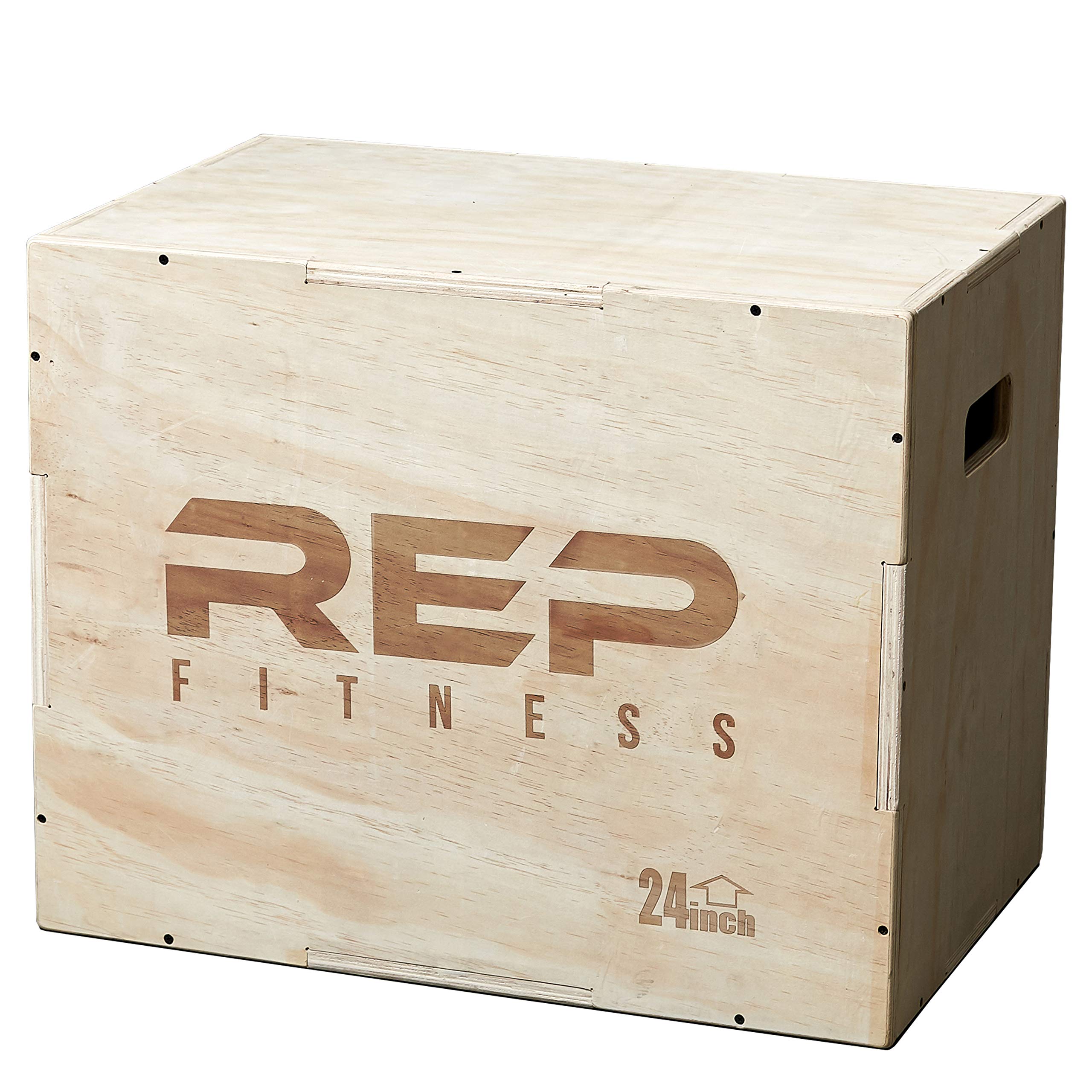
REP 3-in-1 Wood Plyo Box

REP

REP 3-in-1 Wood Plyo Box

  • Weight 50 lb
  • Heights 20, 24, 30 in
  • Material 3/4-inch plywood
  • Weight Capacity 400 lb
Check Price on Amazon

The widest landing faces here and three heights, in a box that barely moves mid-jump.

A 30 x 24 x 20 inch box gives you three landing faces, and the smallest of them measures 20 by 24 inches, which is bigger than the entire top of several compact boxes in this guide. That is the number we kept circling back to. However you rotate it, there is a real target under your feet, and a target you can see is a jump you commit to instead of one you bail on halfway up.

The rest of it is built to match. Three-quarter-inch plywood panels lock together as a puzzle, with internal bracing that takes the flex out of the middle, and landing on it gives a flat, dead thud rather than a hollow ring. Rated to 400 pounds, it is the box in this set that handles a big jumper without complaint, and it does not creep when you come down slightly forward. Assembly is easier than most flat-pack wood: the holes are pre-drilled, the panels line up, and a power driver gets you through it in the time it takes to brew a pot of coffee.

The trade-off is heft. Fifty pounds with no handle cut into the sides means this box lives where you put it, so pick the spot before you build it. Ours sits on a rubber mat against the wall, which keeps the plywood off bare concrete and marks the place it belongs. You move it once a week, not once a set, and the weight stops being a chore and becomes the reason it never slides out from under you.

Bottom Line

For a home gym with floor space and 24-inch ambitions, this is the box we recommend: wide landing faces at every height, no wobble, and capacity to spare.

Check Latest Price

Best Budget

Our Score 9.4/10
CAP Barbell 3-in-1 Plyo Box

CAP Barbell

CAP Barbell 3-in-1 Plyo Box

  • Weight 15.4 lb
  • Heights 16, 14, 12 in
  • Material Engineered wood
  • Weight Capacity 300 lb
Check Price on Amazon

The cheapest wooden 3-in-1 here, with carry handles and a non-slip face.

This is the least expensive wooden 3-in-1 in the guide, and we mean that as a recommendation rather than a warning. Interlocking panels, countersunk screws, rounded edges, a textured face, and handles cut into the sides: the same checklist the pricier wooden boxes run through, at a price that makes a second one for the garage feel reasonable.

Assembly is the usual flat-pack ritual with pre-drilled holes, a few dozen screws, and a far better evening with a driver than with the stubby hex key in the box. The 15.4-pound body is heavy enough to sit still on a mat and light enough to lift by the handles, and the countersunk hardware means nothing protrudes where a foot might land.

Where it makes the most sense is a setup where the box does several jobs: a step for split squats, a seat between sets, a low target for jump practice, and something small enough to leave out in a room that is not really a gym. Sixteen inches is plenty of height for that first year of jumping, and the finish has held up better than we expected for the money.

Bottom Line

The wooden 3-in-1 we send budget shoppers to: handles, a textured face, and enough box for step-ups, squats, and short jumps.

Check Latest Price

Best For Small spaces

Our Score 9.4/10
papababe 3-in-1 Foam Jump Box

papababe

papababe 3-in-1 Foam Jump Box

  • Weight 15 lb
  • Heights 12, 14, 16 in
  • Surface 1000D oxford weave
  • Material Heavy foam
Check Price on Amazon

The appeal here is the footprint: 12 x 14 x 16 inches and 15 pounds, which fits beside a squat rack, under a shelf, or in the corner of a room that is not really a gym. We rate it as the box for a small space and a light jumper. One hand moves it, and the foam is soft enough that a missed jump leaves a bruise rather than a gash.

The cover is a dense oxford weave rather than the usual vinyl, and it stays grippy when hands and shoes are wet, which is more than most foam boxes manage after a sweaty session. The foam itself is firm for something sold as soft, so landings feel planted rather than spongy, and the three faces give you a low step for split squats as well as a jumping target. It is the box we leave out in a small room because it tucks away without a fight.

Bottom Line

We recommend this compact foam box for small rooms and first jumps, with a woven surface that stays grippy when you sweat.

Check Latest Price

Best Foam Box

Our Score 9.2/10
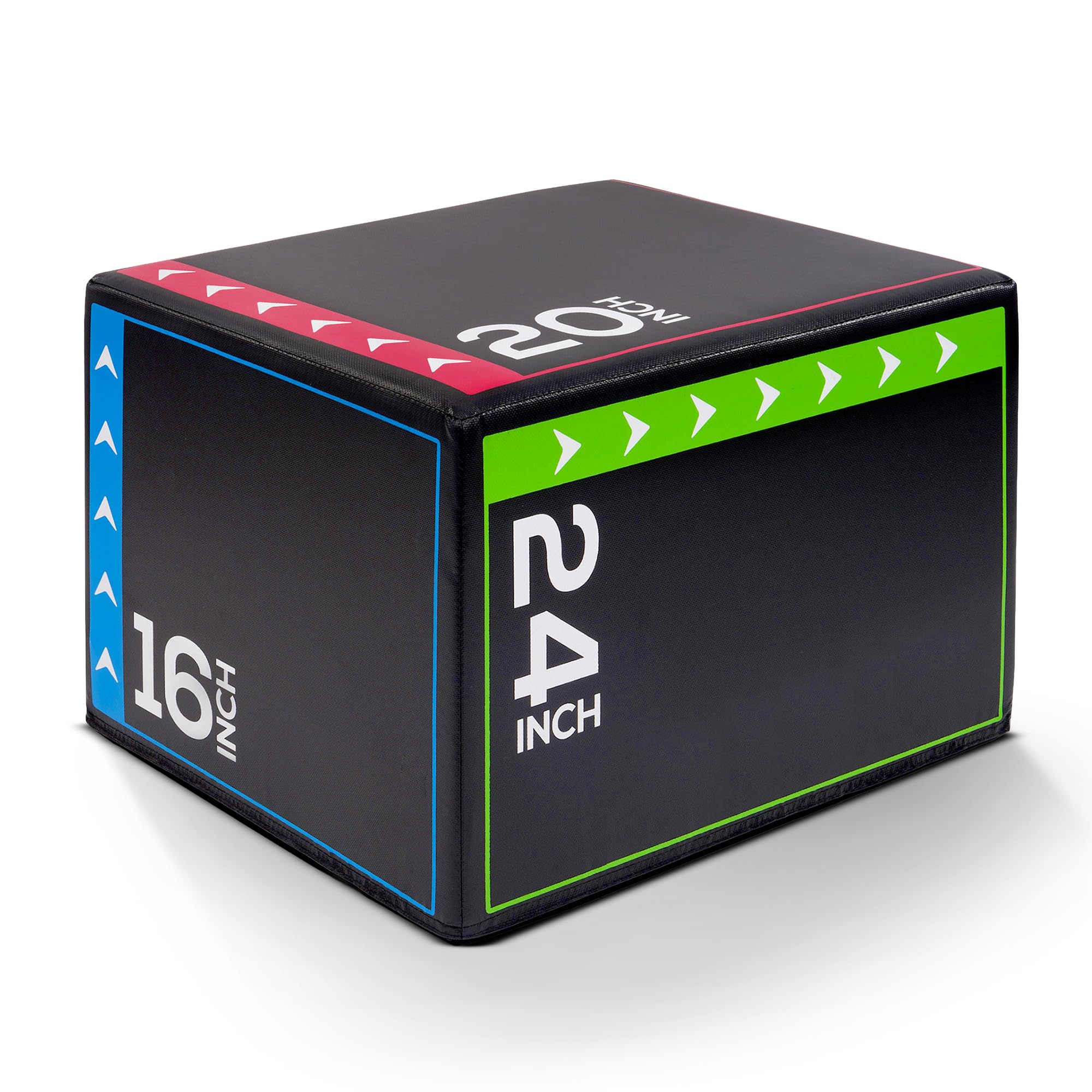
BalanceFrom 3-in-1 Foam Plyo Box

BalanceFrom

BalanceFrom 3-in-1 Foam Plyo Box

  • Weight 10 lb
  • Heights 16, 20, 24 in
  • Surface Textured non-slip
  • Weight Capacity 250 lb
Check Price on Amazon

Soft enough to save your shins, light enough to move, and priced to start today.

If you have ever caught a shin on the way up to a wooden box, the appeal of foam is instant: there is no sharp edge waiting for a mistimed jump. This is the box we hand to the friend who wants to start jumping and keeps finding reasons not to.

Ten pounds means one hand gets it from the corner of the room to the middle and back again, and the textured surface holds on a rubber mat or low carpet. It also wipes clean with a damp cloth, which matters more than it sounds once the box has spent a month on a garage floor.

The foam is dense enough to read as a platform rather than a cushion, and the three faces step up in four-inch increments, so a warm-up and a working set happen on the same piece of equipment. Landing near an edge on the taller faces is where it gets interesting: you can feel the box give and shift under a crooked foot. Line up properly and it is a non-issue; drift and you will notice.

Where it earns its place is as a first box that stays useful. The vinyl cover is the part to watch, so keep it off rough concrete and wipe it down after sweaty sessions. For a spare room, a single-car garage, or anyone who wants a soft landing while they build confidence, this is the one we point to first.

Bottom Line

Our pick for beginners and spare rooms is this foam box: three heights, a forgiving landing, and one-hand portability at 10 pounds.

Check Latest Price

Best Soft-Top

Our Score 9.2/10
Yes4All Soft-Padded Plyo Box

Yes4All

Yes4All Soft-Padded Plyo Box

  • Build Foam over wood core
  • Weight 12.1 lb
  • Heights 16, 14, 12 in
  • Weight Capacity 450 lb
Check Price on Amazon

Foam over a wood core: forgiving landings without the mush of an all-foam box.

Most boxes here are either soft or solid, and this one is deliberately both: an EVA foam layer bonded over a wooden core and wrapped in a vinyl cover. The wood keeps the platform from squashing under you; the foam takes the sting out of a clipped shin.

Twelve pounds makes it easy to shift around a small gym, and the 450-pound rating is the highest capacity in this guide relative to its own weight. That matters in a house where a 120-pound teenager and a 220-pound adult share the same equipment. The PVC surface grips rubber flooring, wipes clean, and does not go slick. It is not plush, though: the foam is dense, and anyone expecting a cushion finds a firm platform.

What we rate it for is the balance. A landing feels solid rather than bouncy, the edges are rounded, and one person can carry it out of the way when the car needs the garage back. It is the box for a small home setup where one piece of equipment has to be a step, a squat target, and a seat between sets, and it is the one we hand to anyone nervous about moving from foam to wood.

Bottom Line

We like this one for smaller setups that need a firm platform with a softer surface: step-ups, split squats, and jumps up to 16 inches.

Check Latest Price

Best For Tall, soft landings

Our Score 9.2/10
Yes4All 3-in-1 Foam Plyo Box

Yes4All

Yes4All 3-in-1 Foam Plyo Box

  • Cover Anti-slip PVC
  • Weight 15.6 lb
  • Heights 30, 24, 20 in
  • Weight Capacity 350 lb
Check Price on Amazon

Twenty, 24, and 30 inches puts this in the big-box class, and it is soft: high-density PE foam under an anti-slip PVC cover. For a tall jumper who wants something forgiving to land on at 30 inches, that combination is rare in this group.

At 15.6 pounds it is light for its size, and that is the thing to understand about it. A box this tall depends on you landing near the middle; drift toward an edge on the 30-inch face and you will feel it move under you. On a rubber mat and on the lower two faces it feels like a proper platform, and the cover wipes down in seconds after a sweaty session.

Our read: it is the best soft landing at real jump heights in this guide, and the one to build up on rather than start at the top. Keep it on the lower faces while you learn where your feet land, treat the 30-inch side as a goal rather than a workspace, and it earns its footprint, especially in a garage where a missed jump is a genuine possibility.

Bottom Line

We reach for this tall foam box when the surface matters more than the height: soft landings at 20 and 24 inches, with the top face as a goal.

Check Latest Price

How We Tested 11 Plyo Boxes Over Six Months

We started by rounding up every plyo box we could find across three constructions — Baltic birch, high-density foam, and foam wrapped in vinyl — in the 12-, 20-, and 24-inch heights people actually train on, then cut the list to 11 based on price, weight rating, and whether the footprint made sense in a home gym rather than a commercial floor. Each one landed in my garage and got the same first hour: unboxed, assembled solo with whatever tools came in the box, and timed.

Then the real work. I jumped on every box from all four sides at full height, landing deliberately off-center to see whether a corner lifted or the whole thing skated across concrete and, later, hardwood. I did step-ups and dips with damp hands to check grip, dragged each one across the floor to judge how much it fought back, and carried them one-handed between garage and driveway to sort the genuinely maneuverable from the ones with a handle merely cut into the side.

Foam boxes got sniffed straight out of the packaging and again after a week shut in a closed garage, since off-gassing never shows up in listing photos. Every few sessions I checked joints and screws, watched for compression at the corners, and noted where vinyl or veneer began to peel; at the three-month mark I re-tightened all the hardware to see what had worked loose.

The keepers shared a wide base, a surface that didn't need chalk, and hardware that stayed tight. We're still using them weekly and will update if anything changes.

How to Choose

Pick the Height Range First

The boxes here fall into two families. Compact 3-in-1s rotate through 12, 14, and 16 inches, which is enough for step-ups, split squats, and a first season of jumping. The large boxes run 20, 24, and 30 inches, where real box jumps live. A 16/20/24 box such as the BalanceFrom splits the difference and covers most home gyms.

Buy for the height you want in six months, not the one you can clear today. A box that tops out below your goal gets replaced, and a box whose lowest face sits above your current jump just gathers dust.

The Landing Face Is the Number Nobody Checks

Stand a 14 x 12 x 16 box on its tall side and your landing surface is 14 by 12 inches at best: small for one foot, tighter still for two, and tighter again when you are in the air. The big wooden and foam boxes give you 20 x 24 or more, which is the difference between aiming and hoping.

Measure the top, not the base, and remember that a wide face usually means a bigger footprint on the floor. The REP takes up more garage than a compact box, and it needs the room to be worth owning.

Foam, Wood, or Steel

Wood is dead and firm underfoot and heavy enough to stay where you put it, and it is unforgiving when you clip a shin. Foam takes the sting out of a miss and moves with one hand, but a light foam box shifts if you land near an edge, especially at its tallest setting. Welded steel sits in between: planted, quiet under a rubber pad, and fixed at one height.

A foam layer bonded over a wooden core gives you most of both, which is why the Yes4All soft-top is the compromise we reach for in a small room.

Weight, Handles, and Where It Lives

A 10-pound box slides out of the way and also slides when you land crooked; a 50-pound box does not move for anything, including you. Decide whether the box has a permanent home or has to disappear between sessions, then pick the weight that matches.

Handles matter more than they look. The REP and the CAP differ by roughly 35 pounds, and only the CAP has grips cut into the sides. If your gym is a shared living space, weigh storage as heavily as training.

Assembly and Hardware

Wooden boxes arrive as flat panels with pre-drilled holes, and the gap between a fifteen-minute build and a miserable evening is a power driver. Count the screws before you start: hardware is the most common complaint about flat-pack boxes, and a missing bag turns a Saturday project into a return.

Once it is together, check that every panel pulls tight and every screw head sits below the surface. A box that rocks on a flat floor is assembled wrong, not built wrong.

Frequently Asked Questions

Final Verdict

Most home gyms should end up with the REP 30 x 24 x 20. It is the box that stays put at every height it offers, and its landing faces are the widest in this guide, which is the difference between committing to a jump and hesitating halfway up. The money goes into plywood thickness and internal bracing rather than features, and you can feel it on every landing.

If you are new to jumping, training in a spare room, or need something you can move with one hand, the BalanceFrom foam box is the friendlier first buy: softer under a missed foot, ten pounds, and easy to put away.