Recovery

Best Home Saunas of 2026

A home sauna is one of the few house upgrades that pays you back in evenings rather than resale value: 20 minutes of quiet heat that undoes a bad day. The catch is that the category splits in two — traditional hot-room builds that want an electrician and a dedicated corner, and infrared cabins that run off a standard outlet but warm you differently. Either way, what you're actually buying is the ability to step out of the weather without booking a spa appointment.

My team and I have spent the past eight months living with six home saunas, and the differences rarely came down to raw temperature. What separated them was assembly — up before dinner or still in boxes on day three — heat-up time, anywhere from 15 minutes to nearly 45, and whether the benches still felt solid after a winter of nightly use. The ones below are the models that earned their price and their footprint.

Best for Standing Room

Our Score 9.4/10
X-Vcak 1-2 Person Infrared Sauna

X-Vcak

X-Vcak 1-2 Person Infrared Sauna

  • Dimensions 40 x 36 x 73 inches
  • Heating Power 1450W
  • Max Temperature 150°F
  • Included Features Bluetooth, MP3, radio
Check Price on Amazon

Stand up inside at 73 inches and push heat to 150°F.

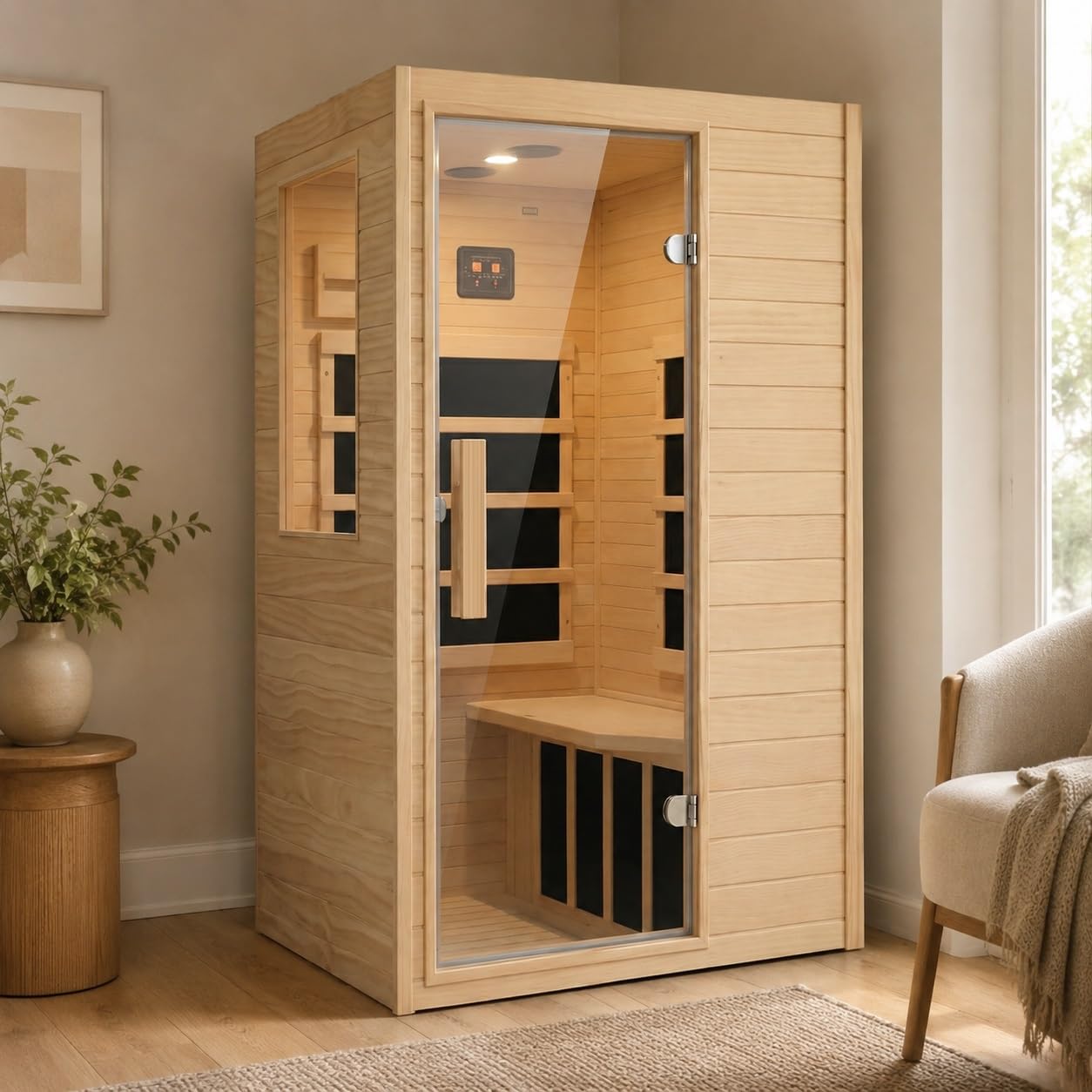
Seventy-three inches of cabin height is the headline, and it's the reason to look here. Most home cabins are sit-down boxes; this one is tall enough that most adults can stand and stretch between rounds, which changes how a 30-minute session feels far more than an extra panel does. It also carries the highest listed maximum among the cabins here, a 150°F ceiling, with a range down to 66°F and a timer that runs to 99 minutes for anyone who wants to start low.

The rest of the package is unusually generous. Six heating panels wrap the body, the 1,450-watt draw runs off a standard three-prong outlet, and the trim includes Bluetooth, MP3 and radio through two speakers, a seven-color therapy light, plus a bookshelf, a towel rack and a cup holder. The wood finish and glass door look better than the price bracket suggests.

What it asks in return is a committed corner: 40 by 36 inches and 231 pounds, and it isn't moving for a party. Set against that, it's the cabin we point taller users and stretch-out sitters to — stand up, run it hot, and stop treating a home sauna as a crouch.

Bottom Line

Our pick for anyone who wants to stand up in a sauna — the tallest cabin here, with the hottest listed ceiling of the wood cabins.

Check Latest Price

Best Two-Person Infrared

Our Score 9.2/10
Dynamic Andora 2-Person Infrared Sauna

Dynamic

Dynamic Andora 2-Person Infrared Sauna

  • Interior 43 x 37 x 68 inches
  • Electrical Standard 15-amp, 120-volt plug
  • Heating Panels Six low-EMF carbon panels
  • Max Temperature 135°F
Check Price on Amazon

Two adults, red light, and a standard wall plug — no electrician.

Two-person saunas split into two kinds: the ones that seat two, and the ones where two adults sit without their shoulders touching. With a 43-by-37-by-68-inch interior, this is the second kind — a cabin where you can share a session and still have somewhere to put your arms. That's a large part of why it costs what it does.

The installation is what makes it practical. Six low-EMF carbon panels, a standard 15-amp, 120-volt plug, and roughly an hour of panel fitting on any indoor floor, carpet included — no electrician, no dedicated circuit, no carpentry. Red-light chromotherapy, a white reading light, Bluetooth and an MP3 input round it out, which makes it the most complete cabin here straight out of the box.

Heat is the compromise. The listed ceiling is 135°F with a comfort band of 115°F to 130°F, which is gentle by infrared standards — if you like a sauna that drives you out, the X-Vcak's 150°F is the better fit. Delivery is the other consideration: at 319 pounds it's a two-person job, and it wants a solid, level floor in a spot you won't rearrange later. Neither of those rules it out for a household that will use it together most weeks.

Bottom Line

Buy it if two of you want to sit together: this is the most comfortable shared cabin we tested, and it still plugs into a standard wall outlet.

Check Latest Price

Best for Daily Sessions

Our Score 9.0/10
ZONEMEL Portable Steam Sauna

ZONEMEL

ZONEMEL Portable Steam Sauna

  • Windows Three
  • Water Tank 4 liters
  • Steamer Power 1500W
  • Session Length Up to 99 minutes
Check Price on Amazon

Four liters and 99 minutes mean one fill covers a long session.

Four liters and 99 minutes is the pitch, and it holds up in practice: a 4-liter reservoir is generous for a tent, and one fill covers a full session with water to spare — no topping up mid-sweat, no cutting things short because the steamer ran dry.

That capacity is why this is the tent we point daily users to. A 1,500-watt steamer, three windows that open for air, a double-headed zipper and a remote you can work from inside add up to a routine that's easy enough to become a habit, and the tent goes up and comes down without tools.

What you accept is a wet sauna in a fabric box. The heat is steamy and mild rather than fierce — fine for a half-hour session, not the thing that drives you out the door — and you're sitting rather than standing, with the three windows doing the work of making it feel less enclosed. It's also a one-person tent, so don't buy it hoping to share.

Bottom Line

We point daily users here: one fill covers a full session, and the routine is easy enough to keep.

Check Latest Price

Best For Fixed-frame steam

Our Score 9.0/10
MUTAMA Portable Steam Sauna Box

MUTAMA

MUTAMA Portable Steam Sauna Box

  • Frame Rigid steel pipe
  • Water Tank 3 liters
  • Tent Height 71 inches
  • Steamer Power 1400W
Check Price on Amazon

Most steam tents wobble. This one sits on a steel pipe frame under the five-layer fabric, and the difference shows the moment you lean back — no flexing, no wall bowing in when the door opens. That rigidity is also why it feels less like camping gear than the pop-up tents here.

The rest of the package is unusually complete: a 1,400-watt steamer with a 3-liter tank, a remote with 15 heat levels and a 99-minute timer, boil-dry protection, a 660-nanometer red light panel, and a 20-by-24-inch window that keeps the inside from feeling closed in. The 32-inch square footprint tucks into a bathroom or the corner of a garage gym.

The frame and the window are why it beats the cheaper tents here; the red light is a nice extra rather than a reason to buy. For a fixed spot — a spare bathroom, a basement corner — it's the steam sauna to buy. What it won't do is fold into a cupboard the way a pop-up does, so treat it as furniture rather than luggage.

Bottom Line

We like the rigid frame and the big window; this is a steam sauna for a fixed spot rather than a suitcase.

Check Latest Price

Best Overall

Our Score 8.8/10
Homsido 1-Person Low EMF Infrared Sauna

Homsido

Homsido 1-Person Low EMF Infrared Sauna

  • Wood Canadian hemlock
  • Dimensions 32 x 27 x 57.9 inches
  • Heating Power 900W
  • Heating Panels Five low-EMF carbon panels
Check Price on Amazon

A real infrared cabin that fits a bedroom corner and heats fast.

Six square feet of floor — about the space of a small armchair — is what this cabin asks for, and that number explains why it's the one we recommend first. You get a genuine infrared sauna, five low-EMF carbon panels behind Canadian hemlock, in a footprint that fits a bedroom, a basement corner, or the end of a home gym. At 900 watts it's also a light electrical load next to the bigger cabins here.

Assembly is the part that surprised us. The panels clasp together without tools, one person can raise the cabin, and there's no screwdriver work and no contractor. Once it's up, the digital controller runs temperature and time and cuts the heaters at the end of a session, and there's Bluetooth and a reading light for music or a book while you sit.

Inside, the heat is dry and even — no water to refill, no steam escaping every time the door opens — and the cabin holds its temperature once it's up. Warm-up is quick enough that a session doesn't need planning, which matters more than a spec sheet suggests: the difference between a short wait and a long one is the difference between a habit and an ornament.

The trade is that you sit rather than stand. At 57.9 inches tall and 27 inches deep, the interior is a seat with your knees bent, not a room to stretch out in — workable for a six-footer and generous for nobody. If standing up between rounds matters, the X-Vcak cabin is the one to look at. For recovery heat after training and a quiet half hour before bed, though, the small footprint stops being a compromise and starts being the point.

Bottom Line

This is the home sauna we recommend first: a real infrared cabin that fits a bedroom corner, assembles without tools, and doesn't need an electrician.

Check Latest Price

Best Lightweight Cabin

Our Score 8.8/10
Albott 1-Person Infrared Sauna

Albott

Albott 1-Person Infrared Sauna

  • Weight 107 lb
  • Footprint 6 square feet
  • Dimensions 31.8 x 27.2 x 60.2 inches
  • Heating Panels Four carbon panels plus foot heat
Check Price on Amazon

107 pounds, one-person setup, and a heated foot zone.

Foot heat is what separates this cabin from the Homsido at the same price. Four carbon panels wrap the body, and a dedicated floor zone warms your feet and lower legs — the part that stays cold longest in a small cabin and the part small cabins tend to neglect.

At 107 pounds it's the lightest cabin here by a wide margin, and it's built to go together with one person and basic tools. Six square feet of floor, Finnish spruce, tempered glass and a door seal strip: this is the cabin for someone who wants wood and panels without recruiting help or hiring out the job.

Inside, 60 inches of height and 27 inches of depth make it a sit-down cabin like the Homsido, with a glass front that keeps it from feeling like a locker. The spruce looks better than the price implies, and the bench is comfortable enough for a full session.

Where it lands: this is the cabin for someone who wants real infrared heat, doesn't need to stand up, and would rather not move 300 pounds or hire help. The foot heat and the light weight are the two things it does better than anything else here at its price.

Bottom Line

The lightest cabin we tested, with heated feet and one-person assembly, and a good buy if a long warm-up doesn't bother you.

Check Latest Price

Best Budget Steam Sauna

Our Score 8.6/10
Manastin 1-Person Portable Steam Sauna

Manastin

Manastin 1-Person Portable Steam Sauna

  • Timer 99 minutes
  • Weight 18.5 lb
  • Dimensions 31.45 x 70.88 x 31.45 inches
  • Heat Levels 15
Check Price on Amazon

Nearly six feet of standing room and 15 heat levels on a budget.

The chair is the tell. It's small and low, and it's the first thing you'll want to swap — but put a patio chair in its place and you're standing in nearly six feet of steam with 15 heat levels, a 99-minute timer and a five-layer shell that holds heat better than the price suggests. That makes it the best-value tent here.

It's also the one we point tall users to on a budget. The 31-inch square footprint tucks into a corner, setup is a three-step job one person can do, and at 18.5 pounds it moves between rooms or packs away between uses without becoming a project. The remote handles heat level and time, so you set it before you step in and don't fiddle once you're sweating.

What it isn't is a dry sauna or a two-person anything. The shell is a shell, the footprint is one chair wide, and the whole thing packs down to something you carry with one hand. If you want wood, a sealed door and heat that keeps radiating after you switch it off, this isn't that; if you want a hot 30 minutes on a Tuesday, it is.

Bottom Line

We send tall users on a budget here — nearly six feet of standing room, 15 heat levels, and a footprint that tucks into a corner.

Check Latest Price

Best Steam Sauna for Two

Our Score 8.4/10
X-Vcak 2-Person Portable Steam Sauna

X-Vcak

X-Vcak 2-Person Portable Steam Sauna

  • Fabric Five-layer waterproof
  • Weight 23.9 lb
  • Steamers Two
  • Dimensions 71 x 49 x 36 inches
Check Price on Amazon

Dual steamers and two chairs for shared sessions without a cabin.

If two of you want to sweat together and there's no room — or no budget — for a wooden cabin, this is the tent we hand people. It's 71 inches tall and 49 inches wide, it runs two steamers at once, and two folding chairs come in the box.

Setup is a click-together frame and a five-layer waterproof shell, and it's a one-person job you can repeat whenever you want a session. The zippered window has hand openings, so you can read or scroll without dumping the heat, and there are pockets inside for a phone.

Steam is generous and fast — the tent fills quickly and holds a proper fog — but this is wet heat, not dry heat, and it comes with the usual tent caveats. The two chairs are low and small enough that taller users end up on a patio chair, and how hot a session feels depends on where you point the steamers.

For couples on a budget, it's still the pick: nothing else here seats two for anything like the money, and it folds away when you're done. Treat it as a steam room rather than a sauna, plan on replacing the chairs, and it does a cabin's job at a fraction of the commitment.

Bottom Line

We recommend it for couples: two steamers, two chairs, standing room, and a tent that folds into a corner afterward.

Check Latest Price

How We Tested Six Home Saunas Over Eight Months

We started by pulling every home sauna we could find that ships to a residential address, then read the spec sheets closely: heater type and wattage, cabin footprint, ceiling height, electrical requirement, and how many people it takes to put one together. That last detail eliminated a surprising number of candidates. Anything needing a dedicated 240-volt circuit and a contractor visit made the shortlist only if it was a full traditional build; everything else had to run on a standard household outlet. We landed on six cabins spanning both heater types, from a one-person corner unit to a four-person room.

Each sauna was assembled and run in a real home — a spare bedroom, a finished basement, and a garage that swings from cold and damp to hot — then used three to four nights a week for eight months. We timed assembly with two people from unboxing to first session and noted where the instructions stalled or the hardware ran short. Every unit got the same heat test: one thermometer at bench height, one near the floor, the clock running from a cold cabin to target temperature, then again after the door had been opened a few times.

Inside, we paid attention to how the heat actually landed — dry and prickly versus soft and enveloping, whether the floor stayed bearable on bare feet, whether the benches got uncomfortably hot at the thighs. After each session we checked door seals, hinges, and bench slats; by month six, the garage unit had shown us which materials tolerate temperature swings and which ones start to creak. Value came down to heater output and build quality weighed against what each cabin cost, plus warranty length and how quickly the manufacturer answered a question.

How to Choose

Cabin or Tent: Decide This First

An infrared cabin is a wooden box with carbon panels. It lives where you put it, needs no water, plugs into a normal wall outlet, and holds its heat between sessions. A steam tent is a fabric shell over a frame with a countertop steamer feeding it: it costs a fraction as much, folds down between uses, and delivers wet heat, which feels hotter at a lower thermometer reading.

Buy the cabin if you have a permanent corner and will use it most weeks. Buy the tent if you rent, move it between rooms, or want to find out whether the habit sticks before giving up floor space to it.

Measure the Floor and the Inside

Listed dimensions are usually the footprint, and the interior is smaller than that number suggests. A two-person cabin is snug for two adults; a one-person cabin is a seat, not a room. Check interior height against your own height — a 73-inch cabin lets most adults stand, a 58-inch one is seated only — and check interior depth against your leg length before you order.

Then tape the footprint on the floor, add the door swing, and walk the delivery path from your front door. A 40-inch crate doesn't turn a hallway corner.

Power, Weight, and Setup

The cabins here run on standard 120-volt household current, from 900 to 1,450 watts, so most don't need an electrician. A 1,450-watt unit pulls about 12 amps, though, which leaves little headroom on a 15-amp breaker shared with anything else — find the circuit before delivery and keep the sauna off the one running a space heater.

Weight matters as much as wiring. Cabins run from about 107 to 319 pounds on a small footprint, so plan for two people and a solid, level floor. Steam tents weigh 18 to 27 pounds and go up in minutes.

What the Heat Actually Feels Like

A listed maximum temperature is a ceiling, not a promise. A small cabin at 135°F can feel more intense than a bigger one rated higher, because there's less air to heat and your body fills more of the space. Panel placement matters as much as the number: a floor or lower-leg zone is what keeps your feet from staying cold, and only some cabins here have one.

Warm-up is the other half of the experience, and it's where these units differ most. A cabin that heats quickly is one you'll use on a weeknight; a slow one becomes a weekend event. Steam works differently — humidity makes a lower reading feel like more, which is why a tent can satisfy where the thermometer suggests it shouldn't.

Upkeep and What Wears Out

Cabins are low-maintenance: wipe the bench and floor after a session, leave the door ajar to dry, and keep the panels dust-free. Steam tents ask more — refill and empty the tank, dry the fabric fully or it will smell, and expect the chair, the basin and the zipper to be the parts that go first.

If you're buying a tent, budget for a sturdier chair from the start and keep the receipt, since the steamer is the component that carries the warranty.

Frequently Asked Questions

Final Verdict

The Homsido is the home sauna to buy: a real infrared cabin, small enough for a bedroom corner, quick enough to heat that you'll use it on a weeknight, and priced like a good appliance rather than a renovation. If two of you want to sit together, the Dynamic Andora is the upgrade — a standard wall plug, about an hour of assembly, and room for two adults without shoulders touching.

And if you rent, move often, or want to spend tent money instead of cabin money, start with the X-Vcak two-person steam tent. It's wet heat rather than dry, but it seats two and folds into a corner.