Strength & Weights

Best Heavy Bags with Stands of 2026

A freestanding heavy bag makes a simple promise: fill the base with water or sand, and the weight holds the bag steady while you throw punches and kicks. The trouble is how many of them break that promise. Bases seep onto the floor, bags slide across the room mid-combination, and assembly turns into an afternoon of wrestling with bolts. What a good one buys you is a real workout at home—no ceiling mount, no contractor, no gym membership—as long as the base stays planted and the bag can take a punch.

Over the past six months, my team and I have tested 10 freestanding bags, filling bases with water and sand, running through jab-cross-hook combinations and kick drills, and timing how long each took to assemble solo. We noted which bases leaked, which bags drifted after a few hard hooks, and which ones felt like a fair price for what you get. The picks below are the ones that stayed upright, held their shape, and made us want to keep training—not just finish the test.

Best for Accuracy Training

Our Score 9.4/10
Century BOB XL

Century

Century BOB XL

  • Body Plastisol over urethane foam
  • Height 78 in
  • Base Capacity 270 lb water or sand
  • Height Settings Multiple
Check Price on Amazon

A torso target that gives you a chin and ribs to aim at.

BOB XL is a torso on a base: shoulders, chest, a head that rocks back when you catch it clean. That shape is the entire argument. A cylinder gives you a target with no landmarks; BOB gives you a chin to measure, ribs to drop a hook into, and a head that moves when you land, which is as close as this list gets to a partner standing still and letting you work.

He stands 78 inches overall on a 24-inch body, with a high-strength plastisol shell over urethane foam and a polyethylene base that swallows 270 pounds of water or sand. The surface has real give — a bare-knuckle jab does not sting the way it does on vinyl — and that texture is what makes head-shot drills feel like drills instead of guesswork.

Where it earns the money is accuracy. Working slip-and-counter on something with actual shoulders teaches you to measure distance in a way a cylinder cannot, because you have to know where the chin is when your hands are already tired. The height settings are the detail we did not expect to use as much as we did: raise him for a taller training partner, drop him for a shorter one.

Fill the base with sand rather than water and he stays put for punches; with water only, he scoots across the floor when you kick. He rolls on the base to move, so the corner of a garage is enough storage between sessions.

Bottom Line

The only pick here shaped like a person — buy it for aim, head movement and body shots rather than raw power.

Check Latest Price

Best Overall

Our Score 9.2/10
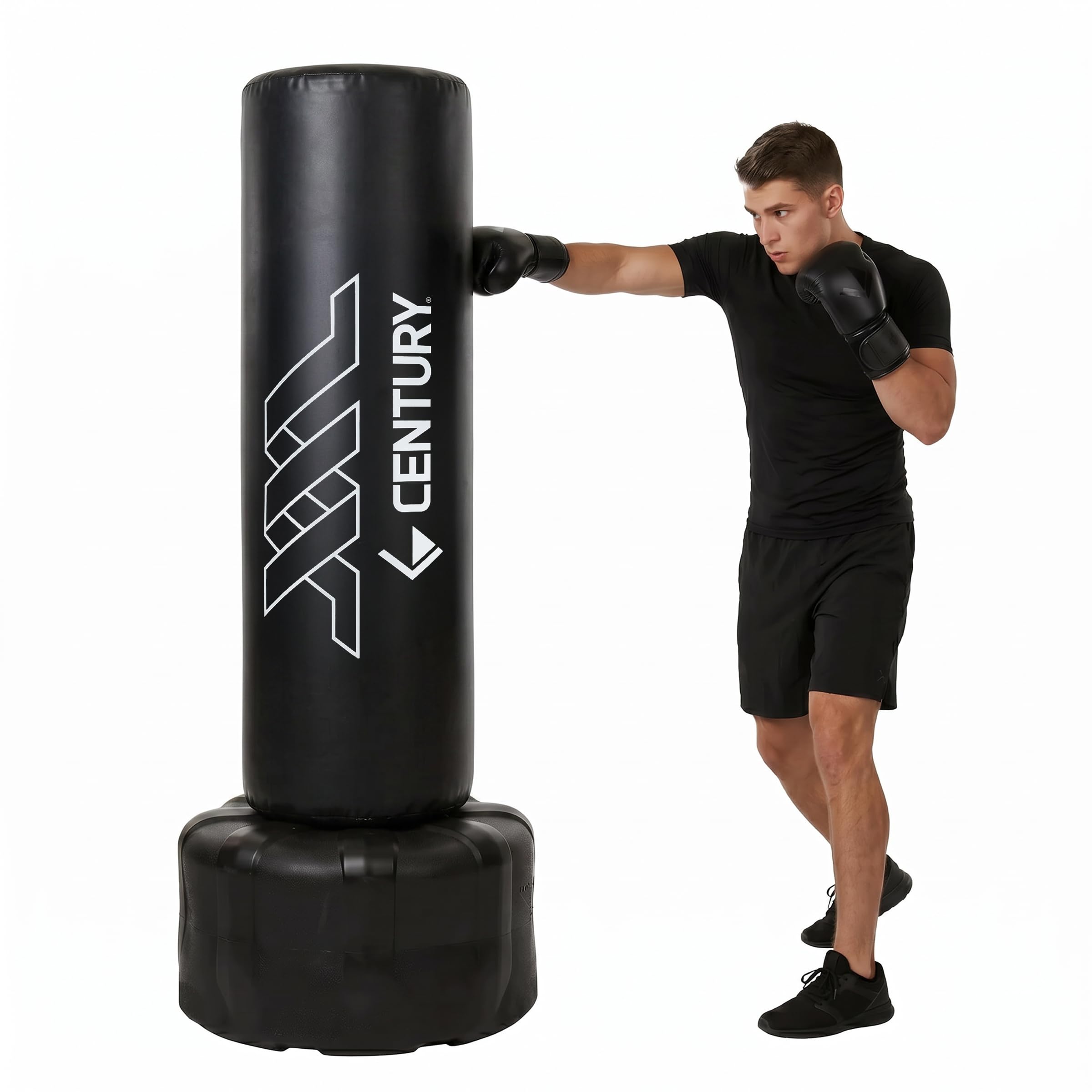
Century Wavemaster XXL

Century

Century Wavemaster XXL

  • Cover Vinyl over high-density foam
  • Height Adjustable, 52–69 in
  • Striking Area 52 in tall, 18 in across
Check Price on Amazon

Adjusts from 52 to 69 inches, stays upright, and rolls out of the way.

Two things decided the Wavemaster XXL for us: it changes height, and it stays upright. The striking section slides between 52 and 69 inches, so a tall adult works head shots at full extension and a 12-year-old can set it to their own chin in under a minute. In a house where more than one person trains, that single feature does more work than anything else on this page.

The striking area is the biggest in this group as well — 18 inches across and 52 inches tall, vinyl wrapped over high-density foam. We noticed the size most on body shots. There is room to drop a hook to the ribs without clipping the edge of the bag, and the surface is firm enough that a straight right feels like it landed on something instead of sinking away.

Setup is close to nothing: the base is one molded piece, the bag drops on top, and moving it is a tip-and-roll job, leaning it onto the edge of the base and walking it across the room. It does slide. Sit down on your punches on smooth concrete and it creeps a few inches over a round; a rubber mat under the base settles most of that, and a bag that slides is easier to live with than one that goes over.

The surface is dense, which is the whole reason a jab feels like a jab, but it is also why we tell people to wrap up for the first few sessions if their hands are not conditioned. The plastisol body on the BOB XL is the softer of the two if bare-knuckle work matters to you.

Bottom Line

The bag we point most homes to: it adjusts from 52 to 69 inches so several people can use it, and it takes hard shots without going over.

Check Latest Price

Best Complete Kit

Our Score 9.0/10
FITVEN Freestanding Punching Bag

FITVEN

FITVEN Freestanding Punching Bag

  • Height 70 in
  • Included Boxing gloves
  • Suction Cups 12
  • Base Capacity 205 lb sand
Check Price on Amazon

Gloves, bag and a 205-pound sand base in one order for beginners.

Two boxes, sometimes on different days, and between them you have a complete setup: bag, base, 12 suction cups and a pair of gloves. The bag stands 70 inches, the base takes up to 205 pounds of sand, and the whole thing goes together in about ten minutes on a smooth, level floor.

For the price, nothing here fills out a first home gym as completely. The three-year manufacturer warranty is longer than either premium bag carries, the rebound comes off two absorbers and four springs at a 15-to-45-degree angle, and the gloves mean you can train the day it lands. The base is where the corners were cut: water can work its way out around the screw holes, so plan on sand.

Kicks land well because the bag gives and springs back rather than deadening the shot, and 70 inches puts the striking zone where an adult actually aims. What it is not is a puncher's bag — the springs and the flexible shaft soak up a lot of what you throw, and a genuinely heavy hitter will want more mass under their hands. For a teenager, a beginner, or a couple sharing a garage, it is the sensible first buy.

Bottom Line

The kit we hand beginners: gloves, bag and a 205-pound base in one order, for well under half what the top pick costs.

Check Latest Price

Best For Casual training

Our Score 9.0/10
RORALA Punching Bag with Stand

RORALA

RORALA Punching Bag with Stand

  • Base 7.5 mm ABS, 12 cups
  • Height 70 in
  • Included 12 oz gloves
Check Price on Amazon

Seventy inches, a 7.5 mm ABS base ringed with 12 suction cups, and 12-ounce gloves in the box. On paper the RORALA is the LEKÄRO's twin: same height, same cup count, same multi-layer bag over a steel prop, same one-year replacement warranty.

Once the base is full, the bag returns off the steel prop with a firm, quick snap — not the damped feel of a spring-free base, and not quite as springy as the LEKÄRO's four coils. It sits in the middle, which is where the whole product sits: nothing about the RORALA is extreme in either direction.

Grip is where it separates from the other budget kits. Twelve cups on a thick 7.5 mm base is more hold than the price suggests, and the bag is tall without being wide, so it fits in rooms where the RDX's 61-inch leg span would not.

This is the quiet overachiever of the budget group. It does what the cheaper kits do without the wobble, the gloves are good enough to start in, and the base stays where you put it once there is sand in it. It will not out-hit a Wavemaster or out-adjust one, but at this price that is not the ask.

Bottom Line

A steady middle-of-the-road kit with gloves in the box — nothing about it will let you down in casual home training.

Check Latest Price

Best Budget

Our Score 8.8/10
LEKÄRO Freestanding Punching Bag

LEKÄRO

LEKÄRO Freestanding Punching Bag

  • Height 70 in
  • Included 12 oz gloves
  • Warranty 6 years
  • Base Capacity 205 lb sand
Check Price on Amazon

The least expensive bag-and-gloves kit here, with six years of stated coverage.

Seventy inches tall, a 205-pound sand base, 12 suction cups, a four-layer shell over a steel bracket, and 12-ounce gloves in the box. On paper the LEKÄRO reads like the FITVEN and costs a good deal less, and the manufacturer's stated warranty runs to six years — several times what the premium bags carry.

That combination makes it the budget pick we are comfortable recommending. The caveat is the warranty itself: a six-year term on a bag in this price bracket is a promise worth keeping the receipt for, because a warranty is only as good as the company honoring it. What we can vouch for is the bag — the four springs return it at 15 to 45 degrees, and it assembles from the picture instructions in a few minutes.

Filling takes a while, since 205 pounds is four or five bags of sand, and doing it with the base already in place saves lifting a full one twice. The removable base is the practical detail we appreciated most: on moving day you can empty it and carry it out in two trips instead of wrestling it through a doorway.

Bottom Line

The least expensive bag-and-gloves package here, and the one that stands behind it the longest: 70 inches tall, a 205-pound base, six years of coverage.

Check Latest Price

Best for Apartments

Our Score 8.8/10
GIKPAL Freestanding Punching Bag

GIKPAL

GIKPAL Freestanding Punching Bag

  • Height 70 in
  • Rebound Spring-free tumbler
  • Included Hand wraps, assembly tools
  • Base Capacity 180 lb sand
Check Price on Amazon

Spring-free rebound keeps the noise down without losing the workout.

No springs. The GIKPAL uses a spring-free tumbler in the base, so the bag returns on a smooth arc instead of bouncing off metal coils — and springs are exactly what turn a punch into a thump the neighbor downstairs can follow.

It stands 70 inches, takes up to 180 pounds of sand in a base ringed with 12 suction cups, and ships with hand wraps rather than gloves. Assembly tools are in the box, the bag and base arrive separately, and the fill has to happen before the first session or the whole thing walks away from you.

Quiet is worth paying for if you train after the kids are asleep or above someone else's ceiling. The trade is liveliness: a spring-free rebound is more damped than a sprung bag, so fast combination work feels a half-beat behind, and 180 pounds is on the light side for this group. Neither has bothered us in a small room with a rubber mat underneath.

Bottom Line

The apartment answer: no springs to clang, 180 pounds of sand to hold it down, and a rebound quiet enough for a second-floor flat.

Check Latest Price

Best For Small rooms

Our Score 8.8/10
PEXMOR Freestanding Punching Bag

PEXMOR

PEXMOR Freestanding Punching Bag

  • Width 11.02 in
  • Height 53.94 in
  • Weight 37.5 lb
Check Price on Amazon

At 53.94 inches tall and 11 inches across, the PEXMOR is the smallest bag here, and that is the reason to buy it. Set it up and it sits around chest height for an average adult, which changes the workout: this is a bag for body hooks, knees, low kicks and speed work, not for practicing head shots.

The core is a thick steel pipe under a PU leather shell, and the base is a suction-cup armor plate that does its best work on smooth concrete. It weighs 37.5 pounds empty, so one person can carry it upstairs and set it up alone, and it will sit on a balcony or in the corner of a bedroom without eating the room.

What we did not expect was how much the size changes what you practice. Without a full-length bag in front of you, you stop throwing head-height combinations and start working the body, which is the part most home trainees skip anyway. It is the least substantial build here, and it is priced to match.

Bottom Line

For a small room or a shorter user, this is the practical one: 54 inches tall and 11 across, it fits where the 70-inch bags cannot.

Check Latest Price

Best for Tall Strikers

Our Score 8.6/10
RDX XXL 6FT

RDX

RDX XXL 6FT

  • Base 8 legs, 17 suction cups
  • Height 72 in
  • Included Mitts, funnel, bag cover
  • Base Capacity 285 lb sand
Check Price on Amazon

72 inches of bag on 285 pounds of sand for heavy hitters.

Six feet of bag standing 72 inches tall, on a base that takes 285 pounds of sand. Nothing else on this list is built for as much weight or as much reach, and the base is the reason: an eight-legged octa-truss platform ringed with 17 suction cups spreads the load outward instead of stacking everything under one small disc.

The extras are the surprise. A funnel comes in the box, which turns filling a 285-pound base from an afternoon into a job you finish before lunch, and there is a bag cover and a pair of punch mitts in there too. Two boxes, and in most cases they land on the same day.

The base is also the part to check when it arrives. A bag this tall puts leverage on the joint at the bottom every time you land a kick above waist height, and a split around the fill opening is the failure that takes these bags out of service. We kept an eye on the seams through our sessions; on finished concrete the cups gripped hard enough that the whole setup felt anchored rather than balanced.

What the extra money buys is the top of the bag. At 72 inches there is striking surface above a six-foot puncher's shoulders, so head shots stop being something you aim down at — that is the difference between this and every 69- or 70-inch bag here, and the reason it ranks first in this group for tall strikers. The leg span is the widest too, at 61 inches, so measure the corner of the garage before it arrives.

Bottom Line

The biggest setup here — 72 inches of bag on a 285-pound base — for tall strikers and anyone who has been bottoming out smaller bags.

Check Latest Price

How We Chose and Tested Freestanding Heavy Bags

We started by gathering freestanding bags from brands we've trusted for boxing gear and from newer names with strong review records, then narrowed the field by base type, height range, and price. We cut anything with a base that couldn't be filled with both water and sand, anything that required wall or ceiling mounting, and anything that arrived with a suspicious number of assembly complaints. That left us with 10 bags to test over six months.

Testing happened in garages, living rooms, and a converted basement gym—the places these bags actually live. I assembled each one solo with the included tools, timing the process and noting whether the instructions matched the hardware. Once filled, I ran a standard 15-minute workout on each: jab-cross-hook combinations, front kicks, and roundhouse kicks, plus a few minutes of freeform heavy bag work. Between sessions, I checked the base for seeping water, watched whether the bag migrated across the floor, and tested the suction cups on hardwood, concrete, and a rubber mat.

Stability was the first thing to go. Bags with narrow bases wobbled after a solid hook; wider bases held but were harder to move. I noted how much each bag weighed once filled, whether the base could be drained without a mess, and how the bag's shell held up after repeated kicks—loose stitching, dents, and surface wear all counted. For value, I compared the workout each bag delivered against its price and asked whether a beginner would outgrow it in a month. The bags that scored well did two things: they stayed put during hard combinations, and they made me forget I was testing.

How to Choose

Your Floor Decides More Than the Bag Does

Suction cups only work on a smooth, sealed surface: finished concrete, tile, hardwood, epoxy. On carpet or a broom-finished slab they are decoration, and the sand in the base is doing all the work alone. Check the floor before you check the spec sheet.

If you train on carpet, buy the biggest fill capacity you are willing to pour — the RDX takes 285 pounds of sand — and do not pay extra for cup count. On a smooth floor, cups plus sand is the most planted combination on this list.

Sand Beats Water, and the Fill Hole Matters

Sand is denser than water, does not slosh, and does not find its way out around screw holes the way water does. It is also heavier to pour and miserable to empty, which is why the fittings matter as much as the capacity. A funnel and a base that lifts off turn an afternoon into twenty minutes.

Fill the base where the bag will live, before the bag goes on. A full base is not something you want to lift twice, and every one of these bags behaves badly on its first session with an empty one.

Height and Striking Area

Seventy inches is the standard here, and it puts the striking zone at adult head-and-chest height. If more than one person will use the bag, pay for adjustability: the Wavemaster XXL slides between 52 and 69 inches and the BOB XL shifts between height settings, because a bag set for a six-footer is useless to a twelve-year-old.

Short bags are a different tool. The 54-inch PEXMOR is fine for body shots, knees and speed work in a tight room, but it will not teach you head movement.

Noise, Neighbors and Where It Sits

Springs are the noise. Each punch compresses four coils and lets them snap back, and that metal-on-metal return travels through a floor. A spring-free base such as the GIKPAL is quieter, and a heavier sand fill deadens more than water does at the same volume.

Placement finishes the job: a rubber mat under the base stops the slow creep on smooth concrete, and a bag that slides is easier to live above than one that tips and lands.

Kits, Gloves and Warranty

Half of these setups ship with something: gloves on the FITVEN, LEKÄRO and RORALA, hand wraps on the GIKPAL, mitts and a funnel on the RDX. Included gloves are beginner-grade, so if you already own a pair, ignore that line entirely.

Compare on base capacity and warranty instead, where the spread is wider than you expect. The most expensive bag here carries a one-year warranty; one of the cheapest states six.

Frequently Asked Questions

Final Verdict

Start with the Century Wavemaster XXL. It costs more than most of this list, but it adjusts to fit everyone in the house, its 18-inch striking area is the biggest here, and it stays upright when you sit down on a punch — the three things that decide whether a freestanding bag gets used or becomes a coat rack.

If the budget is the constraint, the FITVEN covers a first setup for well under half the money. If you are tall or heavy-handed, skip both and go to the RDX, where the bag actually reaches above your shoulders.