Cardio Machines

Best Exercise Bikes of 2026

An exercise bike is one of the easiest pieces of home fitness gear to buy and one of the easiest to abandon. The bikes that end up draped in laundry usually share the same three flaws: a saddle that turns painful around minute twenty, a frame that rocks when you stand to climb, and a drivetrain loud enough that you feel guilty riding before 7 a.m. Fix those things and a 45-minute class stops being a countdown. Add an assembly you can finish in one evening and a price that lines up with the build quality, and you have a bike you'll actually keep.

Twelve bikes have been living in my team's homes for the past six months, and the differences show up in places the spec sheet skips — how much the seat gives under you, whether resistance changes in smooth steps or clunky jumps, whether the thing still feels solid in month five. Here's the piece first-time buyers miss: seat size and shape matter more than almost any feature, because the saddle is the part your body argues with daily. The picks below are sorted by who they actually fit.

Best Recumbent

Our Score 9.2/10
MERACH S19 Recumbent Bike

MERACH

MERACH S19 Recumbent Bike

  • Drive Dual-belt drive
  • Resistance 8 magnetic levels
  • Seat Adjustment 8 positions
  • Weight Capacity 330 lb
Check Price on Amazon

A comfortable low-impact bike for riders who want back support and easier mounting.

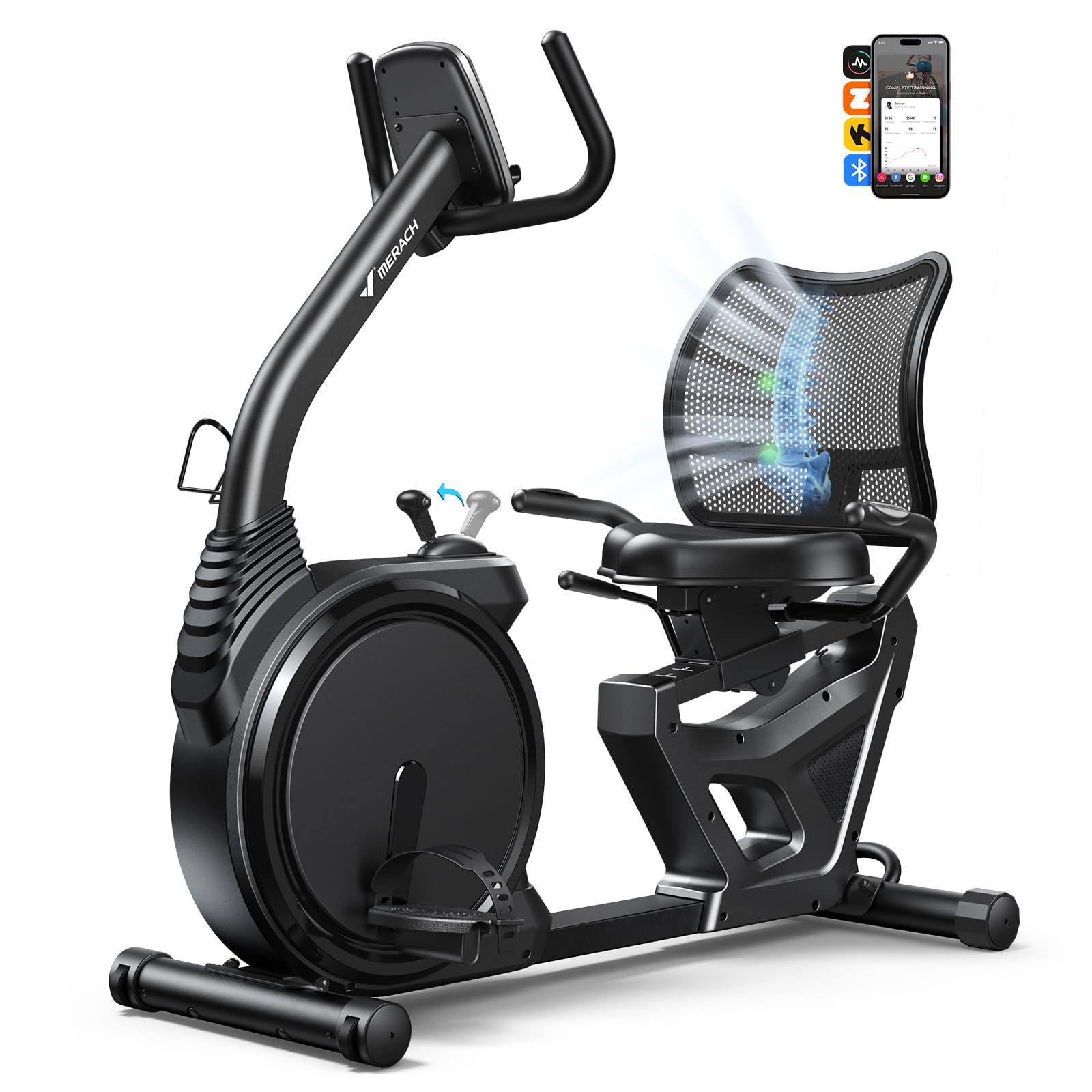
Back support is the reason to choose a recumbent, and the S19 is the recumbent we recommend first because it also makes mounting easier. The step-through frame lets you sit down before you start pedaling, and the thick seat and backrest give you something to push against on longer rides.

The resistance is adjusted with a car-style lever rather than a twist knob, which is easier to reach mid-interval. There are eight magnetic levels and a dual-belt drive, and the bike is rated to 330 pounds. The seat moves through eight positions, so two riders can share it without a tools-heavy reset.

The ride is smooth and quiet, and the forward and side handles give you more than one place to put your hands. We also appreciate that the console shows heart rate, because recumbent riders often want to keep the effort steady rather than chase intervals. The car-style lever is the detail that makes it easier to change effort without breaking rhythm.

Bottom Line

A comfortable recumbent for low-impact cardio, rehab, or anyone who wants back support and easier mounting.

Check Latest Price

Best Overall

Our Score 9.0/10
Schwinn IC4 Indoor Cycling Bike

Schwinn

Schwinn IC4 Indoor Cycling Bike

  • Drive Belt drive
  • Warranty 10-year frame; 3-year parts
  • Resistance 100 magnetic levels
  • Weight Capacity 330 lb
Check Price on Amazon

A stable, app-friendly spin bike with fine magnetic resistance and a strong frame warranty.

If you have ridden a studio spin bike, the IC4 is the closest thing here to bringing that experience home. The 100-level magnetic resistance moves in fine enough steps for short intervals, and the belt drive stays quiet enough to ride in the same room as someone reading. Bluetooth pairing with Peloton, Zwift, and JRNY is the other draw, though those services are separate subscriptions.

Stability is what seals it. The frame is rated to 330 pounds, the bike itself weighs 112 pounds, and the wide base stays planted when you stand to climb. The warranty is another point in its favor: 10 years on the frame and three years on parts is real backing at this price tier.

The 100 levels are what separate it from the eight-level bikes here when a class calls for a precise jump. You can nudge the load for a recovery spin or crank it down for a standing climb without a big gap between settings. At 54.6 inches long and 30.7 inches wide, it also asks for a dedicated corner rather than a spot beside the sofa. For app-led cardio and hard intervals, that is a fair trade.

Bottom Line

Choose the IC4 if you want a stable, app-friendly spin bike for studio-style workouts without paying for a built-in screen.

Check Latest Price

Best Value

Our Score 9.0/10
MERACH S26 Exercise Bike

MERACH

MERACH S26 Exercise Bike

  • App MERACH app
  • Resistance 8 magnetic levels
  • Fits Heights 4'8" to 6'2"
  • Weight Capacity 300 lb
Check Price on Amazon

Quiet magnetic ride, app workouts, and a fit range that suits most households.

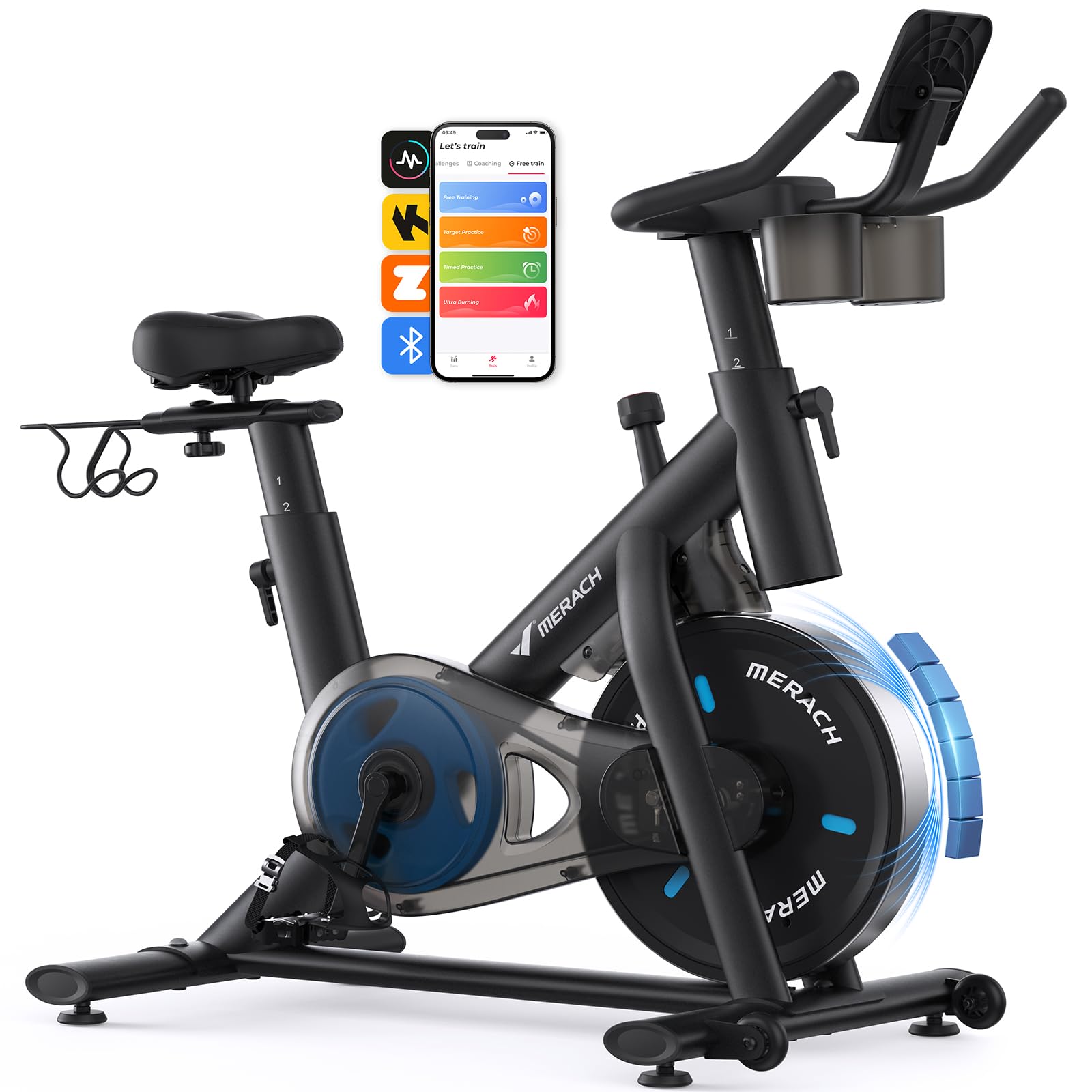
Between the budget bikes and the premium IC4 sits the S26, a midrange upright with eight magnetic resistance levels, a belt drive, and a 62-pound frame rated to 300 pounds. The seat and handlebars adjust for riders from 4'8" to 6'2", and the MERACH app adds guided workouts without requiring a separate subscription.

What makes it our value pick is how little it gives up in daily use. The ride is quiet, the frame feels solid at speed, and the eight levels cover easy spinning through hard efforts. The jumps between levels are bigger than on the Schwinn, so finely paced intervals take more guesswork, but most riders will not miss the extra steps.

The app is better for structured workouts than for entertainment, and the console is small. We also like that the bike rolls on front wheels and does not need a permanent gym corner. For a first serious upright, it is an easier recommendation than a premium bike with features you may never use.

Bottom Line

A quiet, app-connected upright for riders who want everyday cardio and a fit range that covers most households.

Check Latest Price

Best Quiet Compact Bike

Our Score 9.0/10
YPOO BC710 Exercise Bike

YPOO

YPOO BC710 Exercise Bike

  • Noise Under 25 dB
  • Resistance 16 magnetic levels
  • Fits Heights 4'8" to 6'1"
  • Weight Capacity 300 lb
Check Price on Amazon

A small-footprint magnetic bike that stays quiet and fits riders up to six-one.

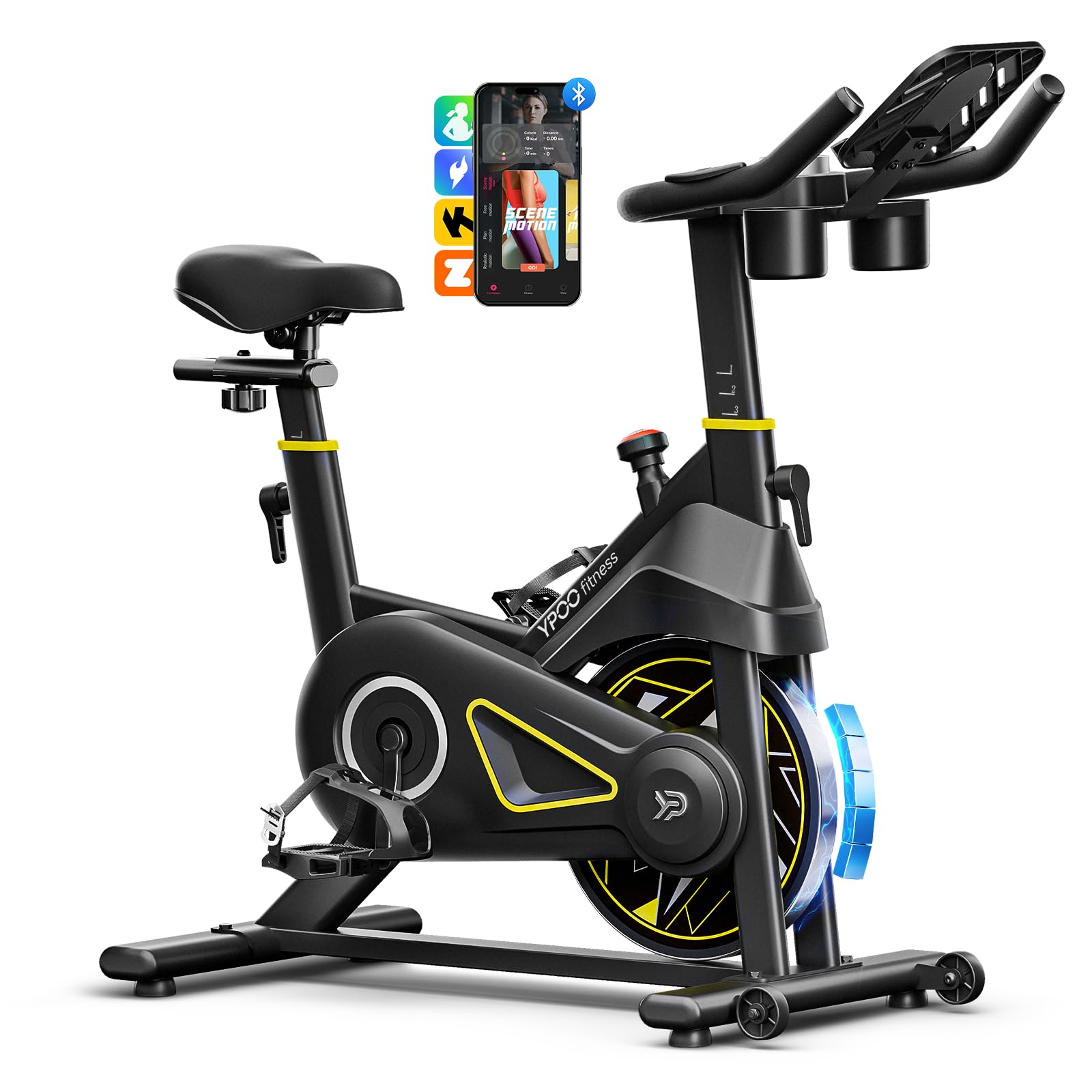
Compact spin bikes often trade stability for floor space, and the YPOO BC710 is trying to avoid that trade. It uses 16 magnetic resistance levels, a belt drive, and a frame rated to 300 pounds. The bike itself weighs 44 pounds, which is light enough to roll aside but still substantial enough to feel planted.

It fits riders from 4'8" to 6'1", and the seat and handlebars adjust without tools. The bike arrives 80% preassembled, and the resistance knob doubles as a brake. The YPOOFIT app and Kinomap/Zwift compatibility add structure, though the console is basic and the app is the main reason to connect.

The claimed noise floor is under 25 dB, and in a shared room that is the number to care about. The belt drive and magnetic brake keep the ride smooth, and the compact frame does not rock when you stay seated. It is easy to move between rooms, which matters if the bike has to share space with a desk or sofa.

What we appreciate most is how little the BC710 intrudes on a room. It rolls aside, stays quiet, and has enough resistance for a real sweat without the footprint of a studio bike. For apartment riders who want a compact magnetic bike, this is a strong fit.

Bottom Line

A compact, quiet magnetic bike for apartment riders who want a small footprint and app-friendly workouts.

Check Latest Price

Best Folding for Seniors

Our Score 8.8/10
Goimu 5-in-1 Folding Bike

Goimu

Goimu 5-in-1 Folding Bike

  • Folding Folds for storage
  • Resistance 16 magnetic levels
  • Item Weight 50.6 lb
  • Weight Capacity 330 lb
Check Price on Amazon

Backrest, side handles, and a foldable frame make daily low-impact rides easier to start.

Folding is the headline, but the backrest is the feature that changes how the Goimu is used. This is a bike for someone who wants to sit down, settle in, and pedal without balancing over a narrow saddle. The side handles add confidence when you mount and dismount.

The frame is rated to 330 pounds and uses 16 magnetic resistance levels, and the bike weighs 50.6 pounds. It rolls on its front wheels when folded, and the seat and handlebars adjust for a wide range of riders. The X-frame looks purposeful rather than decorative, and it stays stable during a steady ride.

What we like most is how low the barrier to a daily ride feels. The folding hinge lets the bike live in a closet and come out for a 20-minute session, and the backrest makes that session more comfortable than a bare upright. The 16 levels are enough for gentle progression, and the side handles make mounting less of a production.

Bottom Line

A senior-friendly folding bike with a backrest and side handles, built for low-impact rides and easy storage.

Check Latest Price

Best for Small Spaces

Our Score 8.8/10
PLENY 5-in-1 Folding Bike

PLENY

PLENY 5-in-1 Folding Bike

  • Folding Folds to narrow footprint
  • Assembly 85% preassembled
  • Resistance 16 magnetic levels
  • Weight Capacity 300 lb
Check Price on Amazon

Folds narrow enough to tuck into a corner and still offers 16 magnetic resistance levels.

A narrow folded footprint is the first thing to check on the PLENY, because that is the job it is built for. It uses a 6.6-pound flywheel and 16 magnetic resistance levels, and it is rated to 300 pounds. The frame arrives 85% preassembled, so setup is closer to unfolding than building.

That folded footprint is why it earns a place in a small home. The X-frame feels stable for a folding bike, and the seat and handlebars move through enough positions for two riders. The 5-in-1 layout adds arm and leg ergometer positions, so you can use it for more than a seated ride.

The ride is quieter than we expected from a chain-drive bike, and the 16 levels are enough for steady cardio. The compact riding position is the trade-off: taller riders may feel more folded up than they do on a full spin bike. For a short daily session in a tight room, that is a reasonable compromise.

Bottom Line

A folding 5-in-1 bike for small homes and riders who want one machine for short cardio and light strength work.

Check Latest Price

Best For Full-body budget

Our Score 8.8/10
SLUNSE 6-in-1 Exercise Bike

SLUNSE

SLUNSE 6-in-1 Exercise Bike

  • Arm Work Two resistance bands
  • Resistance 100 magnetic levels
  • Fits Heights 4.8 to 6.1 feet
  • Weight Capacity 350 lb
Check Price on Amazon

Arm resistance bands are unusual on an exercise bike, and the SLUNSE uses them as the centerpiece of a 6-in-1 setup. The bands attach at the front, so you can switch from pedaling to upper-body work without a second piece of equipment.

The 100 magnetic levels and 350-pound frame give it more range than most budget bikes, and the 59.5-pound body feels stable when you stand. It fits riders from 4.8 to 6.1 feet, and the app compatibility adds options. The curved rear base is a small design detail that makes the bike feel less tippy when you lean into the bands.

The arm bands are the detail that earns the SLUNSE its place: you can switch from legs to upper body without a second machine. The 6-in-1 positions also give you a standing option, though the bike is still happiest as a seated cardio machine. The 100 levels make it easy to dial in a gentle warm-up or a harder finish.

Bottom Line

A budget 6-in-1 bike for light full-body workouts, with arm bands and a high weight capacity.

Check Latest Price

Best For Tight budgets

Our Score 8.6/10
CURSOR CBE10 Exercise Bike

CURSOR

CURSOR CBE10 Exercise Bike

  • Assembly About 30 minutes
  • Resistance 100 friction levels
  • Fits Heights 4'8" to 6'2"
  • Weight Capacity 300 lb
Check Price on Amazon

First-time buyers are the target of the CURSOR CBE10, the lowest-priced upright bike here. It uses friction resistance with 100 levels, a belt drive, and a 39.7-pound frame rated to 300 pounds. It fits riders from 4'8" to 6'2", and CURSOR says it assembles in about 30 minutes.

The friction system is the key difference from the magnetic bikes here. It can deliver a wide range of resistance, and the bike is lighter and easier to move than the premium models. The compact frame also makes it easier to tuck into a bedroom or office.

The 31.5-inch length and 21.25-inch width are easier to place than the Schwinn. The seat and handlebars adjust for a range of riders, and the belt drive keeps the pedaling smooth. The console and app are basic, but they cover the metrics most people need for a simple cardio session.

The CBE10 is the bike we treat as a budget starting point rather than a long-term centerpiece. If you want to test whether home cycling sticks before spending more, it covers the basics. Check the return policy and warranty before you commit, because the friction brake is the part that will decide how it holds up.

Bottom Line

A low-cost upright for first-time buyers who want a simple spin bike and can accept friction resistance.

Check Latest Price

How We Tested a Dozen Exercise Bikes

We started with roughly 30 bikes sold by the major fitness retailers and narrowed the field by frame weight, resistance type, footprint, warranty length, and what verified buyers complained about most. Twelve made the cut — uprights, recumbents, and studio-style spin bikes, from basic models to near-gym-grade machines. Each one was assembled at home by a single person using only the tools in the box, with a timer running and notes on every step the instructions got wrong or skipped.

Every bike logged at least 30 rides over six months. We rode in socks before work, in cycling shoes through back-to-back classes, and in the living room while a partner watched TV with the door open. A decibel meter at pedal height gave us a number for each resistance level, but the honest test was whether anyone in the next room noticed the ride at all.

Comfort and fit got the longest look. Riders from 5-foot-2 to 6-foot-2 did 20-, 45-, and 60-minute sessions and recorded where the saddle hit them, whether their hips rocked at the top of the pedal stroke, and whether the seat post and handlebars held a setting once a second person adjusted them. Once a month we checked every bike for flywheel wobble, clicking pedals, squeaks, and resistance that had drifted out of calibration.

Value and functionality were judged last, after the novelty wore off — whether the console or app did anything we'd bother using twice, and whether the price still felt fair once the assembly headaches were factored in.

How to Choose

Match the frame to your riding position

Upright bikes put you over the pedals for a familiar cardio posture; recumbent bikes sit you back with a larger seat and backrest, which is easier on the lower back and simpler to mount. Folding bikes split the difference: they ride like a compact upright but fold for storage. If you have knee or hip limitations, a recumbent like the MERACH S19 is the more comfortable place to start. If floor space is the constraint, the Goimu and PLENY fold away.

The trade-off is that folding frames usually feel less like a studio bike than a fixed upright. That is fine for shorter rides, but if you want to stand and climb, choose a fixed frame.

Resistance type and level count

Magnetic resistance uses magnets to create drag without touching the flywheel, so it is usually quieter and needs less upkeep. Friction resistance presses a pad against the flywheel; it can be smooth and inexpensive, but the pad is a wear item. The number of levels matters less than the gap between them. The Schwinn's 100 levels let you make tiny jumps; an eight-level bike like the MERACH S26 is still fine for steady cardio but coarser for intervals.

Choose magnetic if you ride in a shared room or want low maintenance. Choose friction if the budget is tight and you do not mind checking the pad.

Fit is more than seat height

A bike can match your height and still feel wrong if the seat cannot move forward or back. Look for a four-way seat and at least two-way handlebars; that lets you tune reach as well as leg extension. The MERACH S26 fits 4'8" to 6'2", and the YPOO fits 4'8" to 6'1", but those ranges assume the seat and bars are set correctly.

Check the weight capacity as a separate limit, not a proxy for build quality. A 300-pound rating is common here; the SLUNSE lists 350 pounds, but the frame design matters just as much. If you are near the top of a range, choose a bike with a wide base and a proven stable ride.

Budget for the saddle

Nearly every upright bike here can be improved with a different saddle. The stock seats are built to a price, and longer rides are where that shows. A gel cover is the cheap fix; a replacement seat with a cutout is better if you ride more than 30 minutes at a time. Recumbent riders have less of an issue because the backrest spreads the load, but the seat bottom still matters.

Do not choose a bike solely on the saddle, since it is the easiest part to change. Choose the frame, resistance, and fit first, then plan a little extra for comfort.

Space, noise, and setup

Measure the floor space and the path to where the bike will live. The Schwinn is 54.6 inches long, while the YPOO is 32.9 inches deep; that difference decides whether a bike can stay out or has to fold. Folding models like the PLENY and Goimu are easier to store, but you still need room to unfold them.

Noise is the other shared-space issue. Magnetic bikes are generally quieter, and the YPOO claims under 25 dB. Assembly varies too: the CURSOR is designed for about 30 minutes, while the PLENY arrives 85% preassembled.

Frequently Asked Questions

Final Verdict

The Schwinn IC4 is the bike we recommend first for most people who want a serious home setup. Its fine magnetic resistance, stable frame, and app compatibility make it the closest thing here to a studio bike without a built-in screen.

If you want to spend less, the MERACH S26 is the better value; if back support matters more than studio feel, choose the MERACH S19. Start with the IC4 unless one of those needs pulls you away.